Synthetic vs Natural Psilocybin
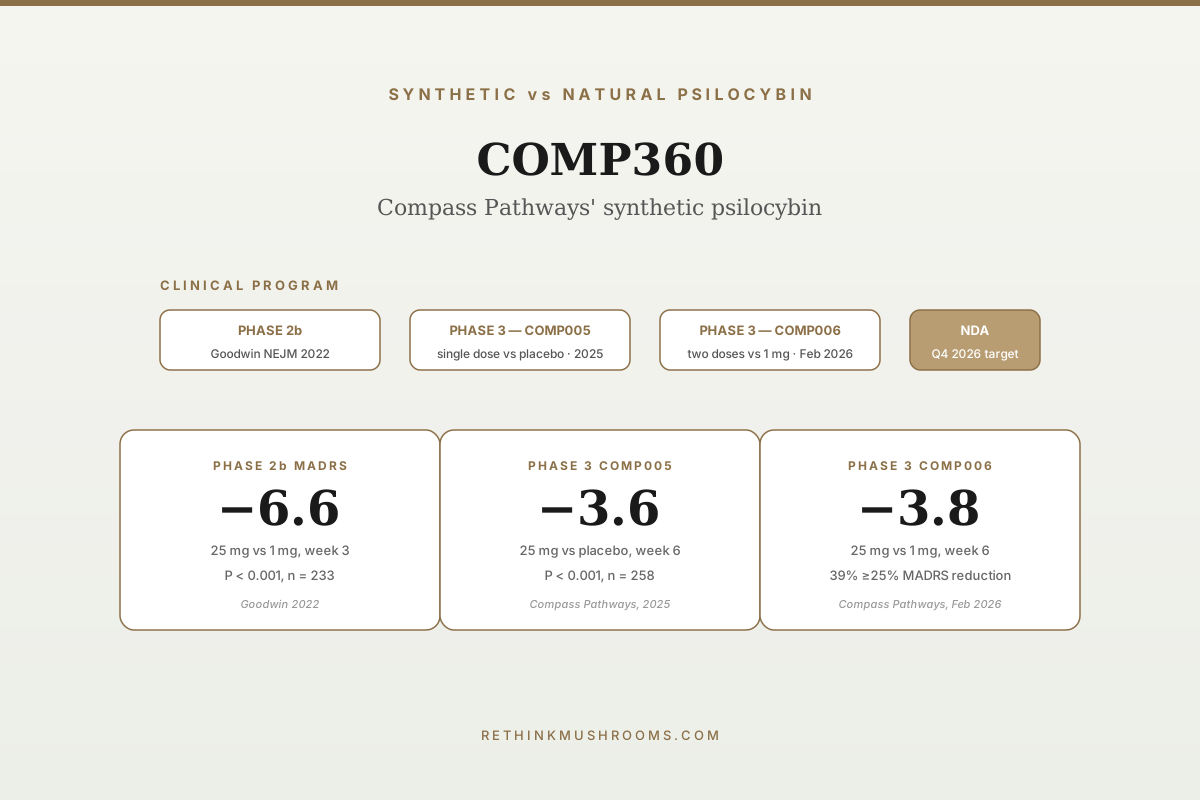
-6.6 MADRS (25mg vs 1mg, wk 3)
COMP360 is Compass Pathways' proprietary synthetic crystalline psilocybin. The phase 2b trial in treatment-resistant depression (Goodwin et al., NEJM, 2022) showed a -6.6 MADRS difference between the 25 mg and 1 mg arms at week 3, and both phase 3 trials (COMP005 and COMP006) have now met primary endpoints.
Goodwin et al., New England Journal of Medicine, 2022
Polymorph A crystal
proprietary GMP synthesis and formulation
Breakthrough Therapy
FDA designation granted 2018 for TRD
NDA Q4 2026
planned filing after two positive phase 3 trials
Goodwin et al., New England Journal of Medicine, 2022
 View as image ↗
COMP360 is the proprietary synthetic psilocybin formulation developed by Compass Pathways plc (Nasdaq: CMPS) as an investigational drug for treatment-resistant depression and, at the preclinical and early clinical stage, other psychiatric indications. It is not a mushroom extract, it is not a tincture, and it is not chemically different from the psilocybin produced by Psilocybe fungi. COMP360 is the same molecule, delivered in a GMP-manufactured, pharmaceutical-grade crystalline form that is standardised, dose-controlled, and designed to survive the rigour of FDA drug approval.[1]
For how COMP360 compares to mushroom-derived psilocybin and the broader entourage-effect debate, see COMP360 vs. mushroom-derived psilocybin: bioequivalence research, synthetic vs. natural psilocybin: does the source matter?, the entourage effect debate: do other mushroom compounds matter?, and why clinical trials use synthetic psilocybin.
Key Takeaways
- COMP360 is a GMP-manufactured synthetic psilocybin in a proprietary crystalline polymorph A form, owned and developed by Compass Pathways plc
- The FDA granted COMP360 Breakthrough Therapy designation for treatment-resistant depression in 2018, accelerating its regulatory path
- The phase 2b trial (Goodwin et al., NEJM, 2022) randomised 233 TRD patients to 25 mg, 10 mg or 1 mg COMP360 and reported a -6.6 MADRS difference between the 25 mg and 1 mg arms at week 3 (P<0.001)
- Phase 3 COMP005 met its primary endpoint in 2025: a single 25 mg dose produced a -3.6 MADRS difference versus placebo at week 6 (P<0.001) in 258 TRD patients
- Phase 3 COMP006 met its primary endpoint in February 2026: two fixed 25 mg doses three weeks apart produced a -3.8 MADRS difference versus 1 mg at week 6 (P<0.001), with 39% of the 25 mg arm achieving a ≥25% MADRS reduction
- Safety data across COMP005 and COMP006 describe treatment-emergent adverse events as mild to moderate, mostly resolving within 24 hours, with no clinically meaningful imbalance in suicidality between arms
- Compass has announced plans to file an NDA in Q4 2026 based on the combined phase 3 dataset
- COMP360 is molecularly identical to psilocybin in Psilocybe mushrooms; the distinction is manufacturing, formulation and regulatory pathway, not pharmacology at the receptor level
What COMP360 Actually Is
COMP360 is the brand name Compass Pathways has given to its specific version of psilocybin as a drug product. At the molecular level it is psilocybin, the same 4-phosphoryloxy-N,N-dimethyltryptamine that serves as the prodrug to psilocin (the active 5-HT2A agonist responsible for the subjective and therapeutic effects). What makes COMP360 distinct is not chemistry at the molecule level but chemistry at the formulation and manufacturing levels:
- Synthesised chemically rather than extracted from fungal biomass
- Manufactured to Good Manufacturing Practice (GMP) standards required for human pharmaceutical use
- Stabilised in a specific crystalline form, "polymorph A", which Compass has characterised in peer-reviewed and patent literature as providing better stability and consistency than alternative crystal forms
- Delivered as a hard gelatin capsule at fixed doses (historically 1 mg, 10 mg and 25 mg in clinical trials)
- Paired with a structured psychological support protocol that Compass has codified and trained therapists to deliver
The practical consequence is that a patient receiving 25 mg of COMP360 in a trial is receiving a precisely quantified, chemically pure dose under a documented therapeutic-support model. A Psilocybe cubensis mushroom, by contrast, contains variable concentrations of psilocybin, psilocin, norpsilocin, baeocystin, norbaeocystin, aeruginascin, and associated non-alkaloid compounds, with composition varying by strain, cultivation conditions, and drying. The drug-development logic for synthetic psilocybin is the same as the drug-development logic for any pharmaceutical: a controlled and reproducible active ingredient is required for regulatory approval.
The Manufacturing And Crystal Form Story
Psilocybin synthesis has a documented chemical history dating to Albert Hofmann's work at Sandoz in 1958. Hofmann originally produced psilocybin in the laboratory as part of characterising the active components of Psilocybe mexicana, and the synthetic route has been refined repeatedly since. Compass Pathways' contribution was not inventing the synthesis, but engineering a GMP-compatible process that produced a consistent crystalline form at commercial scale.
Crystalline polymorph A is the specific crystal packing of psilocybin that Compass identified, patented and developed as the basis of COMP360. Different polymorphs of the same molecule can have different stability, solubility and bioavailability properties, and a pharmaceutical developer typically selects a single polymorph for a drug product and builds the manufacturing process around it. Compass's patent portfolio covers the polymorph and the synthesis and purification routes that produce it reliably at scale.
The practical operational consequence is that COMP360 batches are analytically identical to one another in ways that mushroom-derived material cannot be. Identity, assay, impurities, residual solvents and physical form are all tightly specified. For regulatory review by the FDA or EMA, this reproducibility is a gating requirement, not a nice-to-have. See synthetic vs. natural psilocybin: does the source matter? for the pharmacology implications of these differences.
The Phase 2b Trial: Goodwin 2022 NEJM
The foundational clinical result for COMP360 is the Goodwin et al. phase 2b trial published in the New England Journal of Medicine in 2022. The trial randomly assigned 233 adults with treatment-resistant depression across 22 sites in ten countries to a single dose of COMP360 at 25 mg (n=79), 10 mg (n=75), or 1 mg (n=79), delivered with structured psychological support. The primary endpoint was the change from baseline in MADRS total score at week 3.[1]
The mean baseline MADRS was 32 or 33 across arms, reflecting moderate-to-severe depression. At week 3, least-squares mean changes from baseline were -12.0 in the 25 mg arm, -7.9 in the 10 mg arm, and -5.4 in the 1 mg control arm. The 25 mg versus 1 mg difference was -6.6 points (95% CI, -10.2 to -2.9; P<0.001), establishing dose-dependent efficacy. The 10 mg versus 1 mg difference (-2.5 points, P=0.18) did not reach statistical significance, providing justification for the 25 mg dose as the therapeutic target.
Response and remission rates at week 3 supported the primary result. Adverse events occurred in 179 of 233 participants (77%), generally during and immediately after dosing, and were consistent with the known subjective effects of psilocybin. Suicidal ideation and behaviour were observed across arms and represented a focus of safety analysis.
This result, achieved with a single dose in a highly treatment-resistant population, was the strongest controlled evidence at the time for synthetic psilocybin in depression and the clinical basis on which Compass advanced into phase 3.
The Mechanistic Context
The mechanism by which psilocybin (synthetic or natural) relieves depression has been studied in parallel to the efficacy trials. Daws and colleagues (2022) showed that psilocybin therapy increased global integration across functional brain networks in depression patients, with decreased network modularity correlating with antidepressant response.[2] Stenbæk and colleagues (2021) reported that brain serotonin 2A receptor (5-HT2AR) binding predicted subjective temporal and mystical effects of psilocybin, anchoring the pharmacology at the receptor level.[3]
These mechanistic studies clarify that COMP360's effects are mediated through 5-HT2A agonism and the downstream network-integration changes that follow, not through a COMP360-specific chemistry. Any 25 mg oral dose of psilocybin, whether synthetic or extracted, should produce the same receptor-level and network-level effects at pharmacokinetic equivalence. The COMP360 distinction is not mechanism, it is pharmaceutical-grade control.
Earlier supporting foundations came from the open-label and controlled trials that preceded COMP360 development. Griffiths and colleagues (2016) and Ross and colleagues (2016) used synthetic psilocybin produced under university GMP to demonstrate substantial and sustained antidepressant and anxiolytic effects in cancer patients, establishing the clinical signal that motivated later commercial development.[4][5] Ross and colleagues (2025) added further controlled evidence in the same population with a phase 2b randomised controlled trial of psilocybin-assisted psychotherapy in adults with life-threatening illness, reporting significantly greater reductions in depression and anxiety than active placebo, with benefits sustained at 26 weeks.[6]
Carhart-Harris and colleagues (2021) provided an active-comparator benchmark in major depressive disorder, randomising patients to psilocybin (25 mg x2) plus placebo or escitalopram plus 1 mg psilocybin across six weeks.[7] The primary endpoint did not separate the two arms, but secondary measures favoured psilocybin, and the trial established that synthetic psilocybin could be compared head-to-head with first-line pharmacotherapy in a depression trial.
Phase 3: COMP005 And COMP006
Compass advanced COMP360 into two pivotal phase 3 trials, COMP005 and COMP006, each designed to support an NDA submission for treatment-resistant depression.
COMP005 was a randomised, double-blind, placebo-controlled study of a single 25 mg dose of COMP360 versus placebo in 258 TRD patients across 32 US sites. The primary endpoint was the change from baseline in MADRS at week 6. Results announced by Compass in 2025 reported a statistically significant -3.6 point difference in favour of COMP360 (P<0.001), with a safety profile consistent with the phase 2 experience and no new or unexpected findings. This was the first phase 3 efficacy readout for any classical psychedelic drug candidate.
COMP006 was the second pivotal phase 3, a fixed-dose design comparing 25 mg COMP360 to 1 mg COMP360 (as active comparator, for blinding and psychoactive-experience matching) with doses administered three weeks apart. The primary endpoint was change from baseline in MADRS at week 6. Results announced by Compass Pathways on February 17, 2026 reported a -3.8 point difference in favour of the 25 mg arm (P<0.001), with 39% of 25 mg participants achieving a clinically meaningful MADRS reduction of at least 25% at week 6.
Safety data across COMP005 and COMP006 described treatment-emergent adverse events as predominantly mild to moderate with the majority resolving within 24 hours of dosing, consistent with the prior literature on supervised psilocybin administration. Compass reported no clinically meaningful imbalance in suicidality between arms in either study.
Commentary from specialised sources including Psychedelic Alpha noted that while the phase 3 primary endpoint was met in both trials, the magnitude of the treatment effect (-3.6 and -3.8 MADRS points) was more modest than some observers had expected from the phase 2b (-6.6 MADRS). Whether this reflects placebo-response dynamics in the phase 3 populations, stricter trial conduct, or a real effect-size recalibration for the larger population will be evaluated in the peer-reviewed publications and in regulatory review.
COMP360 MADRS Effect Size, Trial by Trial
The Phase 3 effect landed smaller than Phase 2b
Placebo-adjusted difference in MADRS total score (points). All three primary endpoints were met at P<0.001; a larger negative number means a bigger antidepressant advantage over control.
Goodwin 2022 · NEJM
−6.625 mg vs 1 mg, week 3 · n = 233
Set the 25 mg dose carried into Phase 3
COMP005 · 2025
−3.625 mg vs placebo, week 6 · n = 258
First Phase 3 efficacy readout for any classical psychedelic
COMP006 · Feb 2026
−3.825 mg vs 1 mg, week 6 · n = 581 dosed
39% of the 25 mg arm reached a ≥25% MADRS reduction
Sources: Goodwin et al., NEJM (2022); Compass Pathways COMP005 readout (2025) and COMP006 readout (17 February 2026). Phase 3 figures are from company announcements pending peer-reviewed publication.
Regulatory Path And Timing
FDA granted Breakthrough Therapy designation to COMP360 for treatment-resistant depression in 2018, following initial phase 2 evidence. Breakthrough Therapy designation accelerates FDA review by providing intensive guidance during development and facilitating expedited review of the eventual NDA. Compass has also announced that it intends to discuss a rolling-review process with FDA, which would allow submission of completed modules of the NDA as they are ready rather than waiting for the complete package.
The company announced that NDA submission is targeted for the fourth quarter of 2026, following the COMP006 readout and the completion of long-term follow-up data. Standard FDA review timelines put a potential approval decision in 2027 at the earliest, though Priority Review (if granted alongside Breakthrough Therapy) could compress that window modestly.
Because COMP360 contains psilocybin, which is a Schedule I controlled substance under U.S. federal law, an eventual approval would trigger a parallel scheduling process at DEA. The precedent for Schedule I-derived drugs (including certain cannabinoid drugs) is a move to Schedule II or III, though the specific schedule COMP360 would land in has not been decided.
How COMP360 Differs From The Non-Pharmaceutical Psilocybin Landscape
The Colorado and Oregon regulated-access programs use psilocybin from various sources, including Psilocybe mushrooms cultivated to meet state purity and labelling requirements. Those programs are state-regulated wellness frameworks. COMP360 is on a completely different track: a federally-regulated prescription drug, with narrower indication (TRD to start), stricter protocols, insurance-reimbursable delivery, and physician prescription. See Colorado's Natural Medicine Act: how regulated psilocybin access actually works and how Colorado's psychedelic law differs from Oregon for the state-access side.
The existence of both pathways is likely to be a feature of the mental-health landscape rather than a competition. McClure-Begley and Roth (2022) surveyed the pharmacological and regulatory terrain and argued that psychedelic drug development involves a set of unresolved promises and perils that apply differently in FDA-approved-drug and regulated-access contexts.[8]
Safety Profile Across The Program
Psilocybin's safety profile in controlled-setting trials has been consistent across multiple studies and populations. The Goodwin phase 2b and the phase 3 readouts align with earlier evidence that supervised dosing of psilocybin at therapeutic doses is well tolerated acutely, with transient and mostly mild-to-moderate adverse events resolving within hours to a day. The principal safety concerns in supervised settings are the acute psychological experience (which is intentionally intense) and the management of suicidality, which is inherent to the depressed population being studied rather than newly introduced by the drug.
Khan and colleagues (2022) reviewed the emerging psilocybin evidence in trauma-related disorders and flagged the intersection of PTSD phenomenology with acute psychedelic experience as requiring careful screening and preparation, a concern that applies to any psilocybin therapy, synthetic or natural.[9]
Cardiac safety with psilocybin is generally regarded as acceptable at therapeutic doses in screened populations, with clinically meaningful effects on blood pressure and heart rate during dosing that resolve afterward. 5-HT2B agonism remains a theoretical concern for chronic dosing because of its association with cardiac valvulopathy, but the single- or twice-dosed protocols used with COMP360 do not involve chronic administration.
Limitations Of The Evidence
Several limitations apply to the COMP360 evidence base as of April 2026. First, both phase 3 trials reported modest absolute MADRS differences (-3.6 and -3.8) that, while statistically robust, are smaller than many observers expected based on the phase 2b magnitude. The interpretation of those effect sizes will be clarified when the detailed datasets are peer-reviewed.
Second, blinding in psilocybin trials is intrinsically difficult. Participants receiving 25 mg typically have a subjective experience that makes blinding unreliable, and the 1 mg active comparator used in COMP006 is chosen specifically to mitigate this. The residual expectancy and unblinding effects likely influence effect-size estimates in both directions, and the field has not settled on a gold-standard blinding strategy.
Third, the durability of response beyond week 6 requires further data. Both phase 3 trials include longer follow-up periods, and the published Goodwin 2022 phase 2b data showed some fall-off in sustained response at 12 weeks compared to week 3. Durability will be critical for both clinical utility and health-economic case.
Fourth, head-to-head comparison with existing TRD treatments (ketamine, esketamine, vagus nerve stimulation, TMS) will matter for eventual positioning. The current evidence base is largely versus placebo or low-dose active control, not versus the alternative interventions patients with TRD are considering.
What The Evidence Establishes
The COMP360 evidence base supports several precise claims as of April 2026:
- COMP360 is molecularly psilocybin, delivered in a proprietary GMP-manufactured crystalline polymorph A formulation
- Single-dose 25 mg COMP360 produces a statistically significant antidepressant effect at week 3 versus low-dose control in treatment-resistant depression (Goodwin 2022, phase 2b)
- Two pivotal phase 3 trials (COMP005 single-dose vs placebo; COMP006 two doses vs 1 mg active comparator) have met primary endpoints at week 6 with smaller absolute effect sizes than phase 2b
- Safety across the program is consistent with the broader supervised-psilocybin literature: transient mild-to-moderate acute events, no signal of new or unexpected adverse findings
- Compass plans an NDA submission in Q4 2026 with potential FDA approval decision in 2027 or later
- The mechanistic basis is 5-HT2A agonism by the prodrug psilocybin and its active metabolite psilocin, identical to mushroom-derived psilocybin; the COMP360 distinction is manufacturing and regulatory, not pharmacology
This article summarizes clinical research for educational purposes and is not medical advice or a substitute for care from a qualified clinician. COMP360 is an investigational drug that is not approved or available by prescription as of this writing, and every efficacy and safety figure described here comes from trials that carefully screened participants and delivered psilocybin with structured psychological support. Psilocybin remains a Schedule I substance under U.S. federal law, and unsupervised self-treatment for depression carries legal and health risks.
The Bottom Line
COMP360 is Compass Pathways' proprietary synthetic psilocybin in crystalline polymorph A form, engineered for pharmaceutical-grade consistency rather than chemical difference from mushroom-derived psilocybin. The phase 2b NEJM trial (Goodwin 2022) showed a -6.6 MADRS advantage for 25 mg over 1 mg control at week 3 in treatment-resistant depression. Two positive phase 3 trials (COMP005 in 2025, COMP006 in February 2026) have met their primary endpoints with more modest effect sizes (-3.6 and -3.8 MADRS), and Compass has announced NDA submission planned for Q4 2026.
Frequently Asked Questions
Sources & References
- 1RTHM-00761·Goodwin, Guy M et al. (2022). “Single-Dose Psilocybin for a Treatment-Resistant Episode of Major Depression..” The New England journal of medicine.Study breakdown →PubMed →↩
- 2RTHM-00752·Daws, Richard E et al. (2022). “Increased global integration in the brain after psilocybin therapy for depression..” Nature medicine.Study breakdown →PubMed →↩
- 3RTHM-00720·Stenbæk, Dea Siggaard et al. (2021). “Brain serotonin 2A receptor binding predicts subjective temporal and mystical effects of psilocybin in healthy humans..” Journal of psychopharmacology (Oxford.Study breakdown →PubMed →↩
- 4RTHM-00426·Griffiths, Roland R et al. (2016). “Psilocybin produces substantial and sustained decreases in depression and anxiety in patients with life-threatening cancer: A randomized double-blind trial..” Journal of psychopharmacology (Oxford.Study breakdown →PubMed →↩
- 5RTHM-00445·Ross, Stephen et al. (2016). “Rapid and sustained symptom reduction following psilocybin treatment for anxiety and depression in patients with life-threatening cancer: a randomized controlled trial..” Journal of psychopharmacology (Oxford.Study breakdown →PubMed →↩
- 6RTHM-00949·Ross, Margaret L et al. (2025). “Psilocybin-assisted psychotherapy for depression and anxiety associated with life threatening illness: A phase 2b randomized controlled trial..” General hospital psychiatry.Study breakdown →PubMed →↩
- 7RTHM-00675·Carhart-Harris, Robin et al. (2021). “Trial of Psilocybin versus Escitalopram for Depression..” The New England journal of medicine.Study breakdown →PubMed →↩
- 8RTHM-00787·McClure-Begley, Tristan D et al. (2022). “The promises and perils of psychedelic pharmacology for psychiatry..” Nature reviews. Drug discovery.Study breakdown →PubMed →↩
- 9RTHM-00770·Khan, Amanda J et al. (2022). “Psilocybin for Trauma-Related Disorders..” Current topics in behavioral neurosciences.Study breakdown →PubMed →↩