Colorado Psilocybin
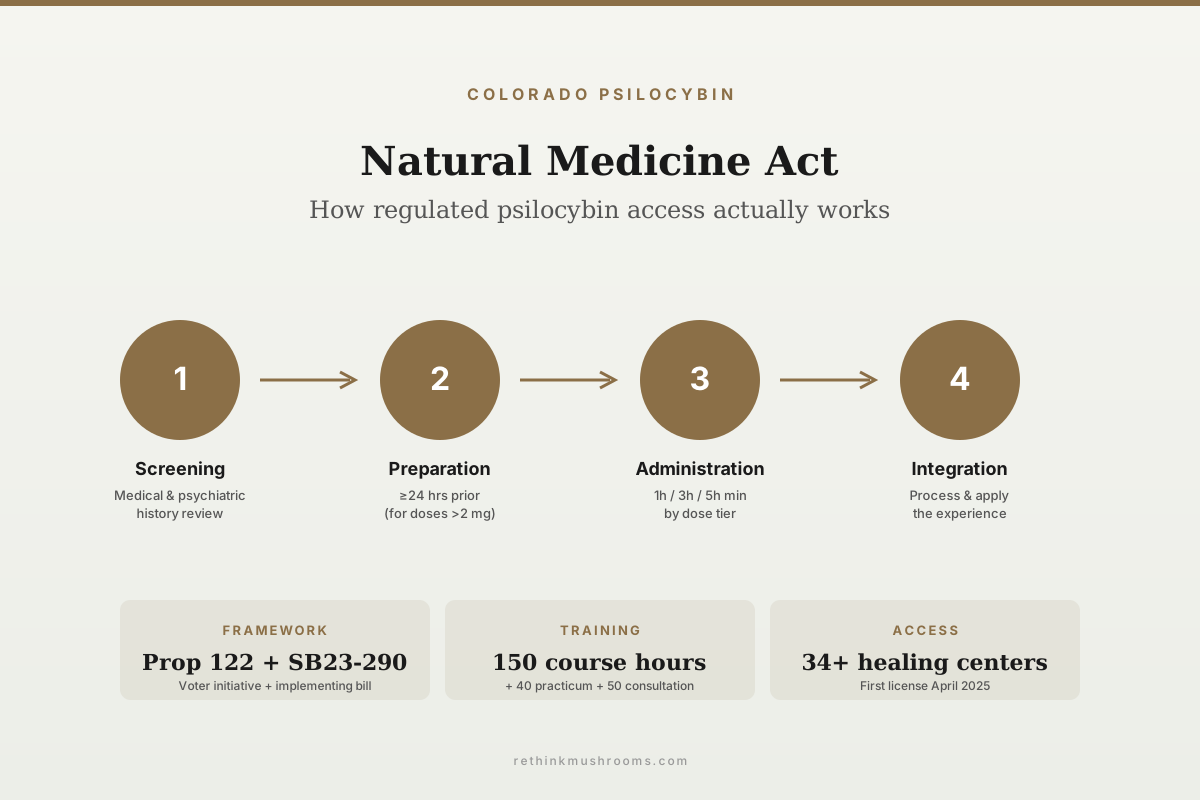
34+ licensed healing centers
Colorado regulates adult psilocybin access through a state-licensed facilitator and healing-center system, with tiered session rules, a 150-hour training standard, and a first operational license issued in April 2025.
Colorado Department of Natural Medicine; Colorado DORA, 2024–2026
Prop 122 + SB23-290
the two laws that built the framework
150 hours training
DORA facilitator curriculum standard
1, 3, or 5 hours
minimum session length by dose tier
Colorado Department of Natural Medicine; Colorado DORA, 2024–2026
 View as image ↗
Colorado voters passed Proposition 122 (the Natural Medicine Health Act) in November 2022, making Colorado the second U.S. state after Oregon to legalise adult psilocybin use outside of federal research settings. The implementing legislation, SB23-290, signed by Governor Jared Polis in May 2023, set up a two-agency regulatory structure: the Department of Revenue licenses natural medicine businesses (healing centers, cultivations, manufacturers, testing facilities) while the Department of Regulatory Agencies (DORA) licenses individual facilitators. The first operational healing center license was issued to The Center Origin in Denver in April 2025, and by early 2026 Colorado had approved 34-plus state-licensed healing centers, with more than a dozen additional applications pending.
This article walks through how the Colorado Natural Medicine Act psilocybin framework actually works in practice: who can become a client, who can become a facilitator, what a session looks like, what psilocybin dose tiers trigger which supervision requirements, and where the program sits as of April 2026. For adjacent coverage in this cluster see Colorado psilocybin implementation timeline and progress, Colorado's healing centers: what to expect, Colorado's Natural Medicine Act: psilocybin and beyond, and how Colorado's psychedelic law differs from Oregon.
Key Takeaways
- Proposition 122 (Nov 2022) legalised adult personal use and decriminalised possession; SB23-290 (May 2023) created the licensed healing-center and facilitator system that actually regulates commercial access
- Two state agencies split the work: the Department of Revenue licenses businesses; DORA licenses facilitators under the Division of Professions and Occupations
- Facilitator licensing requires age 21+, a high-school diploma or equivalent, Basic Life Support certification, and completion of a DORA-approved 150-hour training program plus 40 practicum hours and 50 consultation hours
- Session length is tiered to psilocin dose: 1 hour minimum supervision for ≤2 mg, 3 hours for >2 to <10 mg, 5 hours for ≥10 mg total psilocin
- Group sessions are capped at four clients per facilitator for any dose above 2 mg
- Doses ≤2 mg are exempted from the 24-hour-advance preparation session requirement
- Treatment plans at early Colorado healing centers have been priced in the $3,500–$4,500 range, reflecting the preparation-plus-administration-plus-integration session structure
- The program is limited to psilocybin and psilocin until June 1, 2026, at which point regulators may add DMT, ibogaine, and mescaline
The Two Laws Behind The Framework
Colorado's regulated psilocybin access rests on two distinct legal instruments, passed about six months apart, that do different things.
Proposition 122 (Natural Medicine Health Act, Nov 2022) is the voter-approved ballot initiative that created the legal category of "natural medicine" (initially psilocybin and psilocin, later allowing DMT, ibogaine and mescaline via regulator action after June 1, 2026), decriminalised personal adult possession and use of those substances, and directed the legislature to build a regulated access program. Prop 122 also permits personal cultivation on one's own property without commercial sale.
Senate Bill 23-290 (May 2023) is the implementing statute that translated the voter mandate into an operating regulatory structure. SB23-290 split jurisdiction between the Department of Revenue (which licenses healing centers, cultivation facilities, testing laboratories, and natural medicine product manufacturers) and the Department of Regulatory Agencies (which licenses facilitators as regulated professionals). The bill created the Natural Medicine Advisory Board, established a rule-making process, and set the substance scope to psilocybin/psilocin until the June 2026 expansion window.
The practical consequence is that possession of psilocybin by an adult in Colorado has been legal since late 2022, but commercial psilocybin services (paid access at a healing center with a licensed facilitator) only became available starting in mid-2025 once the first operational licenses issued. That gap is a common source of confusion; the Prop 122 decriminalisation and the SB23-290 regulated-access system are separate legal regimes that happen to share a substance.
Who The Two Agencies Regulate
The regulatory architecture is deliberately bifurcated. Understanding the split clarifies how any given actor in the system gets their authority to operate.
Department of Revenue, Natural Medicine Division. regulates the businesses. That includes healing centers (the physical facilities where administration sessions occur), cultivation licensees (who grow the mushrooms or produce psilocybin-containing products), product manufacturers, and testing labs. Healing centers come in two license sub-types: a standard license allowing more than 750 mg of psilocybin on-site, and a micro-healing-center license limiting on-site psilocybin to under 750 mg. Aspen-area reporting has highlighted the standard license as the norm for centers aiming at group sessions or higher client volume, with the micro-healing-center tier serving smaller therapist practices.
DORA, Division of Professions and Occupations. regulates the individuals. Facilitator licensing runs through DORA under five pathways: original licensure (the default route for new entrants), endorsement (for facilitators already licensed in another recognised jurisdiction), legacy healer (a culturally informed pathway for practitioners from communities with traditional use), clinical facilitator (for licensed mental-health professionals adding psilocybin facilitation to an existing scope of practice), and accelerated clinical facilitator (a shortened pathway for clinicians meeting specific prior-experience thresholds).
The practical implication is that running a legal psilocybin session in Colorado requires both a licensed facilitator and a licensed healing-center venue. A DORA-licensed facilitator cannot legally conduct commercial administration sessions in a non-licensed space, and a licensed healing center cannot legally provide services without a licensed facilitator on staff or under contract.
Who Can Become A Client
Colorado's Natural Medicine Act sets baseline client requirements but delegates detailed screening to the facilitator and the healing center.
The statutory client baseline is: adult (21 or older) by statute, able to provide informed consent, and not presenting with contraindications identified during the screening assessment. There is no residency requirement, no medical diagnosis prerequisite, and no prescription required. Colorado's program is explicitly a wellness access model, not a medical prescribing model.
Before an administration session, the facilitator must conduct an initial consultation with a screening assessment. That screening covers medical history, current medications (with specific attention to serotonergic agents like SSRIs, MAOIs, lithium and tramadol), psychiatric history (including personal and family history of psychotic disorders, bipolar disorder, and certain other conditions the facilitator is trained to identify), and physical conditions that elevate risk (severe cardiovascular disease in particular). The 150-hour DORA facilitator curriculum allocates 5 hours specifically to "Drug Effects, Contraindications, and Interactions" and 25 hours to "Physical and Mental Health and State," giving facilitators formal training in this screening.
The screening is the clinical gate. A client who presents with a contraindication identified during screening cannot lawfully proceed to an administration session with that facilitator, and the facilitator is trained (and legally obliged under DORA rules) to decline the session in that case. The clinical literature backs the screening emphasis: Khan et al. (2022) reviewed psilocybin safety and noted that pre-existing psychotic vulnerability and serotonergic medication combinations are the principal identifiable risk factors for adverse psychological outcomes.[1]
Anatomy Of A Session: Screening, Preparation, Administration, Integration
A compliant Colorado natural medicine service under SB23-290 is structured around four distinct components, not a single visit.
1. Screening assessment
Conducted at the initial consultation. Can be same-day as the preparation session but must occur before any psilocybin is administered. Establishes medical and psychiatric history, current medications, and suitability.
2. Preparation session
For doses greater than 2 mg total psilocin, the preparation session must occur at least 24 hours before the administration session. The 24-hour separation rule is a safety buffer that allows the client to reflect and revoke consent without time pressure. For doses of 2 mg or less, Colorado rules exempt the session from the 24-hour-advance requirement, enabling same-day service for low-dose experiences.
3. Administration session
The client consumes psilocybin under the direct supervision of a licensed facilitator at a licensed healing center. Minimum supervised time is set by dose tier:
| Psilocin dose | Minimum supervised time | Preparation timing |
|---|---|---|
| ≤ 2 mg | 1 hour | Can be same-day |
| > 2 mg and < 10 mg | 3 hours | ≥ 24 hours prior |
| ≥ 10 mg | 5 hours | ≥ 24 hours prior |
These are minimums. Facilitators may extend sessions at their discretion or at the client's request. Group administration sessions are capped at a four-clients-to-one-facilitator ratio for any dose above 2 mg.
4. Integration session
At least one integration session must accompany the administration session. Integration is where the client and facilitator discuss and process the experience, with the stated goal of translating session content into the client's ongoing life. Integration is the component most directly aligned with the clinical-trial psilocybin-assisted psychotherapy protocols that underlie the evidence base Colorado policymakers drew on.
The regulatory emphasis on all four components, rather than on administration alone, reflects the clinical psychedelic-therapy literature. Davis et al. (2021) and Ross et al. (2016), two of the most frequently cited psilocybin efficacy trials, both used protocols that wrapped administration in preparation and integration, not as optional ancillaries but as integral to the intervention.[2][3]
Facilitator Training: The 150-Hour DORA Curriculum
DORA-approved facilitator training programs must deliver at least 150 hours of classroom coursework, 40 hours of supervised practicum, and 50 hours of consultation across a six-month period during which the trainee provides facilitation under a training license. The 150-hour curriculum is specified by DORA and allocated as follows:
- Facilitator Best Practices: 5 hours
- Ethics and Colorado Natural Medicine Rules and Regulations: 25 hours
- Relational Boundaries and Introduction to Physical Touch: 10 hours
- Physical and Mental Health and State: 25 hours
- Drug Effects, Contraindications, and Interactions: 5 hours
- Introduction to Trauma-Informed Care: 10 hours
- Introduction to Suicide Risk: 5 hours
- Indigenous, Social, and Cultural Considerations: 10 hours
- Screening: 5 hours
- Preparation: 10 hours
- Administration: 10 hours
- Integration: 10 hours
- Group Facilitation: 10 hours
- Facilitator Development and Self-Care: 10 hours
Where The 150 Required Hours Go
Colorado’s facilitator training front-loads safety and ethics, not the trip itself
DORA’s mandated 150 hours of classroom coursework, grouped by theme. The four administration-and-session-craft modules together account for 40 of the 150 hours — the majority of the curriculum sits in screening, health assessment, ethics, law, and cultural context.
Safety, screening & health assessment
50 h- Physical and Mental Health and State25 h
- Screening5 h
- Drug Effects, Contraindications, and Interactions5 h
- Introduction to Trauma-Informed Care10 h
- Introduction to Suicide Risk5 h
Ethics, law & cultural context
45 h- Ethics and Colorado Natural Medicine Rules and Regulations25 h
- Indigenous, Social, and Cultural Considerations10 h
- Relational Boundaries and Introduction to Physical Touch10 h
Session craft (prep · administration · integration · groups)
40 h- Preparation10 h
- Administration10 h
- Integration10 h
- Group Facilitation10 h
Facilitator foundation & self-care
15 h- Facilitator Best Practices5 h
- Facilitator Development and Self-Care10 h
Source: Colorado Department of Regulatory Agencies (DORA), Division of Professions and Occupations — Natural Medicine facilitator 150-hour training curriculum. Beyond the 150 classroom hours, licensure also requires 40 supervised practicum hours and 50 consultation hours.
The curriculum is notable for two design choices. First, it weights ethics, regulations, screening, and mental-health assessment heavily (roughly 75 of the 150 hours sit in those categories), reflecting the policy priority of safe gatekeeping. Second, it explicitly includes "Indigenous, Social, and Cultural Considerations" as a standalone module, a response to sustained advocacy from Indigenous and culturally rooted practitioner communities who argued that a Colorado psilocybin regime divorced from traditional-use context would be culturally corrosive.
DORA recognises multiple training providers as approved, including Synthesis Institute, Naropa University's Center for Psychedelic Studies, Changa Institute, and others. Trainees completing an approved program then complete their 40-hour practicum and 50-hour consultation under a DORA training license before becoming eligible for a full facilitator license.
Pricing And Access: What Clients Actually Pay
The Colorado Natural Medicine Act psilocybin program is not a Medicaid-covered benefit and is not generally reimbursed by private insurance as of early 2026. Clients pay out of pocket.
Early Colorado healing centers have priced treatment plans in the $3,500–$4,500 range. A treatment plan typically bundles the initial consultation and screening, at least one preparation session, the administration session, and at least one integration session. Centers differ in how they structure pricing (single bundled fee versus component-priced), and in whether psilocybin itself is part of the package price or billed separately.
The price point is a meaningful access constraint. The clinical-trial literature that generated the evidence base for the program (Davis 2021, Ross 2016, Bogenschutz 2022 on alcohol use disorder) used protocols whose real-world analogue in Colorado costs multiple thousands of dollars out of pocket.[2][3][4] The gap between clinical-trial access (where trials pay subjects) and commercial access (where clients pay centers) shapes who can actually use Colorado's program.
The Natural Medicine Advisory Board and the state legislature have discussed access subsidy and sliding-scale mechanisms, and some centers offer sliding-scale pricing for clients below income thresholds, but no statewide public financing exists as of April 2026.
What The Program Does And Does Not Legalise
Several practical constraints are worth stating plainly, because they shape what is actually available.
Retail psilocybin sales are not permitted. Unlike Colorado's cannabis regime, there are no psilocybin dispensaries. Psilocybin changes hands only inside a licensed healing center as part of a facilitated session. A client cannot buy a gram of psilocybin to take home.
Home cultivation is permitted for personal use. Prop 122 allows adults to cultivate psilocybin mushrooms on their own private property, in an enclosed space, for personal use. Sale or exchange for remuneration is not permitted, and cultivation on public land is not permitted.
Interstate transport remains federally prohibited. Psilocybin is a Schedule I controlled substance federally, so carrying it across state lines (including to and from Colorado) exposes a person to federal drug charges. Colorado's legal framework has no effect on federal law.
Advertising is tightly restricted. Colorado rules prohibit healing centers from advertising with unverified health claims or in ways that might appeal to minors. Therapeutic claims are tightly constrained; centers can describe what they do, not promise outcomes.
Employment and housing protections are limited. Private employers and landlords retain considerable discretion; the Natural Medicine Act does not override at-will employment or private rental terms. Federal workplace drug-testing regimes (for federal employees, DOT-regulated roles, and some federal contractors) continue to apply.
The Evidence Base That Colorado Policymakers Drew On
Colorado's decision to regulate rather than criminalise adult psilocybin access was informed by a clinical-research literature that had accumulated substantially between the early 2000s and 2023. The studies most frequently cited in the Colorado policy record include:
- Ross et al. (2016): a randomised trial of single-dose psilocybin in patients with life-threatening cancer and associated depression or anxiety, showing rapid and sustained symptom reduction persisting at follow-up.[3]
- Davis et al. (2021): a randomised clinical trial of psilocybin-assisted therapy for major depressive disorder, with protocol-adherent preparation and integration sessions, showing clinically meaningful depression reductions at follow-up.[2]
- Bogenschutz et al. (2022): a trial of psilocybin-assisted psychotherapy for alcohol use disorder, showing reductions in percentage of heavy drinking days relative to placebo.[4]
- Khan et al. (2022): a review of psilocybin for trauma-related disorders, summarising the emerging evidence base and the principal safety considerations.[1]
- Nichols (2020): a history-and-pharmacology review placing modern psilocybin clinical trials in context, widely cited in the Natural Medicine Advisory Board record.[5]
- Ross et al. (2025): a phase 2b double-blind randomised controlled trial of psilocybin-assisted psychotherapy for depression and anxiety in patients with life-threatening illness, adding to the palliative-care evidence base that the 2016 cancer-distress work helped establish.[6]
- Meshkat et al. (2025): a small subgroup analysis (n=4) drawn from a prior treatment-resistant-depression trial, offering a preliminary safety and efficacy signal for psilocybin in bipolar II depression rather than a definitive randomised result.[7]
Colorado's regulatory structure, particularly the preparation-administration-integration triad and the dose-tiered supervision rules, traces directly to the protocols used in these trials. The 5-hour minimum supervised time at the highest dose tier (≥10 mg psilocin) aligns with the typical on-site duration of clinical-trial administration sessions, where subjects remain in a supervised setting for approximately five to six hours post-dose.
Two recent studies directly address operational questions the Colorado program will confront as it scales. Dutton et al. (2026) analyses the regulatory, ethical, and operational challenges of Australia's clinical psilocybin rollout, offering a comparable-jurisdiction case study for Colorado regulators.[8] Copa et al. (2024) uses baseline fMRI connectivity to predict psilocybin response, pointing toward future screening tools that could refine the client-selection process beyond the current mental-health-history assessment.[9]
Limitations And Open Questions
The Colorado Natural Medicine Act psilocybin program is new. Several unknowns remain that the published regulatory record does not yet resolve.
Real-world outcome data are limited. The first operational license was issued April 2025, and the program is barely a year into live commercial operation as of April 2026. No published peer-reviewed evaluation of outcomes from Colorado healing-center clients exists yet. Claims about what the program does or does not achieve therapeutically should be read against that short runway.
Adverse event surveillance is under-specified. The state requires healing centers to report certain adverse events, but the public reporting infrastructure (what gets published, when, at what grain) is still being built. Dutton 2026's critique of Australia's rollout applies directly: without routine adverse-event aggregation and publication, the program's safety profile at population scale will remain a matter of inference rather than evidence.[8]
The clinical-trial-to-real-world gap is real. Colorado clients are not selected the way trial participants are. The clinical-trial literature Davis 2021 and Ross 2016 was built on excluded participants with bipolar disorder, psychotic disorders, and some other conditions, and paid close attention to baseline suicidality.[2][3] Colorado's screening is facilitator-administered rather than research-protocol-governed. Whether real-world Colorado outcomes match trial outcomes is an open empirical question.
The access price point limits the natural experiment. At $3,500–$4,500 per treatment plan, the Colorado client population is substantially self-selected by economic means. Inferences about the program's effect on population mental-health indicators should be tempered accordingly.
Cultivation, traditional use, and the June 2026 expansion. The state is scheduled to consider expanding the regulated substance list to include DMT, ibogaine, and mescaline after June 1, 2026. The rule-making process for that expansion is ongoing, and the program's shape post-expansion is not yet fixed. Ibogaine in particular carries a distinct cardiovascular risk profile that will require different regulatory structure than psilocybin does.
Federal prohibition is not resolved. Psilocybin remains Schedule I federally. The U.S. Drug Enforcement Administration has not enforced against compliant Oregon or Colorado healing centers, but the legal posture is one of federal forbearance rather than legality, and could change.
What The Regulatory Record Actually Establishes
The Colorado Natural Medicine Act psilocybin framework, as of April 2026, establishes a narrow and precise set of things:
- A legal pathway for adults 21+ to receive supervised psilocybin experiences at state-licensed healing centers, administered by DORA-licensed facilitators
- A tiered supervision rule tying minimum supervised time to total psilocin dose
- A 150-hour facilitator training standard with mandatory practicum and consultation hours
- An obligation to conduct screening, preparation, administration, and integration as distinct session components
- A cap on federal decriminalisation: Colorado's legal protections end at the state line
It does not establish: retail psilocybin sales, insurance-covered psilocybin therapy, a cure for any diagnosis, or federal protection for clients or providers. Those are either excluded by design or unresolved.
The Bottom Line
Colorado's Natural Medicine Act psilocybin program combines Prop 122 (voter-approved adult decriminalisation and personal cultivation) with SB23-290 (the licensed-access system). Access runs through licensed healing centers and DORA-licensed facilitators trained in a 150-hour curriculum. Sessions follow a screening-preparation-administration-integration structure with dose-tiered supervised time. The first center opened in mid-2025; by early 2026 more than 34 centers are licensed, with treatment plans priced at $3,500–$4,500.
Frequently Asked Questions
Sources & References
- 1RTHM-00770·Khan, Amanda J et al. (2022). “Psilocybin for Trauma-Related Disorders..” Current topics in behavioral neurosciences.Study breakdown →PubMed →↩
- 2RTHM-00682·Davis, Alan K et al. (2021). “Effects of Psilocybin-Assisted Therapy on Major Depressive Disorder: A Randomized Clinical Trial..” JAMA psychiatry.Study breakdown →PubMed →↩
- 3RTHM-00445·Ross, Stephen et al. (2016). “Rapid and sustained symptom reduction following psilocybin treatment for anxiety and depression in patients with life-threatening cancer: a randomized controlled trial..” Journal of psychopharmacology (Oxford.Study breakdown →PubMed →↩
- 4RTHM-00746·Bogenschutz, Michael P et al. (2022). “Percentage of Heavy Drinking Days Following Psilocybin-Assisted Psychotherapy vs Placebo in the Treatment of Adult Patients With Alcohol Use Disorder: A Randomized Clinical Trial..” JAMA psychiatry.Study breakdown →PubMed →↩
- 5RTHM-00646·Nichols, David E (2020). “Psilocybin: from ancient magic to modern medicine..” The Journal of antibiotics.Study breakdown →PubMed →↩
- 6RTHM-00949·Ross, Margaret L et al. (2025). “Psilocybin-assisted psychotherapy for depression and anxiety associated with life threatening illness: A phase 2b randomized controlled trial..” General hospital psychiatry.Study breakdown →PubMed →↩
- 7RTHM-00944·Meshkat, Shakila et al. (2025). “Psilocybin-Assisted Psychotherapy for Treatment-Resistant Depression in Bipolar II Disorder..” Psychedelic medicine (New Rochelle.Study breakdown →PubMed →↩
- 8RTHM-00958·Dutton, Megan et al. (2026). “Psilocybin in the real world: Regulatory, ethical, and operational challenges in Australia's clinical landscape..” The Australian and New Zealand journal of psychiatry.Study breakdown →PubMed →↩
- 9RTHM-00872·Copa, Débora et al. (2024). “Predicting the outcome of psilocybin treatment for depression from baseline fMRI functional connectivity..” Journal of affective disorders.Study breakdown →PubMed →↩