Colorado Natural Medicine Act
$3,500–4,500 Standard Session
Colorado's licensed healing centers operate under the Natural Medicine Division of the Colorado Department of Regulatory Agencies. A complete protocol runs two preparation sessions, a supervised dosing session of 3.5 to 8 hours, and integration follow-up. The Center Origin in Denver conducted the state's first regulated high-dose session on June 6, 2025.
Colorado Natural Medicine Division rules; The Center Origin press release, June 2025
2 prep sessions
state-required screening and preparation before any dosing session, typically one hour each (Colorado Sun, 2025)
5 g limit
per-session psilocybin mushroom limit under Colorado regulations; micro healing centers may hold under 750 mg on-site at any time
34 centers approved
as of early 2026, Colorado had licensed 34 state healing centers with additional applications pending
Colorado Natural Medicine Division rules; The Center Origin press release, June 2025
 View as image ↗
Colorado became the second state in the US to build a regulated psilocybin access system, following Oregon, when the Natural Medicine Division began issuing healing-center licenses in early 2025. The rollout has been gradual: the state granted its first healing-center license on April 15, 2025, The Center Origin in Denver received the first legal delivery of licensed, tested psilocybin on June 3, 2025, and the same center facilitated Colorado's first regulated high-dose session three days later on June 6, 2025.[1] By early 2026 the state had approved 34 healing centers with more than a dozen applications pending.[2] For the broader legal context, see colorado's natural medicine act: how regulated psilocybin access actually works and for the comparative framing against the older Oregon programme see how colorado's psychedelic law differs from oregon.
Key Takeaways
- Every session requires a state-mandated screening and two preparation sessions before any psilocybin is administered; the preparation phase exists to assess medical and psychiatric contraindications and align participant and facilitator on intention and dosage
- Dosing sessions run 3.5 to 8 hours depending on dose; a full-day protocol is the norm for high-dose experiences
- Facilitator credentialing requires at least 150 hours of coursework, 40 hours of supervised practice, and Basic Life Support certification; only Colorado Natural Medicine Clinical Facilitators (NMCF) licensed by the state may administer psilocybin
- Standard healing centers may hold more than 750 mg of psilocybin on-site; micro healing centers are capped below that threshold and operate under a reduced licensing fee structure
- Per-session psilocybin limit is 5 grams of mushroom material under the current Colorado rules
- Typical cost for a full protocol (screening + two prep sessions + dosing + integration) runs $3,500 to $4,500; sessions supervised by facilitators-in-training are available at roughly $2,100; industry forecasts project eventual stabilisation near $800 per session as supply and facilitator pools expand
- The Center Origin (Denver), ETC (Golden), and SANCTUM (Aspen) are among the first licensed operating centers; licensing and inspection are administered by the Colorado Department of Regulatory Agencies (DORA) Natural Medicine Division with product-supply oversight by the Department of Revenue
The Regulatory Framework in One Paragraph
Colorado voters approved Proposition 122 (the Natural Medicine Health Act) in November 2022, which decriminalised personal possession and use of psilocybin and tasked the state with building a regulated access system for supervised use. The Natural Medicine Advisory Board delivered recommendations, and the Colorado Department of Regulatory Agencies established the Natural Medicine Division to write and enforce operating rules. Licensing pathways include facilitators (clinical and non-clinical), healing centers (standard and micro), cultivators, and testing laboratories. Colorado's model differs from Oregon's in several structural ways (notably by allowing limited personal-use home cultivation and use outside regulated centers), but the regulated-access pathway that defines "what to expect at a healing center" is substantively similar to Oregon's Measure 109 infrastructure.
Phase 1: Screening and Intake
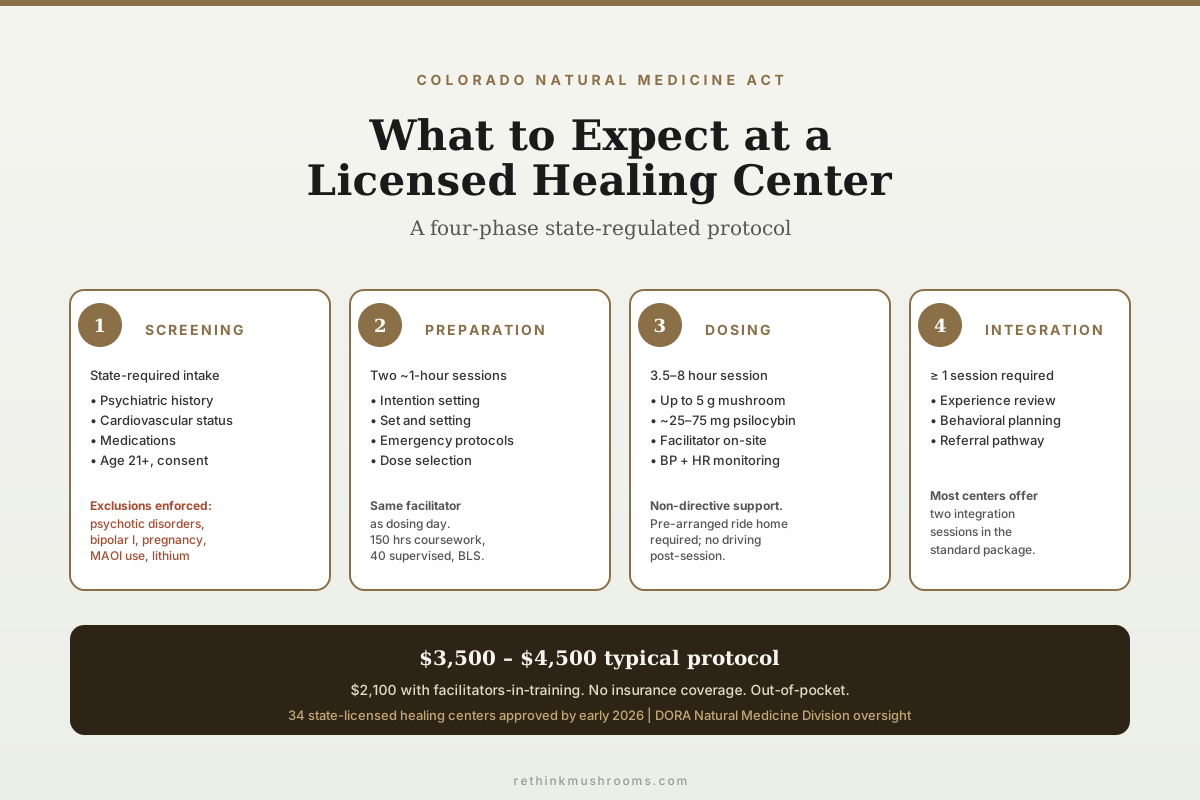
Before anyone receives psilocybin at a licensed Colorado healing center, they complete a state-required screening. The screening is clinical and legal at the same time. Clinically, it covers psychiatric history (current or past psychosis, schizophrenia spectrum diagnoses, and bipolar I disorder are standard contraindications across the psilocybin research literature and are reflected in state exclusion criteria), cardiovascular history (uncontrolled hypertension, recent cardiac events), current medication list (SSRIs, MAOIs, lithium, and certain antipsychotics affect psilocybin pharmacology and safety), and substance use context. Legally, it confirms the participant is 21 or older, a Colorado resident or visitor, and competent to provide informed consent.
Participants with exclusionary medical or psychiatric conditions are turned away at this stage. Healing centers vary in how they communicate this: some refer excluded participants to conventional psychiatric care with a referral pathway, others simply decline and offer a written explanation. Screening is not a formality. It is a liability control for the healing center, a safety control for the participant, and a state compliance obligation, all simultaneously.
Phase 2: Two Preparation Sessions
State rules require two preparation sessions before any dosing session. These are typically one hour each and delivered by the same facilitator who will oversee the dosing session, which is an important element of the model: the facilitator–participant relationship builds across three encounters before the dose, which is the highest-risk and most vulnerable interval.[3]
Content of the preparation sessions typically covers:
- Intention and context. What the participant is hoping to work through, what past experiences (if any) they bring, what outcomes they would and would not accept.
- Set and setting education. How the dosing environment will be structured, what is expected of the participant behaviorally, what the facilitator will and will not do.
- Emergency protocols. What happens if the participant experiences acute distress, panic, cardiovascular symptoms, or dissociation. Facilitators hold Basic Life Support certification and the healing center has defined escalation procedures, including direct contact with emergency medical services when indicated.
- Dose selection. Final decision on dose is typically made during the second preparation session based on body mass, psychiatric history, previous exposure to serotonergic psychedelics, and stated goals.
- Integration plan. Preliminary framing of what integration work will follow the dosing session, and whether the participant has outside therapeutic support.
Preparation sessions are not therapy in the clinical sense, and Colorado regulations are explicit that non-clinical facilitators are not providing psychotherapy. For participants who want conventional psychotherapeutic support integrated with the psilocybin experience, clinical facilitators (licensed mental health professionals who have also completed the state facilitator credential) are available, typically at a higher cost.
Phase 3: The Dosing Session
The dosing session itself is the structural core of the protocol. Depending on dose it runs 3.5 to 8 hours inside the healing center, with the facilitator present for the full duration.
Physical environment. Licensed healing centers typically have dedicated dosing rooms with a reclining couch or bed, eye mask, curated music, natural light control, and a private adjacent bathroom. The aesthetic tends toward calm residential rather than clinical. The facilitator is seated nearby, unobtrusive but directly available.
Dosage. Under Colorado regulations, a single session is limited to 5 grams of mushroom material. Standard healing centers can hold more than 750 milligrams of psilocybin on-site at any time; micro healing centers are limited below that threshold and operate under a lower-fee licensing tier ($4,000 versus $8,000 for product manufacturing). Actual psilocybin content per gram of mushroom varies by strain, typically 0.5 to 1.5%, so a 5-gram session delivers roughly 25 to 75 mg of psilocybin, a range spanning moderate to high-dose experiences as defined in clinical trials.
Facilitator role during dosing. Facilitators do not guide the experience directively in a psychotherapy sense. The Colorado model, aligned with Oregon and with clinical trial protocols, uses a supportive non-directive framework: the facilitator is present, holds space, responds to participant-initiated need (water, bathroom, reassurance, physical repositioning), and intervenes directly only if safety requires it. This framework differs from indigenous ceremonial traditions and from some underground psilocybin facilitation, and it is the model licensed facilitators are trained in.
Monitoring. Blood pressure and heart rate monitoring at intervals is standard practice. Participants are not typically hooked up to continuous monitoring equipment but are assessed by the facilitator at regular intervals and before discharge.
Discharge. The participant is not allowed to drive themselves home. Healing centers require a pre-arranged ride, and many require the participant to remain on-site for a defined post-session observation window (typically 30 to 60 minutes after the facilitator assesses the experience has pharmacologically ended).
Phase 4: Integration
Integration sessions are the post-dosing follow-up that research and clinical experience have identified as critical for translating acute psilocybin experiences into durable psychological change. Colorado regulations require at least one integration session, with most healing centers offering two as part of a standard package and additional integration available on a fee-per-session basis. Content varies by facilitator but typically includes:
- Structured review of what the participant experienced during the dosing session.
- Translation of insights into practical behavioral or cognitive changes the participant wants to make.
- Identification of elements of the experience that remain confusing, frightening, or unresolved.
- Referral to outside psychotherapeutic resources when needed.
For participants with pre-existing mental health care, the healing center typically encourages continued integration work with their outside therapist. The Colorado model does not assume the healing center becomes the participant's ongoing mental health care provider.
Facilitator Credentialing
Colorado Natural Medicine Clinical Facilitators (NMCF) and non-clinical facilitators complete a credentialing pathway that includes at least 150 hours of formal coursework, 40 hours of supervised practice, and current Basic Life Support certification. Clinical facilitators must also hold an active Colorado license in a qualifying mental health profession (LPC, LCSW, LMFT, psychologist, or psychiatrist). The 150/40-hour requirement positions Colorado facilitators above most underground training lengths but below the thousands of hours typical for clinical psychology doctorates. Facilitators are regulated, inspected, and subject to disciplinary action through the Natural Medicine Division.
Facilitator identity is disclosed to participants during the preparation phase. Participants may request a different facilitator if the pairing does not feel safe or workable, and healing centers generally accommodate this.
Cost Structure
A complete protocol at a Colorado healing center typically costs $3,500 to $4,500 and includes the screening, two preparation sessions, the dosing session, and one or two integration sessions.[4] Some centers quote up to $5,000 for higher-touch protocols. Sessions supervised by facilitators-in-training are priced lower, typically $2,100, and provide a lower-cost access route while the student facilitator gains supervised practice hours. Industry forecasters estimate that session costs will stabilise around $800 as the facilitator pool expands and psilocybin supply costs decline, though this projection is not yet observed in current pricing.[3]
Insurance coverage for psilocybin services is not available. The Colorado programme operates entirely outside the insurance reimbursement system because psilocybin remains a federal Schedule I substance and state-licensed services are not billable to federal or federally regulated insurance programmes. All participants pay out of pocket.
Who Gets Turned Away
The Colorado model has an explicit exclusion list. Conditions that disqualify participants from receiving psilocybin at a licensed healing center include:
- Current or past psychotic disorder (schizophrenia spectrum), current psychotic symptoms
- Bipolar I disorder (active or historical, in most protocols)
- Current uncontrolled severe hypertension or recent cardiovascular event
- Current pregnancy
- Active suicidality requiring higher-level care
- Concurrent use of specific medications that pharmacologically interact unsafely with psilocybin (MAOIs, lithium in some protocols)
Relative contraindications that may or may not disqualify depending on the centre and facilitator include mild-to-moderate depression on SSRI therapy (SSRIs blunt psilocybin effect), mild well-controlled anxiety disorders, and controlled medical conditions.
Early Operational Data
The Center Origin (Denver) conducted Colorado's first regulated high-dose session on June 6, 2025, facilitated by licensed Natural Medicine Clinical Facilitator Vincent Bruno, LPC NMCF.[1] Public operational data on total session volume, demographics, adverse events, or outcomes across Colorado healing centers in the first year of operation are not yet comprehensively reported. Early-adopter healing centers include The Center Origin, ETC in Golden, and SANCTUM in Aspen, with additional centers online through the second half of 2025 and into 2026.
For ongoing programme timeline and progress updates, see colorado psilocybin implementation: timeline and progress and for the broader policy envelope see colorado's natural medicine act: psilocybin and beyond.
What This Model Is Not
Colorado's licensed healing center model is not recreational access, is not a retreat, and is not religious ceremony. The model is supervised access to psilocybin under state-regulated conditions with facilitator oversight. Participants who want a recreational experience, extended multi-day retreat format, or ceremonial container are looking at a different product from what Colorado healing centers offer. The state model is structurally closer to the dosing protocols used in published clinical trials (Johns Hopkins, NYU, Usona Institute, COMPASS Pathways phase 2 and 3 trials) than to any retreat or ceremonial tradition.
This is a positive feature for participants who want legal, regulated, safety-focused access with documented facilitator credentials and accountability. It is a limitation for participants who want depth, duration, or tradition that the clinical protocol does not provide. Both framings are legitimate; the choice depends on what the participant is actually seeking.
The Bottom Line
Colorado's licensed psilocybin healing centers operate under a defined protocol: state-required screening, two one-hour preparation sessions, a supervised dosing session of 3.5 to 8 hours, and at least one integration session. The Natural Medicine Division of the Colorado Department of Regulatory Agencies licenses and inspects healing centers, cultivators, and facilitators. Facilitators complete at least 150 hours of coursework, 40 hours of supervised practice, and hold Basic Life Support certification. A complete protocol costs $3,500 to $4,500, with lower-cost access via facilitators-in-training at roughly $2,100. The first regulated high-dose session occurred at The Center Origin in Denver on June 6, 2025, and 34 healing centers had been approved by early 2026. Exclusions include active or historical psychotic disorder, bipolar I, uncontrolled cardiovascular disease, pregnancy, active suicidality, and specific medication interactions. Insurance does not cover services; all costs are out of pocket. The model is supervised clinical access, distinct from retreat, ceremonial, or recreational use.
Frequently Asked Questions
Sources
- The Center Origin, "The Center Origin Conducts Colorado's First Regulated High-Dose Psilocybin Session," press release, June 2025.
- We toured three psychedelic healing centers in Colorado. Here's what we saw, Colorado Public Radio, February 2026.
- Colorado Sun, "Mushroom startups ready themselves for Colorado's untested psilocybin healing industry," May 29, 2025.
- My Denver Therapy, "How Much Will Psilocybin-Assisted Therapy Cost in Colorado?"; ONE Retreats 2026 Colorado Guide.
- Colorado Department of Regulatory Agencies, Natural Medicine Division rules; Colorado Natural Medicine Health Act (Proposition 122, 2022).