Colorado Psilocybin Law
34 licensed healing centers
As of February 2026, Colorado had issued 34 healing center licenses under the Natural Medicine Health Act — nine standard and 25 micro-healing — with 18 applications pending, three years after the 2022 ballot initiative.
Colorado Department of Revenue, Natural Medicine Division, reported in CPR News, February 2026
Nov 2022
Proposition 122 passes with 53.6% of vote
Apr 2025
First healing center licensed (The Center Origin, Denver)
Sep 2025
Advisory Board votes 5–2 to recommend ibogaine
Colorado Department of Revenue, Natural Medicine Division, reported in CPR News, February 2026
 View as image ↗
Colorado became the second U.S. state to build a regulated access framework for psilocybin, following Oregon, when voters approved Proposition 122 in November 2022. The nearly four years since have been a continuous rulemaking and licensing project rather than an immediate launch, and the actual shape of the program only became concrete in 2025, when the first healing centers began receiving licenses. This article tracks what has happened, what is operational now, and what remains pending under the statute.
For the broader legal framework, see Colorado's Natural Medicine Act: how regulated psilocybin access actually works, Colorado's Natural Medicine Act: psilocybin and beyond, Colorado's healing centers: what to expect, and how Colorado's psychedelic law differs from Oregon.
Key Takeaways
- Colorado Proposition 122 passed November 2022 with approximately 53.6% in favour and 46.4% opposed, making Colorado the second state to legalise regulated psilocybin access
- SB23-290 (2023) consolidated and amended the statutory framework, splitting regulatory authority between the Department of Revenue (business licensing) and DORA (facilitator licensing)
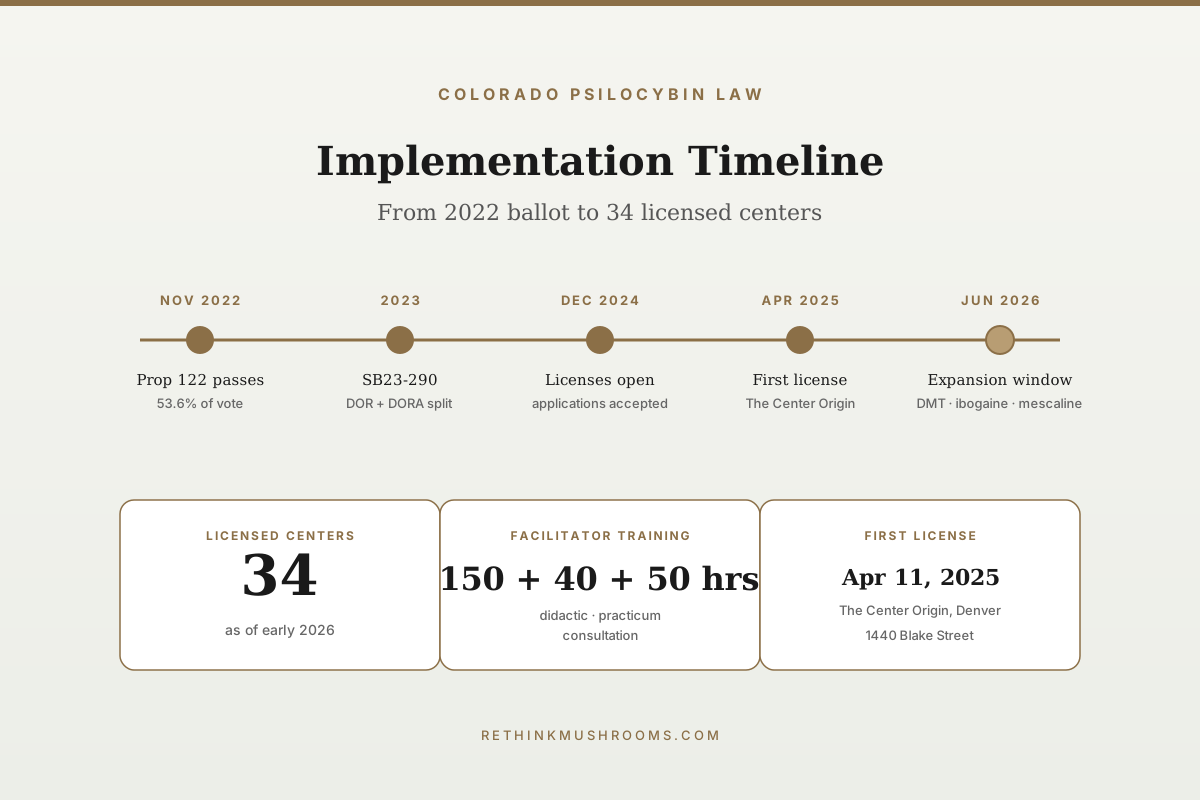
- The Natural Medicine Division opened license applications on December 31, 2024, and The Center Origin in downtown Denver became the first licensed healing center on April 11, 2025
- The first legal supervised psilocybin session under the program was delivered on June 6, 2025 — roughly 31 months after the vote
- As of February 2026, Colorado had 34 state-licensed healing centers, but only nine were standard licenses; the other 25 were lower-cost micro-healing centers capped below 750 mg of psilocybin on site, with 18 applications pending
- Contrary to a widespread reading of the statute, only DMT and non-peyote mescaline are gated to June 1, 2026 — SB23-290 prioritised ibogaine and left it available for recommendation at any time
- The Natural Medicine Advisory Board voted 5–2, with two abstentions, in September 2025 to recommend adding ibogaine, conditioned on Nagoya Protocol–compliant sourcing and a federal import waiver
- HB26-1325, effective August 12, 2026, creates a separate ibogaine research pilot inside the Behavioral Health Administration authorising up to five research sites
- Facilitator training requires 150 hours of didactic instruction, a 40-hour experiential practicum and 50 hours of supervised consultation over six months
- The framework targets conditions for which psilocybin has shown clinical efficacy in randomised trials, but no pooled outcome data yet exists for state-regulated, non-trial delivery
Ballot To Operating Programme
Colorado’s psilocybin law took 31 months to reach its first legal session
Every milestone in the Natural Medicine Health Act rollout, from the November 2022 vote to the August 2026 ibogaine research pilot. The gap between passing the law and delivering one session was consumed almost entirely by statute-writing and rulemaking, not by licensing.
- 8 Nov 2022Ballot
Proposition 122 passes
The Natural Medicine Health Act carries 53.6% to 46.4%, decriminalising five natural psychedelics for adults 21+ and authorising a regulated access programme.
- May 2023Statute
SB23-290 splits the regulators
Business licensing goes to the Department of Revenue’s Natural Medicine Division; facilitator licensure goes to DORA. Ibogaine gets an any-time recommendation pathway; DMT and mescaline are gated to June 2026.
- Jun–Aug 2024Rulemaking
Final rules approved
Roughly eighteen months of parallel DOR and DORA rulemaking conclude, covering facility standards, testing, facilitator training, screening and discipline.
- 31 Dec 2024Rulemaking
Applications open
Healing centre, cultivation, manufacturing, testing and facilitator applications all open on the same day — two years and one month after the vote.
- 11 Apr 2025Licensing
First healing centre licensed
The Center Origin, 1440 Blake St in Denver’s LoDo, receives licence number one — about three and a half months after applications opened.
- 6 Jun 2025Licensing
First regulated session
The first legal, supervised psilocybin session under the programme is delivered — roughly 31 months after the ballot passed.
- Jul 2025Licensing
Boulder comes online
Happy Rebel Healing becomes Boulder’s first licensed centre. Two more follow within five months, forming the state’s second cluster.
- Sep 2025Expansion
Board recommends ibogaine
The Natural Medicine Advisory Board votes 5–2, with two abstentions, to recommend ibogaine — conditioned on Nagoya Protocol compliance and a federal import waiver.
- Feb 2026Licensing
34 centres licensed
Nine standard and 25 micro-healing centres are licensed, with 18 applications pending — concentrated along the Front Range.
- 1 Jun 2026Expansion
DMT / mescaline window opens
The statutory earliest date for the Board to recommend DMT and non-peyote mescaline arrives. Peyote-derived mescaline stays excluded.
- 1 Jul 2026Rulemaking
Revised rules take effect
The current Natural Medicine Rules come into force, incorporating the first full cycle of operational experience.
- 12 Aug 2026Expansion
Ibogaine research pilot
HB26-1325 takes effect, authorising the Behavioral Health Administration to select up to five ibogaine research sites — a track separate from healing centres.
Sources: Colorado Secretary of State 2022 canvass; Colorado General Assembly SB23-290 and HB26-1325; Colorado Department of Revenue Natural Medicine Division; Colorado DORA Division of Professions and Occupations; The Center Origin announcement (11 Apr 2025); CPR News (4 Feb 2026); Marijuana Moment and Westword (Sept 2025 Advisory Board vote).
The Ballot Initiative: Proposition 122, November 2022
Proposition 122, formally titled the Natural Medicine Health Act, appeared on the Colorado ballot in November 2022. It did two things simultaneously. First, it decriminalised the personal use, possession, growth and sharing (without remuneration) of five natural psychedelic substances for adults 21 and older: psilocybin, psilocin, DMT, ibogaine and mescaline (excluding peyote, which remains federally protected for Native American religious use). Second, it created the statutory authority for a state-regulated access program under which trained facilitators could administer these substances to clients in licensed healing centers.
The initiative passed with approximately 53.6% of votes in favour and 46.4% opposed, a closer margin than Oregon's 2020 Measure 109 psilocybin program. The campaign committees behind the measure — Natural Medicine Colorado and Citizens for Natural Medicine — reported roughly $5.8 million in combined contributions and expenditures, of which about $4.6 million came from the national New Approach PAC. The opposition campaign, Protect Colorado's Kids, raised approximately $51,000. The roughly hundred-to-one funding asymmetry is a recurring feature of state psychedelic ballot campaigns rather than a Colorado peculiarity.
The measure was a citizen-initiated amendment rather than legislative action, which is characteristic of psychedelic reform at the state level in the United States. No U.S. state has yet advanced such a framework purely through its legislature without direct voter action or direct citizen-legislator collaboration.
SB23-290: Legislative Refinement, 2023
Colorado's legislature revisited the framework in 2023 with Senate Bill 23-290, which amended and extended Proposition 122 rather than overturning it. The key effect of SB23-290 was to divide regulatory authority between two agencies, a structural choice that has shaped implementation since.
- Colorado Department of Revenue (DOR), Natural Medicine Division: licenses and regulates healing centers, cultivation operations, manufacturing facilities, testing laboratories, and their owners and employees
- Colorado Department of Regulatory Agencies (DORA), Division of Professions and Occupations: licenses and regulates the human facilitators who administer psilocybin sessions, through its Office of Natural Medicine Licensure
This split parallels the Colorado cannabis model, in which DOR handles business licensing and other agencies handle professional licensure. For psilocybin the practical consequence is that any functional healing center requires coordination between both regulatory tracks: the business must have a DOR license, and every facilitator delivering sessions must have a DORA license.
SB23-290 also set the terms for expanding the program beyond psilocybin — and it did not treat the three candidate substances identically. It directed the Natural Medicine Advisory Board to prioritise ibogaine and allowed a recommendation on it at any time, subject to director-level approval, while gating DMT and non-peyote mescaline to recommendations made on or after June 1, 2026. That asymmetry is the single most misreported feature of the statute, and it explains a sequence of events that otherwise looks like regulators jumping the gun.
Rulemaking, 2023 Through 2024
The period between SB23-290 and the opening of license applications was occupied by parallel rulemaking processes at DOR and DORA. Both agencies were required to draft, publish for comment, revise and finalise detailed operational rules covering every aspect of the program.
DOR's rulemaking covered healing center facility requirements, cultivation and manufacturing standards, testing requirements, product tracking, financial requirements, operating procedures, and zoning-compatible provisions. DORA's rulemaking covered facilitator training standards, continuing education, scope of practice, ethical standards, client screening protocols, and a disciplinary framework.
The Natural Medicine Advisory Board, a statutorily-mandated body of experts, provided guidance across both tracks throughout this period. Board composition included clinicians, researchers, indigenous practitioners, harm-reduction advocates, regulatory experts, and representatives of affected communities. Final rules were approved in June and August 2024, with a final fee-focused rulemaking hearing in September 2024, clearing the path for the December 2024 license-application opening. A revised set of Natural Medicine Rules — the first to incorporate a full cycle of operating experience — took effect July 1, 2026.
License Applications Open: December 31, 2024
The Natural Medicine Division began accepting license applications on December 31, 2024, with DORA facilitator licensing opening simultaneously. This was the effective start of the operational phase of the program, two years and one month after voters approved Proposition 122.
A state survey conducted during the rulemaking period found approximately 213 individuals who expressed interest in opening some kind of natural medicine business. Of those, roughly 146 were interested in a healing center, 96 in a cultivation facility, 66 in processing and manufacturing, and 11 in a testing laboratory. The gap between expressed interest and ultimate license applications has been wide, reflecting the capital intensity, regulatory complexity, and operational unknowns that separate a stated intention from an operating license.
First License: The Center Origin, April 11, 2025
On April 11, 2025, the Natural Medicine Division issued the first operational healing center license to The Center Origin, located at 1440 Blake Street, Suite 330, in Denver's LoDo district. The license came approximately three and a half months after applications opened and approximately two and a half years after the ballot passed. The Center Origin is co-founded by Elizabeth Cooke and Mikki Vogt, the latter a licensed professional counsellor and licensed addiction counsellor who became Colorado's first natural medicine clinical facilitator.
The Center Origin has positioned itself as a wellness and mental-health-oriented facility, offering supervised "Journey Work" sessions for clients dealing with PTSD, depression, anxiety and end-of-life distress. Colorado's first regulated psilocybin session was delivered on June 6, 2025, roughly 31 months after the vote. The City of Denver later issued its own municipal license to the center, permitting the employment of non-clinical facilitators in addition to the clinically-credentialled staff.
The significance of being first was practical as well as symbolic. The Center Origin's application and inspection process effectively stress-tested the entire DOR licensing workflow and generated template documentation that subsequent applicants have drawn on. Several of the subsequent licensees have publicly cited the opening of The Center Origin as the moment they concluded the program was real.
Boulder Comes Online: Mid-2025 Through Early 2026
Boulder was the second major metropolitan area to host licensed healing centers, after the city council approved local siting rules in January 2025. Happy Rebel Healing, co-founded by Teresa Crossland and Erin Pfarr, became Boulder's first licensed psilocybin center in July 2025. By December 2025 Boulder had three operating centers — Happy Rebel Healing, Chariot Psilocybin Healing Center and Psychedelic Growth — according to reporting by Axios Boulder and the Boulder Reporting Lab. By early 2026, Colorado Public Radio reporters toured multiple Boulder-area centers and described a locally concentrated ecosystem.
The Boulder cluster reflects the broader geographic pattern of Colorado licensing. Facilities have concentrated along the Front Range corridor, particularly in Denver, Boulder, Fort Collins, Colorado Springs and their immediate suburbs, where the combination of population density, professional workforce and local political support makes the regulatory and business case easier. Rural Colorado has seen far fewer applications and licenses, a distribution mirrored in Oregon's earlier rollout.
State Totals: What "34 Centers" Actually Means
As of February 2026, Colorado had issued 34 healing center licenses with 18 additional applications pending review, per Colorado Public Radio reporting. The headline number is accurate but incomplete in a way that matters: only nine of the 34 were standard healing center licenses. The other 25 were micro-healing centers — a lower-cost license class that caps on-site psilocybin below 750 milligrams and is designed for operators running a limited number of sessions per week or per year.
What The “34 Centres” Number Contains
Three in four licensed Colorado healing centres are the small-volume tier
The headline count of 34 licensed centres is accurate, but it is not 34 full-scale clinics. Twenty-five of the 34 are micro-healing centres — a cheaper licence class capped below 750 mg of psilocybin on site. The programme did not simply grow slowly; it routed itself into the least capital-intensive licence available.
Micro-healing centres
25 · 74%Lower-cost licence class, capped below 750 mg of psilocybin on site. Built for a limited number of sessions per week or year.
Standard healing centres
9 · 26%Full-scale licence with no micro-tier inventory ceiling. Higher capital, staffing and compliance load.
34
Licensed, Feb 2026
18
Applications pending
146
Said they wanted one, pre-launch
Sources: CPR News, 4 February 2026 (34 licensed centres — nine standard, 25 micro-healing; 18 applications pending); Colorado Natural Medicine Rules, 1 CCR 212-3 (micro-healing 750 mg ceiling); The Colorado Sun, 19 November 2024 (pre-launch state survey: 213 prospective natural-medicine businesses, 146 of them healing centres).
That composition changes the interpretation of the rollout. Thirty-four centers after roughly thirteen months of licensing is materially below what the pre-launch surveys of stated interest would have predicted, and three quarters of what did get built chose the cheapest available license tier. The program did not simply grow slowly; it routed itself toward the lowest-capital format on offer. Several structural factors contribute:
- Capital requirements for a compliant standard facility (building, security, medication handling, session space, documentation systems) run into the hundreds of thousands of dollars
- The facilitator training pathway is long, with the 150-hour didactic program, 40-hour practicum and 50-hour consultation requirements adding up to roughly a year of part-time commitment for most candidates
- Insurance and banking remain difficult due to the federal controlled-substance status of psilocybin
- Zoning negotiations with municipalities have added delay in some jurisdictions and blocked siting entirely in others
- Several would-be applicants are waiting to see the operational and financial performance of the first wave before committing
The facilitator license count has been reported only in aggregate and approximate terms; the state has not published a regularly-updated public total. Both the center and facilitator counts continue to grow.
Facilitator Training Pathway
A Colorado Natural Medicine Facilitator license requires successful completion of a DORA-approved training program plus examination. The training requirements consist of three components that every candidate must complete:
- Didactic training: 150 hours of formal coursework covering pharmacology, neuroscience, psychology, ethics, scope of practice, cultural competency, screening protocols, risk management, and Colorado regulatory framework
- Experiential practicum: 40 hours of in-person supervised practice, including direct session experience under the supervision of an approved clinical facilitator
- Consultation: 50 hours of supervised reflection on practice over a six-month period, typically delivered as group and individual consultation meetings
Beyond these hours, candidates must hold current Basic Life Support certification, pass a written examination, submit to a background check, and satisfy continuing education requirements to maintain licensure. Prior clinical credentials can waive portions of the didactic requirement, but the 25-hour module on Ethics and Colorado Natural Medicine rules cannot be waived by anyone. DORA has approved multiple training providers, including established psychedelic education organisations and Colorado-specific new entrants.
The Clinical Evidence Base Behind The Framework
The regulatory framework rests on a clinical-trial evidence base that accumulated across the decade preceding the ballot. The conditions Colorado's healing centers are positioning to address — depression, end-of-life anxiety, PTSD, addiction — are precisely the conditions for which randomised psilocybin trials have reported the strongest signals.
Griffiths and colleagues (2016) at Johns Hopkins reported substantial and sustained decreases in depression and anxiety in patients with life-threatening cancer treated with psilocybin.[1] Ross and colleagues (2016) at NYU reported rapid and sustained symptom reduction for anxiety and depression in a comparable cancer population.[2]
Carhart-Harris and colleagues (2021) conducted a head-to-head trial of psilocybin versus escitalopram for depression. On the primary endpoint the difference between arms did not reach statistical significance, though several secondary measures favoured psilocybin; the trial is best read as showing broad comparability rather than superiority.[4] Goodwin and colleagues (2022) reported results of a phase 2b single-dose psilocybin trial for treatment-resistant depression in the New England Journal of Medicine.[5] Bogenschutz and colleagues (2022) reported that psilocybin-assisted psychotherapy produced a statistically significant reduction in heavy drinking days among adults with alcohol use disorder versus an active placebo of diphenhydramine.[6]
The most recent addition to this literature is an independent Australian replication in the palliative population, reported by Margaret Ross and colleagues in 2025.[3]
Ross ML, Iyer R, Williams ML, et al. (2025) · General Hospital Psychiatry
- Population
- 35 adults aged 18–80 with a life-threatening illness and clinically significant depression and/or anxiety, at a single palliative care unit in Melbourne
- Intervention
- 25 mg psilocybin with three preparatory and six integration psychotherapy sessions, followed by an open-label 25 mg dose for all participants
- Comparator
- 100 mg niacin as active placebo, with identical psychotherapy
- Finding
- At 6–7 weeks, psilocybin produced significantly greater reductions than placebo on HADS depression (B = −2.49, p = .02, d = 1.12), BDI-II (B = −7.56, p = .004, d = 2.97) and STAI state anxiety (B = −12.59, p = .005, d = 4.51). Benefits were sustained at 26 weeks. No serious treatment-emergent adverse events occurred; one participant withdrew due to anxiety during dosing.
positive A genuine independent replication outside the US research groups, but small (n = 35), single-site, and conducted with intensive psychotherapeutic support that Colorado's licensed-access model does not require.
Ross ML et al., General Hospital Psychiatry, 2025;96:322–331. PMID 40858059.
This clinical evidence base supplied the public-policy framing that got Proposition 122 on the ballot and through the electorate. It does not mean Colorado's regulated-access model directly replicates the conditions of those trials, because it does not. The trials used screened populations, standardised doses, trained clinicians and extensive therapeutic support. The Colorado framework permits broader access with a different set of safeguards, and the outcome distributions in a real-world licensed-access context may differ from the clinical-trial baseline.
- Receptor and cell studiescompleted
5-HT2A agonism and downstream plasticity mechanisms characterised over decades.
- Animal modelscompleted
Consistent behavioural and neuroplastic effects across rodent models.
- Case reports and open-label seriescompleted
Both the 1960s-era literature and modern open-label pilots.
- Small randomised trialscompleted
Griffiths 2016 and Ross 2016 in life-threatening illness; Ross 2025 as independent replication.
- Larger randomised controlled trialscurrent
Goodwin 2022 phase 2b in treatment-resistant depression; Bogenschutz 2022 in alcohol use disorder; phase 3 programmes ongoing.
- Pooled real-world outcome datamissing
No published pooled outcome data from state-regulated, non-trial healing-center delivery in either Colorado or Oregon.
The trial literature supporting psilocybin in depression, end-of-life distress and alcohol use disorder is genuinely strong and now includes independent replication. What does not exist is outcome data from the model Colorado chose: supervised sessions delivered by licensed facilitators to a self-selected paying public, without trial-grade screening or the intensive psychotherapy scaffolding used in the studies.
Griffiths 2016; Ross 2016; Carhart-Harris 2021; Goodwin 2022; Bogenschutz 2022; Ross 2025. See references below.
Reader guidance
ModerateThis article documents policy, not treatment recommendations
Concern
Colorado's regulated framework operates outside the FDA drug-approval system. Psilocybin remains a federal Schedule I substance, insurance generally does not cover sessions, and the conditions people seek healing centers for — treatment-resistant depression, PTSD, end-of-life distress, alcohol use disorder — are serious diagnoses where trial results do not transfer automatically to real-world delivery.
What the research says
Psilocybin carries real contraindications, including personal or family history of psychosis or bipolar disorder, certain cardiac conditions, and interactions with serotonergic medications. Licensed facilitators are required to screen for these, but screening standards in a licensed-access model are not equivalent to clinical-trial eligibility criteria.
Particularly relevant for: Anyone considering a licensed session, particularly those currently taking SSRIs, SNRIs, lithium or MAOIs, or with a personal or family history of psychotic or bipolar illness
What to do
This article is not medical advice. Discuss any psilocybin session with your own physician or psychiatrist before booking, and disclose your full medication list to the facilitator during screening.
Colorado DORA facilitator screening rules; contraindication criteria applied in Griffiths 2016, Ross 2016, Carhart-Harris 2021 and Goodwin 2022.
The Expansion Question: What June 2026 Actually Gated
Colorado's expansion clause is widely described as opening DMT, ibogaine and mescaline to consideration on June 1, 2026. That description is wrong on one of the three substances, and the error has real consequences for anyone tracking the program.
SB23-290 directed the Natural Medicine Advisory Board to prioritise ibogaine and permitted it to recommend ibogaine's addition at any time, subject to approval by the director and executive director of the state licensing authority. Only DMT and mescaline not sourced from peyote were gated to recommendations on or after June 1, 2026. Peyote-derived mescaline is excluded from consideration altogether, preserving the federal protection for Native American religious use.
Statutory reading
Was ibogaine locked behind the June 2026 date?
The claim
“Colorado's statute prevented regulators from considering DMT, ibogaine and mescaline until June 1, 2026.”
The three substances are usually listed together as the 'expansion' substances, and the June 2026 date is the only date in the clause — so summaries collapse the three into one deadline.
What research shows
MisleadingSB23-290 treated ibogaine differently from the other two. It directed the Advisory Board to prioritise ibogaine and allowed a recommendation at any time with director-level approval. The June 1, 2026 gate applies only to DMT and non-peyote mescaline.
This is why the Board could lawfully vote 5–2 to recommend ibogaine in September 2025, nine months before the June 2026 date — a sequence that looks like regulators acting early only if you assume a single shared deadline.
Colorado General Assembly, SB23-290; Marijuana Moment and Westword reporting on the September 2025 Advisory Board vote.
The Advisory Board first took up ibogaine at its June 2025 meeting. At its August 14, 2025 meeting it recommended that the state write a letter of intent to follow the Nagoya Protocol — the international agreement on equitable benefit-sharing from genetic resources and traditional knowledge — and request a federal Controlled Substances Act waiver to import iboga or ibogaine from Nagoya-compliant infrastructure in Gabon. In September 2025 the Board voted 5–2, with two abstentions, to recommend therapeutic access to ibogaine in healing centers, subject to those sourcing conditions.
That recommendation is not self-executing. It goes to the directors of the Department of Revenue and DORA's Division of Professions and Occupations, and, if approved, requires substance-specific rulemaking. A state assistant attorney general noted that the Board must also consider whether existing rules on administration and training should differ for ibogaine, which they almost certainly must: ibogaine carries documented QT prolongation and rare but serious cardiac adverse events, requiring medical screening and monitoring well beyond the psilocybin baseline.
Meanwhile, a separate legislative track opened. The Colorado legislature passed HB26-1325 on May 12, 2026, creating an ibogaine research pilot program inside the state's Behavioral Health Administration. The law, effective August 12, 2026, authorises the BHA to select up to five research sites through a competitive application process reviewed by a Pilot Proposal Review Committee, with decisions due within ninety days of the application deadline, funded through a dedicated cash fund able to accept gifts, grants and donations. This is an evidence-generating track that runs outside the healing-center program entirely.
Three Tracks, Not One Deadline
Ibogaine was never behind the June 2026 gate — only DMT and mescaline were
Colorado’s expansion clause is routinely described as opening all three additional substances on 1 June 2026. In fact SB23-290 prioritised ibogaine and left it ungated, which is why the Advisory Board could recommend it in September 2025. A separate 2026 statute added a research track that bypasses healing centres entirely.
Ibogaine
No date gateAdvisory Board voted 5–2 (two abstentions) in September 2025 to recommend adding ibogaine to the regulated programme.
Still required
- Sign-off from the Department of Revenue and DORA directors
- Nagoya Protocol–compliant sourcing arrangement
- Federal Controlled Substances Act import waiver
- Substance-specific rules on dosing, screening and facilitator training
DMT · mescaline (non-peyote)
On or after 1 Jun 2026The statutory window opened on 1 June 2026. State officials had signalled a possible July 2026 Advisory Board recommendation; peyote-derived mescaline remains excluded entirely.
Still required
- A formal Advisory Board recommendation
- Director-level approval at DOR and DORA
- Full rulemaking cycle at both agencies
- Training standards for a substance with a different duration profile
Ibogaine (research pilot)
Effective 12 Aug 2026HB26-1325 creates an ibogaine research pilot inside the Behavioral Health Administration — a parallel evidence-generating track that does not run through healing centres.
Still required
- BHA selection of up to five pilot sites by competitive application
- Pilot Proposal Review Committee review, decisions within 90 days of the deadline
- Funding via the programme’s dedicated cash fund (gifts, grants, donations)
Sources: Colorado General Assembly, SB23-290 (ibogaine prioritised and ungated; DMT and non-peyote mescaline gated to on or after 1 June 2026) and HB26-1325 (ibogaine research pilot, passed 12 May 2026, effective 12 Aug 2026); Marijuana Moment and Westword, September 2025 (Advisory Board 5–2 ibogaine vote and Nagoya Protocol condition).
For DMT and mescaline, the statutory window opened as scheduled on June 1, 2026, and state officials had signalled that both substances, alongside ibogaine, were candidates for Advisory Board action in July 2026. The practical issues around each substance differ substantially:
- DMT: Short duration (approximately 15–45 minutes depending on route) creates a different operational model than psilocybin; ayahuasca traditions raise questions about religious-use considerations alongside regulated-access frameworks
- Ibogaine: Cardiac safety concerns require screening and monitoring protocols that exceed the psilocybin baseline, and lawful supply remains unresolved pending the Nagoya and federal-waiver questions
- Mescaline: Cactus-sourced mescaline (San Pedro and related species) raises Indigenous cultural considerations that the Board has formally engaged with; peyote is excluded outright
The regulatory framework anticipates phased, substance-by-substance expansion rather than a single bulk addition. Counting board recommendation, director approval, rulemaking and new training standards, the earliest realistic date for any substance to become operationally available in a Colorado healing center is late 2026 at the very soonest, and more plausibly 2027. The Polis administration has publicly signalled an interest in seeing ibogaine access begin before the governor's final term ends in November 2026.
What Has Not Gone According To Plan
Several aspects of implementation have diverged from the initial projections.
Application volume has been lower than early surveys suggested, and the license mix skewed small. Some of this is the ordinary gap between stated interest and business commitment, but part reflects the real operational and financial friction of compliance. The capital required to stand up a fully licensed standard facility priced out many of the independent practitioners who had expressed early interest — which is precisely the gap the micro-healing tier was designed to fill, and which now accounts for roughly three quarters of licensed centers.
Insurance and banking remain constrained. Most major insurance carriers do not cover Natural Medicine facilitator services, which keeps the program an out-of-pocket market. Banking is workable but often requires specialised providers and comes with elevated fees, a pattern familiar from cannabis.
Geographic distribution has been more concentrated than proponents hoped. Rural Colorado, which has among the highest suicide rates and lowest mental-health-service density in the state, has seen few licensed facilities. The program's ability to address mental-health needs in underserved geographies is constrained by the economics of site-based access.
Municipal opt-out dynamics have been uneven. Colorado's framework allows municipalities to regulate time, place and manner of healing centers, which has led to effective bans in some jurisdictions even where a state license would otherwise be available.
What The Evidence Establishes
The implementation of Colorado's Natural Medicine Health Act has reached a demonstrable operational phase, with 34 licensed healing centers as of February 2026, an active facilitator pipeline, a revised rule set in force since July 2026, and two distinct paths toward adding ibogaine. The program took approximately 29 months from ballot to first license and 31 months to first session — closely tracking Oregon, where Measure 109 passed in November 2020 and EPIC Healing Eugene opened as the nation's first licensed service center in June 2023, about 31 months later.
Colorado's model sits between decriminalisation (no regulation, no licensed access) and pharmaceutical approval (FDA-regulated drug prescribed by physicians). The clinical-trial evidence base that motivated the policy has strong signals, and now includes independent international replication, but it does not directly validate the operational framework Colorado chose. No pooled outcome data yet exists from either state's regulated delivery model. Evaluation of the Colorado program against real-world endpoints is the next phase of the story, and much of it will unfold over the 2026–2028 window.
The Bottom Line
Colorado's Natural Medicine Health Act passed in November 2022 with roughly 53.6% of the vote. Regulatory rulemaking occupied 2023–2024, license applications opened December 31, 2024, The Center Origin in Denver became the first licensed healing center on April 11, 2025, and the first regulated session was delivered June 6, 2025. As of February 2026 Colorado had 34 licensed healing centers — nine standard and 25 lower-cost micro-healing centers — with 18 applications pending. Contrary to common summaries, only DMT and non-peyote mescaline were gated to June 1, 2026; SB23-290 prioritised ibogaine and left it ungated, which is why the Advisory Board could recommend it in September 2025. A separate 2026 statute, HB26-1325, opened an ibogaine research pilot inside the Behavioral Health Administration from August 12, 2026. The program sits between decriminalisation and FDA pharmaceutical approval, and real-world evaluation against the clinical-trial evidence base is the next phase.
Frequently Asked Questions
Sources & References
- 1RTHM-00426·Griffiths, Roland R et al. (2016). “Psilocybin produces substantial and sustained decreases in depression and anxiety in patients with life-threatening cancer: A randomized double-blind trial..” Journal of psychopharmacology (Oxford.Study breakdown →PubMed →↩
- 2RTHM-00445·Ross, Stephen et al. (2016). “Rapid and sustained symptom reduction following psilocybin treatment for anxiety and depression in patients with life-threatening cancer: a randomized controlled trial..” Journal of psychopharmacology (Oxford.Study breakdown →PubMed →↩
- 3RTHM-00949·Ross, Margaret L et al. (2025). “Psilocybin-assisted psychotherapy for depression and anxiety associated with life threatening illness: A phase 2b randomized controlled trial..” General hospital psychiatry.Study breakdown →PubMed →↩
- 4RTHM-00675·Carhart-Harris, Robin et al. (2021). “Trial of Psilocybin versus Escitalopram for Depression..” The New England journal of medicine.Study breakdown →PubMed →↩
- 5RTHM-00761·Goodwin, Guy M et al. (2022). “Single-Dose Psilocybin for a Treatment-Resistant Episode of Major Depression..” The New England journal of medicine.Study breakdown →PubMed →↩
- 6RTHM-00746·Bogenschutz, Michael P et al. (2022). “Percentage of Heavy Drinking Days Following Psilocybin-Assisted Psychotherapy vs Placebo in the Treatment of Adult Patients With Alcohol Use Disorder: A Randomized Clinical Trial..” JAMA psychiatry.Study breakdown →PubMed →↩