Colorado Natural Medicine Act
June 1, 2026 DMT, ibogaine, mescaline eligible
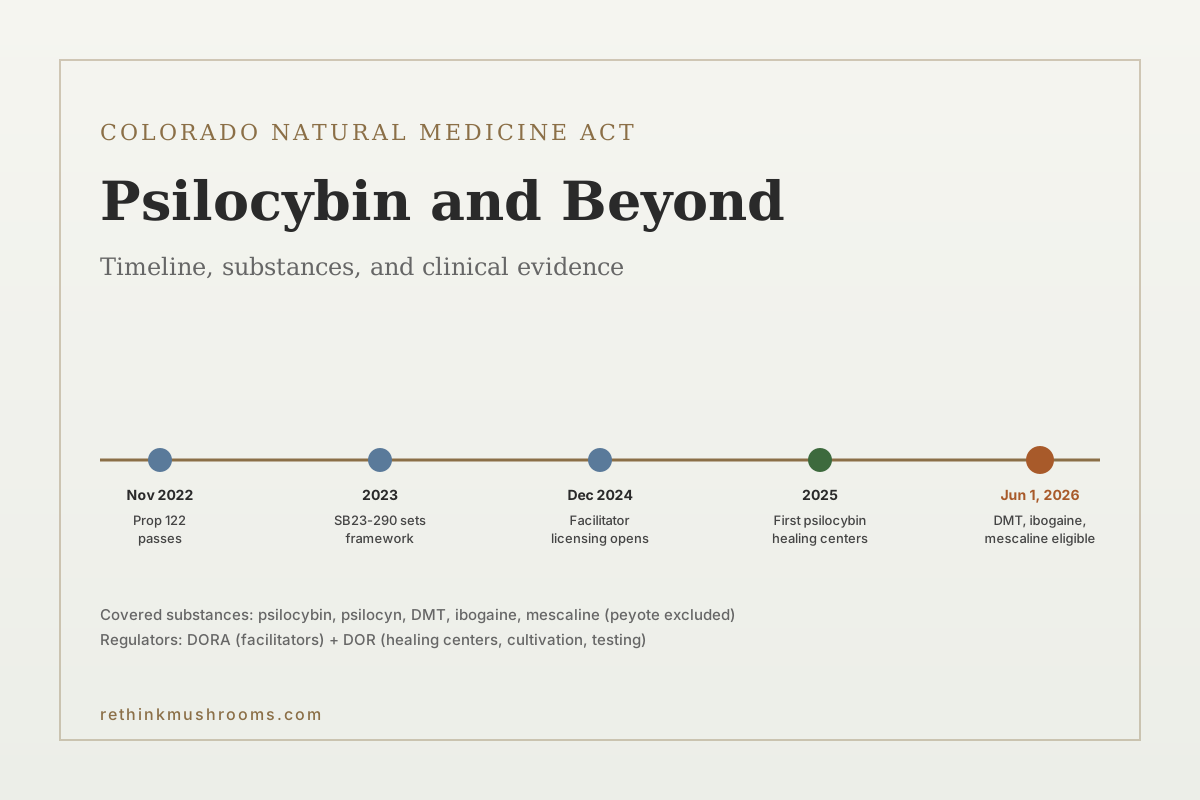
Colorado's Natural Medicine Health Act legalized psilocybin access in licensed healing centers in 2025 and set June 1, 2026 as the earliest date the Natural Medicine Advisory Board can add DMT, ibogaine, and mescaline to the regulated program.
Colorado Proposition 122 (2022); SB23-290 (2023)
Ages 21+
legal age for supervised access
5 substances
covered by personal-use decriminalization
DORA + DOR
dual-agency regulatory structure
Colorado Proposition 122 (2022); SB23-290 (2023)
 View as image ↗
Colorado's Natural Medicine Health Act is the second state-level regulated psychedelic access program in the United States, after Oregon's Measure 109 psilocybin services program. The two laws differ in significant ways: Colorado decriminalized personal use and cultivation at passage in November 2022, its statute covers five substances rather than one, and its expansion path from psilocybin to dimethyltryptamine (DMT), ibogaine, and mescaline was written into the original law with a June 1, 2026 eligibility date. That date is now current, which is what makes a 2026-perspective article on the law different from one written during the rulemaking phase.
This article explains what the Natural Medicine Act actually legalizes, how the regulated-access system is structured, and what the clinical evidence looks like for each of the substances on Colorado's expansion list. The focus is on the mechanics and the evidence, not on policy advocacy. For the implementation timeline in isolation, see Colorado psilocybin implementation: timeline and progress. For the participant experience at a healing center, see Colorado's healing centers: what to expect. For the Oregon comparison, see how Colorado's psychedelic law differs from Oregon.
Key Takeaways
- Colorado Proposition 122 (the Natural Medicine Health Act) passed in November 2022 with approximately 54% support and covers five substances: psilocybin, psilocyn, DMT, ibogaine, and mescaline (excluding peyote)
- Personal use, possession, cultivation, and gifting of all five substances by adults 21+ was decriminalized immediately on passage; regulated commercial access was delayed for rulemaking
- SB23-290, passed in 2023, built the regulatory structure around Proposition 122 and created the Natural Medicine Advisory Board, the DORA facilitator licensing system, and the Department of Revenue's cultivation and healing-center licensing framework
- Facilitator licensing opened in December 2024; the first licensed healing centers began administering psilocybin services in 2025
- June 1, 2026 is the earliest date the Natural Medicine Advisory Board can recommend adding DMT and mescaline to the regulated program; ibogaine has no statutory date limit and can be added at any time
- Clinical evidence for psilocybin-assisted therapy in depression includes the Carhart-Harris (2021) escitalopram comparison trial, the Davis (2021) MDD randomized trial, and the Goodwin (2022) COMP360 treatment-resistant depression phase 2b trial
- Psilocybin also has FDA breakthrough therapy designations for treatment-resistant depression and major depressive disorder, but remains Schedule I at the federal level, creating a state-federal conflict that licensees and participants navigate directly
What the Law Actually Does
Proposition 122, codified in Article 170 of Title 12 and implemented by SB23-290, has four operational components.
1. Personal-use decriminalization (immediate, November 2022). Adults 21 or older in Colorado may legally possess, use, cultivate, and gift (without compensation) psilocybin, psilocyn, DMT, ibogaine, and mescaline. The decriminalization is not a legalization: commercial sale outside the regulated healing-center system remains prohibited, and there is no retail dispensary model analogous to adult-use cannabis.
2. Regulated access through healing centers (phased). Licensed healing centers, overseen by the Department of Regulatory Agencies (DORA) and the Department of Revenue (DOR), provide natural medicine services consisting of a preparation session, an administration session, and an integration session. Only licensed facilitators may administer natural medicine in healing-center settings. The initial rollout was limited to psilocybin and psilocyn, with the expansion path to DMT, ibogaine, and mescaline deferred to at least June 1, 2026 (for DMT and mescaline) or whenever recommended (for ibogaine).
3. Facilitator licensing. DORA administers a tiered facilitator licensing system with training, supervision, and continuing-education requirements. Licensing opened in December 2024 and the first licensed facilitators began practicing in 2025. Facilitator training programs must be approved by DORA and cover pharmacology, medical safety, screening, supervised practicum hours, and ethics.
4. No prescription requirement. Unlike the federal breakthrough-therapy development pathway for MDMA and psilocybin, Colorado's regulated access does not require a medical diagnosis, a prescription, or insurance-based reimbursement. Participants self-refer, complete a screening with a facilitator, and pay out of pocket. This structure is closer to Oregon's psilocybin services model than to an FDA-approved medication framework.
The law also does not legalize driving under the influence, workplace impairment, or any use by people under 21. It does not preempt local government authority to further restrict healing-center siting (municipalities can prohibit them within their boundaries), and it does not create any federal-law protection.
Why Psilocybin First: The Clinical Evidence
The decision to begin the regulated program with psilocybin reflects the relative depth of the clinical evidence base rather than any judgment about the other four substances. Psilocybin has been the subject of more modern clinical trials than DMT, ibogaine, or mescaline combined.
The depression evidence is the strongest. Davis et al. (2021) randomized 24 patients with major depressive disorder to two psilocybin sessions with supportive psychotherapy versus waitlist control. The psilocybin group showed large decreases in depression severity on the GRID-Hamilton Depression Rating Scale, with 71% meeting response criteria and 54% meeting remission criteria at four weeks.[1] Carhart-Harris et al. (2021) directly compared psilocybin to the SSRI escitalopram in moderate-to-severe depression. On the primary outcome (QIDS-SR-16), there was no statistically significant difference between arms, but psilocybin showed larger numerical improvements on most secondary measures.[2] Goodwin et al. (2022) reported the COMP360 phase 2b trial in 233 patients with treatment-resistant depression: a single 25 mg dose produced significantly larger reductions in Montgomery-Åsberg Depression Rating Scale (MADRS) scores at three weeks versus 1 mg control.[3]
The cancer-associated distress evidence predates the MDD work. Griffiths et al. (2016) and Ross et al. (2016) independently randomized patients with life-threatening cancer to high-dose versus low-dose (active control) psilocybin. Both trials found substantial and sustained reductions in anxiety and depression measures, with effects persisting at six-month follow-up.[4][5]
The addiction literature is smaller but consistent. Bogenschutz et al. (2022) randomized 95 participants with alcohol use disorder to psilocybin-assisted therapy or diphenhydramine-assisted therapy. Percentage of heavy drinking days was significantly lower in the psilocybin arm over 32 weeks of follow-up.[6] Johnson et al. (2014) reported an open-label pilot of psilocybin for tobacco addiction with 80% biochemically confirmed seven-day abstinence at six months in 15 participants.[7]
Bipolar depression is a later addition to the evidence base. Aaronson et al. (2024) published a nonrandomized open-label trial of single-dose synthetic psilocybin with psychotherapy for treatment-resistant bipolar II depressive episodes, reporting MADRS reductions that met response criteria in most participants without precipitating hypomanic episodes.[8] This matters for Colorado's facilitator screening protocols because bipolar disorder is a common exclusion criterion in clinical trials and has been a screening gray area in the regulated-access context.
This is the evidence depth the Natural Medicine Advisory Board and DORA had in hand when building the regulatory framework. It is not the evidence depth they have for the three substances eligible for addition on or after June 1, 2026.
The June 2026 Expansion: DMT, Ibogaine, and Mescaline
Proposition 122 defined three additional substances as "natural medicine" and set a path for their addition to the regulated access program. The evidence base for each differs substantially from psilocybin's.
Ibogaine
Ibogaine is a tryptamine alkaloid from the West African shrub Tabernanthe iboga, used traditionally in Bwiti religious practice and studied since the 1960s for its effects on opioid withdrawal and addiction. Clinical trials in the U.S. have been constrained by ibogaine's cardiac risk profile: it prolongs the QT interval and has caused fatal arrhythmias in under-monitored contexts. Observational data from offshore treatment clinics (Mexico, New Zealand) show substantial reductions in opioid craving and withdrawal severity, but these are not randomized controlled trials. More recent work at Stanford has studied ibogaine in veterans with traumatic brain injury and PTSD, with open-label results showing large reductions in depression, anxiety, and PTSD symptom scales alongside improvements in neuropsychological function.
The Colorado expansion path for ibogaine has no statutory date limit: the Natural Medicine Advisory Board can recommend adding ibogaine at any time. The practical gate is the safety profile. Healing-center administration of ibogaine would likely require cardiac monitoring infrastructure (continuous ECG, telemetry, medical rather than peer facilitator staffing) that the current psilocybin-oriented rules do not mandate.
DMT (N,N-Dimethyltryptamine)
DMT is a short-acting tryptamine with a psychedelic experience lasting roughly 15-30 minutes when vaporized or 4-6 hours when taken orally as part of the ayahuasca brew (with an MAO inhibitor). The clinical evidence base is smaller than psilocybin's but growing. Ayahuasca trials in Brazil (Palhano-Fontes et al., 2019) have reported rapid antidepressant effects in treatment-resistant depression. Pharmaceutical DMT and 5-MeO-DMT programs (Small Pharma, GH Research) are in phase 2 development for depression.
For Colorado regulators, DMT presents a pharmacology question that psilocybin does not: the short duration of vaporized DMT makes a session model structured around 6-hour oral psilocybin dosing a poor fit, and the ayahuasca form involves an MAO inhibitor (harmine, harmaline) with its own safety profile. Healing-center protocols for DMT would likely be distinct from psilocybin protocols rather than a simple substance substitution.
Mescaline
Mescaline is a phenethylamine psychedelic present in peyote (Lophophora williamsii), San Pedro (Trichocereus pachanoi / Echinopsis pachanoi), and related cacti. Proposition 122 specifically excluded peyote from the definition of natural medicine, reflecting advocacy from Indigenous communities that depend on peyote for ceremonial use and that view commercial regulated access as a threat to the species (peyote is slow-growing and already under harvesting pressure). Mescaline from San Pedro and synthetic mescaline are therefore the practical substances at issue for the expansion.
The modern clinical trial literature on mescaline is thin. Most evidence is historical or derives from recent survey research on naturalistic mescaline use. Unlike ibogaine and DMT, mescaline has no prominent pharmaceutical development program and few registered clinical trials, which means its addition to the Colorado program would rely more heavily on traditional-use evidence and survey data than on phase 2 trials.
For the full regulatory mechanics of how these substances would be added, see Colorado's Natural Medicine Act: how regulated psilocybin access actually works.
The State-Federal Conflict
All five substances in Colorado's Natural Medicine Act are Schedule I under the federal Controlled Substances Act. The schedule classification means federal law treats them as having no currently accepted medical use and high abuse potential, which is legally inconsistent with a state's regulated medical-access program. This conflict is not resolved in the Colorado law and has practical implications:
- Healing centers cannot hold federal firearms licenses because their licensees are, in the federal government's view, unlawful users of a controlled substance.
- Federal employees (including postal workers, military personnel, federal contractors with security clearances) cannot participate in the program without risk to their employment.
- Healing centers cannot deduct ordinary business expenses under IRC 280E, the same tax provision that applies to state-legal cannabis businesses.
- Banks with federal charters have been cautious about providing services to healing centers; most operate on a cash-heavy model.
The FDA breakthrough-therapy designations for psilocybin in major depressive disorder and treatment-resistant depression are administrative accelerants within the drug approval process; they do not reschedule psilocybin and do not confer any state-federal conflict relief.
What Changes on June 1, 2026
The June 1, 2026 date in Proposition 122 is an eligibility date, not an automatic expansion date. On and after that date, the Natural Medicine Advisory Board may recommend, and the DORA/DOR directors may approve, adding DMT and mescaline to the regulated access program. Such an expansion would require a full rulemaking cycle including public comment, new facilitator training standards (especially for short-acting DMT sessions), and likely new healing-center licensing categories.
Ibogaine is a special case. Proposition 122 places no statutory date limit on when ibogaine can be added, but the practical barrier is the cardiac safety profile. A policy path that includes ibogaine is likely to require medical-grade healing centers with continuous cardiac monitoring, physician oversight, and participant screening protocols more demanding than those used for psilocybin. Whether Colorado chooses to build that infrastructure, rely on referral to out-of-state medical clinics, or defer ibogaine addition indefinitely is the significant policy decision in the expansion phase.
For the participant-facing implications, see Colorado's healing centers: what to expect.
The Bottom Line
Colorado's Natural Medicine Health Act decriminalized personal use of psilocybin, psilocyn, DMT, ibogaine, and mescaline for adults 21 and older at passage in November 2022 and created a regulated healing-center access system that launched with psilocybin in 2025. June 1, 2026 is the earliest date the Natural Medicine Advisory Board may add DMT and mescaline to the regulated program; ibogaine has no statutory date limit. The clinical evidence that justified psilocybin as the initial substance is substantially deeper than the evidence for any of the three expansion candidates, which means the 2026 expansion decisions will rely more heavily on observational and traditional-use data than on phase 2 randomized trials.
Frequently Asked Questions
Sources & References
- 1RTHM-00682·Davis, Alan K et al. (2021). “Effects of Psilocybin-Assisted Therapy on Major Depressive Disorder: A Randomized Clinical Trial..” JAMA psychiatry.Study breakdown →PubMed →↩
- 2RTHM-00675·Carhart-Harris, Robin et al. (2021). “Trial of Psilocybin versus Escitalopram for Depression..” The New England journal of medicine.Study breakdown →PubMed →↩
- 3RTHM-00761·Goodwin, Guy M et al. (2022). “Single-Dose Psilocybin for a Treatment-Resistant Episode of Major Depression..” The New England journal of medicine.Study breakdown →PubMed →↩
- 4RTHM-00426·Griffiths, Roland R et al. (2016). “Psilocybin produces substantial and sustained decreases in depression and anxiety in patients with life-threatening cancer: A randomized double-blind trial..” Journal of psychopharmacology (Oxford.Study breakdown →PubMed →↩
- 5RTHM-00445·Ross, Stephen et al. (2016). “Rapid and sustained symptom reduction following psilocybin treatment for anxiety and depression in patients with life-threatening cancer: a randomized controlled trial..” Journal of psychopharmacology (Oxford.Study breakdown →PubMed →↩
- 6RTHM-00746·Bogenschutz, Michael P et al. (2022). “Percentage of Heavy Drinking Days Following Psilocybin-Assisted Psychotherapy vs Placebo in the Treatment of Adult Patients With Alcohol Use Disorder: A Randomized Clinical Trial..” JAMA psychiatry.Study breakdown →PubMed →↩
- 7RTHM-00328·Johnson, Matthew W et al. (2014). “Pilot study of the 5-HT2AR agonist psilocybin in the treatment of tobacco addiction..” Journal of psychopharmacology (Oxford.Study breakdown →PubMed →↩
- 8RTHM-00863·Aaronson, Scott T et al. (2024). “Single-Dose Synthetic Psilocybin With Psychotherapy for Treatment-Resistant Bipolar Type II Major Depressive Episodes: A Nonrandomized Open-Label Trial..” JAMA psychiatry.Study breakdown →PubMed →↩