Psychedelic Law & Policy
6 key structural differences
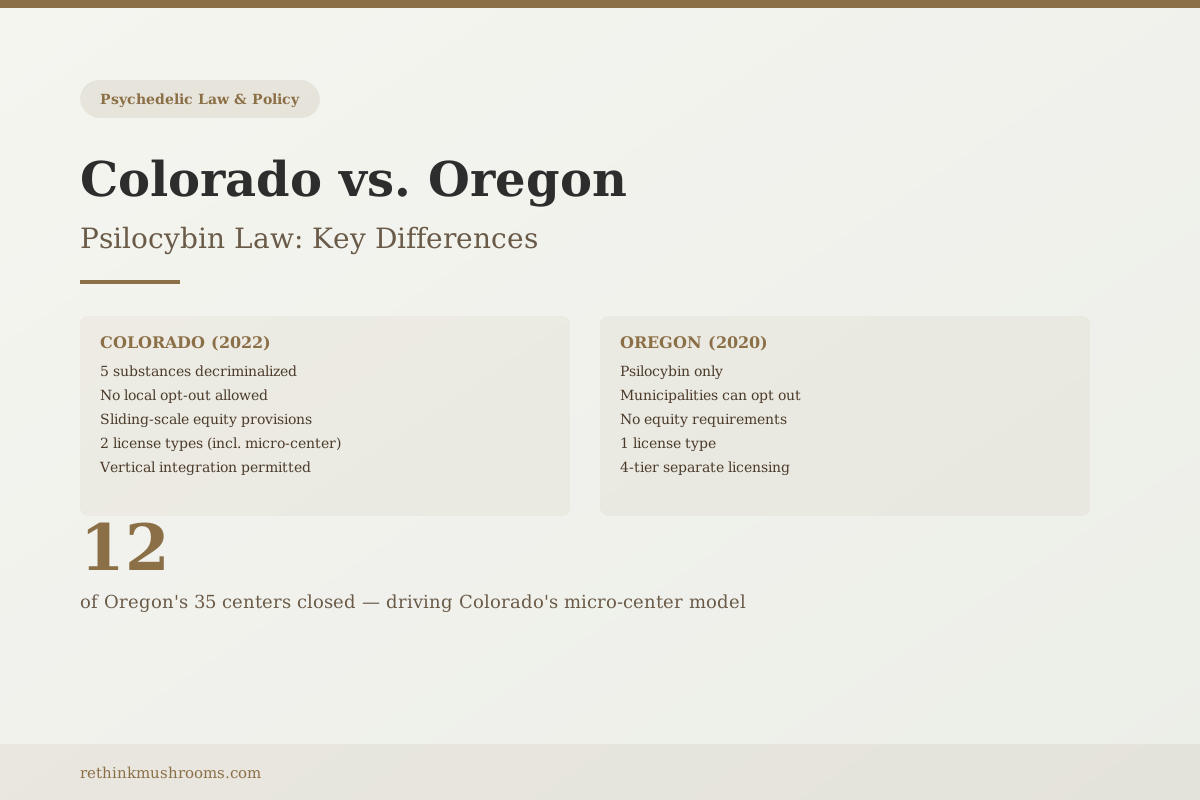
Oregon's Measure 109 (2020) was the first. Colorado's Natural Medicine Act (2022) was designed with two years of Oregon's implementation in view. The differences between the two programs are deliberate.
Siegel et al., JAMA Psychiatry, 2023
5
substances decriminalized in Colorado vs. 1 in Oregon (psilocybin only)
0
Colorado counties can ban healing centers; Oregon municipalities CAN opt out
12
of Oregon's 35 healing centers closed due to operational costs — driving Colorado's micro-center model
Siegel et al., JAMA Psychiatry, 2023
 View as image ↗
Oregon passed the world's first law creating regulated psilocybin service centers in November 2020. Colorado followed with Proposition 122 in November 2022 — and did so with two years of observing what Oregon had built. The differences between Colorado's Natural Medicine Act and Oregon's Measure 109 are not accidental. They reflect deliberate design choices made with Oregon's implementation challenges in view.
Six structural differences separate the two programs: the substances covered, the license types available, local government authority over siting, personal use protections, equity provisions, and approach to supply-chain regulation. Each difference addresses a specific limitation that appeared in Oregon's model.
The federal legal context for both programs is the same: both operate against the backdrop of psilocybin's federal Schedule I classification. Both states created regulated state-level access in the absence of federal approval. Siegel and colleagues' 2023 JAMA Psychiatry analysis of U.S. state-level psychedelic legislative reform documented this parallel trajectory — state programs running ahead of federal scheduling driven by clinical evidence accumulating faster than the regulatory process.[1]
Key Takeaways
- Oregon's Measure 109 passed November 2020 and opened the first regulated service centers in January 2023; Colorado's Prop 122 passed November 2022 and issued its first healing center license in March 2025
- Colorado's law covers 5 substances (psilocybin, psilocyn, DMT, ibogaine, mescaline for personal use; healing centers limited to psilocybin now, expanding June 2026); Oregon's program covers only psilocybin
- Colorado prohibits localities from banning healing centers entirely; Oregon allowed municipal opt-outs, leaving some regions without access
- Colorado built equity provisions into the regulatory framework (sliding scale, Medicaid/veteran discounts); Oregon's sessions have cost $1,000-$3,000 with no equity requirements
- Colorado created two license types — healing center and micro-healing center — specifically to reduce the operational costs that forced 12 of Oregon's 35 service centers to close
- Roseman et al. (2017) showed experience quality during the session directly predicts therapeutic outcomes, establishing the scientific basis for why both states require in-facility facilitated sessions rather than take-home access
Oregon First, Colorado Second: Why the Sequence Matters
Oregon's Measure 109 passed with 55.8% of the vote on November 3, 2020. It created the Oregon Psilocybin Services program — the first regulated psilocybin service framework in the world. The Oregon Health Authority spent two years building the regulatory infrastructure: training standards, licensing requirements, product safety rules, service center specifications. The first licensed service centers opened in January 2023, roughly 26 months after the ballot initiative passed.
During that same 26 months, Colorado was watching. Advocates and legislators studying the Oregon model for the Colorado ballot initiative had access to real-world information about implementation costs, the difficulties small operators faced with Oregon's regulatory structure, the absence of equity provisions in a therapy costing $1,000-$3,000 per complete session, and the risk that some municipalities would use opt-out provisions to create geographic access gaps.
Colorado's Proposition 122 passed November 8, 2022, with 53.4% of the vote. The enabling legislation (SB23-290) was signed May 2023. License applications opened December 31, 2024. The first healing center license was issued to The Center Origin in Denver in March 2025 — 28 months after the ballot initiative, nearly matching Oregon's timeline despite the added complexity of a multi-agency regulatory framework.
The detailed timeline and what each regulatory milestone means for patient access is in Colorado Psilocybin Implementation: Timeline and Progress.
Six Ways Colorado's Law Differs From Oregon's
1. Substances covered.
Oregon Measure 109 covers psilocybin only. Colorado Prop 122 decriminalized five substances for personal use by adults 21+: psilocybin, psilocyn (the active metabolite), DMT, ibogaine, and mescaline (excluding peyote). However, Colorado's healing centers are licensed to administer only psilocybin and psilocyn until at least June 1, 2026, when the Natural Medicine Advisory Board may authorize regulated facility use of DMT, ibogaine, and mescaline.
2. License types.
Oregon created a single service center license type. Colorado created two: the standard healing center (dedicated facility, larger psilocybin storage capacity, full security requirements) and the micro-healing center (limited to 750 milligrams or less of psilocin on-site, designed to be operated as an adjunct practice by licensed mental health professionals without requiring a separate dedicated space). The micro-healing center model specifically addresses the cost-of-entry problem that drove many Oregon operators to exit.
3. Local government authority.
Oregon's Measure 109 allowed individual municipalities to refer the question of psilocybin services to local voters for opt-out elections, and many did. Some Oregon communities voted to prohibit service centers within their boundaries, creating geographic access gaps. Colorado's Natural Medicine Act prohibits counties and municipalities from banning natural medicine healing centers. Localities retain authority to regulate time, place, and manner — operating hours, signage, distance from schools — but cannot prohibit the facilities outright.
4. Personal use protections.
Both states decriminalize personal use for adults. Oregon's Measure 110 (a separate 2020 ballot initiative) decriminalized small quantities of most drugs. Colorado's Prop 122 creates specific personal-use protections for the five designated substances — adults may possess, consume, and cultivate for personal use without criminal penalty.
5. Equity provisions.
Oregon built no equity requirements into Measure 109. The result is that a complete Oregon psilocybin therapy package — preparation, administration, integration — typically costs $1,000 to $3,000, paid out of pocket, with no insurance coverage. Colorado's SB23-290 included explicit equity provisions: healing centers may charge on a sliding-scale basis, the state created a Medicaid access pathway for low-income adults, and veterans and their families are eligible for specific access programs. Whether these provisions produce meaningfully better real-world access is an open empirical question, but the structural framework exists in Colorado where it does not in Oregon.
6. Supply chain and vertical integration.
Oregon's regulatory structure created four separate license tiers: producer, processor, laboratory, and service center — each requiring a separate license with separate regulatory oversight. Colorado's framework allows more vertical integration: a single entity can hold multiple license types. This reduces operating costs for businesses that want to produce and serve, addressing one of the structural challenges Oregon operators identified.
Why Both Programs Use In-Facility Facilitation: The Science
A question some consumers ask is why neither state allows take-home psilocybin use. The answer is grounded in evidence rather than regulatory conservatism.
Roseman and colleagues published a study in Frontiers in Pharmacology in 2017 examining what predicted therapeutic outcomes in psilocybin-treated patients with treatment-resistant depression.[4] The finding: the subjective quality of the session itself — specifically the presence of what the researchers called oceanic boundlessness (a felt sense of unified, expanded awareness) — directly predicted antidepressant response at one week and at three months after treatment. The quality of the session, shaped by facilitation, setting, preparation, and intention, was a therapeutic variable.
This is not a ceremonial claim. It is a measurable prediction. Participants whose sessions included more of these features had better outcomes. Participants whose sessions were characterized by anxiety and struggle had less reliable outcomes. The presence of a skilled facilitator who can support a positive trajectory — while providing grounding when needed — is part of the mechanism, not just a safety provision.
Johnson and colleagues' 2018 analysis of psilocybin against all eight criteria of the Controlled Substances Act found that psilocybin has low abuse potential, no documented overdose deaths, and no physical dependence — making the argument for restrictive take-home controls scientifically weak.[2] But the facilitated model is not about preventing misuse. It is about maximizing the probability of a therapeutic outcome. Both states chose facilitation because the evidence supports it.
The science behind Oregon and Colorado's healing center session design is detailed in Colorado's Healing Centers: What to Expect.
What Oregon's Two-Year Head Start Has Produced
Bellman and colleagues published a 2024 review of psilocybin use for depression among cancer patients under Oregon's approved program, providing one of the first systematic assessments of real-world outcomes.[5] Oregon Health Authority data through early 2025 documented roughly 8,000 clients served across all indications, with 6 serious adverse reactions reported among approximately 1,500 clients in the first quarter of 2025 — a serious adverse event rate under 0.5%.
That safety profile is consistent with the broader population-level evidence. Johansen and Krebs examined psychedelic use in a sample of 135,095 U.S. adults and found no association between psychedelic use and increased rates of mental health problems, depression, anxiety, or suicidal ideation.[3] Oregon's first two years of regulated access have not produced the adverse event signal that skeptics predicted.
The operational story is less clean. Of the original 35 licensed Oregon service centers, 12 closed within the first 18 months. The primary reason was economic: the four-tier licensing structure, combined with the session-length billing model (facilitators typically bill for 4-8 hour sessions at $150-$300/hour), created cost structures that small operators could not sustain at the price points that would make the service accessible. Oregon's program produced premium-priced boutique access in urban areas. The equity gaps were immediate.
Colorado's micro-healing center design, combined with the vertical integration permissions and the equity provisions in SB23-290, are direct responses to this documented Oregon failure pattern.
What Neither Program Has Fully Solved
Schonholz and colleagues' 2024 legal analysis in the Journal of the American Academy of Psychiatry and the Law identified several concerns that apply to both Oregon's and Colorado's frameworks.[6]
Screening limitations. Both programs permit access with screening criteria focused on safety contraindications (personal or family history of psychosis, current suicide risk, certain medications) but do not require the depth of psychiatric evaluation that clinical trials use. Someone with subclinical risk factors that clinical trials would exclude may access services without those factors being identified.
Liability gaps for non-licensed facilitators. Colorado's facilitator licensure creates professional accountability for licensed practitioners. But as Schonholz notes, the accountability structure for misconduct differs substantially from licensed healthcare professionals — there is no medical board equivalent with the same disciplinary authority.
Insurance non-coverage. Neither state has a pathway for insurance coverage of healing center services. Medicaid provisions in Colorado are a structural step forward, but the pathway from structure to actual covered service is not automatic and has not yet been fully operationalized.
The federal tension. Both programs operate under continuing federal Schedule I classification. Federal law does not recognize state authorization for Schedule I substances. The practical implications for practitioners who hold federal licenses (DEA registration, federal medical licenses) remain a source of legal uncertainty for healthcare professionals considering operating or referring to these programs.
The ethics and legal dimension of both programs, including the concerns Schonholz identifies, is explored in the cluster article Colorado's Natural Medicine Act: Psilocybin and Beyond. For readers seeking to understand the access options these programs create, Colorado's Natural Medicine Act: How Regulated Psilocybin Access Actually Works covers the Colorado mechanics in full.
For the broader legal landscape — including what's available in neither Oregon nor Colorado — Decriminalization vs. Legalization: What's the Difference? provides the policy framework.
The Bottom Line
Colorado's Natural Medicine Act (2022) differs from Oregon's Measure 109 (2020) in six key areas: Colorado covers five substances vs. Oregon's one, prohibits local opt-outs vs. Oregon's municipal veto rights, includes equity provisions Oregon lacks, creates two license types (including micro-healing centers) to address cost failures Oregon documented, and permits more vertical integration. Both programs use facilitated in-facility sessions — backed by Roseman et al.'s 2017 finding that session experience quality directly predicts therapeutic outcomes.
Frequently Asked Questions
Sources & References
- 1RTHM-01791·Siegel, Joshua S et al. (2023). “Psychedelic Drug Legislative Reform and Legalization in the US..” JAMA psychiatry.Study breakdown →PubMed →↩
- 2RTHM-00514·Johnson, Matthew W et al. (2018). “The abuse potential of medical psilocybin according to the 8 factors of the Controlled Substances Act..” Neuropharmacology.Study breakdown →PubMed →↩
- 3RTHM-00696·Johansen, Pål-Ørjan et al. (2015). “Psychedelics not linked to mental health problems or suicidal behavior: a population study..” Journal of psychopharmacology (Oxford.Study breakdown →PubMed →↩
- 4RTHM-00907·Roseman, Leor et al. (2017). “Quality of Acute Psychedelic Experience Predicts Therapeutic Efficacy of Psilocybin for Treatment-Resistant Depression..” Frontiers in pharmacology.Study breakdown →PubMed →↩
- 5RTHM-01858·Bellman, Val (2024). “Review of Psilocybin Use for Depression among Cancer Patients after Approval in Oregon..” Cancers.Study breakdown →PubMed →↩
- 6RTHM-01983·Schonholz, Stephanie M et al. (2024). “Legal and Ethics Concerns of Psilocybin as Medicine..” The journal of the American Academy of Psychiatry and the Law.Study breakdown →PubMed →↩