Psilocybin Decriminalization
6/100 harm score for psilocybin
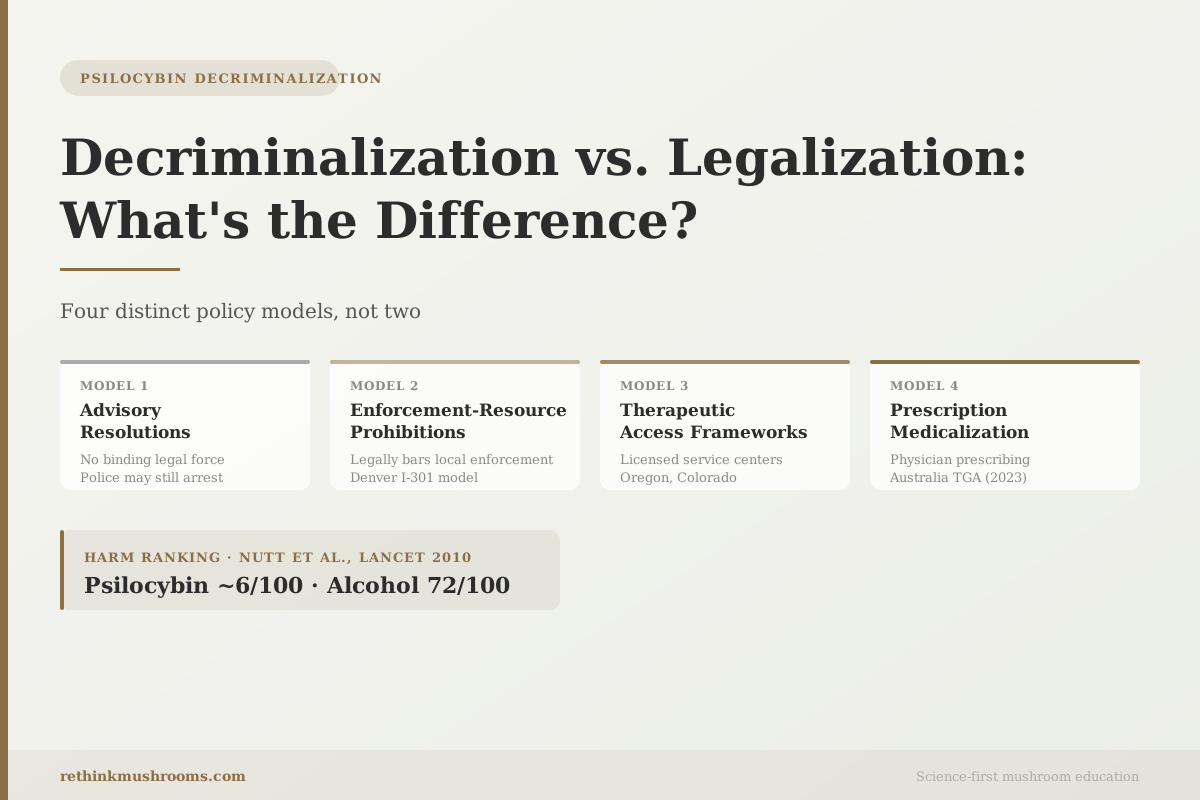
A 16-criterion multicriteria analysis ranked psilocybin mushrooms at roughly 6/100 on an aggregate harm scale, compared to 72/100 for alcohol, the quantified basis for many psilocybin reform arguments.
Nutt et al., Lancet, 2010
4 models
distinct policy tiers from advisory resolutions to full medicalization
2 states
Oregon and Colorado have therapeutic access frameworks as of 2025
1 country
Australia became first to allow physician prescribing in 2023
Nutt et al., Lancet, 2010
 View as image ↗
When people ask whether psilocybin is "decriminalized" in their city, they're often asking the wrong question. The more useful question is which of four distinct policy models applies, because "decriminalization" covers a range of legal outcomes: from a symbolic council resolution that police can legally ignore, to a voter-approved measure that prohibits spending law enforcement resources on psilocybin cases, to a statewide framework that creates licensed therapeutic access centers, to the prescription model that Australia became the first country to implement in 2023.
These four models differ in three concrete ways: what happens if you are found with psilocybin in your possession, whether any form of commercial activity is permitted, and whether federal law creates criminal exposure regardless of local policy. Siegel and colleagues, mapping US psychedelic legislative reform for JAMA Psychiatry, documented how these distinct legal frameworks have proliferated across the country in the last decade.[1]
For background on why psilocybin carries federal criminal penalties in the first place, see Psilocybin's Schedule I Status: History and Controversy.
Key Takeaways
- "Decriminalization" covers at least two legally distinct models: advisory lowest-priority resolutions (no binding force on police) and enforcement-resource prohibitions (legally ban spending law enforcement funds on psilocybin cases)
- Therapeutic access frameworks (Oregon 2020, Colorado 2022) are a third model: they permit supervised psilocybin use at licensed service centers without retail sales; it sits between full decriminalization and commercial legalization
- Full medicalization, as in Australia's 2023 prescription model, allows physician prescribing but introduced substantial regulatory and operational challenges in its first years (Dutton et al., 2026)
- Possession in any decriminalized jurisdiction remains a federal offense: the Controlled Substances Act applies nationwide regardless of city or state policy (Johnson et al., 2018)
- A 2018 peer-reviewed analysis applying the DEA's own 8-factor Schedule I evaluation to psilocybin concluded it does not meet the scientific criteria for Schedule I classification
- A 2010 Lancet multicriteria analysis ranked psilocybin mushrooms at roughly 6/100 on a 16-criterion harm scale, compared to 72/100 for alcohol, the most-cited comparative harm figure in the policy debate
The Binary Everyone Uses Misses Two Entire Policy Models
The phrase "decriminalization vs. legalization" implies a spectrum with two endpoints and a clear line between them. In practice, US and international psilocybin policy has produced at least four distinct models, each with different legal mechanisms and consequences.
Siegel and colleagues documented this landscape in a 2023 JAMA Psychiatry analysis, mapping how US jurisdictions have differentiated their approaches to psychedelic reform.[1] The typology that emerges from that analysis and from the policy record:
Model 1: Lowest-priority resolutions. A city council, mayor's office, or law enforcement agency declares psilocybin a lowest enforcement priority. This is an administrative directive. Police can still arrest for possession; they are just instructed not to prioritize it. No statute protects the person who gets stopped.
Model 2: Enforcement-resource prohibitions. Voters or elected officials pass a measure that legally prohibits the city from spending law enforcement resources on psilocybin possession cases. This model has genuine legal force; it restricts what police are authorized to do. Possession is still technically illegal under state and federal law, but local enforcement is legally blocked.
Model 3: Therapeutic access frameworks. Oregon and Colorado created licensed supervised-use centers where adults can access psilocybin under professional oversight. This is not decriminalization of possession and it is not a dispensary model. It creates a new regulated activity (supervised psilocybin services) without creating a retail market.
Model 4: Prescription medicalization. Australia's Therapeutic Goods Administration authorized physician prescribing of psilocybin in 2023, making it the first country to allow clinical administration under a prescription framework. This requires a diagnosis, a licensed prescriber, and clinical setting, a fundamentally different structure from all US models.
Understanding which model a given city or state has adopted changes the answer to the practical question: what actually happens if you are caught with psilocybin there?
The Weakest Form: Advisory Resolutions That Police Can Legally Ignore
The lowest-tier model is often reported as decriminalization without qualification. It is technically that: the city has declared it wants to not criminalize psilocybin possession. But the declaration carries no legal mechanism that prevents an officer from making an arrest.
Under a lowest-priority resolution, the city has expressed a policy preference. Law enforcement agencies may choose to follow that preference, and most officers in cities with such resolutions do deprioritize psilocybin enforcement. But "choose to" is the operative phrase. Nothing in the resolution prevents an arrest, prevents prosecution, or prevents the charges from being pursued. If someone is arrested for psilocybin possession in a lowest-priority city, that arrest is legally valid. Any resulting charge is legally valid. The resolution has no effect on the outcome.
This matters particularly because the legal exposure is not just from local law. Even in a city with the most progressive resolution on psilocybin, federal law classifies possession as a Schedule I controlled substance offense. Local police working with federal task forces, arrests that lead to federal prosecution, and situations where federal law enforcement is involved are all entirely unaffected by a city's lowest-priority resolution.
The practical picture: a lowest-priority resolution reduces the likelihood of a psilocybin arrest in a given jurisdiction. It does not eliminate it, does not create a legal defense, and does not provide any protection against federal prosecution.
For a city-by-city breakdown of which jurisdictions have which type of policy, see Psilocybin Decriminalization: A City-by-City Guide.
When Decriminalization Has Legal Force: The Enforcement-Resource Prohibition
The second tier operates through a different mechanism. Instead of an administrative preference, it creates a legal prohibition on local government spending: the city is barred from allocating law enforcement funds to investigate or prosecute psilocybin possession cases.
Denver's Initiative I-301, passed by voters in May 2019, established this model. The ballot measure prohibited the city from spending money to enforce psilocybin possession, a legally binding restriction on government action rather than an administrative recommendation. When the measure passed with 50.6% of the vote, it became the first US policy of its kind.
This model has real consequences for the person found with psilocybin by local police. Local enforcement is legally prohibited. But several important limits apply. State law enforcement is not bound by the city measure. Federal law enforcement is entirely unaffected. And the individual's legal exposure under state and federal statute is unchanged; the prohibition is on city government action, not on criminal liability for possession.
Denver's 2019 initiative was superseded in March 2025 when the Denver City Council repealed it. The repeal wasn't a rollback of policy; it was a recognition that Colorado's 2022 Proposition 122 had created a statewide therapeutic access framework that rendered the city initiative redundant. The city moved from a second-tier enforcement-resource prohibition to operating under a third-tier therapeutic access framework.
For the full history of how Denver and Oakland launched the decriminalization wave, see Denver, Oakland, and Beyond: The Decriminalization Wave.
Oregon and Colorado's Third Path: Supervised Access Centers, Not Dispensaries
Oregon's Measure 110 and Colorado's Proposition 122 represent a model that doesn't fit neatly into either "decriminalization" or "legalization." Siegel and colleagues classified this type of framework as a regulated therapeutic access model, distinct from both enforcement-focused decriminalization and commercial retail legalization.[1]
Under Oregon's and Colorado's frameworks:
- Adults can access psilocybin at licensed service centers under the supervision of a licensed facilitator
- There is no retail market; you cannot purchase psilocybin and take it home
- Psilocybin is not treated as a pharmaceutical requiring a prescription or diagnosis
- The activity permitted is supervised administration in a licensed facility, not possession for personal unsupervised use
The practical distinction from decriminalization: you still cannot legally possess psilocybin for personal use in Oregon outside a licensed facility context, though personal possession of small amounts became decriminalized separately under Measure 110. Colorado's Proposition 122 includes both therapeutic access and personal possession decriminalization provisions, but the therapeutic access centers are the central commercial mechanism.
The practical distinction from legalization: there is no retail cannabis-style market. No storefronts, no online sales, no mail-order. The framework is built around supervised therapeutic services, not consumer access.
Oregon was the first jurisdiction to implement this model. Colorado adopted a similar structure. Both states are working through the licensing, facility requirements, and facilitator training infrastructure that make this model far more operationally complex than either decriminalization or simple legalization.
For a detailed comparison of how these two state frameworks differ from each other, see How Colorado's Psychedelic Law Differs from Oregon.
The Country That Went Furthest, and the Operational Challenges That Followed
Australia's Therapeutic Goods Administration moved psilocybin into a prescription framework in 2023, making it the first country to authorize physician prescribing. This is categorically different from all US models: it is not decriminalization, not supervised therapeutic access without a prescription, and not retail legalization. It is a clinical medicalization model: psilocybin becomes available through the same regulatory pathway as any prescription medication.
Dutton and colleagues documented what happened in the first years of implementation in a 2026 study published in the Australian and New Zealand Journal of Psychiatry.[2] The findings are instructive for any jurisdiction considering moving to a medicalization framework. The regulatory and operational challenges were substantial. Training requirements for prescribers and supervisors were demanding. Insurance liability was unresolved. Facility costs made the treatment inaccessible without subsidization for most patients. Supply chains for pharmaceutical-grade psilocybin required establishing entirely new infrastructure.
The consent and liability questions that medicalization creates are also distinctive. Schonholz and colleagues, writing in the Journal of the American Academy of Psychiatry and the Law, identified key consent, liability, and equity concerns that arise when psilocybin is treated as a medicine, issues that neither decriminalization nor legalization models are designed to address.[3] Who is liable if a patient has an adverse psychiatric event? What level of informed consent is required, and who provides it? How do you serve patients without insurance coverage in a model where clinical delivery is the only legal access pathway?
Australia's experience suggests that moving all the way to medicalization trades one set of access problems (criminal enforcement) for another set (clinical access barriers, cost, infrastructure requirements).
For more on Australia's prescription framework and how it operated in practice, see Australia's TGA Approval: The First Country to Prescribe Psilocybin.
Why Federal Law Means Possession Is Still a Federal Crime in Every Decriminalized City
All four policy models operate inside the same federal legal structure. The Controlled Substances Act classifies psilocybin as a Schedule I substance, placing it in the highest restriction category alongside heroin and above cocaine. That classification is national. City and state policies cannot override it.
Johnson and colleagues published a peer-reviewed analysis in 2018 that applied the DEA's own statutory 8-factor evaluation framework to psilocybin and concluded it does not meet the scientific criteria for Schedule I classification.[4] The co-authors included Roland Griffiths, the Johns Hopkins researcher whose clinical work had established much of the modern psilocybin evidence base, and Jack Henningfield, a former FDA scientist who had helped develop the original scheduling framework. Their argument: the DEA's own criteria require that a Schedule I substance have high abuse potential, no currently accepted medical use, and a lack of accepted safety for use under medical supervision. The research record, they argued, no longer supports all three conditions for psilocybin.
The 8-factor analysis carries no legal weight until the DEA or Congress acts on it. What it provides is a peer-reviewed basis for arguing that psilocybin's federal Schedule I status is scientifically contestable under the agency's own standards. That argument underlies most formal rescheduling petitions and congressional reform proposals.
For the full structure of the Controlled Substances Act and how it applies to psilocybin, see The Controlled Substances Act and Psilocybin: Legal Framework.
The Harm Ranking That Shapes the Policy Debate
Any policy debate about criminal penalties for a substance eventually encounters the question of what harm the criminal penalties are meant to address. Nutt and colleagues published a multicriteria analysis in The Lancet in 2010 that ranked 20 drugs across 16 criteria: nine categories of harm to the individual user and seven categories of harm to others.[5]
The rankings: alcohol scored 72/100 overall (highest harm of any drug tested). Psilocybin mushrooms scored approximately 6/100 (among the lowest). Tobacco scored 26/100. Heroin scored 55/100. Cocaine scored 27/100.
This analysis is the single most-cited comparative harm figure in drug policy reform arguments, and for the psilocybin debate specifically, it serves as the quantitative basis for asking why a substance with a measured harm score of 6/100 carries Schedule I criminal penalties while a substance with a harm score of 72/100 is sold legally in every supermarket.
The Nutt 2010 study has limitations worth noting. The ratings were assigned by a panel of drug harm experts rather than derived from population outcomes data. Harm scoring is inherently value-dependent: weighting harm to others more heavily than harm to self shifts rankings. And the analysis is from 2010; the evidence base on both psilocybin effects and alcohol harms has developed considerably since then.
The analysis remains influential in the policy literature because no comparable systematic multicriteria comparison has superseded it. It is cited not as a definitive judgment but as the most rigorous attempt to put comparative harm estimates on a consistent quantitative scale.
The Legal Gaps That Persist Across All Four Models
None of the four models has resolved all of the legal and ethical tensions that psilocybin's complex pharmacology and use context create. Schonholz and colleagues identified several gaps that decriminalization alone does not address: consent standards for guided experiences, liability allocation when adverse events occur in therapeutic settings, and equity in access, particularly the concern that therapeutic access models may serve well-resourced populations while enforcement continues against lower-income communities.[3]
Decriminalization (Models 1 and 2) focuses exclusively on reducing enforcement. It does not create quality standards, safety guidelines, trained facilitator requirements, or any mechanism for ensuring that people accessing psilocybin in underground or informal contexts receive informed guidance. That is not a criticism of decriminalization as a policy goal; it is an accurate description of what decriminalization is designed to do. Enforcement reduction and access safety are two different problems.
Therapeutic access frameworks (Model 3) attempt to address safety through licensure and supervision requirements, but create an access model that serves only people who can afford or access licensed centers. Underground and ceremonial use continues in parallel, outside the regulated framework.
Full medicalization (Model 4) resolves some consent and safety questions through the prescription framework, but introduces the access barriers documented in Australia's first years: cost, geography, training requirements, and liability questions that remain unresolved.
The arguments for and against each approach, grounded in the full evidence base, are covered at The Arguments for and Against Psilocybin Decriminalization.
The Bottom Line
US psilocybin policy has produced four distinct legal models: advisory lowest-priority resolutions that do not bind police, enforcement-resource prohibitions that legally prevent local enforcement, therapeutic access frameworks like Oregon's and Colorado's that permit supervised use without retail sales, and the prescription medicalization model that Australia implemented in 2023. Each model differs in what it permits, what legal exposure it leaves in place, and what infrastructure it requires. Federal Schedule I classification applies to all four: city and state policies narrow local enforcement but cannot override federal criminal law.
Frequently Asked Questions
Sources & References
- 1RTHM-01791·Siegel, Joshua S et al. (2023). “Psychedelic Drug Legislative Reform and Legalization in the US..” JAMA psychiatry.Study breakdown →PubMed →↩
- 2RTHM-00958·Dutton, Megan et al. (2026). “Psilocybin in the real world: Regulatory, ethical, and operational challenges in Australia's clinical landscape..” The Australian and New Zealand journal of psychiatry.Study breakdown →PubMed →↩
- 3RTHM-01983·Schonholz, Stephanie M et al. (2024). “Legal and Ethics Concerns of Psilocybin as Medicine..” The journal of the American Academy of Psychiatry and the Law.Study breakdown →PubMed →↩
- 4RTHM-00514·Johnson, Matthew W et al. (2018). “The abuse potential of medical psilocybin according to the 8 factors of the Controlled Substances Act..” Neuropharmacology.Study breakdown →PubMed →↩
- 5RTHM-00356·Nutt, David J et al. (2010). “Drug harms in the UK: a multicriteria decision analysis..” Lancet (London.Study breakdown →PubMed →↩