Psilocybin Decriminalization
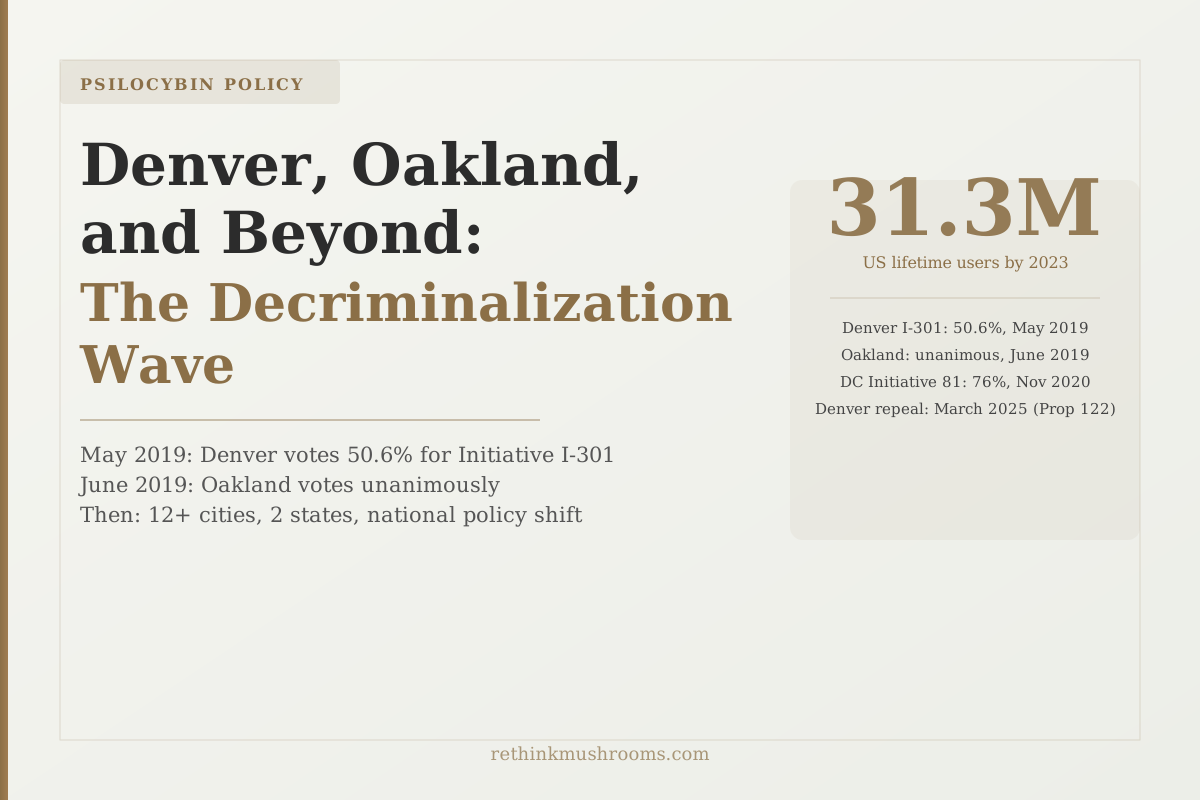
31.3M Americans with lifetime psilocybin use by 2023
Five years after Denver's 2019 vote, lifetime psilocybin use in the US rose from 25 million to 31.3 million people. The decriminalization wave corresponded with the fastest recorded surge in psychedelic use.
Rockhill et al., Ann Intern Med, 2025
50.6%
Denver I-301 margin, May 8, 2019
Unanimous
Oakland city council vote, June 4, 2019
March 2025
Denver repealed its 2019 initiative after Prop 122 superseded it
Rockhill et al., Ann Intern Med, 2025
 View as image ↗
On May 8, 2019, Denver voters approved Initiative I-301 by 50.6%. The measure prohibited the city from spending police resources to enforce laws against adults possessing or using psilocybin mushrooms for personal consumption. It did not make psilocybin legal, did not permit sales, and did not touch state or federal law. But it was the first time any US city had put the question to a public vote, and the narrow margin, barely over half, made it a genuine democratic test. Three weeks later, Oakland's city council voted unanimously to extend similar protections across all entheogenic plants. What followed was a policy movement that spread to more than a dozen US cities by 2025, pushed state-level initiatives in Oregon and Colorado, and generated the first peer-reviewed studies examining what decriminalization actually does. For context on why federal law made city-level measures necessary, see Psilocybin's Schedule I Status: History and Controversy.
Key Takeaways
- Denver approved Initiative I-301 on May 8, 2019, by 50.6%, prohibiting police from spending resources on psilocybin personal-use enforcement. The first US city to do so.
- Oakland's city council voted unanimously on June 4, 2019 to extend similar protections to all entheogenic plants, not just psilocybin
- Johnson et al. (2018, Neuropharmacology) applied the DEA's own 8-factor Schedule I evaluation to psilocybin and concluded it does not meet the criteria. This is the peer-reviewed foundation that armed advocates nationally.
- By 2023, more than a dozen US cities and two states had followed Denver and Oakland's lead, documented in Siegel et al.'s JAMA Psychiatry legal landscape analysis (2023)
- Rockhill et al. (2025, Annals of Internal Medicine) found lifetime psilocybin use rose from 25 million to 31.3 million Americans between 2019 and 2023
- Denver repealed its own 2019 initiative in March 2025. Not because it failed, but because Colorado Prop 122 had provided stronger statewide protections, making the city measure redundant
Denver, May 2019: How 50.6% Changed the Policy Conversation
Initiative I-301 passed on May 8, 2019, making Denver the first US city to enact a psilocybin decriminalization policy through a public vote. The initiative did not legalize psilocybin mushrooms. It directed the Denver Police Department to treat personal psilocybin use by adults 21 and older as the city's lowest enforcement priority, and it prohibited Denver from spending public funds to enforce psilocybin possession laws against personal-use adults.
What that meant in practice: police could still arrest someone for possession, because state and federal law remained unchanged. But the city would not dedicate resources to it, and the political message was explicit. Denver had voted, and a majority said they did not want their city treating psilocybin users as criminals.
The 50.6% margin is worth sitting with. A 50.6% vote is not a landslide. It is 50.6%, and a different 1.2% of turnout would have killed it. The narrowness told a specific story: this was a genuinely contested question, not a referendum that was always going to pass. That contested quality actually made the result more significant for advocates. A divided city had still said yes, which was more useful evidence for replication than a one-sided vote in a liberal enclave.
The campaign that produced I-301 was small and grassroots. It did not have institutional backing from psychedelic therapy companies, which barely existed yet in 2019. It had a core of researchers, veterans' advocates, and harm-reduction activists who had spent years building the intellectual case for decriminalization.
Oakland, June 2019: Unanimous and Broader
Three weeks after Denver, Oakland's city council met on June 4, 2019 and voted unanimously to decriminalize not just psilocybin mushrooms but all entheogenic plants and fungi: ayahuasca, iboga, mescaline-containing cacti, and others. The resolution declared these substances "ground sacred" and instructed Oakland police to make enforcement of laws against their use by adults the city's lowest priority.
Oakland's approach differed from Denver's in two important ways. First, the scope was broader. Denver targeted psilocybin specifically. Oakland's council acted on the argument that natural psychedelics as a category shared a similar harm profile and a similar relationship to indigenous ceremonial tradition.
Second, the process was different. Denver's change came through a ballot initiative, which required gathering signatures, running a campaign, and winning a majority vote. Oakland's came through a city council resolution, which required persuading seven elected officials. Both methods produced the same practical result, but they demonstrated that decriminalization could move through two different political routes.
The combination of Denver and Oakland in a three-week window created a media moment. Major outlets covered both stories. The question of psilocybin decriminalization, which had been confined to advocacy circles, entered mainstream political debate in the summer of 2019.
The Intellectual Foundation: Johnson 2018 and the 8-Factor Argument
The Denver campaign did not win on sentiment alone. It had a scientific argument at its center, and that argument had been built in a peer-reviewed journal the year before.
In 2018, Matthew Johnson and his colleagues, including Roland Griffiths of Johns Hopkins and Jack Henningfield, a former FDA official, published a paper in Neuropharmacology applying the DEA's own 8-factor Schedule I evaluation framework to psilocybin.[4] The DEA uses that eight-factor test to determine whether a substance belongs in Schedule I, the most restrictive classification under federal law. Johnson's team worked through each factor systematically and concluded that psilocybin does not meet the criteria for Schedule I.
The paper did not carry legal force. The DEA was not obligated to respond to it. But it gave decriminalization advocates something important: a peer-reviewed, credentialed argument, not an opinion but a formal scientific analysis, published in a pharmacology journal and co-authored by someone who had worked at the FDA. When opponents argued that psilocybin belonged in Schedule I, advocates could point to a study that had actually tested that claim against the government's own evaluation framework.
That is the reason Johnson 2018 became the intellectual backbone of the US decriminalization movement. It translated a policy question into a scientific one and answered it on the record. For a deeper look at how the federal drug scheduling framework works in practice, see Why Psilocybin Is Federally Illegal Despite Proven Medical Value.
The Wave: City After City, 2020 to 2023
Denver and Oakland were the proof of concept. What followed over the next four years demonstrated that the concept was replicable.
Santa Cruz, California voted to decriminalize entheogenic plants in January 2020, extending the Oakland model to a third California city. In September 2020, Ann Arbor, Michigan's city council voted unanimously to decriminalize psilocybin and other plant medicines. Two months later, Washington DC voters passed Initiative 81 with 76% support, the highest vote share of any city-level decriminalization measure, making natural psychedelics the district's lowest enforcement priority.
In November 2021, Detroit and Hazel Park in Michigan followed. That same year, three Massachusetts cities, Somerville, Cambridge, and Northampton, adopted similar policies through their city councils. In July 2023, Minneapolis Mayor Jacob Frey issued an executive order directing police to deprioritize enforcement of psilocybin laws. By January 2025, Tacoma, Washington had added its name to the list.
At the state level, Oregon voters passed Measure 109 in November 2020, creating the world's first legal psilocybin service system for therapeutic access. Colorado voters passed Proposition 122 in November 2022, adopting a broader legalization model. New Mexico enacted therapeutic access provisions in April 2025.
Siegel et al.'s 2023 analysis in JAMA Psychiatry mapped this landscape systematically, documenting the full range of US psychedelic legislative reform through 2022 and distinguishing between decriminalization models, state therapeutic access programs, and the emerging medicalization frameworks being developed internationally.[3]
Bhave et al. (2025) published what may be the first peer-reviewed empirical study specifically examining the effects of psilocybin decriminalization: what actually happened after US city-level measures passed, in terms of measurable outcomes.[2] For the full comparison between decriminalization, legalization, and therapeutic access models, see Decriminalization vs. Legalization: What's the Difference?.
Six Years, Two Coasts
The US Psilocybin Decriminalization Wave, 2019–2025
From Denver’s narrow ballot win the movement spread through more than a dozen cities and produced two state-level legal programs. Note the distinction the map keeps clear: city measures only deprioritize enforcement, while Oregon and Colorado built actual legal frameworks.
- May 8, 2019City deprioritization
Denver — Initiative I-301
The first US city to decriminalize psilocybin by public vote, approved 50.6%. Directed police to make adult personal use the lowest enforcement priority — no legalization, no sales.
- Jun 4, 2019City deprioritization
Oakland — unanimous council vote
The city council extended lowest-priority status to all entheogenic plants and fungi (psilocybin, ayahuasca, iboga, mescaline cacti) — broader scope than Denver, via council rather than ballot.
- Jan 2020City deprioritization
Santa Cruz, CA
A third California city adopts the Oakland entheogenic-plants model.
- Sep 2020City deprioritization
Ann Arbor, MI — unanimous
City council votes to deprioritize psilocybin and other plant medicines.
- Nov 2020City deprioritization
Washington, DC — Initiative 81 (76%)
The highest vote share of any city-level measure, making natural psychedelics the district’s lowest enforcement priority.
- Nov 2020State legal program
Oregon — Measure 109
Voters create the world’s first legal, regulated psilocybin service system for supervised therapeutic access — a legalization model, not decriminalization.
- Nov 2021City deprioritization
Detroit & Hazel Park, MI · MA cities
Detroit and Hazel Park follow, alongside Somerville, Cambridge, and Northampton, Massachusetts, through their city councils.
- Nov 2022State legal program
Colorado — Proposition 122
Statewide legalization model creating legal protections plus a regulated therapeutic access program — later the mechanism that made Denver’s city measure redundant.
- Jul 2023City deprioritization
Minneapolis — mayoral order
Mayor Jacob Frey issues an executive order directing police to deprioritize psilocybin enforcement.
- Jan 2025City deprioritization
Tacoma, WA
Adds its name to the roster of city-level deprioritization measures.
- Mar 2025Repeal (superseded)
Denver — repeals I-301
Not a reversal: Colorado Prop 122 had provided stronger statewide protection, making the 2019 city ordinance redundant. An administrative cleanup, not a policy defeat.
- Apr 2025State legal program
New Mexico — therapeutic access
Enacts therapeutic access provisions, extending the state-program model beyond Oregon and Colorado.
Policy dates from the documented public record; the national legislative landscape through 2022 is catalogued in Siegel et al., JAMA Psychiatry, 2023. City measures deprioritize enforcement but do not legalize possession or sale; state and federal law remained in force throughout. This is a policy timeline, not medical or legal advice.
What the Data Shows About Use After 2019
As the movement spread, a parallel research question was developing: was psilocybin use actually changing?
Rockhill et al. (2025) published what is now the most comprehensive answer in Annals of Internal Medicine, drawing on five nationally representative US datasets: the National Survey on Drug Use and Health, Monitoring the Future, the National Poison Data System, the National Hospital Ambulatory Medical Care Survey, and the National Morbidity Utilization and Revascularization survey.[1]
The findings: lifetime psilocybin use rose from approximately 25 million people (10% of US adults) in 2019 to 31.3 million (12.1%) in 2023. Past-year use increased 44% among adults aged 18 to 29 and 188% among adults aged 30 and older. Poison center calls involving psilocybin rose 201% in adults, 317% in adolescents, and 723% in children under 12 over the same period.
Rockhill et al. (2025) · Annals of Internal Medicine
- Population
- US general population, five nationally representative datasets (2019–2023)
- Intervention
- Observational surveillance of self-reported use and poison-center exposures
- Comparator
- 2019 baseline (pre- and early-wave) vs. 2023
- Finding
- Lifetime use rose from ~25M (10%) to 31.3M (12.1%) of adults. Past-year use rose 44% in ages 18–29 and 188% in ages 30+. Psilocybin poison-center calls rose 201% in adults, 317% in adolescents, and 723% in children under 12.
narrow-scope A multisource observational study documents the trend but cannot attribute it to decriminalization specifically — many drivers moved at once.
Rockhill et al., Annals of Internal Medicine, 2025
Rockhill's data does not establish that decriminalization caused these increases. The expansion in use tracked with the wave of city-level policies, with growing mainstream attention to psychedelic research, with the explosion of psychedelic therapy coverage in the press, and with changing cultural attitudes driven by multiple forces simultaneously. Isolating decriminalization as a causal variable from everything else happening between 2019 and 2023 would require a controlled study design that this kind of surveillance data cannot provide.
Fact Check
Did decriminalization cause the surge in use?
The claim
“Denver's 2019 decriminalization vote caused the national spike in psilocybin use and poison-control calls.”
A common reading of the 2019–2023 usage data, which rose sharply after Denver.
What research shows
OverstatedUse did rise steeply after 2019 — lifetime use climbed from ~25M to 31.3M adults — but the surveillance data is correlational. Decriminalization moved alongside surging research coverage, media attention, and shifting cultural attitudes.
Rockhill et al. explicitly cannot isolate decriminalization as the cause; that would require a controlled design this kind of national surveillance cannot provide.
Rockhill et al., Annals of Internal Medicine, 2025
What the data does establish clearly: psilocybin use rose significantly in the years after Denver and Oakland, and the pediatric poison center numbers represent a real public health signal regardless of cause. The arguments for and against decriminalization both have empirical data to work with now. For a full analysis of both sides of that debate using primary research, see The Arguments for and Against Psilocybin Decriminalization.
Public Health Signal
ModeratePediatric psilocybin exposures rose sharply after 2019
Concern
Psilocybin poison-center calls involving children under 12 rose 723% between 2019 and 2023, with a 317% rise among adolescents — a real signal regardless of whether decriminalization caused it.
What the research says
The surveillance data flags accidental and adolescent exposure as the clearest public-health concern of the wave, even though it cannot attribute the rise to any single policy. Secure storage away from children matters as access widens.
Particularly relevant for: Children under 12 and adolescents
What to do
Store any psilocybin-containing material locked and out of reach of children; contact Poison Control (1-800-222-1222 in the US) for suspected ingestion.
Rockhill et al., Annals of Internal Medicine, 2025
This article is educational and is not medical or legal advice.
Denver, March 2025: A City Repeals the Law It Made Famous
The story of Denver's 2019 initiative has a final chapter that most coverage has missed.
In March 2025, Denver City Council voted to repeal Initiative I-301, the 2019 ballot measure that had started everything. The repeal was not a reversal. It was not evidence that decriminalization had failed or that political winds had shifted. It was the administrative result of Colorado Proposition 122 passing in November 2022.
Prop 122 created statewide legal protections for psilocybin use and established Colorado's regulated therapeutic access program. When a state law provides more comprehensive protection than a city ordinance, the city ordinance becomes redundant. Denver's 2019 initiative had prohibited the city from spending police resources on personal psilocybin use. Prop 122 did the same at the state level, and went further. Repealing I-301 in 2025 was not a retreat from decriminalization. It was acknowledgment that Denver's goal had been achieved through a more durable mechanism than a city ballot measure.
The 2019 vote had served its purpose. It had demonstrated that a US city would vote to decriminalize psilocybin. That demonstration had helped build the movement that eventually produced statewide legalization in the same state. Denver repealed I-301 because Prop 122 made it unnecessary, which is a different outcome from repeal because the policy failed.
What Six Years of the Wave Built
The decriminalization wave that began in Denver in May 2019 has produced a documented record that did not exist before: peer-reviewed analysis of what happens when cities make these policy changes, national surveillance data on how use patterns have shifted, and a legal and policy landscape that several academic researchers have now analyzed in the field's top journals.
It also produced two state-level legalization programs, an expanding list of city-level policies from coast to coast, and a policy debate that has moved from advocacy circles into the mainstream of US drug law discussion.
What the movement did not produce is clear causal evidence that city-level decriminalization on its own changes outcomes. Use trends correlated with the wave, but multiple forces drove those trends simultaneously. The peer-reviewed analysis is catching up to the policy activity, and the findings are not settled.
For a comprehensive look at where decriminalization has been enacted and what each measure actually requires, see Psilocybin Decriminalization: A City-by-City Guide and Psilocybin Decriminalization City by City: A Complete US Tracker. For a real-world example of a country that went further than decriminalization to regulated prescribing, see Australia's TGA Approval: The First Country to Prescribe Psilocybin.
The Bottom Line
Denver's 50.6% vote for Initiative I-301 in May 2019 launched a US psilocybin decriminalization movement that reached more than a dozen cities and two states by 2025. Oakland followed three weeks after Denver with a unanimous council vote. Rockhill et al. (2025, Annals of Internal Medicine) documented that lifetime psilocybin use rose from 25 million to 31.3 million Americans between 2019 and 2023, though the increase reflected multiple simultaneous drivers rather than decriminalization alone. Denver repealed its 2019 initiative in March 2025 after Colorado Prop 122 rendered it redundant.
Frequently Asked Questions
Sources & References
- 1RTHM-02169·Rockhill, Karilynn M et al. (2025). “The Rise of Psilocybin Use in the United States: A Multisource Observational Study..” Annals of internal medicine.Study breakdown →PubMed →↩
- 2RTHM-02058·Bhave, Ashutosh (2025). “Magic of the Mushrooms: Effects of Psilocybin Decriminalization..” Journal of psychoactive drugs.Study breakdown →PubMed →↩
- 3RTHM-01791·Siegel, Joshua S et al. (2023). “Psychedelic Drug Legislative Reform and Legalization in the US..” JAMA psychiatry.Study breakdown →PubMed →↩
- 4RTHM-00514·Johnson, Matthew W et al. (2018). “The abuse potential of medical psilocybin according to the 8 factors of the Controlled Substances Act..” Neuropharmacology.Study breakdown →PubMed →↩