Psychedelic Law & Policy
134 US clinical trials — and zero FDA approvals
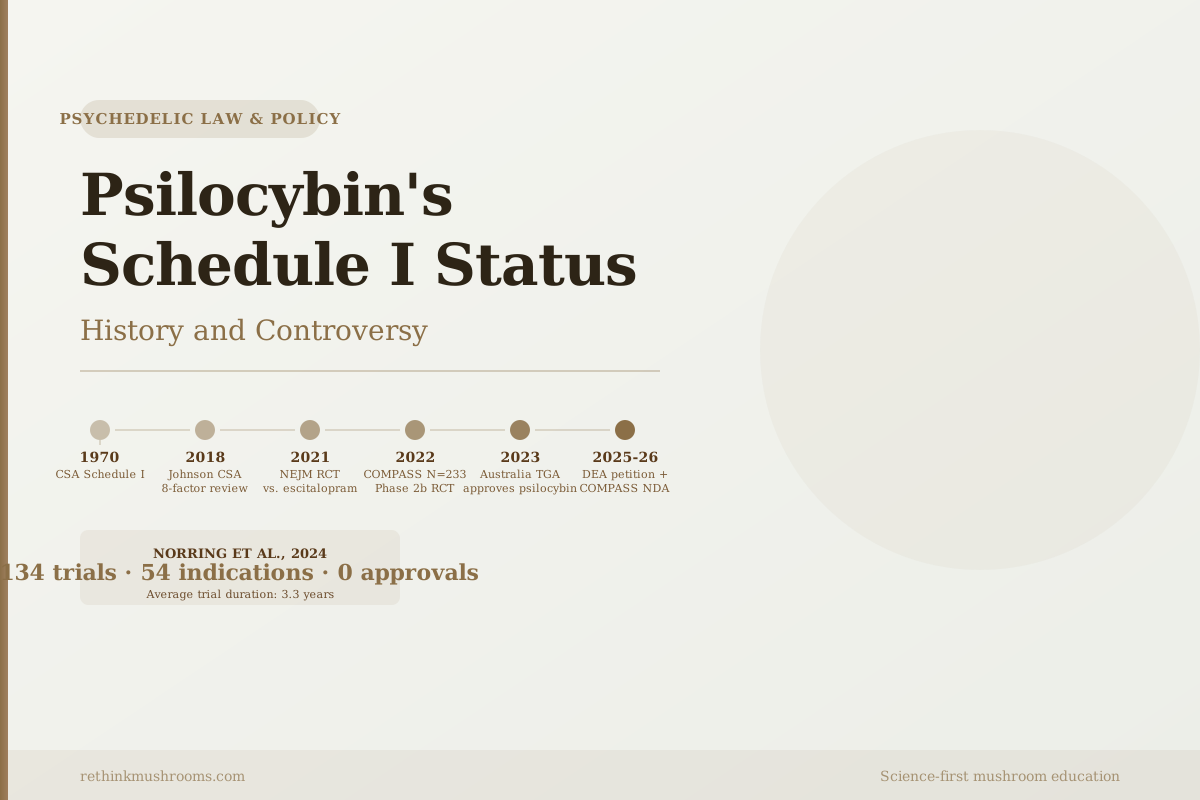
As of 2024, 134 interventional psilocybin trials had been registered across 54 potential indications with zero FDA marketing approvals. This gap between research and regulatory status is the core tension in the psilocybin scheduling debate.
Norring et al., Drug Design, Development and Therapy, 2024
Since 1970
Psilocybin's Schedule I classification under the US Controlled Substances Act — a designation the 1970 Congress placed without conducting a clinical safety review
2023
Year Australia's TGA became the first national regulator to approve psilocybin for treatment-resistant depression (Nutt et al., 2024)
N=233
COMPASS Pathways Phase 2b RCT — the largest placebo-controlled trial to date — showed significant depression reductions at 3 weeks (Goodwin et al., 2022)
Norring et al., Drug Design, Development and Therapy, 2024
 View as image ↗
In 1970, the United States placed psilocybin in Schedule I of the Controlled Substances Act, a designation reserved for substances the government classifies as having high abuse potential, no accepted medical use, and no safe level of use under medical supervision. Fifty-five years later, 134 interventional clinical trials have registered psilocybin for 54 potential indications. Australia's national regulator approved it for treatment-resistant depression in 2023. The FDA has granted breakthrough therapy designation twice. The federal classification has not changed.
Psilocybin's Schedule I status is both a legal fact and an ongoing scientific argument. This article covers the full arc: how the classification came to exist in 1970, what the pharmacological and clinical research says about whether the Schedule I criteria are justified, how other countries have approached the question, and what the current US reform landscape looks like.
Key Takeaways
- Psilocybin has been Schedule I under the US Controlled Substances Act since 1970, a classification that requires high abuse potential, no accepted medical use, and no safe level of use under medical supervision.
- A 2018 systematic review by Johnson et al. (Neuropharmacology) applied all 8 statutory CSA scheduling factors to psilocybin and concluded it has low abuse potential and no evidence of physical dependence — directly contradicting Schedule I criteria.
- Nichols (2016) in Pharmacological Reviews established that serotonergic psychedelics including psilocybin have no known lethal dose in humans, no physical withdrawal syndrome, and negligible abuse liability relative to most scheduled substances.
- In a 2021 head-to-head RCT (NEJM, N=59), psilocybin matched escitalopram's antidepressant effect on the primary outcome and outperformed it on several secondary measures (Carhart-Harris et al.).
- State-level reform bills grew from 5 in 2019 to 36 in 2022 across 25 states; Oregon reduced psilocybin-related arrests by 87% after decriminalization; an analytic model projects a majority of US states will have legalized psychedelics by 2033-2037 (Siegel et al., 2023).
- Australia's TGA approved psilocybin for treatment-resistant depression in 2023, making it the strongest international proof of concept for regulatory reclassification (Nutt et al., 2024).
What Psilocybin's Schedule I Status Actually Means
Psilocybin is a Schedule I controlled substance under the US Controlled Substances Act of 1970. The federal government classifies it as having high abuse potential, no accepted medical use, and no safe level of use under medical supervision. This classification sits at the top of the federal drug scheduling hierarchy, in the same category as heroin and LSD. Methamphetamine and fentanyl are Schedule II, meaning they are legally prescribed.
Schedule I status has concrete practical consequences. Researchers who study psilocybin must obtain a Schedule I researcher license from the DEA, maintain a Schedule I vault on site, and document every milligram of material. Pharmaceutical companies pursuing FDA approval must source psilocybin through DEA-licensed manufacturers, which limits supply and increases costs. Physicians cannot prescribe psilocybin; its use in clinical trials requires an Investigational New Drug application and DEA approval. If a state legalizes psilocybin for therapeutic use, practitioners still face federal law, which supersedes state law for Schedule I substances.
This is what psilocybin's Schedule I status actually means, not just a label but a system of regulatory controls that shapes what research is possible, at what cost, and how fast it can move.
The classification is contested on scientific grounds. A 2018 systematic review by Johnson and colleagues, published in Neuropharmacology, applied all 8 statutory scheduling factors in the Controlled Substances Act to psilocybin and concluded the compound has low abuse potential and no evidence of physical dependence, findings that directly contradict the basis for Schedule I placement.[1] For a full explanation of the CSA framework and what each factor means, see The Controlled Substances Act and Psilocybin: Legal Framework.
How Psilocybin Became Schedule I: The 1970 Decision
Psilocybin was first synthesized in 1958 by Albert Hofmann at Sandoz Laboratories, the same chemist who had synthesized LSD fourteen years earlier. From the late 1950s through the mid-1960s, psilocybin was a legal research compound studied in psychiatric settings. Early clinical work explored its use in psychotherapy, addiction treatment, and the study of consciousness. A 2020 review by Nichols, published in the Journal of Antibiotics, documents this pre-prohibition research era: psilocybin was administered to thousands of participants in clinical settings without a reported fatality, and the research produced promising findings for several psychiatric conditions before federal restriction ended the work.[3]
The political context shifted sharply after 1965. Harvard University's dismissal of Timothy Leary and Richard Alpert for their psychedelic research program drew national attention and accelerated the association of psychedelics with counterculture. The Drug Abuse Control Amendments of 1965 placed hallucinogens under federal regulatory oversight for the first time. In 1968, the federal government banned psilocybin and psilocin directly. In 1970, the Controlled Substances Act codified this into the five-schedule framework still in use today, and psilocybin was placed in Schedule I.
Geiger and colleagues' 2018 review in ACS Chemical Neuroscience noted that this scheduling occurred without the evidence-based review that would later be required for scheduling decisions, and without a formal finding on the three Schedule I criteria based on existing clinical data.[4] The scheduling coincided with the political movement to suppress the counterculture, not with a finding that psilocybin met the pharmacological profile of a Schedule I substance.
Nichols (2020) describes the result as a research shutdown: after 1970, the studies that had been underway in hospital and clinical settings could not continue, and the clinical literature largely stopped accumulating for roughly three decades.[3] Research began again in the 1990s through a series of carefully structured safety studies at Johns Hopkins University and New York University, initiated not because the law had changed but because the researchers established that they could conduct the work within existing Schedule I constraints. The clinical literature since then has grown substantially.
For a detailed timeline of psilocybin's legal history and the rescheduling process, see Psilocybin and Schedule I: The Legal History and Path to Rescheduling.
The Three Schedule I Criteria Applied to Psilocybin's Evidence
The Schedule I designation requires a substance to meet three criteria: high potential for abuse, no currently accepted medical use in treatment in the United States, and lack of accepted safety for use under medical supervision. The Johnson et al. (2018) review is the most rigorous academic analysis of how psilocybin scores against all three.[1]
High potential for abuse: The 8-factor CSA analysis applied by Johnson and colleagues assessed psilocybin against the statutory definition of abuse potential: compulsive use, drug-seeking behavior, physical dependence, and self-administration in animal models. Psilocybin scores low on all measures. It does not produce physical dependence or a withdrawal syndrome. Animals self-administer classical stimulants and opioids readily; they do not self-administer serotonergic psychedelics at rates that indicate compulsive use. The compound produces a tachyphylaxis response (rapid tolerance development with daily use), which functionally limits the pattern of escalating use that characterizes high-abuse-potential substances.
The definitive pharmacological review by Nichols, published in Pharmacological Reviews in 2016, established that classic serotonergic psychedelics including psilocybin have no known lethal dose in humans, no physical withdrawal syndrome, and negligible abuse liability relative to most substances on lower schedules.[2]
No currently accepted medical use: This criterion is where the clinical research most directly challenges the Schedule I classification. "Accepted medical use" has a specific regulatory definition, and the FDA's granting of breakthrough therapy designation does not itself satisfy it. But the clinical evidence base has grown substantially.
A 2021 randomized controlled trial by Davis and colleagues, published in JAMA Psychiatry, enrolled 27 adults with major depressive disorder at Johns Hopkins.[5] Psilocybin-assisted therapy produced rapid, large reductions in depression. At the 4-week follow-up, 71% of participants met the definition of responder. This was the trial that contributed to FDA granting breakthrough therapy designation for major depressive disorder.
In the same year, Carhart-Harris and colleagues published a head-to-head RCT in the New England Journal of Medicine comparing psilocybin directly with escitalopram, a standard SSRI antidepressant, in 59 patients with moderate-to-severe depression.[6] Psilocybin matched escitalopram on the primary outcome measure and outperformed it on several secondary measures, including emotional processing and psychosocial functioning. The study did not find psilocybin superior on the primary endpoint, and the authors were appropriately careful about the trial's limitations (open-label, small sample). But a drug that performs equivalently to a standard-of-care antidepressant in a randomized controlled trial has demonstrated something that complicates the "no accepted medical use" criterion.
The largest controlled trial to date is the COMPASS Pathways Phase 2b trial reported by Goodwin and colleagues in the New England Journal of Medicine in 2022.[7] Of 233 patients with treatment-resistant depression randomized to 1mg, 10mg, or 25mg psilocybin, the 25mg group showed statistically significant reductions in depression scores compared to placebo at 3 weeks, with a response rate meaningfully higher than the 1mg group. This is the evidence base driving COMPASS's ongoing Phase 3 program and its NDA submission timeline.
McClure-Begley and Roth (2022), in Nature Reviews Drug Discovery, synthesized the evidence base and concluded it is compelling enough to warrant regulatory reconsideration, while identifying key standardization and safety challenges that must be addressed before broad clinical approval.[9]
The Clinical Evidence, Trial by Trial
Six Pivotal Psilocybin Depression Trials (2017–2026)
Carhart-Harris et al. — Neuropharmacology (fMRI)
Positive20 patients, treatment-resistant (open-label) · Two doses, 10mg then 25mg
Rapid antidepressant response in 12 of 20; reduced amygdala reactivity and altered default-mode activity on fMRI
First mechanistic imaging study; uncontrolled, no placebo
Davis et al. — JAMA Psychiatry
Positive27 adults with MDD (waitlist-controlled RCT) · Two doses, 20mg then 30mg / 70kg
71% response and 54% remission at 4 weeks; benefits largely sustained at 12 months
First randomized trial in major depressive disorder
Carhart-Harris et al. — NEJM
Mixed59 adults, moderate-to-severe depression (vs escitalopram) · Two doses, 25mg, 3 weeks apart
Tied escitalopram on the primary depression scale; superior on every secondary measure
Primary endpoint not significant vs an active comparator
Goodwin et al. — NEJM
Positive233 adults, treatment-resistant depression · Single dose, 25mg vs 10mg vs 1mg
25mg significantly outperformed 1mg on MADRS at week 3; largest trial to that point
Set the 25mg dose carried into Phase 3
Raison et al. — JAMA
Positive104 adults with MDD (vs niacin placebo) · Single dose, 25mg
12.3-point greater MADRS reduction than placebo at day 43; effect detectable by day 8
Single-dose confirmation in non-resistant MDD
Mertens et al. (EPISODE) — JAMA Psychiatry
Null / Negative142 adults, treatment-resistant (active placebo) · Two doses, 25mg vs 5mg vs nicotinamide
Primary endpoint missed (17% vs 10.6% response; OR 1.73, P = .19); secondary measures favored psilocybin
Active-placebo design; inconclusive result
Sources: Carhart-Harris (2017); Davis (2021); Carhart-Harris (2021); Goodwin (2022); Raison (2023); Mertens / EPISODE (2026)
Lack of accepted safety for use under medical supervision: Johnson et al. (2018) found this criterion also unsupported by the existing data.[1] The primary risks associated with psilocybin are psychological, not physiological: acute anxiety, paranoia, and perceptual disturbance, all of which resolve within hours and are substantially mitigated by controlled set and setting. There is no documented case of fatal overdose from psilocybin alone in the published literature. The risk profile is materially different from most Schedule I substances.
Therapeutic Safety Ratio
How Wide Is the Gap Between a Dose and a Dangerous Dose?
The safety ratio is the distance between the amount a person typically takes and the amount estimated to be toxic. A higher number means a wider margin. Psilocybin’s ratio of roughly 600 is among the highest reported for any psychoactive substance — many times wider than two legal psychoactives most adults use without a second thought.
Psilocybin
~600×Typical therapeutic dose vs estimated toxic threshold
Caffeine
35–50×A cup of coffee vs a lethal caffeine dose
Ethanol (alcohol)
~10×A standard drink vs a lethal blood-alcohol level
How to read it: a large safety ratio does not mean psilocybin is risk-free — it describes the toxicological margin, not the psychological or cardiovascular considerations covered elsewhere in this article. It simply means the dose that produces effects and the dose that threatens the body are unusually far apart.
Source: Nahlawi et al. 2025, Nature Cardiovascular Research [9]. Bar widths are log-scaled (log₁₀ of each ratio, normalized to psilocybin = 100%) so all three bars stay legible across a roughly 60-fold range; the printed ratios are the actual values.
For the full point-by-point analysis of the Schedule I criteria versus the clinical evidence, see Why Psilocybin Is Federally Illegal Despite Proven Medical Value.
134 Clinical Trials Later: The Scale of the Research Obstruction
A 2024 analysis by Norring and colleagues, published in Drug Design, Development and Therapy, catalogued every interventional psilocybin trial registered on ClinicalTrials.gov through 2024.[8] The count was 134 trials across 54 potential indications. The average trial duration was 3.3 years. The number of FDA marketing approvals: zero.
The Norring analysis illustrates what Schedule I status costs in practice. Each of those 134 trials required researchers to obtain Schedule I research licenses, maintain controlled vault facilities, source material through DEA-licensed channels, and navigate regulatory requirements that do not apply to any Schedule II or lower substance. The clinical research literature on psilocybin has grown significantly since the early 2000s, but it has grown in spite of regulatory constraints, not because of a permissive research environment.
The FDA's breakthrough therapy designation, granted twice for psilocybin (for treatment-resistant depression and for major depressive disorder), is a signal that the FDA has determined preliminary clinical evidence is encouraging enough to warrant expedited review. It is not an approval, but it does mean the FDA can work collaboratively with the sponsor earlier in development. The designation does not change DEA scheduling; only DEA rescheduling or a new drug approval does that.
Australia Approved It in 2023: What That Means for the US
In February 2023, Australia's Therapeutic Goods Administration (TGA) became the first national regulatory authority in the world to approve psilocybin as a prescription medicine, specifically for treatment-resistant depression. Australia classified it as Schedule 8 — the equivalent of a US Schedule II — accessible to authorized psychiatrists in specific clinical settings.
A 2024 review by Nutt and colleagues, published in the British Journal of Pharmacology, documented the background and implications of the Australian decision.[10] The TGA's evidence review concluded that the clinical data for treatment-resistant depression was sufficient to justify a controlled but accessible regulatory pathway. Nutt and colleagues describe this as the strongest international proof of concept for regulatory reclassification: a major national drug regulator reviewed the same clinical literature that exists in the US and reached a different conclusion from the DEA.
What the Australian experience also shows is that approval creates its own implementation challenges. Dutton and colleagues (2026), writing in the Australian and New Zealand Journal of Psychiatry, documented the practical problems that emerged after TGA approval: gaps in prescriber training, complexity of informed consent for such an unusual treatment, insurance coverage barriers, and questions about equitable access for lower-income patients.[11] These are not arguments against rescheduling; they are arguments for planning implementation thoroughly before rescheduling happens. The regulatory challenge is not only getting psilocybin to a different schedule but building the clinical infrastructure to administer it responsibly.
For the full Australia story and its implications, see Australia's TGA Approval: The First Country to Prescribe Psilocybin. For a comparison of psilocybin's legal status across other countries, see Psilocybin Legal Status Around the World: A Complete Guide.
The Reform Pipeline: Three Paths to Federal Change
Federal rescheduling of psilocybin can happen through three mechanisms: congressional legislation, a DEA administrative petition, or FDA approval triggering automatic DEA action.
State-level context: Before the federal picture, the state-level movement provides the political backdrop. Siegel and colleagues (2023), publishing in JAMA Psychiatry, analyzed the legislative trajectory of psychedelic reform.[12] State-level reform bills grew from 5 in 2019 to 36 in 2022, with 25 states having considered a total of 74 psychedelic reform bills. Oregon's decriminalization reduced psilocybin-related arrests by 87%. An analytical model in the Siegel paper projects that a majority of US states will have legalized psychedelics by 2033-2037 if current trends continue. State action does not change federal law, but it changes the political environment in which federal reform is considered.
Six Years, Two Coasts
The US Psilocybin Decriminalization Wave, 2019–2025
From Denver’s narrow ballot win the movement spread through more than a dozen cities and produced two state-level legal programs. Note the distinction the map keeps clear: city measures only deprioritize enforcement, while Oregon and Colorado built actual legal frameworks.
- May 8, 2019City deprioritization
Denver — Initiative I-301
The first US city to decriminalize psilocybin by public vote, approved 50.6%. Directed police to make adult personal use the lowest enforcement priority — no legalization, no sales.
- Jun 4, 2019City deprioritization
Oakland — unanimous council vote
The city council extended lowest-priority status to all entheogenic plants and fungi (psilocybin, ayahuasca, iboga, mescaline cacti) — broader scope than Denver, via council rather than ballot.
- Jan 2020City deprioritization
Santa Cruz, CA
A third California city adopts the Oakland entheogenic-plants model.
- Sep 2020City deprioritization
Ann Arbor, MI — unanimous
City council votes to deprioritize psilocybin and other plant medicines.
- Nov 2020City deprioritization
Washington, DC — Initiative 81 (76%)
The highest vote share of any city-level measure, making natural psychedelics the district’s lowest enforcement priority.
- Nov 2020State legal program
Oregon — Measure 109
Voters create the world’s first legal, regulated psilocybin service system for supervised therapeutic access — a legalization model, not decriminalization.
- Nov 2021City deprioritization
Detroit & Hazel Park, MI · MA cities
Detroit and Hazel Park follow, alongside Somerville, Cambridge, and Northampton, Massachusetts, through their city councils.
- Nov 2022State legal program
Colorado — Proposition 122
Statewide legalization model creating legal protections plus a regulated therapeutic access program — later the mechanism that made Denver’s city measure redundant.
- Jul 2023City deprioritization
Minneapolis — mayoral order
Mayor Jacob Frey issues an executive order directing police to deprioritize psilocybin enforcement.
- Jan 2025City deprioritization
Tacoma, WA
Adds its name to the roster of city-level deprioritization measures.
- Mar 2025Repeal (superseded)
Denver — repeals I-301
Not a reversal: Colorado Prop 122 had provided stronger statewide protection, making the 2019 city ordinance redundant. An administrative cleanup, not a policy defeat.
- Apr 2025State legal program
New Mexico — therapeutic access
Enacts therapeutic access provisions, extending the state-program model beyond Oregon and Colorado.
Policy dates from the documented public record; the national legislative landscape through 2022 is catalogued in Siegel et al., JAMA Psychiatry, 2023. City measures deprioritize enforcement but do not legalize possession or sale; state and federal law remained in force throughout. This is a policy timeline, not medical or legal advice.
Congressional pathway: Multiple bills have addressed psilocybin scheduling. The Breakthrough Therapies Act would allow breakthrough-designated drugs to be studied under a different regulatory framework. The Freedom to Heal Act (Senators Booker and Paul) would remove psilocybin from Schedule I entirely. As of 2026, none has passed, but the political coalition supporting psychedelic reform has expanded across partisan lines.
DEA administrative petition: In August 2025, a formal petition was submitted to the DEA and HHS requesting rescheduling of psilocybin to Schedule IV (which would make it roughly equivalent to benzodiazepines). This petition is the first formally advanced since the research base grew to include multiple large-scale RCTs. HHS must evaluate the petition and make a recommendation; DEA is not legally required to follow it but typically does. The timeline for this process is measured in years, not months.
FDA approval pathway: This is currently the most concrete timeline. If COMPASS Pathways completes its Phase 3 program and submits a New Drug Application, FDA approval would automatically trigger a mandatory DEA scheduling review. Schedule I status cannot coexist with FDA approval for a specific indication. COMPASS's NDA submission target is Q4 2026, though pharmaceutical development timelines shift regularly. If the NDA is submitted and FDA approves it, DEA would be required to act within 90 days.
What rescheduling would and would not change: Schonholz and colleagues (2024), in the Journal of the American Academy of Psychiatry and the Law, examined the legal and ethical landscape after rescheduling.[13] The study identified several unresolved issues: the standard of care for physicians who administer psilocybin off-label under a "respectable minority doctrine," equitable access for patients without insurance or in underserved areas, and the disconnect between state laws that have already moved and federal law that has not. Rescheduling resolves the federal prohibition on research and prescription but does not automatically create the clinical infrastructure, training standards, or insurance coverage frameworks needed for broad access.
For a detailed breakdown of the federal reform bills, DEA petition, and FDA timeline, see Federal Psilocybin Reform Efforts: Current Bills and Proposals. For the breakthrough therapy designation specifically, see Breakthrough Therapy Designation: What It Means for Psilocybin.
The Bottom Line
Psilocybin has been Schedule I since 1970, a classification made without a clinical evidence review and during a period of politically motivated drug policy escalation. The pharmacological research that developed after the research shutdown ended makes a clear case that psilocybin does not meet the Schedule I criteria: it has no known lethal dose, no physical dependence, and low abuse potential. Multiple large-scale RCTs have demonstrated antidepressant effects comparable to standard treatments. Australia approved it for clinical prescription in 2023. In the US, the reform paths include an August 2025 DEA petition, a COMPASS NDA timeline targeting Q4 2026, and ongoing congressional legislation. Even if rescheduling occurs, the practical challenges of training, informed consent, and equitable access documented in Australia suggest that the regulatory decision is the beginning of implementation, not the end of the policy problem.
Frequently Asked Questions
Sources & References
- 1RTHM-00514·Johnson, Matthew W et al. (2018). “The abuse potential of medical psilocybin according to the 8 factors of the Controlled Substances Act..” Neuropharmacology.Study breakdown →PubMed →↩
- 2RTHM-00439·Nichols, David E (2016). “Psychedelics..” Pharmacological reviews.Study breakdown →PubMed →↩
- 3RTHM-00646·Nichols, David E (2020). “Psilocybin: from ancient magic to modern medicine..” The Journal of antibiotics.Study breakdown →PubMed →↩
- 4RTHM-00509·Geiger, Haden A et al. (2018). “DARK Classics in Chemical Neuroscience: Psilocybin..” ACS chemical neuroscience.Study breakdown →PubMed →↩
- 5RTHM-00682·Davis, Alan K et al. (2021). “Effects of Psilocybin-Assisted Therapy on Major Depressive Disorder: A Randomized Clinical Trial..” JAMA psychiatry.Study breakdown →PubMed →↩
- 6RTHM-00675·Carhart-Harris, Robin et al. (2021). “Trial of Psilocybin versus Escitalopram for Depression..” The New England journal of medicine.Study breakdown →PubMed →↩
- 7RTHM-00761·Goodwin, Guy M et al. (2022). “Single-Dose Psilocybin for a Treatment-Resistant Episode of Major Depression..” The New England journal of medicine.Study breakdown →PubMed →↩
- 8RTHM-01959·Norring, Sarah A et al. (2024). “The Promise of Therapeutic Psilocybin: An Evaluation of the 134 Clinical Trials, 54 Potential Indications, and 0 Marketing Approvals on ClinicalTrials.gov..” Drug design.Study breakdown →PubMed →↩
- 9RTHM-00787·McClure-Begley, Tristan D et al. (2022). “The promises and perils of psychedelic pharmacology for psychiatry..” Nature reviews. Drug discovery.Study breakdown →PubMed →↩
- 10RTHM-00898·Nutt, David J et al. (2024). “The Australia story: Current status and future challenges for the clinical applications of psychedelics..” British journal of pharmacology.Study breakdown →PubMed →↩
- 11RTHM-00958·Dutton, Megan et al. (2026). “Psilocybin in the real world: Regulatory, ethical, and operational challenges in Australia's clinical landscape..” The Australian and New Zealand journal of psychiatry.Study breakdown →PubMed →↩
- 12RTHM-01791·Siegel, Joshua S et al. (2023). “Psychedelic Drug Legislative Reform and Legalization in the US..” JAMA psychiatry.Study breakdown →PubMed →↩
- 13RTHM-01983·Schonholz, Stephanie M et al. (2024). “Legal and Ethics Concerns of Psilocybin as Medicine..” The journal of the American Academy of Psychiatry and the Law.Study breakdown →PubMed →↩