Psilocybin FDA Regulation
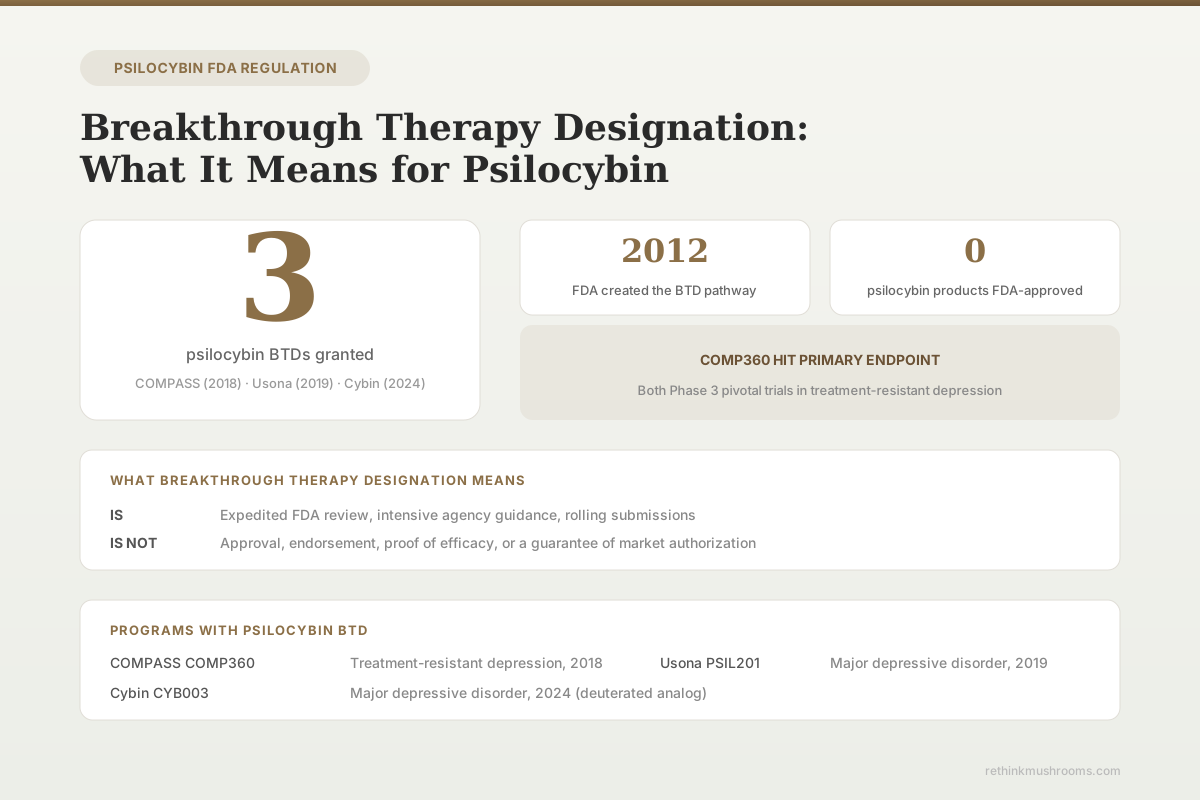
3 BTDs
The FDA has granted Breakthrough Therapy Designation to three separate psilocybin programs: COMPASS Pathways (2018), Usona Institute (2019), and Cybin's CYB003 (2024).
FDA, COMPASS Pathways, Usona Institute, Cybin
2012
year FDA created the BTD pathway
Phase 3
COMP360 hit primary endpoint in both pivotal trials
0 Approvals
psilocybin products FDA-approved as of April 2026
FDA, COMPASS Pathways, Usona Institute, Cybin
 View as image ↗
The FDA's Breakthrough Therapy Designation (BTD) for psilocybin is one of the most misunderstood events in psychedelic medicine. When COMPASS Pathways received the first psilocybin BTD in October 2018 for treatment-resistant depression, headlines framed it as the FDA endorsing psilocybin. It was not. When Usona Institute received a second BTD in November 2019 for major depressive disorder, the same confusion repeated. A third BTD followed in March 2024 when Cybin received it for CYB003, a deuterated psilocybin analog. For a broader look at where the entire FDA approval process stands, see Psilocybin's Path to FDA Approval: Where Things Stand.
What BTD actually means is precise and limited. It is a regulatory mechanism, not a scientific verdict. Understanding exactly what it provides, what it does not provide, and what evidence triggered it is essential for interpreting every clinical development that follows.
Key Takeaways
- Breakthrough Therapy Designation is a regulatory pathway created in 2012 that accelerates drug development; it does not indicate FDA endorsement or guarantee approval
- COMPASS Pathways received psilocybin's first BTD in October 2018 for treatment-resistant depression, based on Phase 2 data
- Usona Institute received a second BTD in November 2019 for major depressive disorder, a broader diagnostic category
- Cybin received a third BTD in March 2024 for CYB003, a deuterated psilocybin analog, for MDD
- COMP360 achieved its primary endpoint in both Phase 3 pivotal trials (COMP005 and COMP006), with MADRS reductions of -3.6 and -3.8 points versus control
- As of April 2026, zero psilocybin products have received FDA marketing approval despite three BTDs and over 134 registered clinical trials
What Breakthrough Therapy Designation Actually Is
Congress created the Breakthrough Therapy Designation pathway through the FDA Safety and Innovation Act of 2012. The designation applies to drugs that treat serious or life-threatening conditions where preliminary clinical evidence indicates the drug may demonstrate substantial improvement over existing therapies on one or more clinically significant endpoints.
Two criteria must be met: the condition must be serious or life-threatening, and early clinical evidence must suggest a substantial improvement over available treatments. "Substantial improvement" is a higher bar than the standard for accelerated approval, which requires only that a drug provides a meaningful therapeutic benefit. BTD requires evidence of a clear advantage.
What the designation provides is procedural, not scientific:
Intensive FDA guidance on efficient drug development, starting as early as Phase 1. This includes more frequent meetings with FDA reviewers and guidance on trial design that can reduce the total time from Phase 2 to submission of a New Drug Application.
Organizational commitment by the FDA to involve senior managers in the review process, ensuring faster internal decision-making.
Rolling review eligibility, meaning the sponsor can submit completed sections of the New Drug Application before the entire application is finished.
Potential for smaller or shorter trials if the FDA agrees that the evidence supports a more efficient path to approval.
What the designation does not provide: any guarantee of approval. A BTD drug can fail Phase 3, receive a Complete Response Letter, or be withdrawn. The designation is a procedural accelerator, not a scientific endorsement. For context on the regulatory hurdles that remain even with BTD, see The FDA and Psychedelic Medicine: Regulatory Challenges.
The Evidence That Triggered Each Designation
COMPASS Pathways (October 2018): Treatment-Resistant Depression
COMPASS Pathways received the first psilocybin BTD based on early clinical data from its COMP001 study. The foundational evidence came from an open-label trial by Carhart-Harris et al. (2017), which demonstrated that psilocybin with psychological support produced rapid and sustained reductions in depression symptoms in patients with treatment-resistant depression (TRD). Brain imaging showed decreased cerebral blood flow in the amygdala, a region hyperactive in depression, correlating with reported reductions in depressive symptoms.[1]
The designation also drew on the Griffiths et al. (2016) trial at Johns Hopkins, which showed psilocybin produced substantial and sustained decreases in depression and anxiety in patients with life-threatening cancer. At 6-month follow-up, approximately 80% of participants continued to show clinically significant decreases in depressed mood and anxiety. High rates of participants rated the experience among the most personally meaningful of their lives.[2]
The FDA evaluated this early evidence and determined that psilocybin, specifically in the context of treatment-resistant depression, met the threshold for BTD: a serious condition with preliminary evidence of substantial improvement over existing therapies. For TRD patients, existing options (switching antidepressants, augmentation, electroconvulsive therapy) have limited efficacy, making the bar for "substantial improvement" lower than it would be for conditions with effective standard treatments.
Usona Institute (November 2019): Major Depressive Disorder
Usona received the second BTD for a broader indication: major depressive disorder (MDD), not limited to treatment-resistant cases. This matters because MDD is a larger patient population, and the comparison set (SSRIs, SNRIs, psychotherapy) includes treatments with established efficacy, unlike the limited options for TRD.
The data supporting Usona's BTD included the accumulating evidence base from Hopkins, NYU, and Imperial College London, plus Usona's own Phase 2 data. Davis et al. (2021) provided critical evidence with a randomized clinical trial showing psilocybin-assisted therapy produced large, rapid, and sustained antidepressant effects in patients with MDD. Effect sizes were striking: Cohen's d = 2.5 at week 1 and 2.6 at week 4 (scores considered very large). At week 4, 71% of participants showed clinical response (50% or greater reduction in GRID-HAMD score) and 54% were in full remission.[3]
Carhart-Harris et al. (2021) added a head-to-head comparison: psilocybin versus escitalopram (a standard SSRI) for moderate-to-severe MDD over 6 weeks. The trial found no statistically significant difference on the primary outcome (QIDS-SR-16), but secondary outcomes consistently favored psilocybin, including response rates and remission rates. The psilocybin group required only two dosing sessions versus daily medication.[4]
Cybin CYB003 (March 2024): Deuterated Psilocybin for MDD
The third BTD went to CYB003, a deuterated psilocybin analog developed by Cybin Inc. Deuteration replaces hydrogen atoms with deuterium, potentially altering pharmacokinetics (absorption, metabolism, half-life) without changing the core pharmacological mechanism. Cybin's Phase 2 data showed significant MADRS score reductions and four-month durability of antidepressant effects. The FDA designated CYB003 as a breakthrough therapy for adjunctive treatment of MDD, meaning it would be used alongside existing antidepressants rather than as a standalone replacement.
Where Phase 3 Trials Stand Now
COMPASS Pathways: COMP360
COMPASS Pathways completed the largest psilocybin clinical program to date. Their Phase 2b trial (Goodwin et al., 2022) published in the New England Journal of Medicine established the 25 mg dose: a single administration of COMP360 25 mg produced a -6.6 point greater reduction in MADRS score compared to the 1 mg control at week 3 (P < 0.001). Response rates were 37% for the 25 mg group versus 18% for controls.[5]
Building on this, COMPASS ran two Phase 3 pivotal trials:
COMP005 (first Phase 3): A single dose of COMP360 25 mg versus placebo demonstrated a highly statistically significant reduction in MADRS score (P < 0.001) with a clinically meaningful difference of -3.6 points at the week 6 primary endpoint.
COMP006 (second Phase 3): Two fixed doses administered 3 weeks apart of COMP360 25 mg versus 1 mg showed a -3.8 point MADRS difference (P < 0.001) at the primary endpoint. The company reported onset of effect as early as the day after dosing, and for responders, effects lasting through at least 26 weeks.
Both trials met their primary endpoints with no clinically meaningful imbalance in suicidality between treatment arms. COMPASS accelerated its commercial launch plans by 9-12 months based on these results.
Usona Institute: uAspire Trial
Usona launched its Phase 3 study (the uAspire trial) evaluating psilocybin for MDD. This trial uses a different protocol than COMPASS: Usona's formulation is non-proprietary synthetic psilocybin, and the trial design tests psilocybin as a potential standalone treatment for MDD rather than for treatment-resistant cases specifically.
Cybin: PARADIGM Program
Following the BTD, Cybin initiated PARADIGM, a Phase 3 pivotal program evaluating CYB003 for adjunctive treatment of MDD. The trial design was developed collaboratively with the FDA, one of the concrete benefits of the BTD pathway.
What BTD Did Not Prevent
Despite three BTDs, zero psilocybin products have received FDA marketing approval as of April 2026. The designation accelerated the development timeline but did not eliminate the standard requirements: two adequate and well-controlled Phase 3 trials, a complete safety database, manufacturing controls, and the full New Drug Application review process.
The path from BTD to approval has been slower than early optimism suggested. Several factors have contributed:
Trial design complexity. Psilocybin-assisted therapy requires trained therapists, controlled settings, and multi-hour dosing sessions. This is fundamentally different from a pill-based clinical trial and creates logistical, blinding, and scalability challenges that the BTD pathway cannot resolve.
The MDMA precedent. In 2024, the FDA rejected Lykos Therapeutics' MDMA-assisted therapy for PTSD, despite strong Phase 3 data, citing concerns about functional unblinding, expectation bias, and the therapeutic context. This decision reset expectations for all psychedelic drug applications, including psilocybin. For context on how this affected the psilocybin landscape, see After Lykos: What Psilocybin Means for Psychedelic PTSD Treatment.
Safety and access questions. Dutton et al. (2026) documented the regulatory, ethical, and operational challenges that emerged in Australia, the first country to approve psilocybin prescribing (through the TGA in 2023). The Australian experience highlighted issues around trained therapist availability, treatment cost, patient selection, and post-treatment monitoring that any FDA approval framework would need to address.[6] For details on Australia's experience, see Australia's TGA Approval: The First Country to Prescribe Psilocybin.
The Clinical Evidence Base Beyond Depression
While the BTD designations focused on depression (TRD and MDD), the broader psilocybin clinical evidence base spans multiple indications, which strengthens the overall safety profile that FDA reviewers will evaluate.
Ross et al. (2025) published Phase 2b results showing psilocybin-assisted psychotherapy reduced depression and anxiety in patients with life-threatening illness, extending earlier Phase 2 findings with a larger controlled trial.[7]
Johnson et al. (2026) reported results from a pilot randomized clinical trial comparing psilocybin to nicotine patch for smoking cessation. While designed as a pilot, the trial provided controlled data on psilocybin's potential beyond psychiatric indications.[8] For more on this research, see 80% Quit Rate: How Psilocybin Helps Smokers Stop.
McGowan et al. (2025) published the first clinical data on psilocybin for PTSD, demonstrating acceptable safety and tolerability in an open-label design. This expands the range of conditions under active investigation.[9]
Daws et al. (2022) used brain imaging to show that psilocybin therapy for depression increased global functional connectivity, providing a neurobiological mechanism for the observed clinical effects. This type of mechanistic data strengthens the biological plausibility that FDA reviewers assess alongside clinical efficacy.[10]
What the Designation Means and Does Not Mean
BTD means the FDA recognized, based on preliminary data, that psilocybin may offer a substantial improvement over existing treatments for serious conditions. It granted procedural advantages to accelerate development.
BTD does not mean the FDA believes psilocybin works. It does not mean approval is likely. It does not mean psilocybin is safe. It does not mean the science is settled. These are common misinterpretations that appear in both advocacy and media coverage.
The designation is best understood as the FDA saying: "This looks promising enough that we want to see the full data faster." The full data from COMPASS Pathways' two successful Phase 3 trials will now undergo the standard NDA review process. Whether that review leads to approval depends on the totality of efficacy, safety, manufacturing, and risk management data, not on the BTD designation itself.
For a detailed timeline of what comes next, see When Will Psilocybin Be FDA-Approved? Timeline and Obstacles.
The Bottom Line
Three psilocybin programs have received FDA Breakthrough Therapy Designation since 2018, reflecting preliminary clinical evidence of substantial improvement over existing treatments for depression. The designation accelerates development timelines and provides closer FDA collaboration, but it does not guarantee approval. COMP360 has met primary endpoints in both Phase 3 trials, making it the most advanced psilocybin candidate. As of April 2026, no psilocybin product has received FDA marketing approval, and the regulatory path forward involves standard NDA review, manufacturing controls, and resolution of questions raised by the MDMA rejection precedent.
Frequently Asked Questions
Sources & References
- 1RTHM-00463·Carhart-Harris, Robin L et al. (2017). “Psilocybin for treatment-resistant depression: fMRI-measured brain mechanisms..” Scientific reports.Study breakdown →PubMed →↩
- 2RTHM-00426·Griffiths, Roland R et al. (2016). “Psilocybin produces substantial and sustained decreases in depression and anxiety in patients with life-threatening cancer: A randomized double-blind trial..” Journal of psychopharmacology (Oxford.Study breakdown →PubMed →↩
- 3RTHM-00682·Davis, Alan K et al. (2021). “Effects of Psilocybin-Assisted Therapy on Major Depressive Disorder: A Randomized Clinical Trial..” JAMA psychiatry.Study breakdown →PubMed →↩
- 4RTHM-00675·Carhart-Harris, Robin et al. (2021). “Trial of Psilocybin versus Escitalopram for Depression..” The New England journal of medicine.Study breakdown →PubMed →↩
- 5RTHM-00761·Goodwin, Guy M et al. (2022). “Single-Dose Psilocybin for a Treatment-Resistant Episode of Major Depression..” The New England journal of medicine.Study breakdown →PubMed →↩
- 6RTHM-00958·Dutton, Megan et al. (2026). “Psilocybin in the real world: Regulatory, ethical, and operational challenges in Australia's clinical landscape..” The Australian and New Zealand journal of psychiatry.Study breakdown →PubMed →↩
- 7RTHM-00949·Ross, Margaret L et al. (2025). “Psilocybin-assisted psychotherapy for depression and anxiety associated with life threatening illness: A phase 2b randomized controlled trial..” General hospital psychiatry.Study breakdown →PubMed →↩
- 8RTHM-00960·Johnson, Matthew W et al. (2026). “Psilocybin or Nicotine Patch for Smoking Cessation: A Pilot Randomized Clinical Trial..” JAMA network open.Study breakdown →PubMed →↩
- 9RTHM-00941·McGowan, Niall M et al. (2025). “Investigating the safety and tolerability of single-dose psilocybin for post-traumatic stress disorder: A nonrandomized open-label clinical trial..” Journal of psychopharmacology (Oxford.Study breakdown →PubMed →↩
- 10RTHM-00752·Daws, Richard E et al. (2022). “Increased global integration in the brain after psilocybin therapy for depression..” Nature medicine.Study breakdown →PubMed →↩