Psychedelic Law & Policy
134 clinical trials
134 psilocybin trials and 54 potential indications had been registered by 2024 with zero FDA marketing approvals, until COMPASS Pathways posted back-to-back Phase 3 successes in June 2025 and February 2026.
Norring & Spigarelli, Drug Des Devel Ther, 2024
p<0.001
COMP005 Phase 3 result vs placebo in treatment-resistant depression, announced June 2025
Oct 2018
when COMPASS Pathways first received FDA Breakthrough Therapy Designation for psilocybin
2027
expected FDA decision window for COMP360, following an NDA submission targeted for Q4 2026
Norring & Spigarelli, Drug Des Devel Ther, 2024
 View as image ↗
Psilocybin is not FDA-approved as of July 2026. That sentence will need updating before long. In June 2025, COMPASS Pathways announced that COMP360, their proprietary synthetic psilocybin compound, had achieved the primary endpoint in a Phase 3 clinical trial for treatment-resistant depression. This was the first Phase 3 success in the history of psilocybin FDA approval efforts. A second Phase 3 trial confirmed the result in February 2026. The company expects to complete a rolling New Drug Application submission in late 2026, which would put an FDA decision in 2027.
This guide explains what that milestone means, how psilocybin got here, and what still needs to happen before a doctor in the United States can write a prescription. For the broader history of how psilocybin came to be federally prohibited in the first place, see The History of Psilocybin's Schedule I Status.
Key Takeaways
- Psilocybin is not FDA-approved as of July 2026; COMPASS Pathways' COMP360 is the leading candidate, targeting treatment-resistant depression (patients who haven't responded to two or more antidepressants)
- The Phase 3 COMP005 trial hit its primary endpoint in June 2025 at p<0.001, with a 3.6-point difference versus placebo on the MADRS depression rating scale; a second Phase 3 trial, COMP006, confirmed the result in February 2026 (3.8-point difference, p<0.001), and COMPASS expects to complete its NDA submission in late 2026 with an FDA decision likely in 2027
- As of 2024, 134 clinical trials for psilocybin had been registered across 54 potential indications with zero FDA marketing approvals; COMP005 was the first time any psilocybin product crossed the Phase 3 threshold (Norring & Spigarelli, Drug Des Devel Ther, 2024)
- Two separate companies hold FDA Breakthrough Therapy Designation for psilocybin: COMPASS Pathways for treatment-resistant depression (October 2018) and Usona Institute for major depressive disorder (November 2019); these are distinct regulatory tracks with different patient populations and timelines
- The FDA rejected MDMA-assisted therapy in August 2024; psilocybin sponsors have pre-addressed several of the specific concerns FDA cited in that rejection
- A Phase 2 randomized trial published in JAMA supports the efficacy and safety case for psilocybin in major depressive disorder, forming part of the clinical evidence base for the separate MDD track (Raison et al., JAMA, 2023)
From Designation to Decision
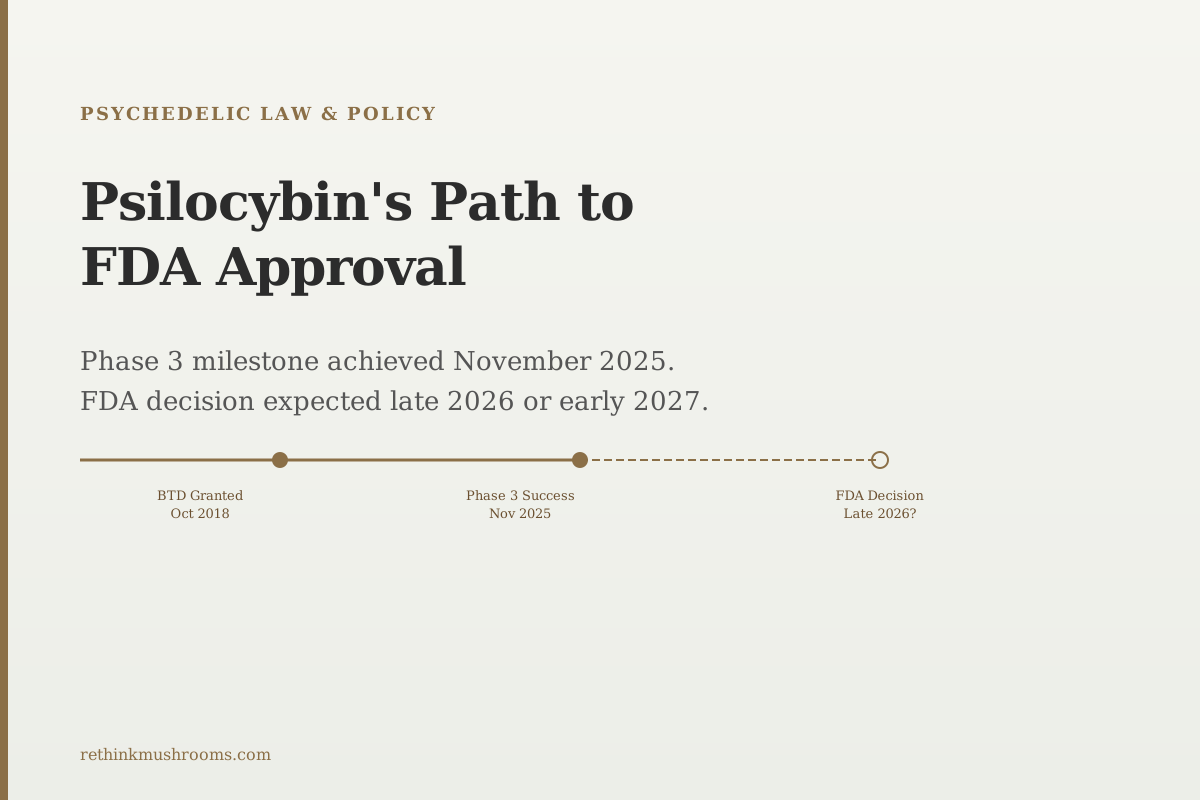
Psilocybin’s Road to FDA Approval, 2018–2027
The two green markers are the ones that changed the picture: back-to-back Phase 3 wins in June 2025 and February 2026. Everything after February 2026 is projected, and even a decision would not, by itself, make psilocybin broadly available.
- Oct 2018COMPASS milestone (achieved)
COMPASS receives Breakthrough Therapy Designation
The FDA grants BTD to COMP360 psilocybin for treatment-resistant depression — a process benefit (more FDA engagement, rolling review), not a guarantee of approval.
- Nov 2019Regulatory context
Usona receives BTD for major depressive disorder
A second, separate track opens: Usona Institute wins BTD for psilocybin in general MDD — a broader population than TRD, on a longer timeline.
- Jun 2023Regulatory context
FDA publishes psychedelic trial guidance
The agency issues formal guidance on psychedelic clinical trials, addressing functional unblinding and therapist-conduct standards — the issues that would later sink MDMA.
- Jul 2023Regulatory context
Australia reschedules psilocybin (Schedule 8)
Australia becomes the first country to let psychiatrists prescribe psilocybin for TRD — but with significant cost barriers, few authorized prescribers, and no listed product (Dutton et al., 2026).
- Aug 2024Regulatory context
FDA rejects MDMA-assisted therapy
A Complete Response Letter to MAPS PBC cites functional unblinding, therapist-conduct concerns, and insufficient efficacy — a cautionary marker for the whole field.
- Jun 2025COMPASS milestone (achieved)
COMP005 — first Phase 3 success
COMPASS announces the first Phase 3 win in psilocybin history: a single 25mg dose beats placebo by 3.6 points on the MADRS (p<0.001) in treatment-resistant depression.
- Feb 2026COMPASS milestone (achieved)
COMP006 — second Phase 3 confirms it
The confirmatory trial hits its primary endpoint: 25mg beats the 1mg comparator by 3.8 points on the MADRS (p<0.001), with 39% of 25mg participants reaching a clinically meaningful response at Week 6.
- Late 2026Projected (not yet occurred)
NDA submission (projected)
COMPASS expects to complete a rolling New Drug Application submission — the formal request for FDA marketing approval, built on two positive Phase 3 trials.
- 2027Projected (not yet occurred)
FDA decision (projected)
Applying the standard ~10-month review to a late-2026 submission points to an FDA decision in 2027. DEA rescheduling and insurance coverage would still follow separately.
Phase 3 topline results are COMPASS Pathways’ publicly announced figures; the 134-trials baseline is Norring & Spigarelli, Drug Des Devel Ther, 2024, and Australia’s rollout is documented in Dutton et al., Aust N Z J Psychiatry, 2026. Dates after February 2026 are projections, not decisions. This is a regulatory timeline, not medical or legal advice.
COMP005: The Phase 3 Trial That Put Psilocybin's Approval on the Clock
Until June 2025, every discussion of psilocybin and the FDA was speculative. Then COMPASS Pathways announced that their Phase 3 trial, called COMP005, had achieved its primary endpoint.
The trial enrolled patients with treatment-resistant depression. Treatment-resistant depression means a patient has tried at least two antidepressant medications and not responded to either. These are patients for whom standard-of-care treatment has failed, and for whom there are few remaining options with strong evidence behind them.
The intervention was a single 25mg dose of COMP360, COMPASS's synthetic psilocybin formulation, administered in a structured clinical session with psychological support. The control condition was placebo with the same psychological support framework.
The primary outcome measure was the Montgomery-Åsberg Depression Rating Scale, a standard 60-point clinician-rated instrument for depression severity. The COMP005 result: statistically significant reduction in depression severity at p<0.001, with a difference of 3.6 points versus placebo. A 3-to-5-point difference on the MADRS is generally treated as clinically meaningful in antidepressant research.
As of 2024, 134 psilocybin clinical trials had been registered on ClinicalTrials.gov across 54 different potential indications. The marketing approval count was zero.[1] COMP005's success was the first time any psilocybin product had cleared Phase 3. A second Phase 3 trial, COMP006, confirmed the finding in February 2026 with a 3.8-point MADRS advantage for the 25mg dose (p<0.001). COMPASS Pathways has said it expects to complete a rolling NDA submission in the fourth quarter of 2026, which, following the standard review period, points to an FDA decision in 2027.
Two Drugs, Two Diseases: Why COMPASS and Usona Are on Separate Tracks
Media coverage of psilocybin and the FDA focuses heavily on COMPASS Pathways. A second company is pursuing FDA approval for psilocybin through an entirely separate development program.
Usona Institute, a nonprofit research organization based in Wisconsin, is pursuing FDA approval of psilocybin for general major depressive disorder. The distinction from COMPASS's target population is significant. Treatment-resistant depression applies only to patients who have failed two or more antidepressant treatments. Major depressive disorder is a broader category covering anyone who meets the diagnostic criteria for depression, regardless of treatment history.
Both organizations hold FDA Breakthrough Therapy Designation:
- COMPASS Pathways: BTD for COMP360 in treatment-resistant depression, granted October 2018
- Usona Institute: BTD for psilocybin in major depressive disorder, granted November 2019
A Phase 2 randomized controlled trial published in JAMA in 2023 by Raison and colleagues documented psilocybin's efficacy and safety in patients with major depressive disorder, providing a key part of the clinical backbone for the MDD approval track.[3] The Usona timeline for Phase 3 completion and NDA submission extends beyond COMPASS's.
Why the distinction matters: FDA approval of COMP360 for treatment-resistant depression would create a prescribable product for a specific, narrowly defined patient population. It would not make psilocybin available as a general antidepressant. MDD approval, which is further out, would cover a much larger group.
For the regulatory mechanics of each track in detail, see The FDA and Psychedelic Medicine: Regulatory Challenges.
Breakthrough Therapy Designation: What It Accelerates and Why It Does Not Guarantee Approval
FDA Breakthrough Therapy Designation is a program the agency created in 2012 to accelerate development of treatments for serious conditions where early evidence is compelling. To qualify, a drug must show preliminary clinical evidence of substantial improvement over available therapies.
For a company developing a drug, BTD provides three concrete changes to how the FDA engages with their program:
First, more frequent and substantive meetings. During clinical development, the FDA will meet with the sponsor more often and engage more deeply with protocol questions, allowing earlier course corrections if a trial is heading toward a design problem.
Second, rolling review. The FDA can accept and review sections of the NDA as they are completed, rather than waiting for the entire package to arrive before starting the clock. For COMPASS, this means FDA reviewers can be evaluating Phase 3 data while other sections of the application are still being assembled.
Third, cross-disciplinary senior-level involvement. BTD brings senior FDA staff into the review process earlier, which can mean more direct feedback on what the agency needs to see.
What BTD does not do: guarantee approval, shorten the Phase 3 clinical trial requirements, or override evidence standards. A drug with BTD still needs to demonstrate efficacy and safety at Phase 3 to receive approval.
MDMA also received FDA Breakthrough Therapy Designation for PTSD, and the FDA still rejected its marketing application in August 2024. BTD is an indicator of FDA engagement and a process benefit. It is not a pathway to approval independent of the clinical evidence.
For a deeper explanation of BTD and its implications for the psilocybin timeline, see The FDA Breakthrough Therapy Designation for Psilocybin: What It Means for Approval.
MDMA Failed FDA Approval in 2024: Here's Why Psilocybin's Path Looks Different
In August 2024, the FDA issued a Complete Response Letter to MAPS PBC, rejecting their New Drug Application for MDMA-assisted therapy for PTSD. A Complete Response Letter means the FDA is declining to approve the application as submitted and requires additional work before approval can be granted.
The FDA's stated concerns were specific. Functional unblinding was the first: participants in MAPS' clinical trials could reliably identify whether they received MDMA or placebo, which the FDA concluded undermined the validity of the trial's placebo comparison. Therapist conduct was the second: documented instances of boundary violations, including inappropriate physical and emotional behavior toward trial participants, raised questions about the safety of the therapeutic model as implemented. On efficacy, the FDA concluded the evidence was insufficient to approve the application and requested an additional Phase 3 trial.
Several factors differentiate psilocybin's regulatory position from MDMA's. The FDA published formal guidance on psychedelic drug clinical trials in June 2023, specifically addressing the blinding challenge and therapist conduct standards. COMPASS Pathways' Phase 3 design was developed after that guidance, in dialogue with FDA, and the COMP005 trial incorporated the conduct safeguards the guidance required.
Psilocybin and MDMA also differ in mechanism. MDMA's effects include a pronounced empathogenic dimension that makes blinding particularly difficult: participants almost always know what they received. Psilocybin produces visual and perceptual changes that make blinding hard as well, but the problem manifests differently, and the FDA guidance acknowledged this challenge explicitly for future psilocybin trial designs.
None of this predicts psilocybin's outcome. The FDA reviews each application on its own evidence package. But the two applications were not built on identical designs, and the FDA's MDMA concerns do not map directly onto the psilocybin submissions.
The Approval Timeline: NDA Submission in Late 2026, FDA Decision in 2027
Following COMP005's June 2025 success, COMPASS Pathways outlined a rolling NDA submission path. Rolling submission means sections of the NDA can be reviewed by the FDA as they are completed, avoiding the full submission date as the starting point for the review clock.
The standard FDA review period for an NDA is 10 months from the completion of the submission. With BTD, the FDA engages more actively throughout that window. COMPASS has said it expects to complete its NDA submission in the fourth quarter of 2026. Applying the standard review period to that timeline points to an FDA decision in 2027.
The confirmatory picture is now stronger than it was when COMP005 first read out. The second Phase 3 trial, COMP006, achieved its primary endpoint in February 2026: the 25mg dose beat the 1mg comparator by 3.8 points on the MADRS (p<0.001), with 39% of 25mg participants reaching a clinically meaningful response at Week 6. Two positive Phase 3 trials substantially strengthen an NDA, and having both in hand removes the earlier strategic question of whether to file on a single trial's data.
One complexity lies beyond FDA approval itself. Psilocybin remains Schedule I under the Controlled Substances Act. FDA approval of a drug does not automatically reschedule it under the DEA's scheduling framework. DEA rescheduling is a separate administrative process that would need to follow, or proceed in parallel with, FDA approval for COMP360 to be legally prescribable as a controlled substance.
For the specific legal access options available to Americans while FDA approval is pending, see Legal Psilocybin Access Before FDA Approval: All Current Options.
FDA Approval Would Not End Complexity: What Changes and What Stays Hard
Approval of COMP360 for treatment-resistant depression would be a genuine landmark. As of 2024, 134 clinical trials for psilocybin had been registered on ClinicalTrials.gov across 54 potential indications with zero FDA marketing approvals.[1] A first approval changes that in a fundamental way.
What approval would not automatically produce:
DEA rescheduling: as noted, a separate administrative process. Until it is complete, prescribing involves navigating controlled substance regulations.
Insurance coverage: FDA approval does not compel Medicare, Medicaid, or private insurers to cover a drug. Coverage determinations are made separately and can take years to resolve after approval. The combination of a novel delivery model (supervised sessions lasting hours, not a pill taken daily) and uncertain reimbursement could limit uptake significantly even after approval.
State-level program independence: Oregon Psilocybin Services and Colorado's Natural Medicine Health Act operate under state law, not federal regulatory approval, and serve populations and use cases that are distinct from what a TRD-specific FDA-approved product would reach. These programs continue regardless of FDA approval status. A 2023 analysis of psychedelic drug legislative reform documented this parallel development of state-level frameworks operating independently from the federal track.[4]
What approval would change: it would create a legal path for a psychiatrist treating a patient with treatment-resistant depression to prescribe COMP360 in a clinical setting. That is both more and less than some accounts suggest.
For the state-level access picture, see Oregon Psilocybin Services: How the World's First Legal Program Works.
Australia Has Had Legal Psilocybin for Three Years: Here's What That Has Produced
The United States is not the first country watching this question develop. Australia's Therapeutic Goods Administration rescheduled psilocybin to a Schedule 8 controlled medicine for treatment-resistant depression in July 2023, making Australia the first country to permit psychiatrists to prescribe it.
A 2026 review in the Australian and New Zealand Journal of Psychiatry examined the regulatory, ethical, and operational realities of Australia's rollout after that rescheduling.[2] What the review documented was a program with genuine legal access and substantial practical constraints: significant cost barriers, a limited pool of Authorized Prescribers qualified to administer the therapy, no product listed on the Australian Register of Therapeutic Goods, and no standardized national training pathway.
The Australia experience is a preview of what FDA approval of COMP360 would produce in the United States: a legal option, not a widely accessible one. The gap between having approval and building the delivery infrastructure (trained therapists, clinical facilities designed for multi-hour supervised sessions, insurance coverage pathways) is substantial and not resolved by the approval decision alone.
That gap does not make approval unimportant. It makes the sequence of what needs to happen afterward worth tracking clearly.
The Bottom Line
Psilocybin is not yet FDA-approved, but COMPASS Pathways' two successful Phase 3 trials for COMP360 in treatment-resistant depression (COMP005 in June 2025 and COMP006 in February 2026) put the first realistic approval timeline on record: an NDA submission targeted for late 2026 and an FDA decision in 2027, with a separate Usona Institute track for major depressive disorder on a longer timeline. The FDA's rejection of MDMA in 2024 raised legitimate questions about psychedelic medicine's regulatory path, but the two applications differ in key ways. FDA approval, when it arrives, will create a legal prescription option. Widespread accessibility is a separate challenge that follows.
Frequently Asked Questions
Sources & References
- 1RTHM-01959·Norring, Sarah A et al. (2024). “The Promise of Therapeutic Psilocybin: An Evaluation of the 134 Clinical Trials, 54 Potential Indications, and 0 Marketing Approvals on ClinicalTrials.gov..” Drug design.Study breakdown →PubMed →↩
- 2RTHM-00958·Dutton, Megan et al. (2026). “Psilocybin in the real world: Regulatory, ethical, and operational challenges in Australia's clinical landscape..” The Australian and New Zealand journal of psychiatry.Study breakdown →PubMed →↩
- 3RTHM-00848·Raison, Charles L et al. (2023). “Single-Dose Psilocybin Treatment for Major Depressive Disorder: A Randomized Clinical Trial..” JAMA.Study breakdown →PubMed →↩
- 4RTHM-01791·Siegel, Joshua S et al. (2023). “Psychedelic Drug Legislative Reform and Legalization in the US..” JAMA psychiatry.Study breakdown →PubMed →↩