Psychedelic Law & Policy
134 trials, 0 FDA approvals
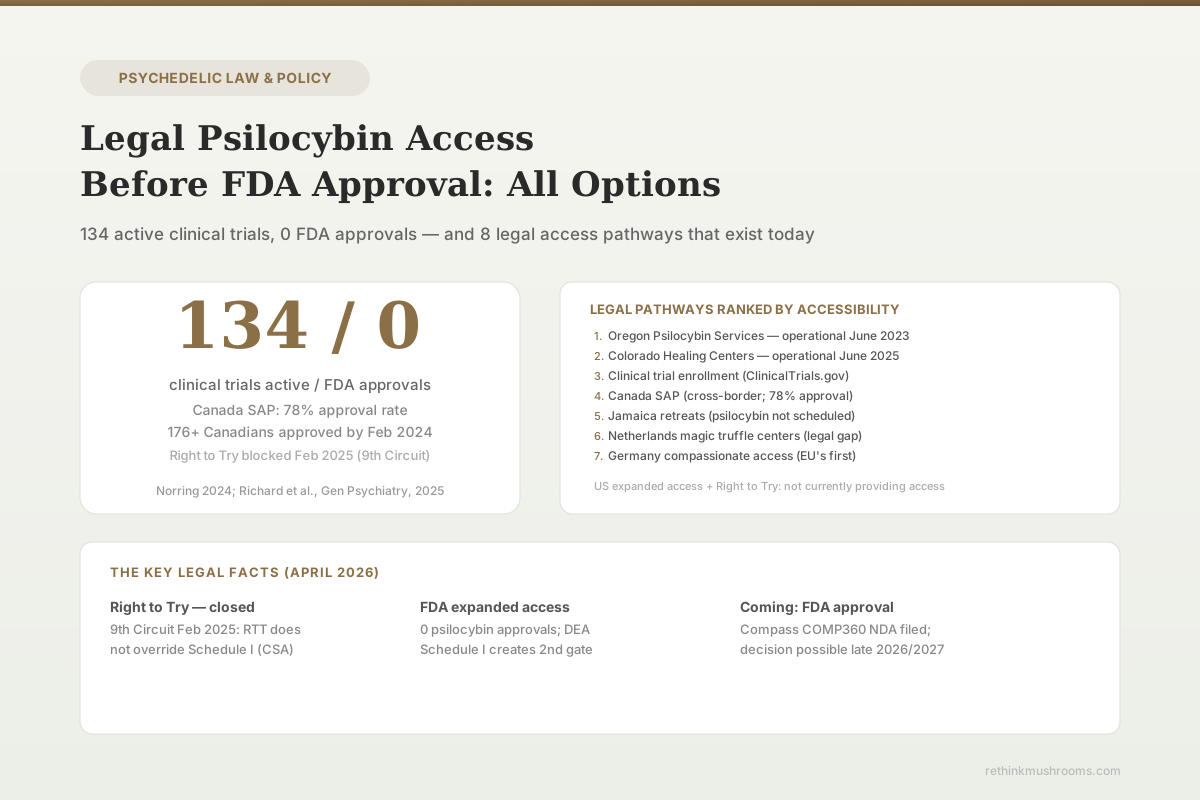
There are 134 active psilocybin clinical trials and 54 researched therapeutic indications, yet no FDA marketing approval exists. Eight legal access pathways operate today, from Oregon's licensed services to Canada's 78% SAP approval rate.
Norring & Spigarelli, Drug Des Devel Ther, 2024
~80% response
terminal cancer patients showed substantial, sustained depression/anxiety reduction in two landmark RCTs (Griffiths 2016; Ross 2016)
78% SAP approval
Health Canada Special Access Programme approved 176+ Canadians by February 2024; far more accessible than any US pathway (Richard et al., 2025)
Feb 2025 ruling
Ninth Circuit closed the Right to Try pathway; Freedom to Heal Act (Dec 2025) proposes the legislative fix
Norring & Spigarelli, Drug Des Devel Ther, 2024
 View as image ↗
In 2016, Griffiths and colleagues published a double-blind trial showing that a single dose of psilocybin produced rapid and sustained reduction in depression and anxiety in terminal cancer patients, with roughly 80% maintaining a clinical response at six months.[1] A companion trial from NYU published in the same journal issue found similar results.[2] Today, in April 2026, those same patients, and their counterparts with treatment-resistant depression, PTSD, and eating disorders, still cannot access psilocybin through any standard US medical channel.
Norring and Spigarelli cataloged the gap in a 2024 review: 134 active clinical trials, 54 potential therapeutic indications, and zero FDA marketing approvals.[4] But that does not mean legal access is impossible. It means navigating a patchwork of programs, state laws, international routes, and clinical trial opportunities, each with different requirements and realistic accessibility.
This article maps every legal pathway as of April 2026: who qualifies, what it costs, what the real barriers are, and what's likely to change in the next 12-18 months. For the foundational explanation of why psilocybin remains Schedule I despite this evidence base, see why psilocybin is federally illegal despite proven medical value.
Key Takeaways
- Oregon Psilocybin Services has been operational since June 2023, the first legal supervised psilocybin program in the US, with licensed facilitators, no diagnosis required, and sessions typically costing $1,500-$3,000
- Colorado Healing Centers became operational in June 2025 (first licensed session June 6, 2025), offering a slightly more healthcare-adjacent model that allows social workers and psychiatrists to integrate
- Clinical trial enrollment is the most accessible route for patients who meet specific diagnostic criteria; 134 active trials as of Norring 2024, with ClinicalTrials.gov as the search tool
- Health Canada's Special Access Programme (SAP) approved 176+ Canadians for psilocybin by February 2024 at a 78% approval rate, an option accessible to patients who can travel (Richard et al., 2025)
- The Right to Try Act does NOT currently provide access: the Ninth Circuit ruled in February 2025 that it does not override the Controlled Substances Act's Schedule I restriction
- US FDA expanded access has zero psilocybin approvals as of April 2026 due to a two-gate barrier (FDA approval plus a separate DEA Schedule I waiver)
All Current Legal Options, Ranked by Accessibility
For patients wanting psilocybin access today, these are the realistic pathways ranked roughly by how many people can actually use them:
- Oregon Psilocybin Services (operational since June 2023): no diagnosis required; anyone 21+ can access; ~$1,500-$3,000 per session; licensed facilitators at approved service centers
- Colorado Healing Centers (operational since June 2025): similar model to Oregon; first licensed healing center December 31, 2024; integrates mental health professionals more directly
- Clinical trial enrollment: requires qualifying diagnosis and meeting specific eligibility criteria; 134 active trials as of 2024; many offer free access; ClinicalTrials.gov is the search tool
- Health Canada Special Access Programme: for Canadians or US patients who can travel; covers end-of-life distress and treatment-resistant depression; 78% approval rate; physician-requested
- Jamaica retreats: psilocybin is not a scheduled substance under Jamaican law; multiple licensed retreat centers operate legally; no prescription required; travel required
- Netherlands magic truffle centers: psilocybin (mushrooms) technically illegal but psilocybin-containing truffles exist in a legal gap; multiple retreat centers operate openly in Amsterdam and elsewhere
- Germany compassionate access: EU's first formal psilocybin compassionate access program; physicians can access psilocybin for seriously ill patients; program still developing as of early 2026
- US FDA expanded access: theoretically available but zero psilocybin approvals achieved; only viable if the DEA barrier is resolved
Oregon Psilocybin Services: Operational Since June 2023
Oregon's Measure 109, passed in 2020, created the Oregon Psilocybin Services Act. The state regulatory infrastructure took three years to build; licensed sessions began in June 2023.
The Oregon model is deliberately not framed as medical. Participants do not need a diagnosis, a physician referral, or a mental health evaluation. The framework is personal development and wellness. Any adult 21 or older can schedule a session with a licensed facilitator at an approved service center, complete a preparation session, undergo a supervised session (typically 6-8 hours), and complete an integration session.
Cost is the primary barrier. Sessions typically run $1,500-$3,000, including facilitator fees and service center fees. There is no insurance coverage. Some sliding-scale programs exist but are limited in capacity. Access to trained facilitators is not yet uniform statewide, and most centers are concentrated in the Portland area and other urban centers.
The Oregon model is the most accessible legal US psilocybin option for people without a specific diagnosis, but it requires travel if you are not in Oregon and involves out-of-pocket costs that exclude lower-income patients. Siegel and colleagues' 2023 JAMA Psychiatry review placed Oregon's program in the context of broader legislative reform as the first operational US model and the template subsequent states are adapting.[3]
Colorado Healing Centers: Operational Since June 2025
Colorado's Proposition 122 passed in November 2022. The Colorado Healing Center framework took longer to operationalize: the first licensed healing center received its license on December 31, 2024, and the first state-regulated healing session took place on June 6, 2025.
Colorado's model differs from Oregon's in one key respect: it more directly integrates mental health professionals. Licensed social workers and psychiatrists can integrate into healing center licenses, allowing a more clinically-adjacent model than Oregon's facilitator-only approach. This does not make it a medical program, but it allows better coordination with ongoing mental health care.
Cost, geographic access, and insurance coverage limitations are similar to Oregon's. Colorado's program is too new as of April 2026 to have published outcome data.
Clinical Trial Enrollment: Free Access but Narrow Eligibility
For patients with specific diagnoses who can meet eligibility criteria, clinical trial enrollment is both legal and often free (with psilocybin and sessions provided at no cost to the participant). The research base has expanded substantially: the Norring 2024 review identified 134 active psilocybin trials investigating 54 potential indications as of their analysis date.[4]
The conditions with the most active trials include treatment-resistant depression, major depressive disorder, PTSD, alcohol use disorder, eating disorders, and cancer-related distress. Searching ClinicalTrials.gov for "psilocybin" and filtering by "recruiting" status returns currently enrolling studies.
The practical limitations are significant. Trials have strict eligibility criteria (specific diagnosis, absence of certain co-occurring conditions, often no current psychiatric medications). Many trials are at academic medical centers in a limited number of cities. Wait lists exist for popular trials. And enrollment in a trial typically means accepting randomization to placebo arms and following strict protocols that may not suit every patient's situation.
Still, for patients who qualify and can access a participating site, clinical trials represent the most medically supervised and evidence-generating legal option available.
Health Canada Special Access Programme: 78% Approval Rate
Canada's regulatory approach to psilocybin differs substantially from the US. Health Canada's Special Access Programme (SAP) was updated in January 2022 to explicitly include psilocybin for end-of-life psychological distress and treatment-resistant major depressive disorder.
Richard and colleagues' 2025 comparative analysis in General Psychiatry documented the contrast directly: as of February 2024, 176 Canadians had been approved under the SAP with a 78% approval rate.[6] The US equivalent, FDA expanded access for psilocybin, had zero approvals over the same period.
For Canadians, the SAP works as follows: a physician submits a SAP request on behalf of their patient, providing the clinical rationale and confirming a serious or life-threatening condition with inadequate existing options. Compass Pathways or PSYCH Rockies (which holds Canadian supply licenses) is then asked to provide the drug. The entire process is physician-driven.
For US patients, this pathway requires traveling to Canada and establishing care with a Canadian physician, which is logistically complex and cost-prohibitive for many people. But for patients with significant resources and a qualifying condition who cannot access effective treatment in the US, Canada SAP is the most rigorously approved non-trial legal pathway available in North America.
The Richard 2025 paper explicitly recommended that the US adopt elements of the Canadian model, noting that the US creates a second barrier to expanded access that Canada does not: the DEA's Schedule I designation requires a separate waiver beyond FDA approval, making US expanded access practically inaccessible even though the FDA itself approves over 99% of individual compassionate use applications.[6]
International Retreats: Jamaica, Netherlands, and Beyond
Several countries provide legal access through either explicit regulation or legal gaps.
Jamaica has never scheduled psilocybin under its national drug laws. Multiple licensed retreat centers operate legally, offering multi-day programs with facilitated psilocybin sessions. No prescription is required. Programs vary widely in quality, price, and therapeutic rigor. Costs typically range from $1,500-$5,000 for a multi-day retreat. For US residents, this requires international travel and involves flying with the realistic understanding that psilocybin cannot be transported back.
Netherlands has a legal anomaly: psilocybin-containing "magic truffles" (sclerotia of Psilocybe species) were not included in the 2008 Dutch prohibition on mushrooms. Multiple retreat centers in Amsterdam and elsewhere operate openly and legally. Session quality varies significantly across providers, from tourism-adjacent experiences to clinically informed programs with preparation and integration.
Germany established the EU's first formal psilocybin compassionate access program in 2024, allowing physicians to access psilocybin for seriously ill patients. The program was still developing its operational framework as of early 2026.
Why Right to Try Doesn't Currently Work for Psilocybin
Many articles and websites still suggest that the federal Right to Try Act (the Trickett Wendler Act, enacted May 30, 2018) provides a pathway for terminally ill patients to access psilocybin. This is incorrect as of February 2025.
The Right to Try Act allows terminally ill patients to request access to investigational drugs that have completed Phase 1 safety trials and are under active investigation. Psilocybin technically meets these criteria. The problem is the Controlled Substances Act's Schedule I restriction, which applies independently of the Right to Try Act.
On February 28, 2025, the Ninth Circuit Court of Appeals ruled in Advanced Integrative Medical Science Institute v. Drug Enforcement Administration that the Right to Try Act does not override the Controlled Substances Act's scheduling restrictions. Dr. Sunil Aggarwal, a palliative care physician in Seattle, had applied to the DEA for permission to administer psilocybin to terminal patients under Right to Try. The DEA refused. The Ninth Circuit upheld that refusal.
This ruling means that, as of April 2026, Right to Try does not provide legal psilocybin access to terminally ill patients in the US. Schonholz and colleagues' 2024 analysis in the Journal of the American Academy of Psychiatry and the Law examined this ethical contradiction directly, noting that patients who responded to psilocybin in clinical trials and have no other effective options face both a legal and an ethical problem that current law has failed to resolve.[5]
For the detailed account of the AIMS v. DEA case and the Right to Try pathway specifically, see compassionate use of psilocybin: individual patient applications.
Why US FDA Expanded Access Has Zero Psilocybin Approvals
A separate confusion exists around FDA expanded access (also called compassionate use). The FDA approves more than 99% of individual expanded access applications. Some sources suggest that this makes psilocybin expanded access achievable.
The same two-gate problem that defeats Right to Try also defeats expanded access. FDA approval of a compassionate use application is necessary but not sufficient: the DEA must separately grant a Schedule I waiver to allow the physician to possess and administer the drug. The DEA has not approved such a waiver for psilocybin. As of April 2026, zero psilocybin expanded access applications have resulted in a US patient receiving the drug through this pathway.
What's Pending: The Freedom to Heal Act and FDA Approval Timeline
Two developments could substantially change the access landscape by 2027.
The Freedom to Heal Act (December 2025): Building on the failed Right to Try Clarification Act that Senators Booker and Paul introduced in 2022 and reintroduced in 2024, the Freedom to Heal Act proposes a formal pathway for people with severe, life-threatening conditions to access Schedule I therapies including psilocybin. It would require physician registration with the DEA and establish formal oversight, essentially creating a supervised access track that bypasses the RTT blockage. As of April 2026, the bill has not passed.
FDA approval of Compass Pathways COMP360: Compass Pathways has submitted a New Drug Application for synthetic psilocybin (COMP360) for treatment-resistant depression. A potential FDA approval decision is anticipated in late 2026 or early 2027. Approval would not immediately mean widespread access, but it would shift psilocybin from Schedule I to Schedule II (as required for an approved pharmaceutical), creating the infrastructure for physician prescribing. The timeline remains uncertain.
What Remains Illegal
Legal psilocybin access in the US depends entirely on using approved state programs (Oregon, Colorado), clinical trials, or leaving the country. The following remain federal crimes regardless of state decriminalization or personal use measures:
- Purchasing psilocybin from online or street vendors for therapeutic or personal use
- Possessing spores with intent to cultivate for therapeutic sessions
- Conducting facilitated psilocybin sessions outside licensed state programs
- Importing psilocybin or psilocybin products from Jamaica or the Netherlands
Several US cities have decriminalized personal possession of psilocybin (including Denver, Seattle, and multiple California and Massachusetts cities), but decriminalization is not legalization: it reduces enforcement priority but does not create a legal framework for accessing or providing psilocybin therapeutically.
Note: This article summarizes publicly documented legal frameworks as of April 2026. It does not constitute legal advice. Patients seeking psilocybin access should consult a qualified attorney and their treating physician before pursuing any pathway.
The Bottom Line
As of April 2026, the most accessible legal psilocybin options are Oregon's licensed therapeutic services (operational since June 2023, no diagnosis required), Colorado's healing centers (operational June 2025), clinical trial enrollment (134 active trials, free access for qualifying patients), and Canada's Special Access Programme (78% approval, 176+ patients approved). The Right to Try Act pathway was closed by the Ninth Circuit in February 2025. US FDA expanded access has zero psilocybin approvals due to a two-gate DEA barrier. The Freedom to Heal Act (pending) and anticipated FDA approval of Compass Pathways COMP360 (late 2026/early 2027) are the most likely near-term changes.
Frequently Asked Questions
Sources & References
- 1RTHM-00426·Griffiths, Roland R et al. (2016). “Psilocybin produces substantial and sustained decreases in depression and anxiety in patients with life-threatening cancer: A randomized double-blind trial..” Journal of psychopharmacology (Oxford.Study breakdown →PubMed →↩
- 2RTHM-00445·Ross, Stephen et al. (2016). “Rapid and sustained symptom reduction following psilocybin treatment for anxiety and depression in patients with life-threatening cancer: a randomized controlled trial..” Journal of psychopharmacology (Oxford.Study breakdown →PubMed →↩
- 3RTHM-01791·Siegel, Joshua S et al. (2023). “Psychedelic Drug Legislative Reform and Legalization in the US..” JAMA psychiatry.Study breakdown →PubMed →↩
- 4RTHM-01959·Norring, Sarah A et al. (2024). “The Promise of Therapeutic Psilocybin: An Evaluation of the 134 Clinical Trials, 54 Potential Indications, and 0 Marketing Approvals on ClinicalTrials.gov..” Drug design.Study breakdown →PubMed →↩
- 5RTHM-01983·Schonholz, Stephanie M et al. (2024). “Legal and Ethics Concerns of Psilocybin as Medicine..” The journal of the American Academy of Psychiatry and the Law.Study breakdown →PubMed →↩
- 6RTHM-02167·Richard, Jérémie et al. (2025). “Expanded access to psychedelic treatments: comparing American and Canadian policies..” General psychiatry.Study breakdown →PubMed →↩