Legal Psilocybin Access
>99% FDA approval rate for single-patient INDs
FDA authorizes over 99% of single-patient expanded access (compassionate use) requests for investigational drugs. The binding constraint for psilocybin is manufacturer willingness to supply, not agency approval.
FDA Expanded Access program data
21 CFR 312.310
single-patient IND regulation
7-day response
FDA target for emergency requests
Section 56
Canadian exemption framework
FDA Expanded Access program data
 View as image ↗
Compassionate use, formally called "expanded access," is the regulatory pathway that allows individual patients with serious or life-threatening conditions to receive an investigational drug outside of a clinical trial. For psilocybin, the pathway exists on paper in both the United States (via FDA single-patient IND under 21 CFR 312.310) and Canada (via Section 56 exemption under the Controlled Drugs and Substances Act). In practice, the availability of compassionate use depends less on regulatory approval than on two other factors: a willing manufacturer to supply the drug, and a physician willing to sponsor the IND. Both factors have shifted significantly as the clinical evidence base has matured.
This article explains the procedural mechanics of single-patient compassionate use for psilocybin, the practical bottlenecks that determine whether a request actually results in treatment, the parallel Canadian pathway, and the clinical evidence base that supports compassionate use requests in specific conditions. For group-level access, see expanded access programs for psilocybin: how they work. For state Right to Try laws, see psilocybin right to try: using terminal illness laws for access. For the complete landscape, see legal psilocybin access before FDA approval: all current options.
Key Takeaways
- FDA single-patient expanded access is governed by 21 CFR 312.310 and requires: a serious or life-threatening condition, no satisfactory alternative therapy, favorable risk-benefit for the individual patient, and no interference with ongoing clinical development
- FDA authorizes over 99% of single-patient expanded access requests it reviews; the binding constraint is almost always manufacturer willingness to supply, not agency approval
- The two principal GMP-grade psilocybin manufacturers with clinical-stage programs (Compass Pathways' COMP360 and Usona Institute's synthetic psilocybin) have historically restricted supply to their own sponsored trials, with rare compassionate use exceptions
- Canada's Section 56 exemption framework under the Controlled Drugs and Substances Act has authorized individual patient access to psilocybin since 2020, primarily for end-of-life distress; hundreds of exemptions have been granted
- The clinical evidence supporting compassionate use requests is strongest for cancer-associated anxiety and depression, where two Phase 2 RCTs (Griffiths et al., 2016; Ross et al., 2016) and a Phase 2b (Ross et al., 2025) report large and durable symptom reductions
- Evidence in treatment-resistant depression is strong (Goodwin et al., 2022; Carhart-Harris et al., 2021; Davis et al., 2021) but TRD is generally not considered "serious or life-threatening" in the regulatory sense unless accompanied by suicidality, complicating compassionate use justification
- Psychiatric side effect case reports (Barber et al., 2022) document that rare adverse events occur and that compassionate use protocols must include psychiatric screening and post-dose monitoring comparable to trial standards
The FDA Single-Patient IND Process
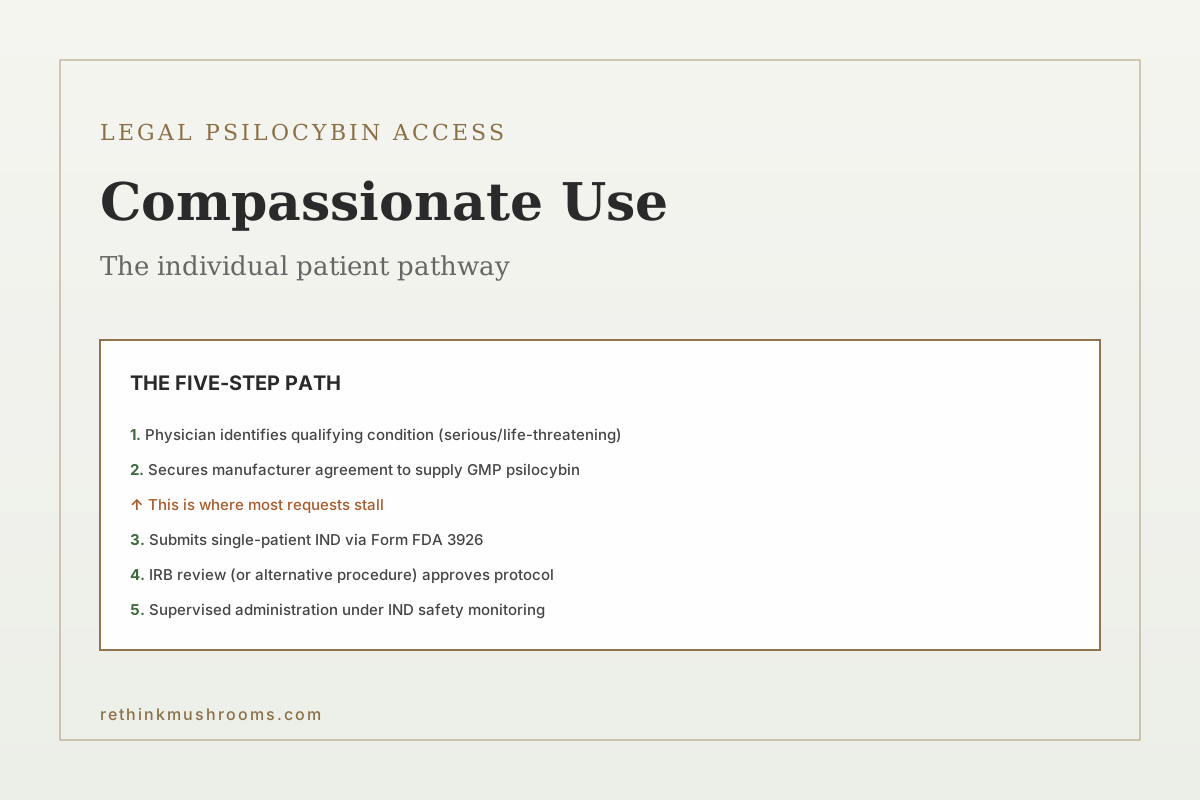
Individual patient expanded access in the United States is administered under 21 CFR 312.310. The physician (not the patient directly) applies for an Investigational New Drug Application (IND) on behalf of a named individual patient. The six procedural requirements:
- Serious or life-threatening condition. The patient's condition must be serious or immediately life-threatening. "Serious" is an FDA-defined term; it includes conditions with substantial impact on day-to-day functioning or progression that becomes life-threatening if untreated.
- No satisfactory alternative. No comparable or satisfactory approved therapy must be available. For psilocybin-responsive indications (cancer distress, TRD), this typically means documented failure of standard options.
- Favorable individual risk-benefit. The potential benefit to the patient must justify the potential risk, and the risk must be reasonable given the severity of the condition.
- Non-interference with clinical development. The expanded access use must not interfere with the initiation, conduct, or completion of clinical investigations supporting approval.
- Manufacturer agreement. The manufacturer must agree to supply the drug. This is the step that most commonly blocks psilocybin requests.
- IRB review. An Institutional Review Board (or FDA-approved alternative procedure since 2017 for individual patient requests) must review and approve the protocol and informed consent.
For emergency requests, FDA can authorize expanded access by phone within 24 hours, with the formal IND filed afterward. For non-emergency requests, the IND is submitted using Form FDA 3926 (simplified for individual patient requests) and the agency has 30 days to respond, though most decisions come in 7-10 days.
The 99%+ authorization rate is a real number, and it has led to a common but misleading framing in the psilocybin access discussion: "FDA won't stop you." That is true. What stops most psilocybin compassionate use requests is that the manufacturer won't supply the drug, not that the agency won't approve the request.
The Manufacturer Bottleneck
Investigational psilocybin for clinical use must be manufactured under Good Manufacturing Practice (GMP) standards. Pharmaceutical-grade synthetic psilocybin is produced by a small number of organizations:
- Compass Pathways manufactures COMP360, the synthetic psilocybin used in the COMP005 and COMP006 Phase 3 trials.
- Usona Institute is a nonprofit manufacturer of synthetic psilocybin used in investigator-initiated trials.
- Filament Health and Psygen are additional GMP-grade manufacturers with commercial and clinical supply programs.
For a single-patient compassionate use request to result in treatment, one of these manufacturers must agree to ship product to the physician's institution under an FDA-authorized IND. Historically, Compass has restricted COMP360 supply to its own sponsored trials with narrow compassionate use exceptions. Usona has been somewhat more flexible but its supply is also prioritized for ongoing trials. This supply-side constraint is the single most important factor determining whether a compassionate use request translates to treatment.
The landscape is shifting. As Phase 3 data become positive and commercial supply scales for approval readiness, manufacturer willingness to support compassionate use typically increases. The approach to Phase 3 and pre-approval is historically the period of peak compassionate use expansion in oncology drugs, and the COMP360 program is now in that phase.
What the Clinical Evidence Supports
A compassionate use request requires a physician to argue that psilocybin has favorable individual risk-benefit for this specific patient. The strength of that argument depends on the indication.
Cancer-associated anxiety and depression
This is the strongest evidence base and the indication where compassionate use has the clearest path. Griffiths et al. (2016) randomized 51 patients with life-threatening cancer and depression or anxiety to high-dose (22 or 30 mg/70 kg) versus low-dose (1 or 3 mg/70 kg) psilocybin in a crossover design. The high-dose arm produced large and sustained decreases in depression and anxiety measures at 6-month follow-up, with 80% of participants showing clinically significant antidepressant response.[1]
Ross et al. (2016) independently randomized 29 patients with cancer-related anxiety and depression to single-dose psilocybin (0.3 mg/kg) versus niacin (active placebo), with a crossover at 7 weeks. Psilocybin produced rapid, robust, and sustained reductions in clinician-rated and self-reported depression and anxiety, with 60-80% maintaining clinically significant antidepressant and anxiolytic response at 6.5 months.[2]
Ross et al. (2025) extended this to a Phase 2b randomized trial, reporting consistent large effects in cancer-associated depression and anxiety and providing additional long-term follow-up data.[3]
For a patient with advanced cancer and severe depression or anxiety not responding to standard antidepressants and psychotherapy, this evidence supports a favorable individual risk-benefit determination even without additional phase 3 data. This is also the population for which Canadian Section 56 exemptions have been most frequently granted.
Treatment-resistant depression
Evidence in TRD is strong: Goodwin et al. (2022) Phase 2b (N=233), Davis et al. (2021) MDD randomized trial, and Carhart-Harris et al. (2021) vs escitalopram.[4][5][6] The regulatory obstacle for TRD compassionate use is that major depression without suicidality is not always considered "serious or life-threatening" in the 21 CFR 312.310 sense. TRD with documented suicidality, or TRD in a patient with a serious comorbid condition, has a cleaner compassionate use path than TRD alone.
Alcohol use disorder
Bogenschutz et al. (2022) randomized 95 participants with AUD to psilocybin-assisted therapy versus diphenhydramine-assisted therapy. Percentage of heavy drinking days over 32 weeks was significantly lower in the psilocybin arm.[7] AUD can qualify as serious if the patient has end-stage liver disease or other life-threatening complications, but the compassionate use path for AUD alone is narrower than for cancer-associated distress.
Chronic pain
Askey et al. (2024) reviewed psilocybin as a novel treatment for chronic pain, including preliminary trial data.[8] The evidence is earlier-stage than the depression literature and individual compassionate use requests in chronic pain would rely on narrower data.
The Canadian Section 56 Path
Canada's Controlled Drugs and Substances Act Section 56 authorizes the Minister of Health to exempt individuals or groups from the Act's provisions for medical or scientific purposes in the public interest. Beginning in 2020, Health Canada began granting Section 56 exemptions for individual patients to receive psilocybin, initially for end-of-life distress and subsequently extended to treatment-resistant depression in some cases.
The Section 56 pathway differs from the FDA compassionate use pathway in several ways:
- Patient or physician application: Patients can apply directly or through their physician (the FDA requires physician sponsorship).
- Substance source: Section 56 exemptions have authorized both pharmaceutical-grade psilocybin and, in some cases, access through licensed producers or healthcare practitioners rather than requiring a manufacturer-sponsored IND.
- Precedent base: Several hundred Section 56 exemptions have now been granted, creating a body of Canadian administrative precedent for psilocybin access that does not have a direct US parallel.
The Section 56 framework has also authorized psilocybin training sessions for healthcare practitioners, a separate use case that has no US analog outside of the clinical trial context.
What Compassionate Use Does Not Provide
It is important to be specific about what individual patient compassionate use does and does not deliver, because the term is often used loosely.
What it provides:
- Legal access to investigational GMP-grade psilocybin for a named individual patient in the US or Canada
- FDA- or Health Canada-authorized administration under physician supervision
- IRB-reviewed informed consent and safety monitoring
- A formal IND or Section 56 authorization that documents the legal basis for the treatment
What it does not provide:
- Insurance coverage (compassionate use is almost always patient-paid)
- A commercial supply commitment (the manufacturer can terminate supply)
- Repeat access (most single-patient INDs authorize a specified number of doses)
- A substitute for clinical trial enrollment (compassionate use is generally the fallback when trial enrollment is not possible)
The financial reality for patients pursuing compassionate use psilocybin in the US is that the treatment is typically $5,000-$15,000 out of pocket for two supervised sessions with psychotherapy, with no insurance contribution. In Canada under Section 56, some provinces' healthcare systems have covered associated professional costs, but drug costs generally remain out of pocket.
Rare but documented psychiatric adverse events (Barber et al., 2022) demonstrate that compassionate use protocols must include the same psychiatric screening, supervision, and post-dose monitoring used in clinical trials.[9] A compassionate use program that cuts corners on screening or supervision is not defensible on a favorable risk-benefit basis.
The Bottom Line
FDA single-patient compassionate use under 21 CFR 312.310 authorizes >99% of requests it reviews, but the operational constraint for psilocybin access is manufacturer willingness to supply GMP-grade drug under the IND rather than agency approval. The clinical evidence most clearly supports compassionate use in cancer-associated anxiety and depression (Griffiths et al., 2016; Ross et al., 2016; Ross et al., 2025), with a stronger evidence base than regulatory fit for treatment-resistant depression absent suicidality. Canada's Section 56 exemption pathway has authorized hundreds of individual psilocybin accesses since 2020 and offers a complementary framework for North American patients that has no direct US analog.
Frequently Asked Questions
Sources & References
- 1RTHM-00426·Griffiths, Roland R et al. (2016). “Psilocybin produces substantial and sustained decreases in depression and anxiety in patients with life-threatening cancer: A randomized double-blind trial..” Journal of psychopharmacology (Oxford.Study breakdown →PubMed →↩
- 2RTHM-00445·Ross, Stephen et al. (2016). “Rapid and sustained symptom reduction following psilocybin treatment for anxiety and depression in patients with life-threatening cancer: a randomized controlled trial..” Journal of psychopharmacology (Oxford.Study breakdown →PubMed →↩
- 3RTHM-00949·Ross, Margaret L et al. (2025). “Psilocybin-assisted psychotherapy for depression and anxiety associated with life threatening illness: A phase 2b randomized controlled trial..” General hospital psychiatry.Study breakdown →PubMed →↩
- 4RTHM-00761·Goodwin, Guy M et al. (2022). “Single-Dose Psilocybin for a Treatment-Resistant Episode of Major Depression..” The New England journal of medicine.Study breakdown →PubMed →↩
- 5RTHM-00682·Davis, Alan K et al. (2021). “Effects of Psilocybin-Assisted Therapy on Major Depressive Disorder: A Randomized Clinical Trial..” JAMA psychiatry.Study breakdown →PubMed →↩
- 6RTHM-00675·Carhart-Harris, Robin et al. (2021). “Trial of Psilocybin versus Escitalopram for Depression..” The New England journal of medicine.Study breakdown →PubMed →↩
- 7RTHM-00746·Bogenschutz, Michael P et al. (2022). “Percentage of Heavy Drinking Days Following Psilocybin-Assisted Psychotherapy vs Placebo in the Treatment of Adult Patients With Alcohol Use Disorder: A Randomized Clinical Trial..” JAMA psychiatry.Study breakdown →PubMed →↩
- 8RTHM-00864·Askey, Tate et al. (2024). “Psilocybin as a novel treatment for chronic pain..” British journal of pharmacology.Study breakdown →PubMed →↩
- 9RTHM-00742·Barber, Gregory et al. (2022). “A Case of Prolonged Mania, Psychosis, and Severe Depression After Psilocybin Use: Implications of Increased Psychedelic Drug Availability..” The American journal of psychiatry.Study breakdown →PubMed →↩