Psilocybin Legal Access
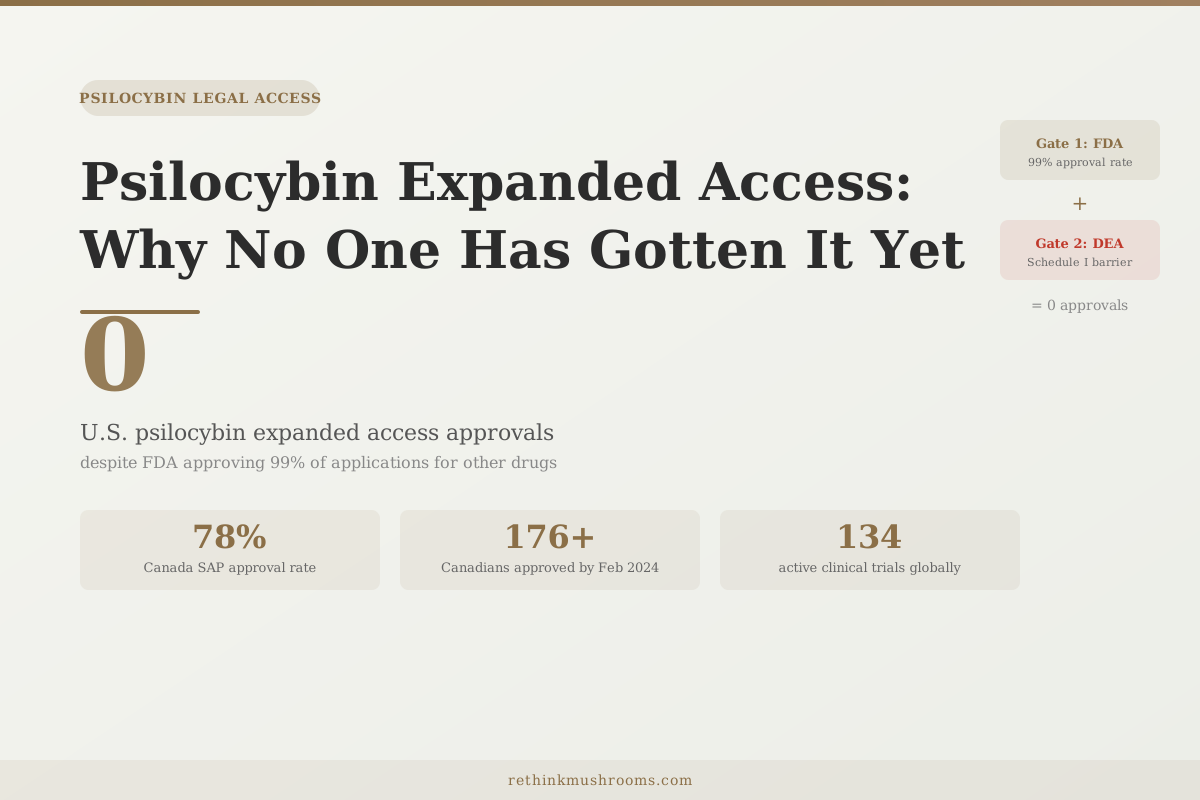
0 U.S. approvals
The FDA allows more than 99% of single-patient expanded access requests to proceed. As of August 2026, no psilocybin compassionate use case has been approved in the United States.
Richard J, et al. Gen Psychiatry. 2025
134
psilocybin trials registered on ClinicalTrials.gov over two decades
78%
Canada's psilocybin Special Access Programme approval rate
176
Canadians authorised for psilocybin access by February 2024
Richard J, et al. Gen Psychiatry. 2025
 View as image ↗
The FDA has a remarkable record: it allows more than 99% of single-patient expanded access applications to proceed. These are cases where a seriously ill patient and their physician ask for access to a drug that hasn't received formal approval yet. The physician must file a detailed application, the manufacturer must agree to supply the drug, and the patient must have no comparable alternative therapy. Despite those requirements, the FDA says yes almost every time. Across one decade of applications, 8,922 requests were filed and only 38 were denied or not allowed to proceed.
So why has no one in the United States successfully obtained psilocybin through this pathway?
The answer is a two-gate problem. FDA clearance is only the first gate. Psilocybin is classified as Schedule I under the Controlled Substances Act, the most restricted category in US drug law, reserved for substances the government has deemed to have high abuse potential and no currently accepted medical use. That classification gives the Drug Enforcement Administration its own, separate authority over psilocybin access. The DEA controls the second gate.
But the second gate is not simply welded shut, and this is the detail most coverage gets wrong. It has been opened once, for a different Schedule I psychedelic, by a pharmaceutical company that supplied the drug to a fixed set of DEA-registered sites. What does not exist is a route for an ordinary physician to obtain that authority for one patient. Psilocybin has never had a sponsor open such a program in the US, and an individual doctor cannot build one alone. That asymmetry — sponsor-passable, physician-impassable — is the real mechanism behind the zero.
This article explains how the expanded access system works, why it has produced nothing for psilocybin, how Canada built a system with a 78% approval rate and 176 patients authorised, what Germany did in 2025, and what the realistic legal paths look like today. For the background on psilocybin's Schedule I classification and its history, that context is essential here: Schedule I is what creates the second gate in the first place, even though scheduling alone does not fully explain the zero.
Key Takeaways
- FDA expanded access (compassionate use) allows more than 99% of single-patient applications to proceed — 8,922 requests over a decade, with 38 refused — but the process has two gates for psilocybin
- As of August 2026, no psilocybin expanded access request is known to have been approved in the United States
- The barrier is not that Schedule I makes expanded access impossible. MDMA, also Schedule I, ran an FDA expanded access program that treated 50 patients at 10 sites between 2021 and 2023
- What is missing for psilocybin is a sponsor willing to run such a program, plus any DEA mechanism for an individual physician to administer a Schedule I drug to their own patient
- Canada's Special Access Programme authorised 176 psilocybin patients with a 78% approval rate, covering end-of-life distress and treatment-resistant depression
- Germany approved the EU's first psilocybin compassionate use program in July 2025, limited to treatment-resistant depression at two clinics
- 134 psilocybin trials have been registered on ClinicalTrials.gov over roughly twenty years, but only three had reached advanced phases at the time of analysis — trial enrolment remains the most realistic legal path for US patients
What FDA Expanded Access Is, and Its Three Tiers
Expanded access is the FDA's formal system for allowing patients to use investigational drugs outside of a clinical trial. It exists because getting a drug through clinical trials takes years, and some patients don't have years.
The FDA recognizes three categories. Individual patient access covers a single person with a specific condition — this is the "compassionate use" pathway most people mean when they use that term. Intermediate-size access covers a small group of patients in similar situations, typically when multiple physicians are treating the same rare condition. Widespread access functions essentially as a large pre-approval treatment program for conditions where there is strong clinical evidence but formal approval is still pending.
For psilocybin, two of these matter. The individual pathway is what a patient and their doctor would pursue directly. But the multi-patient tiers are the ones that have actually produced results for a Schedule I psychedelic, because they let a drug's sponsor run a single umbrella application covering many patients at approved sites — which is precisely the structure that worked for MDMA.
A physician who wants to attempt the individual route must file an Investigational New Drug application, essentially a formal request to use a drug outside its approved indication for a specific patient. The manufacturer of the drug must agree to provide it. The patient must have a serious or immediately life-threatening condition with no comparable therapy available.
None of those requirements are prohibitive. And the FDA's own track record confirms the agency isn't the obstacle. The obstacle is what happens after the FDA says yes.
The Step-by-Step Process, and Where the Pipeline Breaks
The FDA's guidance for physicians requesting single-patient expanded access describes a clear sequence: contact the drug manufacturer first to confirm they will provide the drug, then submit the IND application with documentation of the patient's condition, prior treatment history, and clinical rationale.
The timelines are faster than most people assume. A non-emergency single-patient expanded access IND may proceed 30 days after the FDA receives it unless the agency says otherwise, but in practice the FDA authorises non-emergency requests in roughly four days on average. Emergency requests are handled by phone and typically turned around in a day or less, with treatment authorised before the formal paperwork is complete.
For almost every drug in the expanded access system, that is where the process ends. The FDA clears it, the manufacturer ships, the physician administers.
For psilocybin, there is an additional requirement that does not appear in the standard FDA guidance: someone must also hold DEA authorisation to possess and administer a Schedule I substance. Under the Controlled Substances Act, Schedule I drugs cannot be prescribed by physicians in the ordinary sense. They are handled under DEA registrations that were designed around research and around registered manufacturers and distributors — not around a doctor treating a patient in their own clinic.
This is the structural break in the pipeline. Schonholz and colleagues, writing in the Journal of the American Academy of Psychiatry and the Law, reviewed the current legal regulation of psilocybin alongside questions of standard of care, the right to effective treatment, and the respectable minority doctrine, and concluded with the ethics questions the situation raises — among them informed consent and, directly relevant here, equity and access.[3] Their point is that it remains genuinely unclear how psilocybin will be regulated and who will be able to obtain it. Patients and physicians can complete every FDA step correctly and still find that no one in the room holds the authority the DEA requires.
The Two-Gate Problem: Why FDA Clearance Isn't Enough
Gate 1 is the FDA. It evaluates safety, manufacturing quality, and whether potential benefit outweighs risk for a specific patient. It says yes to virtually every reasonable request. A patient with treatment-resistant depression who has exhausted all approved therapies, whose physician will administer psilocybin under proper monitoring, and whose manufacturer will supply the drug, would almost certainly be allowed to proceed at this gate.
Gate 2 is the DEA. Its authority over Schedule I substances runs parallel to, and separately from, the FDA's drug authorisation authority. A drug can be cleared by the FDA for expanded access while remaining, in practice, unobtainable because no one involved can lawfully hold it.
Psilocybin sits exactly in that gap. The FDA granted it Breakthrough Therapy Designation for depression, which signals the agency's recognition of compelling preliminary evidence and its commitment to expedited review. That designation is also part of why psilocybin technically qualifies under the Right to Try Act, since it has completed Phase 1 trials and remains under active investigation. But neither the designation nor FDA expanded access clearance moves psilocybin through Gate 2.
Two Gates, Not One
Where Each Route Stops
The FDA gate is not the obstacle — it is cleared in more than 99% of single-patient requests. The second gate belongs to the DEA. Note the middle row: it has been cleared once, for MDMA, by a company that supplied the drug to registered sites. That is what makes psilocybin’s zero a structural gap rather than an outright legal impossibility.
An ordinary investigational drug
e.g. an experimental oncology agent, not a controlled substance
Allowed to proceed in >99% of single-patient requests
No second gate — the CSA is not engaged
MDMA, via a corporate sponsor
Lykos Therapeutics umbrella programme, PTSD
Expanded access granted January 2020
Cleared — sponsor supplied the drug to 10 DEA-registered sites
Psilocybin, individual patient
a physician applying on behalf of one patient
Would almost certainly be allowed to proceed
No DEA route for an individual physician to hold Schedule I authority for treatment
FDA clearance rate from the agency’s expanded access reporting (8,922 single-patient requests over a decade, 38 not allowed to proceed). MDMA expanded access dates, the 50-patient cap and the 10-site limit, and the absence of any psilocybin approval are documented in Richard et al., General Psychiatry, 2025. “Cleared” describes regulatory permission only, not clinical suitability for any individual. This is a regulatory map, not medical or legal advice.
The contrast with other drugs in the expanded access system makes the psilocybin situation unusual. Most investigational drugs going through expanded access are simply unapproved. The barrier for a physician trying to get a cancer patient access to an experimental immunotherapy is regulatory paperwork. The barrier for a physician trying to get the same patient access to psilocybin is a separate legal classification administered by a different federal agency with different priorities.
The MDMA Precedent: Proof the Second Gate Can Open
Here is the fact that reframes the entire debate, and it comes from the same paper most often cited for psilocybin's zero.
Richard and colleagues, in a 2025 policy analysis published in General Psychiatry, document that FDA expanded access was granted for MDMA in January 2020, sponsored by Lykos Therapeutics (previously the Multidisciplinary Association for Psychedelic Studies), as part of the agency's efforts to facilitate development of a medicine it had designated a breakthrough therapy. The program allowed MDMA to be administered to up to 50 patients with PTSD at 10 qualified treatment sites, and it operated from November 2021 to August 2023.[1]
MDMA is a Schedule I substance. So the claim that Schedule I status makes expanded access categorically impossible is not correct. It is difficult, sponsor-dependent, and geographically narrow — access was limited to sites in California, Colorado, Connecticut, Maine, Maryland, New Mexico, North Carolina and Oregon, leaving patients in most of the country without a site within reach — but it happened.
What made it possible was structural. A well-capitalised sponsor held the drug supply, negotiated with the FDA, and stood up a fixed set of sites that could carry DEA registration. No individual physician had to obtain Schedule I authority for their own patient, because the program's architecture handled that.
Psilocybin has never had an equivalent. Richard and colleagues write that they are not aware of any other expanded access approvals for MDMA, psilocybin, or other psychedelic therapies in development, and they characterise the FDA's pathway as so burdensome that few patients are likely to benefit from it. Their assessment of why this will not change on its own is blunt: discussions with investigators developing psychedelic medicines suggest broader use of expanded access will not happen without deliberate FDA effort to encourage and streamline the application process.[1]
That is a meaningfully different diagnosis from "the DEA forbids it." The gate is heavy, the incentives to push it open are weak, and for psilocybin no sponsor has opened one.
Zero Approvals: The Numbers That Frame the Paradox
Norring and Spigarelli, writing in Drug Design, Development and Therapy in 2024, captured the psilocybin paradox in a single data point: ClinicalTrials.gov listed 134 psilocybin trials accumulated over roughly twenty years, covering 54 potential therapeutic indications, and zero marketing approvals.[2]
It is worth reading their argument carefully, because it cuts against the optimistic reading. They found that these were typically unblinded studies of 10 to 20 participants, recruited over years at a single site, and that only three advanced-stage trials had been submitted — one Phase 2/3 and two Phase 3 — all within the two years before their analysis. Their conclusion is that this sprawl of small exploratory studies across dozens of indications may actually be slowing psilocybin's route to approval while consuming enormous amounts of capital.
The same structural paradox applies to expanded access. The infrastructure exists. The FDA's clearance rate suggests institutional willingness. Yet the count for US psilocybin expanded access approvals is zero.
Richard and colleagues documented this gap directly when comparing US policy against Canada's.[1] On one side of the border: a theoretical pathway with no psilocybin approvals. On the other: a functioning system with 176 patients authorised.
What Canada Did Differently: 78% Approval and 176 Patients
Canada's approach illustrates what a working system looks like.
Health Canada's Special Access Programme (SAP) is the Canadian counterpart to FDA expanded access. In January 2022, Health Canada instituted regulatory amendments adding psilocybin and MDMA to the drugs that can be requested through it. The SAP supports licensed practitioners seeking options for patients with a serious or life-threatening condition where conventional treatments have failed, are unsuitable, or are unavailable in the country.[1]
The application is physician-led and case-by-case. A practitioner submits the patient's diagnostic history, previous treatment attempts, and scientific references supporting safety and efficacy for the requested use. Health Canada reviews it. Mandatory follow-up forms tracking treatment response and serious or unexpected adverse reactions are required after administration — so the program generates safety data rather than merely dispensing.
By February 2024, 176 Canadians had been authorised to access psilocybin under the SAP, with Health Canada approving 78% of psilocybin applications. A further 41 authorised requests were granted for MDMA.[1]
One Border, Two Outcomes
FDA Expanded Access vs Health Canada’s Special Access Programme
Both countries run a programme for the same purpose: serious or life-threatening illness, conventional treatments exhausted, no satisfactory alternative. The difference in the bottom row is the one that produces every row above it.
Psilocybin patients authorised
Psilocybin application approval rate
MDMA patients authorised
Named qualifying conditions for psilocybin
Programme scope over time
Approving authority
The per-capita gap. The United States has more than 340 million people; Canada has about 41 million. Canada served more than four times as many psychedelic-therapy patients in half the time — and Health Canada reported no serious adverse events among the 200-plus patients treated in the programme’s first two years.
All figures from Richard et al., General Psychiatry, 2025. Canadian counts are as of February 2024 for psilocybin authorisations; the SAP is an ongoing programme and current totals will be higher. “0” for the US reflects no publicly known psilocybin expanded access approval, not a published denial count. Eligibility for any programme is decided case by case by regulators and clinicians. Not medical or legal advice.
Three further details matter. In the SAP's first two years, more than 200 patients were granted access to psilocybin or MDMA with no serious adverse events reported by Health Canada. The conditions within scope are actively expanding — access to psilocybin for cluster headache was granted in June 2024. And preliminary data from a small group of SAP patients treated for cancer-related existential distress showed improvements in anxiety, depression, pain, quality of life and spiritual well-being two weeks after treatment, with no serious adverse effects beyond common transient ones such as nausea, headache and chills.[1] That last finding comes from just eight patients and should be read as encouraging rather than conclusive.
The reason Canada's system works comes down to regulatory structure. Canada does not have the dual-agency problem. Health Canada administers both the special access process and the controlled substances framework. There is one gate, not two, and a SAP authorisation is sufficient.
Richard and colleagues concluded that the US would benefit from adopting elements of the Canadian model, and framed the comparison in terms of biomedical ethics: care should be granted consistently and non-arbitrarily to patients who can give informed consent, for treatments with sufficient empirical support, under close monitoring.[1]
For US patients, the Canadian SAP is a real but demanding option — it requires a qualifying condition, a Canadian physician willing to apply, and cross-border travel. For more detail on how the full Canadian framework operates, including the Section 56 exemption route that preceded the SAP, see Psilocybin in Canada: Section 56 Exemptions and SAP.
Germany Opens the EU's First Psilocybin Compassionate Access Program
The international picture kept moving while the US stayed static.
On 11 July 2025, Germany's Federal Institute for Drugs and Medical Devices (BfArM) approved a compassionate use program for psilocybin in adults with treatment-resistant depression — the first time a psychedelic has been made available to patients under expanded access legislation anywhere in the European Union. The program is delivered at two sites: the Central Institute of Mental Health in Mannheim and the OVID Clinic Berlin, using a botanical psilocybin formulation, within a broader psychiatric care protocol. Gründer and colleagues describe the program in the Lancet Psychiatry.
The limits are as instructive as the milestone. This is not open access to psilocybin in Germany. It covers one indication, at two clinics, and the teams running it expect demand to far outstrip capacity — perhaps 50 patients in the first year, a number strikingly close to the ceiling of the US MDMA program.
What Germany demonstrates is narrower than "psilocybin is available in Europe" but more useful: a functioning compassionate access framework for psilocybin can be built inside existing national drug law, without waiting for marketing approval, when a regulator chooses to act and clinicians are prepared to deliver it.
Clinical Trials as a Back Door: What 134 Registered Trials Actually Means
For US patients who cannot use Canada's SAP and cannot wait for FDA approval, clinical trial enrolment is the most realistic legal route to psilocybin.
The 134 trials Norring and Spigarelli counted are registrations accumulated across roughly two decades, not 134 studies simultaneously recruiting today.[2] The number of trials actively enrolling at any given moment is far smaller. Trials also carry strict eligibility criteria, sit in specific cities, often require multiple visits over months, and routinely exclude people with certain medical histories, concurrent medications, or prior psychiatric diagnoses.
Despite those limits, enrolment has one decisive advantage: it is the only route that functions within the current US legal structure. Participants receive psilocybin lawfully, with clinical oversight, in a controlled setting, without needing the DEA to invent a new mechanism.
Investment has expanded the field. Siegel and colleagues, in their 2023 JAMA Psychiatry review of US psychedelic legislative reform, noted that private investment into psychedelic pharmaceutical research and development surged after 2018, supported by FDA breakthrough therapy designations for psilocybin in depression and MDMA for PTSD — more than $730 million invested by companies in 2021 against roughly $4 million from the NIH that year.[4] More capital has meant more trials, though as Norring and Spigarelli argue, more trials has not straightforwardly meant faster approval.
Patients looking for relevant studies can search ClinicalTrials.gov by condition and location. The fundamental limitation of this path is that trials are designed to generate data, not to treat patients. Enrolment depends on whether a suitable trial is recruiting within reach, whether the patient meets its criteria, and whether its design fits their situation. For patients with rare conditions, severe comorbidities, or limited ability to travel, it may not be realistic at all.
Expanded Access vs. Right to Try: The Key Difference
These two terms are regularly confused, and the distinction matters.
FDA expanded access is an FDA-administered process. A physician applies to the FDA for permission to use an unapproved drug for a specific patient. The FDA reviews and decides. Manufacturers must agree to participate, and DEA authorisation is separately required for Schedule I substances.
The Right to Try Act, enacted in 2018, was designed as a shortcut. It allows eligible patients with life-threatening conditions to access investigational drugs that have completed Phase 1 trials without the standard FDA review step. The intent was to remove the FDA application entirely.
The problem for psilocybin is the same one. The Controlled Substances Act's Schedule I restrictions still apply, and Right to Try does not supersede the CSA. This was tested directly. On 13 February 2025, a Ninth Circuit panel declined to overturn the DEA's refusal to let Dr. Sunil Aggarwal and the Advanced Integrative Medical Science Institute use psilocybin with terminally ill cancer patients under Right to Try. The DEA had argued the federal Right to Try law provides no exemption from CSA restrictions; the court held the agency's reading was reasonable and its decision neither arbitrary nor capricious. Notably, the panel also observed that the petitioners had not supplied a treatment plan or safety protocols — so the ruling is better understood as upholding the DEA's discretion than as a sweeping constitutional holding.
Both expanded access and Right to Try meet the same wall. That wall is not the FDA.
For a detailed analysis of that ruling and the Right to Try Act's application to psilocybin, see Compassionate Use of Psilocybin: Individual Patient Applications. For the legal history behind the DEA's Schedule I authority and the path to changing it, see Psilocybin and Schedule I: The Legal History and Path to Rescheduling.
What Would Have to Change
Four things could move this, each requiring a different actor.
A sponsor could simply do what Lykos did. This is the most overlooked option, because it requires no new law. A company with a psilocybin formulation and the resources to supply registered sites could apply for an intermediate-size expanded access program. Richard and colleagues argue this is unlikely without the FDA actively encouraging and streamlining the process.[1]
Rescheduling. If psilocybin moved out of Schedule I, physicians could work within the standard framework and expanded access would function as designed. This is tied to Compass Pathways' progress: both Phase 3 trials of its synthetic psilocybin formulation for treatment-resistant depression met their primary endpoints, the FDA granted the program a Commissioner's National Priority Voucher in April 2026, and the company has said it expects to complete its New Drug Application submission in the fourth quarter of 2026. An approval would trigger mandatory scheduling review — but as of August 2026 the application is not yet filed, and any decision would follow in 2027 at the earliest.
Legislation. The Freedom to Heal Act, introduced in December 2025 by Senators Cory Booker and Rand Paul with Representatives Madeleine Dean and Nancy Mace, would create a DEA physician registration pathway for Schedule I therapies including psilocybin and MDMA, aimed at people with severe, life-threatening conditions. It targets exactly the gap identified above: the absence of any route for an individual doctor to be authorised. As of August 2026 it has not passed, and prior psychedelic access bills have repeatedly stalled.
A Canada-style named-condition framework. Richard and colleagues recommended adopting elements of the Canadian model — explicit qualifying conditions, and a structure that removes the dual-agency barrier.[1]
What This Means If You Are Looking for Access
The honest summary is that the US federal pathways described in this article do not currently work for psilocybin, and no amount of correctly completed paperwork changes that.
Every Route, Honestly Labelled
What Is Actually Available Today
Six routes are commonly described as ways to obtain psilocybin outside a pharmacy. Only one of them is a functioning medical pathway, and it is not in the United States.
- FDA expanded accessUnited StatesClosed
No psilocybin approval has ever been granted. The FDA gate would open; the DEA gate has no mechanism for an individual physician to administer a Schedule I drug.
- Right to TryUnited StatesClosed
Tested and lost. The Ninth Circuit declined to overturn the DEA on 13 February 2025, finding the refusal was not arbitrary or capricious.
- Clinical trial enrolmentUnited StatesNarrow
The only route that functions under current federal law. But trials recruit to strict criteria at a limited number of sites, and they exist to generate data, not to treat.
- State-regulated servicesOregon, Colorado, New MexicoNarrow
Supervised, state-legal psilocybin services — not a federal medical pathway, not insurance-covered, and legally distinct from expanded access.
- Special Access ProgrammeCanadaFunctioning
78% of psilocybin applications approved, 176 patients authorised by February 2024. Requires a Canadian physician and a qualifying condition.
- Compassionate use programmeGermanyNarrow
EU-first, approved July 2025, but confined to treatment-resistant depression at two clinics with capacity expected to fall far short of demand.
Sources: Richard et al., General Psychiatry, 2025 (expanded access, Canadian SAP); Norring and Spigarelli, Drug Design, Development and Therapy, 2024 (trial landscape); Gründer et al., Lancet Psychiatry, 2026 (German programme); and the public court record for the February 2025 Ninth Circuit decision. Status labels describe regulatory availability as of August 2026 and change with policy. Nothing here is medical or legal advice — eligibility for any route is determined by treating clinicians and the relevant regulator.
If you or someone you care about is considering any of these routes, the realistic first step is a conversation with the treating clinician about clinical trial eligibility, because it is the only route that operates lawfully within the US federal system. State-regulated psilocybin services in Oregon, Colorado and New Mexico exist under state law only and are legally distinct from any federal medical pathway; the full landscape is covered in Legal Psilocybin Access Before FDA Approval.
This article describes regulation, not treatment. Psilocybin is not an approved medicine in the United States, it is not appropriate for everyone, and it carries real risks — particularly for people with personal or family histories of psychotic or bipolar disorders, and for those taking serotonergic medications. Nothing here is medical or legal advice. Decisions about care belong with a qualified clinician who knows the full history.
The Bottom Line
FDA expanded access for psilocybin has zero US approvals despite the agency allowing more than 99% of single-patient requests to proceed. The obstacle is not the FDA. It is the DEA's Schedule I authority — but not as an absolute bar: MDMA, equally Schedule I, ran an FDA expanded access program treating 50 patients at 10 sites from 2021 to 2023 because a corporate sponsor supplied registered sites. What psilocybin lacks is such a sponsor, and what no patient has is a route for their own physician to obtain Schedule I authority. Canada's Special Access Programme shows a workable alternative: 78% approval, 176 patients authorised by February 2024, covering end-of-life distress and treatment-resistant depression. Germany opened the EU's first psilocybin compassionate use program in July 2025 for treatment-resistant depression. For US patients today the realistic options are clinical trial enrolment, state-regulated services in Oregon, Colorado or New Mexico, or cross-border access through Canada's SAP.
Frequently Asked Questions
Sources & References
- 1RTHM-02167·Richard, Jérémie et al. (2025). “Expanded access to psychedelic treatments: comparing American and Canadian policies..” General psychiatry.Study breakdown →PubMed →↩
- 2RTHM-01959·Norring, Sarah A et al. (2024). “The Promise of Therapeutic Psilocybin: An Evaluation of the 134 Clinical Trials, 54 Potential Indications, and 0 Marketing Approvals on ClinicalTrials.gov..” Drug design.Study breakdown →PubMed →↩
- 3RTHM-01983·Schonholz, Stephanie M et al. (2024). “Legal and Ethics Concerns of Psilocybin as Medicine..” The journal of the American Academy of Psychiatry and the Law.Study breakdown →PubMed →↩
- 4RTHM-01791·Siegel, Joshua S et al. (2023). “Psychedelic Drug Legislative Reform and Legalization in the US..” JAMA psychiatry.Study breakdown →PubMed →↩