Psychedelic Law & Policy
0 of 8 abuse criteria met
When Johnson et al. applied all 8 Controlled Substances Act factors for evaluating abuse potential to psilocybin, none were clearly met; this is the scientific foundation underlying Canada's willingness to grant medical exemptions.
Johnson et al., Neuropharmacology, 2018
2020
year of Canada's first legal psilocybin access for terminal patients
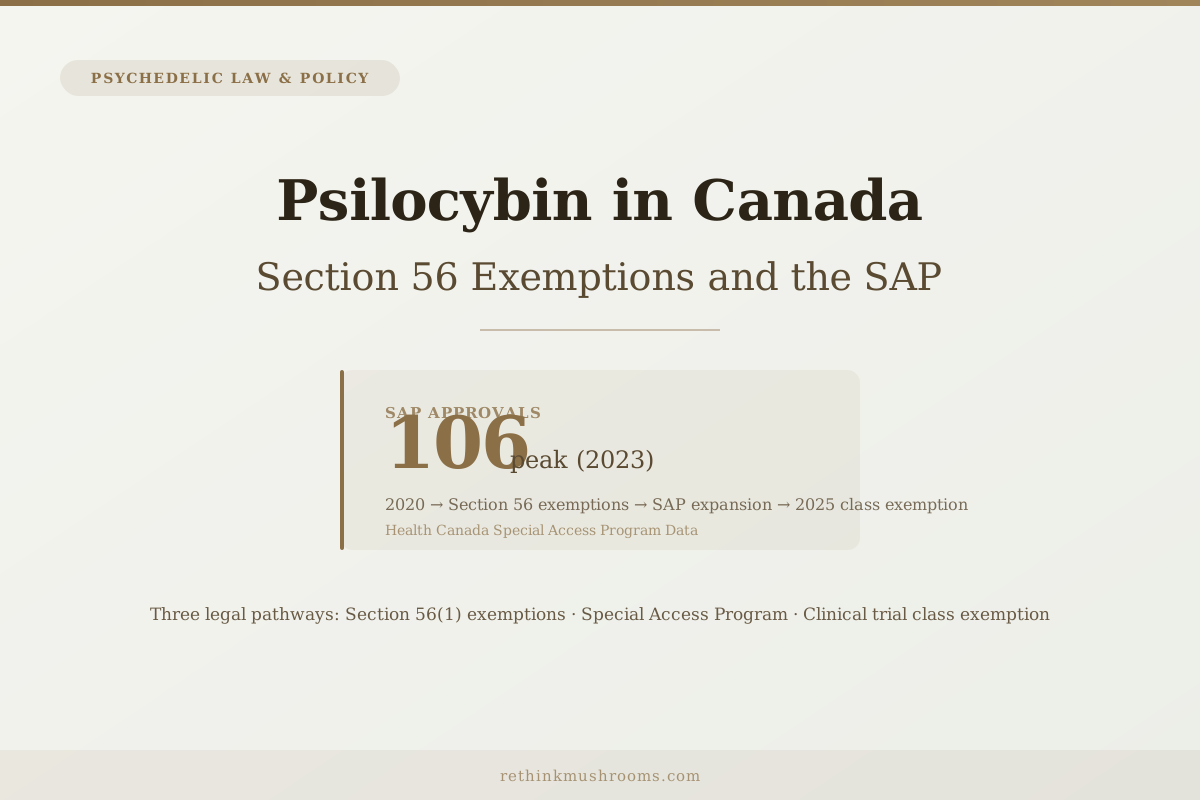
106
SAP approvals at peak in 2023
3 pathways
to legal psilocybin access in Canada today
Johnson et al., Neuropharmacology, 2018
 View as image ↗
Psilocybin is a Schedule III controlled substance in Canada. It is illegal to possess, distribute, or produce without government authorization. And yet since 2020, hundreds of Canadians have gained legal psilocybin access through three distinct mechanisms: Section 56 exemptions, the Special Access Program (SAP), and a class exemption for clinical trial participants introduced in September 2025.
Canada's approach sits between Jamaica's fully unregulated status and Australia's formal national rescheduling. It is not legalization, not decriminalization, and not a regulatory loophole. It is a deliberate administrative framework that government officials can widen or narrow based on political priorities, without changing any law. The rules haven't changed since 2022. The approval rates have. For a broader comparison of how countries have structured psilocybin access, see our guide to psilocybin legal status around the world. For the pillar context on Schedule I classification and the politics of reform, see psilocybin's Schedule I status: history and controversy.
Key Takeaways
- Canada has three legal pathways to psilocybin: Section 56(1) exemptions, the Special Access Program (SAP), and a September 2025 class exemption for clinical trial participants
- When Johnson et al. evaluated psilocybin against all 8 Controlled Substances Act criteria for abuse potential, none were clearly met; this analysis forms the scientific basis for Canada's willingness to grant medical exemptions[1]
- Health Canada approved 56 psilocybin SAP applications in 2022, 106 in 2023, and 104 in 2024; approvals fell to just 35 in the first half of 2025, reflecting political rather than scientific shifts
- Clinicians working with SAP patients face liability risks that formal prescribing authorization would eliminate, because psilocybin has no drug identification number in Canada[2]
- All three legal pathways require physician involvement; patients cannot apply for psilocybin access independently, which creates geographic and economic inequity across Canada[3]
- The September 2025 class exemption streamlined research participation for clinical trial enrollees but did not expand general therapeutic access
Three Ways to Get Legal Psilocybin Access in Canada
Canada has three distinct legal pathways. Each requires physician involvement. None allows patients to apply independently.
- Clinical trials: Participants in Health Canada-approved studies receive automatic possession authorization under a class exemption effective September 2025, including at-home administration between clinical sessions.
- Special Access Program (SAP): A physician applies to Health Canada on a specific patient's behalf. The patient must have a serious or life-threatening condition for which conventional treatments have been inadequate. Health Canada reviews and approves or denies individual applications.
- Section 56(1) exemptions: The federal Minister of Health can exempt any individual from the Controlled Drugs and Substances Act for medical or scientific purposes. This pathway drove Canada's first psilocybin access for terminal illness patients in 2020 and has since been used for practitioner training applications (with contested results, discussed below).
The SAP is now the primary route for patients outside clinical trials. Section 56(1) exemptions continue to be used but are generally reserved for situations the SAP does not cover.
What Canada's Drug Law Actually Says About Psilocybin
Psilocybin appears in Schedule III of Canada's Controlled Drugs and Substances Act (CDSA). Schedule III sits below Schedule I (cocaine, heroin, fentanyl) and Schedule II (formerly cannabis) in enforcement priority. But it still makes possession a criminal offence carrying up to three years in prison for a first indictable offense.
The CDSA includes a specific safety valve: Section 56(1), which allows the federal Minister of Health to exempt any person, substance, or class of persons from any provision of the Act if "the exemption is necessary for a medical or scientific purpose or is otherwise in the public interest." This is not a workaround or a gray area. It is the mechanism the Act itself provides for exactly this situation.
The legal tensions this creates are real. Because psilocybin cannot be formally prescribed (there is no drug identification number, or DIN, the regulatory mechanism that licenses a pharmaceutical product for prescribing), physicians who work with SAP patients operate in a liability gray zone that licensed prescribing would eliminate.[2] The exemption framework solves the access question without resolving the professional liability question. This is one of the structural criticisms the SAP faces from clinicians willing to engage with it.
The Scientific Argument That Made Medical Exemptions Defensible
Before Canada granted the first psilocybin exemptions, there had to be a defensible scientific rationale. That argument arrived in published form in 2018 when Matthew Johnson and colleagues at Johns Hopkins systematically evaluated psilocybin against all eight criteria the U.S. Controlled Substances Act uses to determine abuse potential.[1]
The eight factors include: actual or relative potential for abuse; scientific evidence of pharmacological effect; state of current scientific knowledge; history and current pattern of abuse; scope, duration, and significance of abuse; risk to public health; psychological or physiological dependence liability; and whether the substance is an immediate precursor to another controlled substance.
On each factor, the analysis found evidence pointing away from high scheduling. Psilocybin produces no physical dependence. Laboratory animals do not self-administer it voluntarily. There is no significant street market comparable to opioids or stimulants. The clinical trial record demonstrates a meaningful therapeutic profile.
The Johnson analysis did not create Canadian policy. But it represents the scientific consensus underlying why a Section 56 exemption for medical use is legally coherent: a substance that meets none of the standard criteria for high abuse potential is exactly the kind of substance the exemption mechanism was designed to accommodate.
2020: When the First Canadians Got Legal Access
TheraPsil, a Victoria-based non-profit advocacy organization, drove Canada's first psilocybin exemptions. In August 2020, then-Minister of Health Patty Hajdu granted Section 56(1) exemptions to four patients, all with terminal diagnoses, all seeking psilocybin-assisted therapy to address end-of-life distress.
These were individual exemptions, not a program. Each patient required a separate ministerial decision. The applications included clinical justification from treating physicians, documentation of the terminal prognosis, and a specific therapeutic rationale. The exemptions were narrow in scope, but they established the precedent: the minister's authority under Section 56(1) could reach psilocybin, and the government was willing to exercise it in compassionate circumstances.
TheraPsil continued filing applications for additional patients and, separately, for healthcare providers seeking psilocybin training experience (a more contested category, discussed below). By late 2021, dozens of Canadians held Section 56 exemptions for various therapeutic and training purposes.
The Special Access Program: How It Works and Who Gets In
In January 2022, Health Canada expanded the Special Access Program (a pathway for accessing unapproved drugs that had existed for decades covering experimental treatments) to formally include restricted drugs and controlled substances, including psilocybin.
The SAP has three core requirements:
Physician-initiated applications. A licensed Canadian physician must apply on behalf of the patient. Patients cannot apply independently. This requirement means access is gated by whether the treating clinician knows the program exists and is willing to navigate the application process. In urban centers with psychedelic-familiar psychiatrists, that is a manageable hurdle. In rural or remote communities, it can be an impassable one.
Qualifying clinical circumstances. The patient must have a serious or life-threatening condition for which conventional treatments have been tried and found inadequate, or for which conventional treatments are not appropriate for that patient. Depression and PTSD both qualify under this framing. The physician documents the treatment history.
Health Canada review. Health Canada evaluates the application and grants or denies approval. Approval covers a specific patient, a specific condition, and a specific treatment course. If approved, the physician must source the psilocybin from a licensed Canadian producer and oversee the treatment.
What is notably absent: standardized session protocols, required therapist training, insurance coverage, Medicare reimbursement. The SAP creates a legal pathway to access without creating a care infrastructure to support it. Research on therapeutic access models across multiple jurisdictions has found that specialist-dependent programs like Canada's SAP systematically disadvantage patients in regions where psychedelic-familiar clinicians are sparse, and create cost barriers for patients who must pay entirely out of pocket for extended treatment courses.[3]
2023 Was the Peak: Why the Numbers Have Been Falling
Health Canada's SAP approval data tells a story that none of the policy announcements do:
- 2022: 56 approvals
- 2023: 106 approvals
- 2024: 104 approvals
- First half of 2025: 35 approvals
The 2023-2024 numbers represent genuine momentum. Health Canada was processing roughly one application every three days at peak. The 2025 decline under the Carney government signals a reversal that is not reflected in any public regulatory change. No law was amended. No program was formally restricted. The application review process slowed.
This is how administrative access programs encode political will: not through legislation, but through approval rates. A government enthusiastic about therapeutic psilocybin access moves applications quickly. One that is skeptical allows them to accumulate in review. The patient on the other side of that bureaucratic pacing is waiting for treatment for a serious condition.
The practical effect for Canadians: psilocybin access through the SAP is real but politically fragile. It can be expanded or contracted by any incoming government without a parliamentary vote. Patients and clinicians building care plans around SAP access are operating in a framework that can shift without warning.
For context on how a more durable regulatory framework looks in practice, Australia's TGA approval process created formal rescheduling, a higher bar to clear initially but one that does not bend with each election cycle.
September 2025: The Clinical Trial Class Exemption
In September 2025, Health Canada issued a class exemption (a single authorization covering an entire category of people rather than requiring individual applications) for psilocybin possession by participants in approved clinical trials, including at-home administration between dosing sessions.
Before this change, clinical trial participants technically required individual Section 56 exemptions to legally possess the compound outside a clinical setting during the trial protocol. This paperwork burden slowed trial recruitment, created compliance gaps for researchers, and added administrative friction to studies that Health Canada had already approved as scientifically sound.
The class exemption resolved an internal contradiction: it was illogical for Health Canada to approve a clinical trial while simultaneously requiring each participant to obtain separate ministerial authorization for at-home possession. The September 2025 change aligned the participant experience with the regulatory approval the trial had already received.
What it did not change: people outside clinical trials still need SAP approval or individual Section 56 exemptions to access psilocybin legally. The class exemption helps researchers and enrolled participants. It does not expand general therapeutic access.
The Federal Court Ruling on Practitioner Training
One of TheraPsil's most contested campaigns was over training exemptions: Section 56(1) applications from therapists, nurses, counselors, and physicians who wanted to take psilocybin themselves as part of their clinical training for eventual patient care.
Health Canada refused these applications. The Ministry's position: supporting practitioners seeking personal psilocybin experience did not meet the "medical or scientific purpose" that Section 56(1) requires. Training a therapist is adjacent to medical purpose, but it is not itself a medical treatment of a patient.
TheraPsil challenged the refusals in Federal Court. The court found that Health Canada's reasoning was unreasonable: not that the refusals were necessarily wrong on the merits, but that the Ministry had not properly engaged with the evidence and arguments TheraPsil presented before denying. The ruling required Health Canada to reconsider the applications with proper analysis. As of mid-2025, those reconsiderations are ongoing.
The stakes here extend beyond individual practitioner applications. Therapist training is the bottleneck for any future therapeutic access expansion. SAP approvals are of limited practical use if there are no trained practitioners to provide the treatment. A training exemption pathway, if it ultimately results from this ruling, could meaningfully increase the pool of qualified clinicians over the next several years.
The Access Problem No Program Has Solved
Canada's exemption framework produces a structural paradox: legal access exists in principle for patients with serious conditions, but in practice it is heavily filtered through geography, specialist availability, and cost.
The SAP requires physician initiation. This creates a real access gap between patients in cities with academic medical centers and psychiatrists familiar with the literature, and patients in smaller communities where the only available physician may never have heard of the program. Both patients may carry the same diagnosis and the same failed treatment history. One has a realistic path to SAP access. The other does not.
The cost problem compounds this. Unlike Australia's framework (formal, expensive, but defined with a clear cost structure), Canada's SAP has no standard pricing. Patients pay out-of-pocket for specialist consultations, licensed psilocybin sourcing, and extended therapeutic supervision. Research analyzing therapeutic access models across jurisdictions has found that specialist-dependent, uninsured programs reproduce economic and geographic inequity regardless of how accessible the formal application process looks on paper.[3] Proposed solutions (insurance coverage pathways, sliding-scale models, community health worker integration) remain policy suggestions rather than implemented programs in Canada.
For Canadians who cannot access the SAP and are exploring what is available in other jurisdictions, psilocybin's legal status in Jamaica and legal psilocybin access options before FDA approval cover the full international landscape.
How a Canadian Patient Would Pursue Access Today
Given where programs stand as of 2026, a Canadian patient seeking legal psilocybin access has two realistic routes.
Through the SAP. Find a physician willing to submit a SAP application. TheraPsil maintains a directory of Canadian clinicians who know the program and have worked with patients on applications before. The process takes weeks to months. Approval is not guaranteed. Once approved, the physician must identify a licensed psilocybin producer for sourcing, which adds time and additional operational steps.
Through clinical trial enrollment. For patients who qualify for active trials, enrollment provides legal access under the September 2025 class exemption. Trials are concentrated in Vancouver, Toronto, and Montreal. ClinicalTrials.gov and MAPS Canada list active protocols by indication and location.
No path is available without physician involvement. No path provides insurance coverage or Medicare reimbursement. No path guarantees a reasonable timeline when SAP approval rates are running at first-half-2025 levels.
Whether Canada eventually moves toward a formal therapeutic framework (a licensed practitioner system with defined training standards, session protocols, and a regulated marketplace) is an open political question. The Netherlands truffle model and Oregon's state-regulated program represent two different approaches to formalizing access. Canada's current system has structural elements of neither.
The Bottom Line
Canada has built meaningful but politically fragile legal psilocybin access through Section 56 exemptions and the Special Access Program. The trajectory from four terminal patients in 2020 to 106 SAP approvals in 2023, then declining sharply in 2025, illustrates how administrative programs encode political will without requiring any legislative change. The September 2025 class exemption for clinical trial participants addressed a specific compliance gap without expanding general therapeutic access. For patients pursuing access today, physician advocacy and TheraPsil support remain the primary practical pathways, with the understanding that approval timelines are currently lengthening.
Frequently Asked Questions
Sources & References
- 1. Source details for this reference are not yet available.
- 2RTHM-01983·Schonholz, Stephanie M et al. (2024). “Legal and Ethics Concerns of Psilocybin as Medicine..” The journal of the American Academy of Psychiatry and the Law.Study breakdown →PubMed →↩
- 3. Source details for this reference are not yet available.