Psychedelic Law & Policy
31M Americans have used psilocybin
Psilocybin is now the second most-used illicit substance in the United States, yet whether it is legal, prescribable, or criminal depends entirely on which country you are standing in.
Jones et al., Annals of Internal Medicine, 2025
4 countries
where psilocybin mushrooms were never scheduled: Jamaica, Brazil, Nepal, Bahamas
47 patients
on psilocybin-assisted therapy under Australia's national program as of late 2025
$15,000+ AUD
typical cost of a full psilocybin treatment course in Australia, with no Medicare reimbursement
Jones et al., Annals of Internal Medicine, 2025
 View as image ↗
By 2023, an estimated 31 million Americans had used psilocybin at least once, accounting for 12.1% of all adults, with past-year use having doubled since 2019.[1] Psilocybin is now the second most-used illicit substance in the United States, trailing only cannabis. Yet psilocybin legal status varies dramatically by country: whether a person can access it through a doctor's prescription, an unregulated retreat, or not at all depends entirely on where in the world they live.
This guide maps the current legal landscape, explains the specific mechanisms that make each jurisdiction different, and covers what research shows about what actually happens when a country or city changes its policy. For the history of how psilocybin ended up Schedule I in the United States, see The History of Psilocybin's Schedule I Status.
Key Takeaways
- 31 million Americans had used psilocybin by 2023, with past-year use doubling to 2.1%; psilocybin is now the second most-used illicit substance after cannabis (Jones et al., Annals of Internal Medicine, 2025)
- Jamaica, Brazil, Nepal, and the Bahamas have never scheduled psilocybin mushrooms; possession, use, and sale are all unregulated under those countries' laws
- Australia became the first country to authorize psychiatrists to prescribe psilocybin in July 2023; by late 2025, 47 patients had received it under the program with no serious adverse events recorded (Nutt et al., British Journal of Pharmacology, 2024)
- The Netherlands' legal truffle market exists because a 2008 ban on mushrooms listed only the fruiting body; the underground sclerotia were not named, creating a legal gap that the smart shop industry immediately filled
- After Denver decriminalized psilocybin in 2019, use rates increased but crime arrests did not; most new users cited mental health self-treatment as their motivation (Bhave et al., Journal of Psychoactive Drugs, 2025)
- Legal access remains expensive everywhere: Oregon charges $1,200–$3,500 per session, Australian treatment runs $15,000–$25,000 AUD, and Jamaica retreats cost $5,000–$7,000 per participant (Greenberg et al., 2025)
The Short Answer: Psilocybin Legal Status by Category
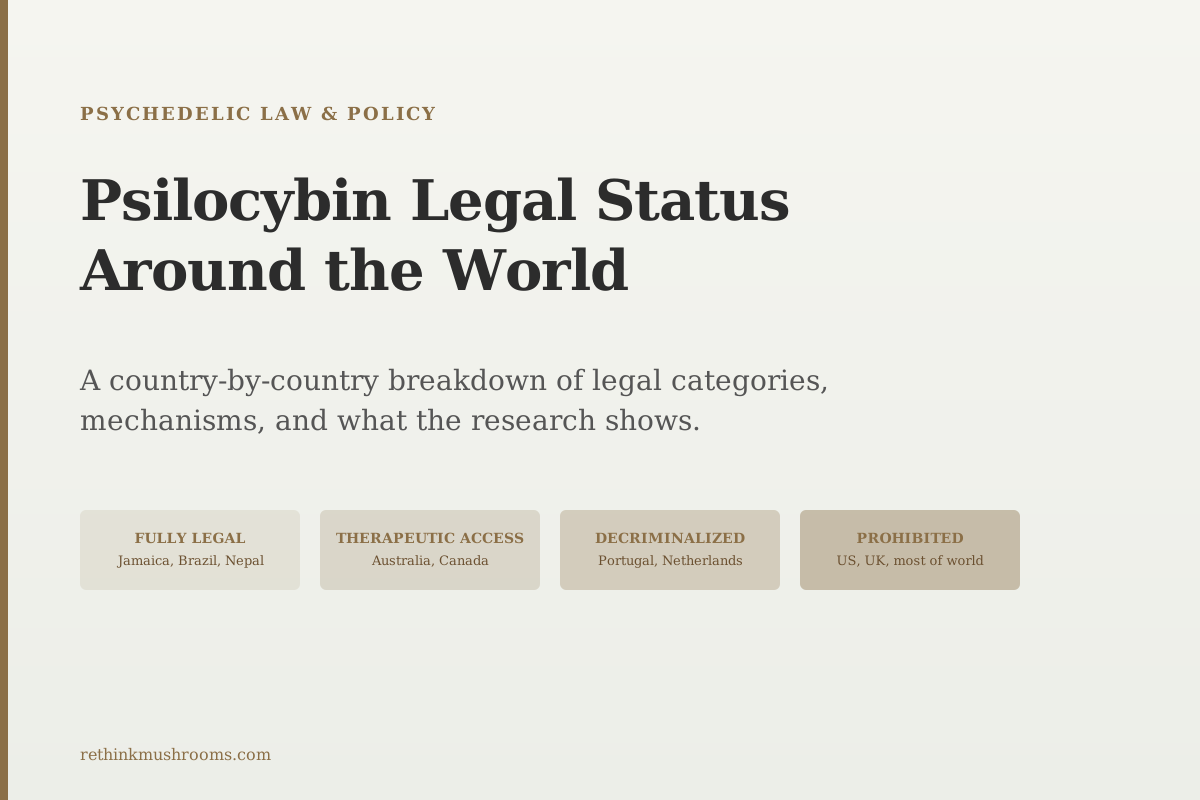
Four categories cover almost every country in the world. The majority of nations fall under the final one.
| Category | What it means | Examples |
|---|---|---|
| Fully legal or unregulated | Psilocybin mushrooms are not listed under national drug law | Jamaica, Brazil, Nepal, Bahamas |
| Therapeutic access | Legal only through medical authorization or licensed programs | Australia, Canada, Switzerland |
| Decriminalized | Personal possession is no longer criminal but the substance remains illegal | Portugal, Czech Republic, Netherlands (truffles only) |
| Prohibited | Scheduled under national law; possession and sale are criminal | United States, United Kingdom, and most of the world |
The dominant framework is prohibition, and the reason traces back to a single international treaty. For a deeper look at what these categories mean in practice, see Decriminalization vs. Legalization: What's the Difference.
Why Most of the World Prohibits Psilocybin by Default
In 1971, the United Nations adopted the Convention on Psychotropic Substances. Psilocybin was placed in Schedule I alongside LSD and mescaline. Signatory countries were obligated to adopt national laws restricting or prohibiting Schedule I substances.
Most of the world's drug laws prohibiting psilocybin were not independent decisions. They were downstream obligations of the 1971 treaty.
The Convention contains an important ambiguity. It applies to psilocybin as a chemical compound, not to mushrooms containing that compound. In 2001, the International Narcotics Control Board clarified that the Convention does not apply to mushrooms themselves, only to extracted psilocybin. This created the legal space for countries like Jamaica and Brazil to argue that their drug laws, which list psilocybin the compound but not psilocybin mushrooms, leave mushrooms technically unregulated.
That distinction explains why a legally gray retreat industry exists in Jamaica while possession of the same compound in extracted form is criminal in most places. It is also the reason that reform advocates have focused on rescheduling the compound rather than simply amending mushroom lists.
Fully Unregulated: Four Countries Where Psilocybin Was Never Scheduled
Jamaica
Psilocybin mushrooms are not listed in Jamaica's Dangerous Drugs Act. This is not an affirmative decision to legalize them. It is a legislative omission. When Jamaica drafted its drug control law, modeled in large part on the UK's Misuse of Drugs Act, psilocybin mushrooms were not included among the controlled substances.
That omission has made Jamaica the most commercially significant destination for Americans and Europeans seeking legal psilocybin access. Retreat operators have built a substantial industry around this legal gap, with packages typically running $5,000–$7,000 per participant.[8] Jamaica's government development body, JAMPRO, has formally endorsed psilocybin as an economic growth sector.
The absence of regulation is also the absence of consumer protection. There is no licensing requirement for retreat facilitators, no safety standard for session environments, and no formal recourse if a participant has a difficult or harmful experience.
For the full breakdown of Jamaica's legal framework and the retreat industry, see Psilocybin in Jamaica: Legal Status and Retreat Industry.
Brazil
Brazil's situation is similar to Jamaica's but with a different history. In the 1990s, psilocybin mushrooms briefly appeared on Brazil's national health regulator's list of prohibited substances. They were subsequently removed from that list. The compound psilocybin remains controlled, but mushrooms are not explicitly banned under Brazilian law, and courts have ruled inconsistently on personal cultivation cases. The practical status for mushrooms is unregulated gray area.
Nepal and the Bahamas
Nepal has no specific prohibition on psilocybin mushrooms, which grow naturally at high altitude in the Himalayas and have a documented history of use in some religious contexts. The Bahamas similarly never scheduled psilocybin or psilocin in its domestic legislation.
Neither country has developed a significant commercial psychedelic industry, which distinguishes them from Jamaica, where the legal status is actively leveraged economically.
Therapeutic Access: Countries Where Psychiatrists Can Legally Prescribe Psilocybin
Australia: The First National Prescription Program
Australia made history on July 1, 2023, when the Therapeutic Goods Administration rescheduled psilocybin from Schedule 9 (prohibited substance) to Schedule 8 (controlled medicine) for treatment-resistant depression.[4] This was the first time any national regulator formally authorized psilocybin as a medicine.
The program works through the TGA's Authorized Prescriber scheme. A psychiatrist must apply to and be approved by the TGA before prescribing psilocybin to individual patients with treatment-resistant depression. By late 2025, 47 patients had received psilocybin-assisted therapy under this framework, with no serious adverse events recorded via Freedom of Information data.[4]
The practical reality is constrained. A full treatment course costs $15,000–$25,000 AUD, and as of 2026, there is no Medicare reimbursement.[5] Training requirements for Authorized Prescribers are not standardized, limiting the available clinician pool. A 2026 analysis in the Australian and New Zealand Journal of Psychiatry described the framework as "over-medicalized compared to therapeutic need" and argued for expanded access models that do not require specialist-level authorization for every patient.[5]
For the full account of how Australia reached this decision and how the program operates, see Australia's TGA Approval: The First Country to Prescribe Psilocybin.
Canada: Therapeutic Access Through Case-by-Case Authorization
Canada provides legal psilocybin access through two pathways: the Special Access Program (SAP), where physicians apply to Health Canada for approval on behalf of individual patients, and Section 56(1) exemptions under the Controlled Drugs and Substances Act, used primarily for palliative and terminal care patients.
Neither is a prescription model. Both require Health Canada approval for each individual case. This case-by-case structure creates practical tensions: clinicians operating within Canada's access framework face liability exposure because psilocybin remains a controlled substance, and the informed consent standards for patients receiving a Schedule I compound outside a regulated clinical trial are not well defined.[7]
Access through Canada's programs is also geographically uneven. Both pathways depend on specialist involvement, which means that patients in rural or remote regions face significant barriers that urban patients do not.[8]
For the full picture of how Canada's access structure works and how it has evolved under successive governments, see Psilocybin in Canada: Section 56 Exemptions and SAP.
Switzerland: Compassionate Use Authorizations
Switzerland permits psilocybin access through compassionate use authorizations issued by Swissmedic, the national drug regulator. This is not a formal therapeutic program. It is a case-by-case mechanism for patients where the potential benefit is judged to outweigh the risk and no approved alternative exists.
Switzerland has also been the site of several significant psilocybin clinical trials, partly because its regulatory environment accommodates research involving Schedule I compounds more readily than most European jurisdictions.
The Netherlands: A 2008 Legislative Accident That Built a Legal Psychedelic Industry
In 2008, after a French tourist died in Amsterdam following psilocybin mushroom use, the Dutch government rushed an emergency amendment to the Opium Act. The amendment banned psilocybin mushrooms by adding them to Schedule I.
The legal language specified the fruiting body: the cap and stem that grow above ground. It did not mention sclerotia, the dense underground fungal structures commonly called truffles. Within days of the ban taking effect, smart shops that had been selling mushrooms pivoted entirely to truffle products. Species including Psilocybe tampanensis and Psilocybe mexicana were already being cultivated for their sclerotia. The industry continued without interruption.
The loophole has proven durable. The Netherlands' smart shop sector and a growing Amsterdam retreat industry now operate openly, selling truffle products that are chemically identical to banned mushrooms but technically legal under the specific wording of the Opium Act amendment.
For the full account of how this industry developed and what it looks like today, see Magic Truffles in the Netherlands: How a Loophole Created an Industry.
Decriminalized but Not Legal: Portugal, Czech Republic, and Others
Decriminalization removes criminal penalties from personal possession but does not make a substance legal. The distinction matters: in a decriminalized jurisdiction, a person cannot be arrested for possessing small amounts of psilocybin mushrooms, but the substance remains illegal. There is no regulated supply, and selling remains a criminal offense.
Portugal went furthest in 2001, when a law decriminalized personal possession of all controlled substances and reframed drug use as a public health matter rather than a crime. An administrative panel can impose non-criminal sanctions (fines, community service, or mandatory treatment referrals), but there is no arrest, no prosecution, and no criminal record for possession of personal quantities.
The Czech Republic similarly decriminalized small amounts of controlled substances, including psilocybin mushrooms.
For the US-specific context, a wave of city-level decriminalization resolutions starting with Denver in 2019 has spread to more than a dozen municipalities. See Denver, Oakland, and Beyond: The Decriminalization Wave for the complete US picture.
What Actually Happens to Use Rates After Decriminalization: The Denver Evidence
The persistent concern about drug policy liberalization is that removing criminal penalties will cause use to surge, bringing associated public safety problems. Denver's 2019 decriminalization vote generated the first dataset in the United States to test this directly.
A 2025 cohort study in the Journal of Psychoactive Drugs tracked outcomes in Denver after decriminalization.[3] Use rates did increase after the vote. Crime arrests associated with psilocybin did not increase, and there were no significant negative public safety outcomes.
The majority of new users were not recreational experimenters. Most were motivated by mental health self-treatment, citing conditions including depression and anxiety as the reason they sought out psilocybin after decriminalization.[3] This pattern matches the national data: in the Jones 2025 survey across all US adults, people with mental health conditions or chronic pain were the most likely to have used psilocybin, regardless of its legal status where they lived.[1]
Denver is one data point, from one American city, with a limited follow-up window. It does not speak to what might happen in countries with different baseline drug cultures or legal contexts. But it is currently the most direct empirical evidence available on what psilocybin decriminalization produces in a real-world setting.
Legal Doesn't Mean Affordable: The Cost Gap Across Legal Jurisdictions
Every legal access pathway has a cost structure that shapes who can actually use it. A 2025 policy analysis documented the approximate costs across the major legal frameworks[8]:
- Oregon (therapeutic access under Oregon Psilocybin Services): $1,200–$3,500 per session
- Australia (TGA Authorized Prescriber scheme): $15,000–$25,000 AUD for a full treatment course
- Jamaica (unregulated retreat model): $5,000–$7,000 per participant
- Canada (Special Access Program): varies by clinic, generally several thousand dollars, no provincial insurance coverage
None of these pathways are covered by standard health insurance. None have built-in mechanisms for subsidized access. The populations most likely to benefit from psilocybin-assisted treatment based on the clinical evidence (those with treatment-resistant depression, PTSD, or substance use disorders) are also the populations with the greatest barriers to absorbing these costs.[8]
This is one of the central criticisms of how the first wave of legal reform has unfolded. Legal access has been achieved in several jurisdictions, but the practical benefits remain concentrated among people with significant disposable income.
The Scientific Argument Behind Every Reform Campaign
For any reform movement, it helps to have a document that frames the scientific case rigorously. For psilocybin, that document was published in Neuropharmacology in 2018.
Matthew Johnson and colleagues applied the Controlled Substances Act's own eight-factor framework for scheduling decisions directly to psilocybin.[6] The CSA requires regulators to evaluate abuse potential, dependence liability, pharmacological effects, and public health risks, among other criteria. The analysis concluded that psilocybin has low abuse potential, produces no physical dependence, and has demonstrated accepted medical use in controlled studies. The paper argued that the current Schedule I classification is scientifically unjustified under the law's own criteria.
This shifted the reform conversation from a values argument to a technical one: not just "we should change this" but "the law's own framework says this compound doesn't belong in Schedule I." It became a foundational citation for reform advocates in Congress, state legislatures, and the FDA's own review processes.
A 2023 review in JAMA Psychiatry by Siegel and colleagues documented how rapidly legislative action followed the scientific argument: between 2019 and 2022, a patchwork of city decriminalization resolutions, state ballot initiatives (Oregon in 2020, Colorado in 2022), and therapeutic access frameworks emerged across the United States at a pace without precedent in modern drug policy history.[2]
The reform wave has outpaced the regulatory infrastructure in most cases. Federal Schedule I classification in the United States still blocks clinical prescribing, creates liability exposure for clinicians operating in legal state programs, and conflicts with the patient protections that normally govern medical treatment.[7] For a full account of the political and legal mechanisms that keep psilocybin federally prohibited despite the evidence, see Why Psilocybin Is Federally Illegal Despite Proven Medical Value.
The Bottom Line
Psilocybin legal status ranges from fully unregulated in Jamaica, Brazil, Nepal, and the Bahamas to nationally prescribable as a medicine in Australia since July 2023. Most countries prohibit it as a downstream obligation of the 1971 UN Convention. The jurisdictions that have liberalized (through therapeutic access programs, decriminalization, or legislative omission) represent a small fraction of the global map, but they are generating the first real-world data on what liberalization produces. Use rates rise after decriminalization; adverse public safety outcomes have not materialized in the jurisdictions studied so far.
Frequently Asked Questions
Sources & References
- 1. Source details for this reference are not yet available.
- 2RTHM-01791·Siegel, Joshua S et al. (2023). “Psychedelic Drug Legislative Reform and Legalization in the US..” JAMA psychiatry.Study breakdown →PubMed →↩
- 3RTHM-02058·Bhave, Ashutosh (2025). “Magic of the Mushrooms: Effects of Psilocybin Decriminalization..” Journal of psychoactive drugs.Study breakdown →PubMed →↩
- 4. Source details for this reference are not yet available.
- 5. Source details for this reference are not yet available.
- 6. Source details for this reference are not yet available.
- 7RTHM-01983·Schonholz, Stephanie M et al. (2024). “Legal and Ethics Concerns of Psilocybin as Medicine..” The journal of the American Academy of Psychiatry and the Law.Study breakdown →PubMed →↩
- 8. Source details for this reference are not yet available.