Psilocybin Legal Status
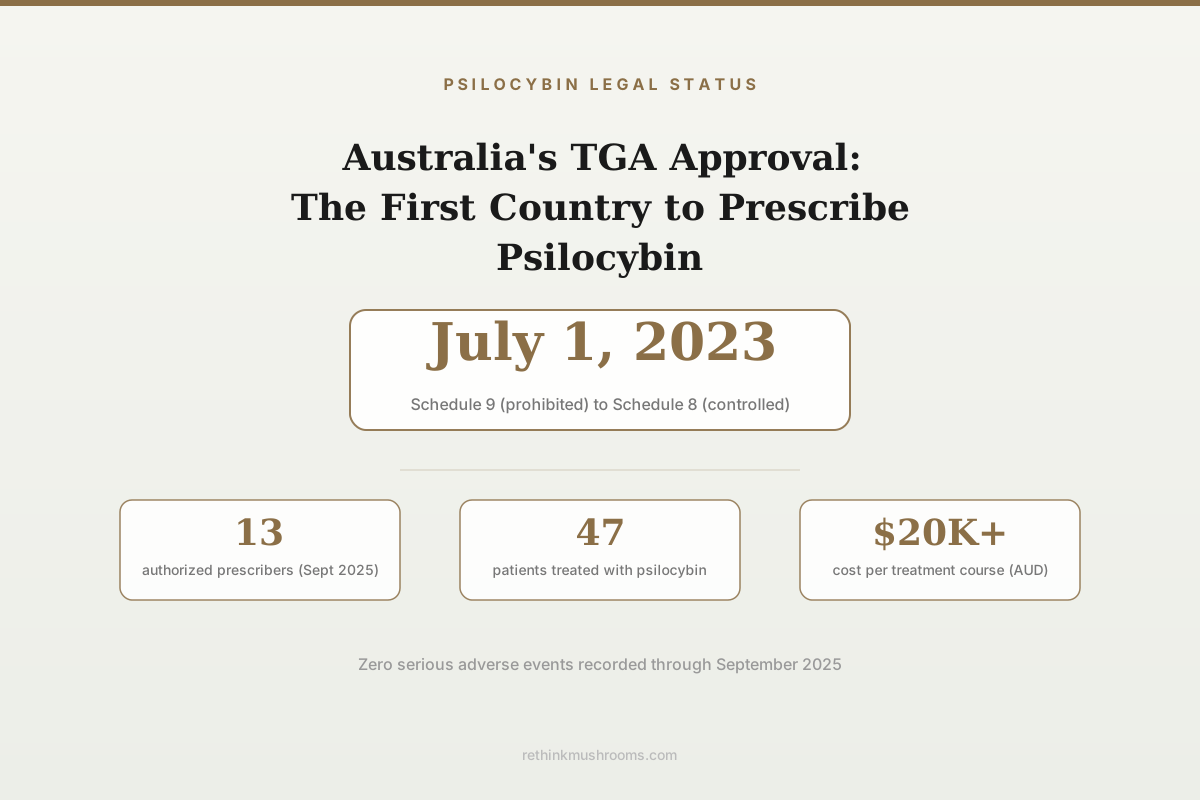
July 1, 2023
Australia became the first country in the world to allow authorised psychiatrists to prescribe psilocybin for treatment-resistant depression, reclassifying it from Schedule 9 (prohibited) to Schedule 8 (controlled medicine).
Nutt et al., British J. Pharmacology, 2024
26
psilocybin authorised prescribers by Sept. 2025
47
patients treated with psilocybin by Sept. 2025
$20,000+
estimated cost per treatment course
Nutt et al., British J. Pharmacology, 2024
 View as image ↗
On February 3, 2023, Australia's Therapeutic Goods Administration (TGA) announced that psilocybin would be reclassified from Schedule 9 (prohibited substance) to Schedule 8 (controlled medicine) for treatment-resistant depression, effective July 1, 2023. The same reclassification applied to MDMA for post-traumatic stress disorder. No other country had taken this step. The decision positioned Australia as a global test case for psychedelic-assisted therapy within a regulated medical framework. Three years in, the results tell a more complicated story than the initial headlines suggested: the regulatory pathway works, the early clinical data is encouraging but thinner than commonly assumed, and access remains severely limited by cost, geography, and administrative complexity. For a broader view of psilocybin's legal status worldwide, see the guide on psilocybin legal status around the world.
Key Takeaways
- Australia reclassified psilocybin from Schedule 9 to Schedule 8 on July 1, 2023, allowing authorised psychiatrists to prescribe it for treatment-resistant depression outside of clinical trials (Nutt et al., 2024)
- By September 2025, 26 psychiatrists held psilocybin Authorised Prescriber status and 47 patients had received psilocybin-assisted therapy, across six of Australia's eight states and territories (TGA data released under Freedom of Information)
- No serious adverse events were reported across the entire programme cohort as of September 2025, though the denominator is small
- Treatment costs upward of AUD $20,000 per course are not covered by the Pharmaceutical Benefits Scheme, creating what researchers describe as a risk of a "two-tiered mental health system" (Dutton et al., 2026)
- Australia's first domestic psilocybin trial found a clinically meaningful aggregate reduction in depression severity, but of seven participants only two sustained response, three relapsed, and two did not substantially improve (Meikle et al., 2025)
- No psilocybin product is listed on Australia's Register of Therapeutic Goods, requiring imported formulations through exemption processes (Dutton et al., 2026)
- The COMPASS Pathways phase 2 trial found a 37% response rate at 3 weeks with 25 mg psilocybin versus 18% for the 1 mg control (remission 29% versus 8%), with adverse events in 77% of participants (Goodwin et al., 2022)
The Reclassification Decision
The TGA's decision moved psilocybin and MDMA from Schedule 9 (prohibited substances available only for research) to Schedule 8 (controlled medicines available by prescription) for specific indications only. Psilocybin was approved for treatment-resistant depression; MDMA was approved for PTSD. All other uses of both substances remain Schedule 9 prohibited.[1]
The reclassification did not follow the conventional drug approval pathway. No psilocybin product had completed Phase 3 clinical trials. No product held marketing authorisation. Instead, the TGA used its existing Authorised Prescriber Scheme, which allows individual clinicians to prescribe unapproved therapeutic goods for specific patients after obtaining ethics committee approval and TGA authorisation.
This regulatory architecture was pragmatic: it acknowledged the growing evidence base while maintaining tight controls. Prescribing was restricted to psychiatrists, given their specialised qualifications to diagnose and manage patients with serious mental health conditions using therapies that are not yet fully established. Each prescribing psychiatrist requires approval from a Human Research Ethics Committee (HREC) registered with the National Health and Medical Research Council, followed by TGA authorisation under the Authorised Prescriber Scheme.[1]
The decision was not unanimous within Australian psychiatry. The Royal Australian and New Zealand College of Psychiatrists (RANZCP) had made a submission to the TGA in May 2022 opposing the rescheduling application, describing the evidence base for psychedelic-assisted therapy as promising but limited and emerging, and advising a cautious approach led by further research. The College has since stated that it was not further consulted on the additional controls the TGA ultimately adopted, and that it accepts those narrower controls and supports restricting prescribing to authorised psychiatrists. A separate objection came from Australian researchers with direct experience delivering psilocybin-assisted psychotherapy for treatment-resistant depression, who published an editorial in the Australian and New Zealand Journal of Psychiatry in 2023 asking why the TGA had not consulted them before making the scheduling change (Rossell, Meikle, Williams and Castle, 2023).
The Evidence Base Behind the Decision
The TGA's decision rested on an evolving but incomplete evidence base. The most influential trial at the time was the COMPASS Pathways phase 2 study published in the New England Journal of Medicine.
Goodwin et al. (2022) randomised 233 adults with treatment-resistant depression to receive a single dose of a proprietary synthetic formulation of psilocybin at 25 mg, 10 mg, or 1 mg (control), alongside psychological support.[2] Mean MADRS (Montgomery-Åsberg Depression Rating Scale) scores at baseline were 32 to 33 in each group. At three weeks, least-squares mean changes from baseline were −12.0 for the 25 mg group, −7.9 for the 10 mg group, and −5.4 for the 1 mg control. The difference between 25 mg and control was −6.6 points (95% CI −10.2 to −2.9; P<0.001). The 10 mg dose did not separate from control (−2.5; 95% CI −6.2 to 1.2; P=0.18). At week 3, 37% of the 25 mg group met response criteria (at least a 50% MADRS reduction) versus 18% of the 1 mg control, and 29% achieved remission (MADRS total of 10 or below) versus 8%. The 29% figure is worth pinning down, because it circulates widely as a response rate: it is the remission rate.
The Trial Behind the Decision
MADRS Change at Three Weeks, by Dose Arm
Longer bars mean greater symptom reduction. The gap that mattered to regulators is the one between 25 mg and the 1 mg control — 6.6 points on a 60-point scale.
- 25 mgn=7937% response · 29% remission-12.0
Separated from control (P<0.001)
- 10 mgn=7519% response · 9% remission-7.9
Did not separate from control (P=0.18)
- 1 mg (control)n=7918% response · 8% remission-5.4
Comparator arm
Two things the headline number leaves out: the 25 mg advantage was measured at three weeks and was not sustained at twelve weeks, and adverse events occurred in 77% of all participants, with suicidal ideation, suicidal behaviour or self-injury recorded in every dose group including the control.
Source: Goodwin et al., New England Journal of Medicine, 2022;387(18):1637-1648. Values are least-squares mean changes from baseline in total MADRS score. Response is a reduction of at least 50% from baseline at week 3; remission is a total MADRS score of 10 or below at week 3. The frequently quoted “29%” is the 25 mg remission rate, not its response rate — quoting it against the 1 mg response rate of 18% compares two different endpoints. Not medical advice.
This trial shaped the regulatory landscape because it was the largest psilocybin trial in treatment-resistant depression and used a rigorous double-blind design. But it is frequently described more favourably than it reads. The 25 mg advantage was measured at three weeks; sustained response at twelve weeks was not supportive of the primary result. Adverse events occurred in 179 of 233 participants (77%), and suicidal ideation, suicidal behaviour, or self-injury occurred in all dose groups, including control.[2] The trial investigators themselves concluded that larger and longer trials, including comparison with existing treatments, were required. The gap between open-label enthusiasm and controlled-trial reality is a recurring pattern in psychedelic research, and Australia's regulators made their decision while that gap was still open.
Goodwin et al. (2022) · New England Journal of Medicine
- Population
- 233 adults with treatment-resistant depression
- Intervention
- Single dose of synthetic psilocybin (25 mg, 10 mg, or 1 mg) with psychological support
- Comparator
- 1 mg psilocybin as the low-dose control arm
- Finding
- At three weeks, 25 mg reduced MADRS scores 6.6 points more than the 1 mg control (P<0.001), with a 37% response rate versus 18% and 29% remission versus 8%. The 10 mg dose showed no significant advantage over control, and the 25 mg advantage was not sustained at twelve weeks.
mixed Statistically convincing at the primary endpoint, modest in magnitude, unsustained at twelve weeks, and accompanied by adverse events in 77% of participants.
Goodwin et al., New England Journal of Medicine, 2022;387(18):1637-1648
Earlier mechanistic work by Carhart-Harris et al. (2017) examined what psilocybin does to the depressed brain using fMRI before and after treatment. In 19 patients with treatment-resistant depression — 16 of whom produced usable pre- and post-treatment imaging — depressive symptoms decreased in all 19 at one week, and 47% met response criteria at five weeks. Whole-brain analysis showed decreased cerebral blood flow in the temporal cortex, including the amygdala, and the size of that amygdala change correlated with the degree of symptom improvement. Resting-state functional connectivity within the default mode network increased after treatment, and specific connectivity changes predicted response at five weeks.[3] The authors proposed a "reset" mechanism. These findings provided mechanistic plausibility beyond symptom scores, though they come from a small, open-label sample. For more on psilocybin's receptor-level mechanisms, see the article on 5-HT2A receptor density and psilocybin response.
- Cell & Lab Studiescompleted
Extensive 5-HT2A receptor pharmacology establishing psilocin as a partial agonist and a plausible mechanism for rapid antidepressant action
- Animal Studiescompleted
Rodent work on dendritic spine growth and behavioural despair models supporting a neuroplasticity hypothesis
- Case Reports & Early Seriescompleted
Open-label series including Carhart-Harris 2017 (19 patients, fMRI mechanisms, 47% response at 5 weeks)
- Small Human Trialscompleted
Multiple small randomised and open-label trials in depression and end-of-life distress, mostly single-site with modest samples
- Large Randomized Trialscurrent
Goodwin 2022 (n=233) was the largest — a phase 2, not phase 3, trial. No psilocybin product had completed phase 3 or held marketing authorisation anywhere in the world when the TGA decided
- Meta-Analyses & Systematic Reviewsmissing
No meta-analysis of phase 3 data existed, because no phase 3 data existed
Australia rescheduled psilocybin on phase 2 evidence. That is the defining fact of this decision: every rung below large randomised trials had been climbed, the top two had not, and the regulator chose a restricted prescribing pathway rather than waiting for marketing approval that did not yet exist.
Goodwin et al. 2022; Carhart-Harris et al. 2017; Nutt et al. 2024
First Patients and Early Results
The first Australian patients received psilocybin-assisted therapy in early 2024 under the Authorised Prescriber pathway. Aggregated TGA data through mid-September 2025, released under a Freedom of Information request lodged by The Psychedelic Consultancy, showed 47 patients treated with psilocybin for treatment-resistant depression and 87 treated with MDMA for PTSD, with 26 psychiatrists holding psilocybin Authorised Prescriber status and 30 holding it for MDMA, spanning six of Australia's eight states and territories. Zero serious adverse events were reported across the entire cohort.
Three Years In — The Verified Numbers
Australia’s Authorised Prescriber Programme to September 2025
These figures come from a Freedom of Information release of TGA data, not from the peer-reviewed policy papers they are often attributed to. The distinction matters, because the numbers in circulation are frequently out of date.
| Metric | Psilocybin (TRD) | MDMA (PTSD) |
|---|---|---|
| Authorised prescribersPsychiatrists holding TGA Authorised Prescriber status; some hold it for both substances. | 26 | 30 |
| Patients treatedUnique patients dosed under the programme, not applications or enquiries. | 47 | 87 |
| Serious adverse eventsZero SAEs reported across the whole cohort — reassuring, but on a very small denominator. | 0 | 0 |
Coverage: the programme reached six of Australia’s eight states and territories, including some regional areas. Forty-seven patients in a country of roughly 27 million is the number that defines this programme — not the scheduling decision that made it legally possible.
Sources: aggregated TGA data through 16 September 2025, obtained under Freedom of Information by The Psychedelic Consultancy and reported by Psychedelic Alpha. Cost and policy findings are from Dutton et al., Australian & New Zealand Journal of Psychiatry, 2026, which does not itself report these counts. Figures describe the programme as of September 2025 and have continued to move since.
These numbers are low for a country of roughly 27 million people. Dutton et al. (2026) documented the structural reasons in a critical analysis of the programme: limited prescriber access, the absence of any product listed on the Australian Register of Therapeutic Goods, the lack of standardised training pathways, and significant cost barriers. The multi-layered approval process — HREC approval, TGA authorisation, state-level permissions, and ongoing reporting — compounds each of these.[4]
The absence of serious adverse events through September 2025 is a genuine finding, but it rests on 47 psilocybin patients. A safety record built on that denominator can rule out common serious harms; it cannot rule out uncommon ones. It is consistent with the broader psilocybin clinical trial literature showing a favourable acute safety profile in controlled clinical settings — a literature that, as the COMPASS trial shows, is not free of concerning signals.
Australia's first domestic psilocybin clinical trial was conducted at Swinburne University of Technology. Meikle et al. (2025) published results from this open-label, single-arm pilot of two 25 mg psilocybin doses delivered alongside three preparatory and six integration psychotherapy sessions, in patients with treatment-resistant depression.[5]
Seven participants completed the protocol. At the three-week primary endpoint, measured with the self-rated Quick Inventory of Depressive Symptomatology, the aggregate mean change was −7.14 (P=0.02; Hedges' g = −1.27, 95% CI −2.40 to −0.37), and the aggregate improvement was maintained at long-term follow-up 20 weeks after the second dose. Individual participant data showed a wider spread than the average suggests: two participants sustained response, three responded and then relapsed, and two showed no substantial improvement. Exploratory analyses identified mindset before dosing, spiritual experiences, and perceptual shifts during dosing as predictors of trajectory, while treatment expectations were not a reliable predictor. Adverse events were largely consistent with previous studies, and no serious adverse events occurred.[5]
Australia’s First Domestic Trial
What “Clinically Meaningful” Looked Like for Each of the Seven
The Swinburne pilot reported a clinically meaningful aggregate reduction in depression severity. Underneath that average, the seven participants split three ways.
- Sustained response2 of 7
Improvement held through long-term follow-up at 20 weeks post-dose.
- Responded, then relapsed3 of 7
Symptoms improved and then returned — the most common single outcome in the cohort.
- No substantial improvement2 of 7
No meaningful change in depression severity at any assessment point.
Aggregate result: mean QIDS-SR change −7.14 at the three-week primary endpoint (P=0.02; Hedges’ g = −1.27, 95% CI −2.40 to −0.37), maintained at long-term follow-up. Both statements are true at once — the average moved, and most individuals did not end up in durable remission.
Source: Meikle et al., Therapeutic Advances in Psychopharmacology, 2025;15. Open-label, single-arm pilot trial (ANZCTR ACTRN12621001097831); two 25 mg doses with three preparatory and six integration sessions. No serious adverse events were reported. Seven participants is a pilot cohort, not a basis for estimating population response rates. Not medical advice.
The Cost Barrier
Treatment costs represent the most significant access barrier. Preliminary cost modelling puts a full psilocybin-assisted therapy protocol at upward of AUD $20,000 per patient, encompassing psychiatrist assessment, medical screening, preparatory psychotherapy sessions, dosing sessions with continuous clinical supervision, and integration therapy afterward.[4]
None of this is covered by the Pharmaceutical Benefits Scheme (PBS). Medicare rebates may apply to some psychiatry or psychology services within the protocol, but the psilocybin itself, the dosing sessions, and the specialised therapeutic components fall outside standard reimbursement.
The insurance picture has changed materially since the programme began, and this is the clearest area of progress. Medibank, Australia's largest private health insurer, has expanded its psychotherapy programme to reimburse psilocybin-assisted therapy for treatment-resistant depression, having previously funded MDMA-assisted therapy for PTSD. The initiative is an insurance-backed programme within a broader five-year mental health commitment, with clinical delivery through Emyria's Empax Centre in Perth. Public funding routes have also opened in specific circumstances through the Department of Veterans' Affairs, the National Disability Insurance Scheme, and WorkCover schemes. These are narrow channels rather than general coverage, and they do not change the position for a patient without veteran status, an NDIS package, a workplace claim, or the relevant private cover.
Dutton et al. (2026) framed the underlying risk plainly: without public funding mechanisms, access remains largely limited to individuals with substantial financial means, risking a "two-tiered mental health system" in which the people most likely to benefit — those with severe, treatment-resistant conditions — are least likely to afford treatment. That concern is compounded by geography: the concentration of authorised prescribers in major urban centres means rural and regional Australians face additional travel and accommodation costs on top of the protocol itself.[4]
Product and Supply Challenges
A practical obstacle that receives less attention than cost: no psilocybin product is listed on Australia's Register of Therapeutic Goods (ARTG). Every treatment requires importing pharmaceutical-grade psilocybin through exemption processes. The TGA addressed the quality side of this in 2024 by registering two Therapeutic Goods Orders — TGO 112 for MDMA and TGO 113 for psilocybine — which set minimum quality requirements for both the active pharmaceutical ingredient and the finished product. From 6 January 2025, all MDMA and psilocybine API and finished product supplied or manufactured in Australia must comply. The standards impose limits on contaminants and synthetic impurities, require accuracy in the statement of active ingredients, and restrict plant-derived psilocybine to a single mushroom species, Psilocybe cubensis. But quality standards are not the same as a registered product, and the absence of one adds administrative complexity and supply chain fragility.[4]
The training pathway for clinicians remains similarly underdeveloped. Australia lacks a nationally endorsed professional training framework for psychedelic-assisted therapy. Several programmes exist and more than 600 therapists had completed recognised training by the end of 2025, but none of those programmes carries national accreditation or independent oversight. Dutton et al. recommended establishing national training accreditation alongside fidelity monitoring tools, and — to improve patient selection — research into neurobiologically informed stratification models.[4]
In May 2026 the TGA published an updated Authorised Prescriber framework following stakeholder consultation, broadening therapist eligibility toward multidisciplinary teams and accepting a wider range of medically supervised treatment settings rather than hospitals alone. Whether that translates into materially more treated patients is the open question for the programme's fourth year.
How Australia Compares
Australia's approach is distinct from other jurisdictions experimenting with psilocybin access. Oregon's Measure 109 created a service centre model where licensed facilitators can administer psilocybin to adults regardless of diagnosis. Colorado's Natural Medicine Health Act established a regulated access programme with a broader scope than Australia's indication-specific model. Both U.S. models operate at the state level and conflict with federal scheduling.
Australia's model is the only one globally that operates through the national pharmaceutical regulatory system, treating psilocybin as a controlled medicine prescribed by specialists for a defined indication. This makes it the closest approximation to how a country might eventually integrate psilocybin into mainstream psychiatric practice. The model's strengths are its clinical rigour, specialist oversight, and safety monitoring. Its weakness is the bottleneck created by requiring multiple layers of approval before a single patient can be treated.
The Netherlands permits psilocybin-containing truffles for sale without prescription, but this represents a legal loophole rather than a medical framework. Jamaica has no specific psilocybin prohibition, enabling a retreat industry. Neither of these models includes the clinical infrastructure, patient selection, or outcome monitoring that Australia's system mandates. For more on these alternative frameworks, see the articles on magic truffles in the Netherlands and psilocybin in Jamaica.
Beyond Depression: Expanding the Evidence
While Australia's approval is specifically for treatment-resistant depression, the broader clinical evidence for psilocybin is expanding into other conditions — and some of the most relevant new work is Australian. Ross et al. (2025) reported a double-blind, randomised phase 2b trial with an open-label extension, conducted at the palliative care department of St Vincent's Hospital Melbourne, in adults with life-threatening illness and clinically significant depression or anxiety. Thirty-five participants were randomised to 25 mg psilocybin or 100 mg niacin as an active placebo, each alongside three preparatory and six integration psychotherapy sessions. At six to seven weeks, psilocybin produced significantly greater reductions in Hospital Anxiety and Depression Scale depression scores (B = −2.49; P=.02; d=1.12), with consistent effects on the Beck Depression Inventory-II and state anxiety.[6] The trial is small and single-site, but it demonstrates that Australia is now generating its own controlled data rather than importing all of it.
These broader indications may eventually influence the scope of Australia's prescribing framework. The current restriction to treatment-resistant depression reflects the state of evidence at the time of the 2023 decision, not a permanent boundary. As phase 3 data accumulates across indications, the question will shift from whether psilocybin-assisted therapy can be prescribed in Australia to how broadly it can be prescribed.
The TGA's decision also has implications beyond psilocybin itself. The precedent of rescheduling a psychedelic compound from prohibited to controlled medicine on phase 2 evidence, using the Authorised Prescriber pathway rather than full marketing approval, creates a template that other compounds could follow. Whether this precedent accelerates or complicates future psychedelic medicine approvals remains to be seen. For context on how the Lykos MDMA rejection at the FDA affected the broader field, see what psilocybin means for psychedelic PTSD treatment after Lykos.
Before You Read Further
ModerateThis article describes a regulated medical programme, not a treatment you can self-administer
Concern
Psilocybin remains a Schedule 9 prohibited substance in Australia for every use outside the narrow authorised pathway, and the trials described here delivered it at fixed doses under continuous clinical supervision with structured preparatory and integration psychotherapy. The pivotal COMPASS trial recorded adverse events in 77% of participants, and suicidal ideation, suicidal behaviour or self-injury occurred in all dose groups, including the low-dose control.
What the research says
Nothing here is a recommendation to seek, obtain, or use psilocybin. This article explains what a regulator decided, what the underlying evidence does and does not show, and what has happened since.
Particularly relevant for: People with treatment-resistant depression, a personal or family history of psychosis or bipolar disorder, or current suicidal ideation
What to do
Eligibility for Australia's programme is determined by an authorised psychiatrist. If you are in distress or considering treatment options, speak to a qualified healthcare provider or a crisis service in your country.
Goodwin et al. (2022); TGA scheduling decision, effective 1 July 2023
What the First Three Years Reveal
Australia's psilocybin programme demonstrates that a national regulatory framework for psychedelic-assisted therapy is possible within existing pharmaceutical governance structures. The safety data through September 2025 shows no serious adverse events across the cohort. The early clinical results from the Swinburne pilot are broadly consistent with the international psilocybin literature — including that literature's variability at the individual level.
The programme also demonstrates that regulatory approval is necessary but insufficient for meaningful patient access. Twenty-six authorised psilocybin prescribers and 47 treated patients in roughly two years of operation, in a country where a substantial minority of people treated for depression respond inadequately to multiple medications, represents a gap between regulatory possibility and clinical reality created by cost, training infrastructure, and administrative complexity.
The recommendations from Dutton et al. (2026) point toward what a mature system would require: national training accreditation, fidelity monitoring, public funding mechanisms, evidence-based patient selection, and structures that reduce administrative burden rather than multiply it.[4] The May 2026 framework update moved on the workforce and setting constraints. Whether Australia builds the rest will determine whether its pioneering regulatory decision translates into population-level impact or remains a proof of concept accessible to the few who can afford it.
The Bottom Line
Australia became the first country to allow authorised psychiatrists to prescribe psilocybin for treatment-resistant depression, effective July 1, 2023. By September 2025 the programme had treated 47 psilocybin patients under 26 authorised prescribers across six of eight states and territories, with no serious adverse events reported. Early clinical data from the Swinburne pilot showed a clinically meaningful aggregate reduction in depression severity, though only two of seven participants sustained response. The primary barriers to broader access are treatment costs exceeding AUD $20,000, the absence of PBS coverage, limited prescriber numbers, no domestically registered psilocybin product, and no nationally accredited training pathway — with private reimbursement through Medibank and a broadened TGA prescriber framework in May 2026 as the clearest signs of movement.
Frequently Asked Questions
Sources & References
- 1RTHM-00898·Nutt, David J et al. (2024). “The Australia story: Current status and future challenges for the clinical applications of psychedelics..” British journal of pharmacology.Study breakdown →PubMed →↩
- 2RTHM-00761·Goodwin, Guy M et al. (2022). “Single-Dose Psilocybin for a Treatment-Resistant Episode of Major Depression..” The New England journal of medicine.Study breakdown →PubMed →↩
- 3RTHM-00463·Carhart-Harris, Robin L et al. (2017). “Psilocybin for treatment-resistant depression: fMRI-measured brain mechanisms..” Scientific reports.Study breakdown →PubMed →↩
- 4RTHM-00958·Dutton, Megan et al. (2026). “Psilocybin in the real world: Regulatory, ethical, and operational challenges in Australia's clinical landscape..” The Australian and New Zealand journal of psychiatry.Study breakdown →PubMed →↩
- 5RTHM-00942·Meikle, Sally et al. (2025). “Psilocybin with psychotherapeutic support for treatment-resistant depression: a pilot clinical trial..” Therapeutic advances in psychopharmacology.Study breakdown →PubMed →↩
- 6RTHM-00949·Ross, Margaret L et al. (2025). “Psilocybin-assisted psychotherapy for depression and anxiety associated with life threatening illness: A phase 2b randomized controlled trial..” General hospital psychiatry.Study breakdown →PubMed →↩