Psychedelic Law & Policy
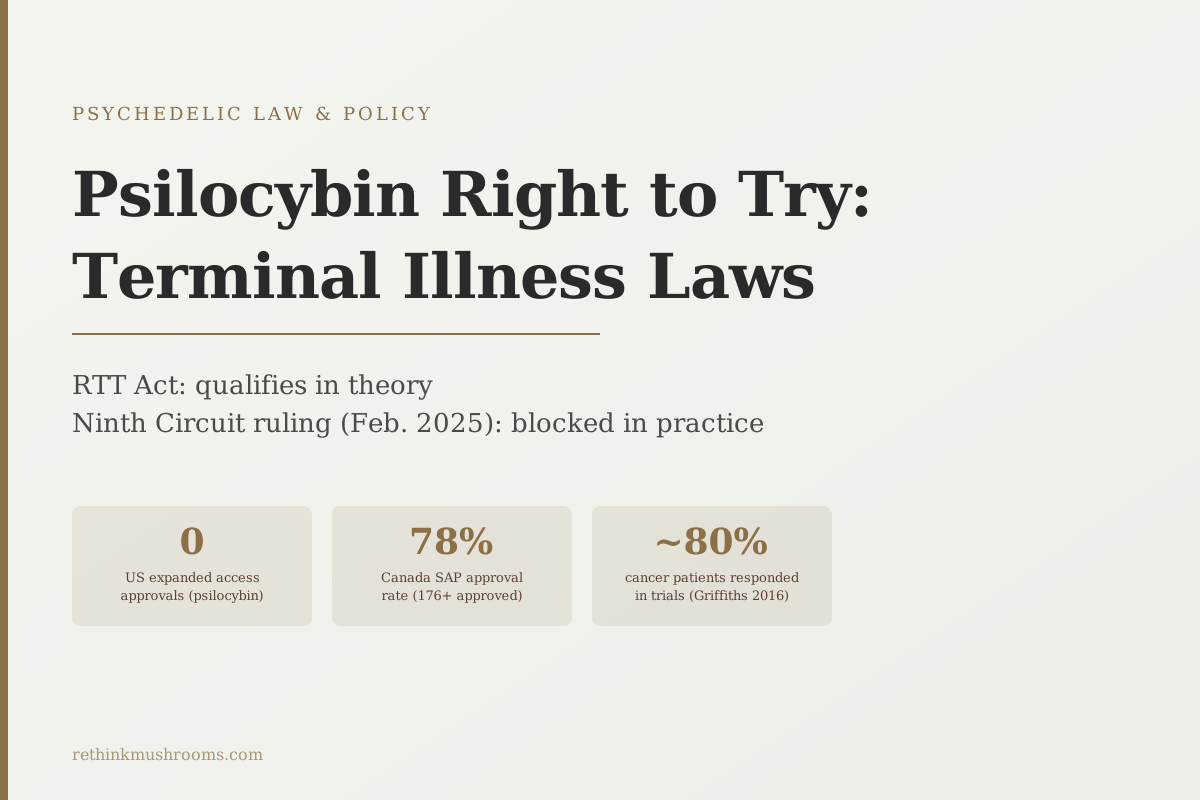
0 US psilocybin expanded access approvals
Terminal cancer patients in clinical trials experienced up to 80% reductions in depression and anxiety from psilocybin. As of 2026, not one American outside a licensed research program can legally access that treatment.
Griffiths et al., J Psychopharmacol, 2016
Feb. 2025
Ninth Circuit ruled RTT does not override Schedule I for psilocybin (AIMS v. DEA)
78%
approval rate for Canada's Special Access Programme for psilocybin — 176+ patients approved by 2024
134 trials
psilocybin studies on ClinicalTrials.gov, 0 FDA marketing approvals as of 2024 (Norring & Spigarelli, 2024)
Griffiths et al., J Psychopharmacol, 2016
 View as image ↗
In 2016, two landmark clinical trials published back-to-back in the same journal reported that psilocybin produced dramatic reductions in depression and anxiety in patients facing terminal diagnoses. Griffiths and colleagues at Johns Hopkins enrolled 51 cancer patients — at 6 months, roughly 80% showed clinically significant reductions in depression and anxiety from a single high-dose session.[1] Ross and colleagues at NYU enrolled 29 more — 60-80% maintained clinical response 6.5 months after a single dose.[2]
Those trials were published a decade ago. The patients who participated had access because they were enrolled in licensed research. The terminal cancer patients who came after them, across dozens of subsequent trials extending and replicating those findings, have had no legal route to the same treatment.
The 2018 federal Right to Try Act seemed, to many observers, to create a pathway. It didn't. A February 2025 federal appeals court ruling settled the question that had been debated since the law passed. This article explains what the Right to Try Act says, what the court found, and what terminal patients can realistically access in 2026.
For the background on why psilocybin is in this position legally, see psilocybin's Schedule I status: history and controversy. For the clinical evidence on what psilocybin does for terminal cancer patients specifically, see psilocybin and quality of life in terminal cancer patients.
Key Takeaways
- Griffiths et al. (J Psychopharmacol, 2016) found ~80% of 51 terminal cancer patients had clinically significant depression and anxiety reductions at 6 months after high-dose psilocybin; Ross et al. (2016) found 60-80% maintained response at 6.5 months in 29 patients — the clinical case for access is strong
- The 2018 federal Right to Try Act allows terminally ill patients to access investigational drugs that have completed Phase 1 safety trials; psilocybin technically meets this standard through its Breakthrough Therapy Designations
- In February 2025, the Ninth Circuit ruled in AIMS v. DEA that the Right to Try Act does NOT override the Controlled Substances Act's Schedule I restriction — terminal patients cannot access psilocybin under RTT as federal law currently stands
- The Right to Try Clarification Act (Booker-Paul, 2022 and 2024) and the Freedom to Heal Act (December 2025) would explicitly authorize Schedule I access for qualifying patients; as of May 2026, neither has passed
- As of 2024, ClinicalTrials.gov listed 134 psilocybin clinical trials and 0 FDA marketing approvals — the clinical evidence exists, the legal access pathway does not (Norring & Spigarelli, 2024)
- Realistic legal options for terminal patients today include Oregon's licensed therapeutic services, Colorado's healing centers (operational June 2025), clinical trial enrollment, and Canada's Special Access Programme (78% approval rate)
What the Right to Try Act Actually Says (And Why Psilocybin Seems to Qualify)
Congress enacted the federal Right to Try Act on May 30, 2018, formally titled the Trickett Wendler, Frank Mongiello, Jordan McLinn, and Matthew Bellina Right to Try Act of 2017. The law was designed to give terminally ill patients a legal route to access experimental drugs that had passed Phase 1 safety trials but had not yet received FDA approval for general use.
Under RTT, the qualifying requirements are:
- The patient has a life-threatening diagnosis
- The patient has exhausted approved treatment options
- The patient's treating physician certifies the drug may benefit them
- The drug has completed Phase 1 safety testing and is the subject of an active Investigational New Drug application with the FDA
On paper, psilocybin checks every box. It has completed numerous Phase 1 safety studies. The FDA granted it Breakthrough Therapy Designation for treatment-resistant depression in 2018 and for major depressive disorder in 2019, which means by definition it is under active FDA review. Dozens of Phase 2 and Phase 3 trials are ongoing. Terminal cancer patients — the population with the strongest clinical evidence for psilocybin benefit — have a life-threatening diagnosis as a matter of course.
The clinical paradox this creates is stark. As of 2024, ClinicalTrials.gov listed 134 active psilocybin clinical trials spanning 54 distinct therapeutic indications, and zero FDA marketing approvals had been issued.[3] The evidence was substantial, the regulatory framework appeared to create access, and yet patients couldn't get treatment. The Right to Try Act looked like a solution.
The critical legal question was whether the RTT eligibility criteria were sufficient on their own, or whether the Controlled Substances Act's separate classification of psilocybin as a Schedule I drug could still block access. The answer arrived in court.
The Case That Answered the Question: AIMS v. DEA (Ninth Circuit, February 2025)
Dr. Sunil Aggarwal is a palliative care physician in Seattle who specializes in treating patients with life-threatening illnesses. In 2021, he applied to the Drug Enforcement Administration to administer psilocybin to two of his terminal patients under the Right to Try Act. Both had life-threatening diagnoses, both had exhausted approved treatment options, and both had depression associated with their terminal conditions. Psilocybin met the RTT eligibility requirements. Aggarwal's physician certification was in place.
The DEA denied the application.
The DEA's reasoning was precise: regardless of what the Right to Try Act says about a patient's right to access investigational drugs, psilocybin is a Schedule I controlled substance under the Controlled Substances Act. The CSA prohibits the manufacture, dispensing, or possession of Schedule I drugs without a separate DEA Schedule I researcher registration. That registration is not available for the purpose of treating individual patients outside of an approved research program. The Right to Try Act does not address the CSA, amend it, or create an exemption from it.
Dr. Aggarwal and his institution, the Advanced Integrative Medical Science Institute (AIMS), appealed the DEA's decision. The case worked its way through the federal courts. In February 2025, the Ninth Circuit Court of Appeals issued its ruling.
The court upheld the DEA.
The Ninth Circuit's finding was direct: the Right to Try Act creates a pathway for accessing unapproved drugs through the FDA's investigational drug framework. The Controlled Substances Act governs a separate legal domain — the DEA's scheduling system. RTT does not modify the CSA and does not provide an exemption from Schedule I restrictions. The DEA's denial of Aggarwal's application was lawful.
The ruling settled the legal question definitively in the Ninth Circuit. As of the date of this ruling, a terminally ill patient in the United States cannot legally access psilocybin under the Right to Try Act.
Why Schedule I Creates a Barrier RTT Alone Cannot Cross
The Right to Try Act and the Controlled Substances Act operate in different legal systems. Understanding that distinction is key to understanding why the Ninth Circuit's ruling wasn't surprising to most legal analysts, even as it disappointed the patients and physicians hoping for a different outcome.
RTT creates a pathway through the FDA's drug approval framework. The FDA regulates whether a drug is "approved" — and the RTT Act gives patients access to drugs that are in the FDA's investigational pipeline but haven't cleared final approval. It's an FDA workaround.
Schedule I classification is a DEA matter under the CSA. The DEA's authority to restrict controlled substances doesn't originate from the FDA's drug approval framework. It derives from a completely separate statute with its own regulatory hierarchy. The DEA does not need FDA permission to maintain Schedule I restrictions, and the FDA cannot override the DEA's scheduling determinations.
When a law says "you may access investigational drugs" and a separate law says "but this specific compound requires a DEA registration that doesn't exist for your purpose," the second law prevails. RTT addresses the first law. It has nothing to say about the second.
A 2024 analysis in the Journal of the American Academy of Psychiatry and the Law by Schonholz and colleagues examined exactly these overlapping legal contradictions facing psilocybin: the Schedule I classification that persists despite clinical evidence of medical value, the ethical obligations physicians have to dying patients who might benefit from access, and the structural gap between what RTT theoretically allows and what DEA enforcement practically prevents.[4] The authors concluded that the current regulatory architecture places clinicians and patients in a genuine ethical bind — a situation with no clean solution under existing law.
For the full legal background on the CSA and its application to psilocybin, see the Controlled Substances Act and psilocybin: legal framework. For the Schedule I classification history, see psilocybin and Schedule I: the legal history and path to rescheduling.
The Legislative Fix That Hasn't Passed Yet
The AIMS v. DEA ruling didn't end the effort to create a legal access pathway. It clarified that a legislative fix — not a creative legal interpretation — was the only route. The court's ruling accelerated political pressure on Congress to act.
In 2022, Senators Cory Booker (D-NJ) and Rand Paul (R-KY), along with Representatives Nancy Mace (R-SC) and Earl Blumenauer (D-OR), introduced the Right to Try Clarification Act. The bill was targeted and narrow: it would explicitly allow terminally ill patients to access Schedule I drugs that had completed Phase 1 safety trials and were under active FDA investigation. By adding Schedule I substances to RTT's scope, it would accomplish what the RTT Act itself could not — override the CSA barrier.
The bill went nowhere in the 117th Congress.
It was reintroduced in the 118th Congress in 2024. It went nowhere again.
In December 2025, advocates and lawmakers introduced a successor bill called the Freedom to Heal Act. The Freedom to Heal Act goes further than the RTT Clarification Act in one meaningful respect: it proposes not just extending RTT to Schedule I substances, but establishing a formal physician registration pathway administered by the DEA. Under the bill's framework, physicians who want to administer psilocybin or MDMA to patients with severe or life-threatening conditions would register with the DEA, follow a supervised protocol, and be subject to DEA oversight — analogous in structure to how certain palliative care opioids are tightly regulated but legally available to authorized practitioners.
This is not decriminalization. It is a controlled, physician-registered access pathway with federal oversight built in, designed to address the DEA's objections to unmonitored Schedule I access.
As of May 2026, the Freedom to Heal Act has not passed. The bipartisan sponsorship across both chambers represents a genuine political coalition that has persisted through multiple congressional sessions. The Ninth Circuit ruling has increased urgency among advocates. But no companion legislation has moved through committee, and there is no confirmed timeline for a floor vote.
What Terminal Patients Can Actually Access Today
Given that RTT does not currently create a legal pathway for psilocybin, the realistic options for a terminally ill patient in 2026 are limited but not zero.
Oregon therapeutic services. Oregon's Measure 109 created the first legal psilocybin therapeutic program in the United States, operational since June 2023. Oregon does not require a medical diagnosis — any adult 21 or older can work with a licensed facilitator for a supervised psilocybin experience. The framing is explicitly non-medical: Oregon's program is structured around personal development and wellness rather than a clinical treatment model. Sessions typically run $1,500-$2,500, including preparation and integration sessions. The program is not covered by insurance. For a terminally ill patient, this represents a legally accessible option in a US state.
Colorado healing centers. Colorado's Proposition 122 created a state-regulated natural medicine program. The first licensed healing centers opened in late 2024, with the first state-regulated psilocybin sessions taking place in June 2025. Colorado's model is structured somewhat closer to a healthcare framework than Oregon's, with pathways for licensed mental health professionals to integrate their credentials into the program. Costs are comparable to Oregon. Colorado is not a medical treatment program, but the practitioner landscape includes more mental health professionals than Oregon's early-stage program.
Clinical trial enrollment. The most common legal access route for patients with serious conditions remains enrollment in an active clinical trial. ClinicalTrials.gov can be searched by condition, location, and recruiting status. The constraint is that most cancer-related psilocybin trials have completed enrollment, geographic eligibility requirements can be restrictive, and trials are not available in all parts of the country.
Canada's Special Access Programme. Health Canada reopened the Special Access Programme for psilocybin in January 2022. The SAP covers end-of-life distress and treatment-resistant major depressive disorder, the two conditions with the strongest psilocybin evidence base. A 2025 analysis comparing US and Canadian expanded access policies found that Canada's SAP had an approximately 78% approval rate and had approved more than 176 patients by February 2024 — compared to zero approved US psilocybin expanded access applications in the same period. US patients who can travel to Canada may pursue SAP approval through a Canadian physician. The process involves a physician application to Health Canada; the SAP's stated turnaround for urgent cases is 24-72 hours.
For the complete guide to every legal psilocybin access pathway with practical requirements, costs, and eligibility details, see legal psilocybin access before FDA approval: all current options. For the companion article on how FDA's expanded access process works and why it has not produced a psilocybin approval in the US, see compassionate use of psilocybin: individual patient applications.
The Honest Assessment: What the Evidence Gap Means
The Griffiths 2016 and Ross 2016 trials are among the most rigorous studies of any intervention for end-of-life psychological distress. The Hopkins trial found roughly 80% of 51 terminal cancer patients showed clinically meaningful depression and anxiety reductions six months after a single high-dose psilocybin session.[1] The NYU trial found 60-80% maintained clinical response 6.5 months after treatment.[2] Both used randomized controlled designs. Both found effects on a scale rarely seen in palliative psychiatry. The clinical case for access is not contested.
What is contested is the legal and regulatory path to delivering that access. The Right to Try Act was one potential route. The Ninth Circuit's AIMS v. DEA ruling in February 2025 closed it. The legislative fixes — the RTT Clarification Act and the Freedom to Heal Act — have not passed.
The result is a documented gap between evidence and access: studies showing clear benefit for dying patients, and a legal structure that cannot yet translate that benefit into available treatment.
That gap may narrow. The Freedom to Heal Act has bipartisan support. COMPASS Pathways' COMP360 NDA submission for treatment-resistant depression is expected to reach FDA review in late 2026 or early 2027 — an approval would not directly create terminal cancer patient access, but it would remove psilocybin from Schedule I for the approved indication and begin a process of de-scheduling that would reshape the legal landscape for all uses.
The clinical evidence established in 2016 is not going anywhere. The question is when the legal framework catches up.
Note: Nothing in this article constitutes legal or medical advice. Patients navigating access options for serious medical conditions should consult both a physician and an attorney who specializes in drug policy or healthcare law, since individual circumstances, state law, and regulatory interpretations can differ substantially.
The Bottom Line
The 2018 federal Right to Try Act technically allows terminally ill patients to access investigational drugs that completed Phase 1 safety trials — and psilocybin qualifies on that basis. But in February 2025, the Ninth Circuit ruled in AIMS v. DEA that the RTT Act does not override the Controlled Substances Act's Schedule I classification. Terminal patients cannot access psilocybin under RTT as federal law currently stands. The legislative fix — the Freedom to Heal Act (December 2025) — has not passed. Realistic legal options today include Oregon and Colorado therapeutic services, clinical trial enrollment, and Canada's Special Access Programme (78% approval rate, 176+ patients approved by 2024).
Frequently Asked Questions
Sources & References
- 1RTHM-00426·Griffiths, Roland R et al. (2016). “Psilocybin produces substantial and sustained decreases in depression and anxiety in patients with life-threatening cancer: A randomized double-blind trial..” Journal of psychopharmacology (Oxford.Study breakdown →PubMed →↩
- 2RTHM-00445·Ross, Stephen et al. (2016). “Rapid and sustained symptom reduction following psilocybin treatment for anxiety and depression in patients with life-threatening cancer: a randomized controlled trial..” Journal of psychopharmacology (Oxford.Study breakdown →PubMed →↩
- 3RTHM-01959·Norring, Sarah A et al. (2024). “The Promise of Therapeutic Psilocybin: An Evaluation of the 134 Clinical Trials, 54 Potential Indications, and 0 Marketing Approvals on ClinicalTrials.gov..” Drug design.Study breakdown →PubMed →↩
- 4RTHM-01983·Schonholz, Stephanie M et al. (2024). “Legal and Ethics Concerns of Psilocybin as Medicine..” The journal of the American Academy of Psychiatry and the Law.Study breakdown →PubMed →↩