Psychedelic Law & Policy
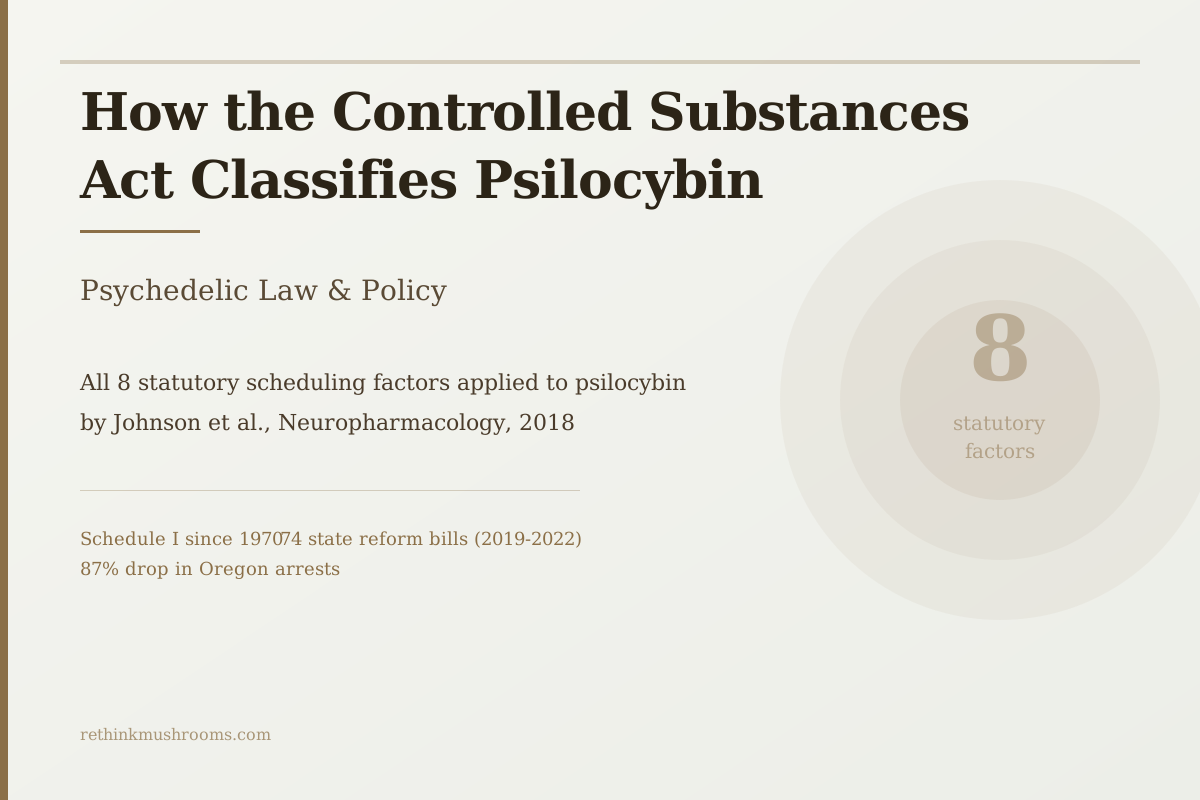
8 statutory factors
In 2018, researchers applied all 8 of the CSA's statutory scheduling factors to psilocybin and found low abuse potential across the board, a direct challenge to its Schedule I placement.
Johnson et al., Neuropharmacology, 2018
Schedule I
most restrictive classification, in place since 1970
74 bills
introduced in 25 states to reform psychedelic law by 2022, nearly all naming psilocybin
50,000g
the DEA's 2026 psilocybin research production quota, up from roughly 30,000g
Johnson et al., Neuropharmacology, 2018
 View as image ↗
In 1970, Congress placed psilocybin in Schedule I of the Controlled Substances Act. Schedule I is the most restrictive category the law creates: reserved for drugs the federal government has concluded have high abuse potential, no accepted medical use, and no safe way to administer them even under medical supervision. Psilocybin has sat in that category ever since, without the clinical trials that the scheduling decision was supposed to require. This article is part of a broader examination of psilocybin's Schedule I status. Here, the focus is on the legal machinery itself: how the Controlled Substances Act works, what criteria the law requires for scheduling, and what it would actually take to change psilocybin's classification.
Key Takeaways
- The CSA divides controlled substances into 5 schedules; Schedule I is the only one that bars any medical use entirely, and psilocybin has been there since 1970
- A 2018 analysis by Johnson et al. in Neuropharmacology applied all 8 statutory CSA scheduling factors to psilocybin and found low abuse potential on every relevant criterion
- Schedule I classification imposes the harshest criminal penalties: up to 1 year in prison for simple possession and 5 to 40 years for distribution under federal law
- The CSA creates a structural problem: Schedule I status restricts the research that would generate the evidence needed to justify rescheduling
- Three federal rescheduling pathways exist: FDA drug approval (which legally compels DEA action within 90 days), a DEA administrative petition (under HHS review as of August 2025), and Congressional legislation
- As of 2022, 25 states had introduced 74 psychedelic reform bills (nearly all naming psilocybin), and an analytic model projects a majority of states will legalize psychedelics by 2034 to 2037, a widening gap between state and federal law
What Schedule I Actually Means, and How It Differs from Every Other Category
The Controlled Substances Act organizes every federally regulated drug into one of five schedules based on three core criteria: abuse potential, accepted medical use, and safety profile under supervision. Each schedule sets different rules for research, prescription, and criminal penalties.
Schedule I is the only category that asserts no accepted medical use at all. That distinction matters more than it might seem. All other schedules permit some form of clinical prescription. Schedule I does not. A physician cannot prescribe a Schedule I drug. A pharmacy cannot dispense it. Research is possible, but only with a separate DEA Schedule I researcher registration on top of standard FDA approval, a requirement that adds months or years to the process of launching a clinical trial.
The five schedules break down as follows:
Schedule I: High abuse potential; no currently accepted medical use; no accepted safety even under medical supervision. Psilocybin, heroin, LSD, and marijuana sit here under federal law.
Schedule II: High abuse potential; accepted medical use, though tightly restricted; risk of severe dependence. Oxycodone, cocaine used topically in surgery, and methamphetamine (prescribed as Desoxyn for ADHD) are Schedule II.
Schedule III: Moderate to low abuse potential; accepted medical use; moderate or low dependence potential. Ketamine, anabolic steroids, and testosterone are Schedule III.
Schedule IV: Low abuse potential; accepted medical use; limited dependence risk. Benzodiazepines such as diazepam and alprazolam sit here.
Schedule V: Lowest abuse potential; accepted medical use; limited dependence potential. Cough preparations containing small amounts of codeine fall in this category.
The gap between Schedule I and Schedule II is not semantic. A drug in Schedule II can be prescribed and dispensed through established pharmacy channels. A drug in Schedule I cannot. Moving psilocybin from Schedule I to Schedule II would not make it freely available, but it would open clinical prescription for the first time and dramatically lower the barriers to running research.
The 8 Statutory Factors the DEA Must Apply, and What the Data Shows for Psilocybin
When the DEA evaluates a drug for scheduling or rescheduling, the Controlled Substances Act requires it to apply 8 specific statutory factors. In 2018, a research team led by Matthew Johnson of Johns Hopkins University published a systematic analysis in Neuropharmacology that did exactly that: it applied all 8 factors to psilocybin using the available clinical and preclinical literature.[1]
Their findings were specific and methodical, not speculative:
Factor 1: Actual or relative potential for abuse. Johnson and colleagues found no evidence of dose escalation, drug-seeking behavior, or compulsive use patterns in the literature. Psilocybin users do not typically redose immediately after a session. The intensity of the experience itself appears to function as a natural deterrent to casual, frequent use.
Factor 2: Scientific evidence of pharmacological effect. Psilocybin is a serotonin 2A receptor agonist. It binds to a specific brain protein that regulates mood, cognition, and perception. Nichols, in a comprehensive 2016 review of classic psychedelics published in Pharmacological Reviews, characterized psilocybin's pharmacological effects as well-mapped and scientifically well-established.[4] That stands in contrast to some synthetic compounds that are simultaneously Schedule I and poorly understood pharmacologically.
Factor 3: State of current scientific knowledge. At the time of the 2018 analysis, multiple Phase 2 trials had already demonstrated antidepressant effects. The clinical literature has grown substantially since.
Factor 4: History and current pattern of abuse. Indigenous and ceremonial use of psilocybin mushrooms spans centuries. Modern recreational use exists but does not follow the escalating, compulsive pattern associated with opioids or stimulants. Psilocybin is not used daily. It does not produce physical tolerance in the way that drives habitual drug use.
Factor 5: Scope, duration, and significance of abuse. Johnson et al. found no evidence that recreational psilocybin use generates the kind of broad societal harm proportional to a Schedule I classification. Comparative harm analyses have consistently ranked psilocybin among the lowest-risk psychoactive substances on measures of both individual and social harm.
Factor 6: Risk to public health. Nichols' 2016 pharmacological review documented no known lethal dose of psilocybin in humans.[4] Acute adverse events are primarily psychological (anxiety, disorientation) rather than physiological. Serious adverse events are associated with environmental factors or pre-existing predisposition to psychosis, not inherent toxicity of the compound at typical doses.
Factor 7: Psychic or physiological dependence liability. Physical dependence does not occur with psilocybin. Johnson et al. found no evidence of withdrawal syndrome and no escalating tolerance pattern driving compulsive use. Those two mechanisms are the pharmacological signatures most strongly associated with dependence in drugs like opioids or alcohol.
Factor 8: Whether the drug is an immediate precursor to an already-controlled substance. Psilocybin is not a chemical precursor to another scheduled substance.
Johnson and colleagues concluded that applying the CSA's own framework, psilocybin's Schedule I classification is not supported on pharmacological grounds.
The CSA's own 8-factor test, applied to psilocybin
What Each Statutory Factor Showed
When the DEA weighs a drug for scheduling, the Controlled Substances Act requires it to apply these 8 factors. In 2018, Johnson and colleagues ran psilocybin through every one of them using the clinical and preclinical literature. Here is what each factor showed.
Factor 1: Actual or relative potential for abuse
Points away from Schedule INo dose escalation, drug-seeking, or compulsive use found in the literature.
Factor 2: Scientific evidence of pharmacological effect
Well establishedA serotonin 2A receptor agonist with well-mapped, well-established effects.
Factor 3: State of current scientific knowledge
Well establishedMultiple Phase 2 antidepressant trials by 2018; the literature has grown since.
Factor 4: History and current pattern of abuse
Points away from Schedule ICenturies of ceremonial use; no daily, escalating, or compulsive pattern.
Factor 5: Scope, duration, and significance of abuse
Points away from Schedule IRanked among the lowest-risk substances on individual and social harm.
Factor 6: Risk to public health
Points away from Schedule INo known lethal dose in humans; adverse events are primarily psychological.
Factor 7: Psychic or physiological dependence liability
Points away from Schedule INo withdrawal syndrome and no escalating tolerance driving compulsive use.
Factor 8: Immediate precursor to a controlled substance
Not applicablePsilocybin is not a chemical precursor to another scheduled substance.
Seven of the eight factors point away from a Schedule I designation and the eighth does not apply. Applying the CSA's own framework, Johnson and colleagues concluded that psilocybin's Schedule I classification is not supported on pharmacological grounds.
Per Johnson et al., “The abuse potential of medical psilocybin according to the 8 factors of the Controlled Substances Act” (Neuropharmacology, 2018); pharmacology per Nichols, Pharmacological Reviews, 2016.
For a direct point-by-point comparison of each of the three Schedule I criteria against the clinical evidence, see why psilocybin is federally illegal despite proven medical value.
The Circular Problem: How Schedule I Creates the Research Barriers That Justify Itself
The rescheduling process has a structural flaw when applied to drugs already in Schedule I.
Demonstrating "accepted medical use" requires clinical trials. Running clinical trials on a Schedule I substance requires a DEA Schedule I researcher registration, which involves a more extensive vetting process than registrations for other schedules. It also requires drug supply, which requires the DEA to approve annual production quotas separately from any FDA authorization. The result is a feedback loop: Schedule I status creates research barriers that limit the evidence needed to justify leaving Schedule I.
The DEA tracks research demand through annual production quotas, which set the maximum amount of each controlled substance that manufacturers can legally produce each year. For psilocybin, this quota was approximately 30,000 grams in recent years. For 2026, the DEA increased it to approximately 50,000 grams. That increase does not change psilocybin's legal classification, but it signals that clinical demand has grown enough to require more supply, a concrete marker of momentum within the existing regulatory system.
The 1970 scheduling itself was not the result of this process working correctly. Nichols, reviewing the history in the Journal of Antibiotics in 2020, documented that psilocybin's Schedule I placement reflected the political climate of the Nixon era more than any systematic pharmacological evaluation.[5] The 8-factor framework was part of the CSA from the beginning, but the initial scheduling decisions largely bypassed it.
The Federal Penalties for Schedule I: Up to 40 Years for Distribution
Understanding the CSA's scheduling framework requires knowing what it actually costs to violate it. Schedule I carries the harshest criminal penalties of any schedule.
For simple possession of any Schedule I substance, including psilocybin, the federal penalty is up to 1 year in prison and a minimum fine of $1,000 for a first offense. A second offense doubles the maximum incarceration to 2 years and raises the minimum fine.
For manufacturing, distributing, or possessing with intent to distribute, penalties scale steeply by quantity and prior record. First offense: 5 to 40 years in federal prison and fines up to $2 million for individuals. A prior felony drug conviction doubles the mandatory minimum sentence.
In practice, federal prosecutors have not pursued broad enforcement against individual psilocybin users in decriminalized states. Enforcement has focused on trafficking. But that reflects prosecutorial discretion, not legal protection. The criminal framework remains fully in force.
The legal risk falls unevenly. Schonholz and colleagues, writing in the Journal of the American Academy of Psychiatry and the Law in 2024, examined what this means specifically for clinicians working in state-authorized psilocybin programs: standard-of-care protections available under state malpractice law do not immunize practitioners from federal criminal charges.[2] A clinician operating legally under Oregon's Measure 109 remains simultaneously in violation of federal Schedule I law. No state authorization changes that.
Three Federal Pathways to Rescheduling, and What Each Actually Requires
The CSA creates three distinct mechanisms by which psilocybin's Schedule I classification could change. Each has different requirements, different actors, different timelines, and different probabilities of success.
Pathway 1: FDA drug approval. If the FDA approves a psilocybin-based pharmaceutical for any indication, the DEA is legally required to reschedule psilocybin to at minimum Schedule II within 90 days of the approval. This is the most binding of the three pathways. The pharmaceutical company COMPASS Pathways, whose psilocybin therapy for treatment-resistant depression completed a 233-patient Phase 2b trial reported in the New England Journal of Medicine in 2022,[6] has cited a target of submitting a New Drug Application to the FDA in late 2026. An FDA approval would trigger mandatory DEA rescheduling without requiring a separate petition or Congressional action.
The FDA breakthrough therapy designation psilocybin has received for two psychiatric indications did not change its scheduling. It signaled that the FDA sees enough evidence to expedite its own review, but it did not constitute a regulatory finding of accepted medical use. For more on what that designation means in practice, see breakthrough therapy designation: what it means for psilocybin.
Pathway 2: DEA administrative petition. Any person may petition the DEA to initiate a scheduling review. Once a petition is filed, the DEA requests HHS to conduct a scientific and medical evaluation using the 8-factor framework. HHS's recommendation on whether accepted medical use exists is binding on the DEA: the agency cannot place a drug in Schedule I if HHS concludes accepted medical use exists. In August 2025, a petition from Dr. Sunil Aggarwal and the Advanced Integrative Medical Science Institute was advanced to HHS for evaluation, the first petition to reach that stage. There is no statutory deadline for HHS to complete its review.
Pathway 3: Congressional legislation. Congress can change drug schedules directly through legislation, bypassing the DEA entirely. No bill introduced so far would reschedule psilocybin outright, but related bipartisan legislation has advanced the access debate. The Freedom to Heal Act, introduced by Senators Cory Booker and Rand Paul in December 2025, would instead create a Schedule I "right to try" pathway, allowing physicians to administer post-Phase 1 investigational drugs such as psilocybin to seriously ill patients without changing the drug's schedule. None of these bills had advanced to a floor vote as of early 2026. Congressional action is the most direct route to rescheduling but requires majority support in both chambers and a presidential signature.
For current status on each pathway and the specific legislation in play, see federal psilocybin reform efforts. For the full historical narrative of how psilocybin was scheduled and what the path to rescheduling looks like in detail, see psilocybin's Schedule I legal history and path to rescheduling.
State Law vs. Federal Law: The Gap That Is Widening Every Year
Psilocybin's Schedule I classification is a federal designation. It operates alongside state law, not instead of it. And the gap between federal policy and state law has been growing faster than at any previous point in psilocybin's legal history.
Siegel and colleagues published a systematic analysis of psychedelic reform legislation in JAMA Psychiatry in 2023, documenting the pace of state-level change.[3] Between 2019 and 2022, the number of state reform bills introduced per year grew from 5 to 36. Over that window, 25 states considered a total of 74 psychedelic reform bills, nearly all of which (90%) named psilocybin. The paper's predictive model projected that a majority of states would have some form of legalized psychedelic use by 2034 to 2037.
Oregon's Measure 109, approved by voters in 2020, created the first state-regulated psilocybin services framework, which opened to clients in 2023. Colorado's Proposition 122, passed in 2022, created a regulated framework for therapeutic psilocybin use starting in 2024. Neither state is overriding federal law, which applies in both states regardless of what state statutes say. What has changed is enforcement priority: state decriminalization and regulated-access measures redirect state and local resources, but the federal Schedule I prohibition remains fully in force underneath them.
That enforcement gap creates a practical gray zone for practitioners. Schonholz et al.'s 2024 analysis examined the standard-of-care implications for physicians operating in state-legal programs.[2] The "respectable minority doctrine" in medicine refers to the principle that a clinical practice can be defensible even if not mainstream, provided enough practitioners in the field use it. That doctrine applies in state malpractice proceedings. It does not protect against federal criminal prosecution. A clinician following Oregon law correctly remains exposed to federal charges.
International precedent makes the federal position increasingly hard to defend on medical grounds. Australia's Therapeutic Goods Administration reclassified psilocybin from a prohibited substance to Schedule 8 (controlled drug, available by prescription) in February 2023, becoming the first national drug regulator to recognize psilocybin's medical use. The Australia TGA approval directly challenges one of the three Schedule I criteria: if Australia's equivalent of the FDA has concluded that psilocybin has accepted medical use, the US assertion that it lacks any accepted medical use globally becomes harder to sustain. Nutt and colleagues documented in the British Journal of Pharmacology in 2024 what followed in Australia: real-world regulatory challenges around prescriber training, informed consent, and insurance coverage emerged quickly.[7] Rescheduling resolves the legal barrier, but it does not solve every problem that follows.
The Bottom Line
The Controlled Substances Act placed psilocybin in Schedule I in 1970, but a 2018 systematic analysis by Johnson et al. applied all 8 statutory scheduling factors and found low abuse potential across every relevant criterion. Federal penalties for Schedule I violations remain in full force regardless of state decriminalization, creating a genuine legal gray zone for practitioners in Oregon, Colorado, and other states that have moved ahead of federal policy. Three rescheduling pathways exist: FDA drug approval, DEA administrative petition, and Congressional legislation. The COMPASS Phase 3 NDA track and the August 2025 DEA petition represent the most concrete current milestones on the path toward change.
Frequently Asked Questions
Sources & References
- 1RTHM-00514·Johnson, Matthew W et al. (2018). “The abuse potential of medical psilocybin according to the 8 factors of the Controlled Substances Act..” Neuropharmacology.Study breakdown →PubMed →↩
- 2RTHM-01983·Schonholz, Stephanie M et al. (2024). “Legal and Ethics Concerns of Psilocybin as Medicine..” The journal of the American Academy of Psychiatry and the Law.Study breakdown →PubMed →↩
- 3RTHM-01791·Siegel, Joshua S et al. (2023). “Psychedelic Drug Legislative Reform and Legalization in the US..” JAMA psychiatry.Study breakdown →PubMed →↩
- 4RTHM-00439·Nichols, David E (2016). “Psychedelics..” Pharmacological reviews.Study breakdown →PubMed →↩
- 5RTHM-00646·Nichols, David E (2020). “Psilocybin: from ancient magic to modern medicine..” The Journal of antibiotics.Study breakdown →PubMed →↩
- 6RTHM-00761·Goodwin, Guy M et al. (2022). “Single-Dose Psilocybin for a Treatment-Resistant Episode of Major Depression..” The New England journal of medicine.Study breakdown →PubMed →↩
- 7RTHM-00898·Nutt, David J et al. (2024). “The Australia story: Current status and future challenges for the clinical applications of psychedelics..” British journal of pharmacology.Study breakdown →PubMed →↩