Psychedelic Law & Policy
134 clinical trials
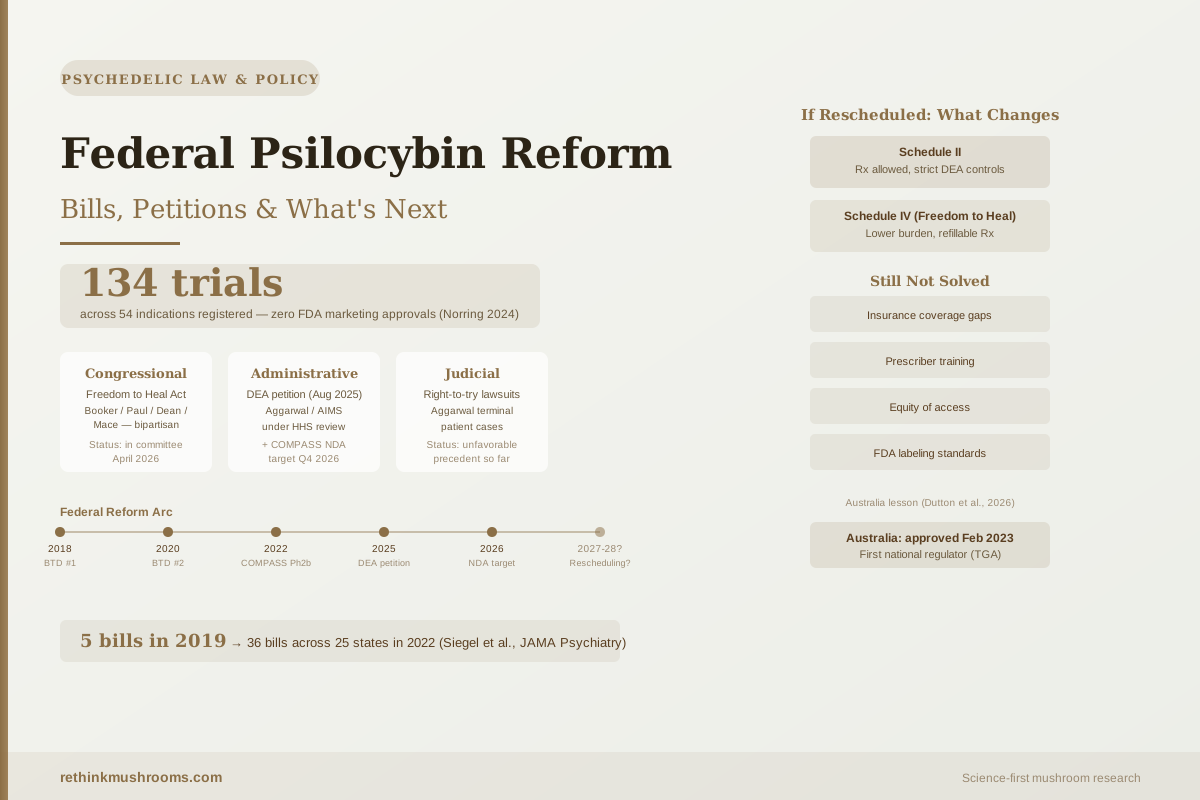
As of 2024, 134 interventional psilocybin trials across 54 potential indications had been registered at ClinicalTrials.gov — and not one had received FDA marketing approval.
Norring et al., Drug Design, Development and Therapy, 2024
36 bills
introduced across 25 states in 2022 alone (Siegel et al., JAMA Psych. 2023)
Phase 2b
COMPASS 25mg RCT N=233 — the NDA track's clinical anchor (Goodwin 2022)
2023
Australia became the first country to approve psilocybin for TRD (Nutt 2024)
Norring et al., Drug Design, Development and Therapy, 2024
 View as image ↗
As of April 2026, psilocybin remains a Schedule I controlled substance under federal law — classified alongside heroin as having high abuse potential, no accepted medical use, and no safe level of use under medical supervision. At the same time, 134 interventional clinical trials have studied it across 54 potential indications, the FDA has granted breakthrough therapy designations twice for depression, and Australia's national regulator approved it as a prescription treatment in 2023.[2] The gap between that legal classification and that scientific record is the engine driving federal reform efforts.
This article maps the three active federal reform pathways and their current status. For the underlying science-policy contradiction and the history of how psilocybin became Schedule I in the first place, see Psilocybin's Schedule I Status: History and Controversy.
Key Takeaways
- Three federal pathways exist for rescheduling psilocybin: congressional legislation, DEA administrative petition, and FDA drug approval (which triggers automatic DEA action)
- The Freedom to Heal Act — a bipartisan Senate bill — would move psilocybin to Schedule IV and require a federal research program; as of April 2026 it has not advanced out of committee
- The most active track is FDA approval: COMPASS Pathways is targeting a Q4 2026 NDA submission based on its Phase 2b trial (N=233, significant depression reduction vs. placebo)
- An August 2025 DEA administrative petition, filed by Dr. Sunil Aggarwal and the AIMS Institute, is under HHS review as of April 2026
- State-level reform has dramatically outpaced federal action: from 5 state bills in 2019 to 36 in 2022, with a model projecting majority-state legalization by 2033-2037 (Siegel et al., 2023)
- Australia's 2023 approval shows what federal rescheduling would actually require in practice — and what challenges arise immediately after (Dutton et al., 2026)
The Numbers Behind the Push: Why Reform Is Now a Policy Question, Not Just a Research One
A 2024 analysis by Norring and colleagues in Drug Design, Development and Therapy captured the contradiction precisely: 134 interventional psilocybin trials across 54 potential indications had been registered at ClinicalTrials.gov, with an average trial duration of 3.3 years per study — and not one had received FDA marketing approval.[2] That zero-for-134 figure reflects the structural obstacle Schedule I creates: researchers can study psilocybin, but the same legal status that allows research also prevents the commercial approval that would normally follow clinical success.
State-level reform has moved much faster than federal action. A 2023 analysis by Siegel and colleagues in JAMA Psychiatry tracked psychedelic reform legislation across the US from 2019 to 2022. The trend line is stark: 5 bills across a handful of states in 2019 grew to 36 bills across 25 states by 2022. Oregon's Measure 109 — the first state-level supervised psilocybin legalization — reduced psilocybin-related arrests by 87% following decriminalization. An analytic projection based on the rate of state adoption models a majority of states having some form of legal psychedelic access by 2033-2037.[1]
The state-federal divergence creates practical tension. Practitioners in states with legal access operate under state permission but federal prohibition — a conflict that affects liability, insurance reimbursement, and prescribing authority in ways that remain legally unresolved. A 2024 analysis in the Journal of the American Academy of Psychiatry and the Law examined the "respectable minority doctrine" — a legal theory under which physicians practicing psilocybin-assisted therapy in states with legal access may have defensible grounds even without federal sanction — but concluded the exposure remains real and unresolved until federal law changes.[5]
Key federal reform milestones, 2018-2026:
- 2018: FDA grants breakthrough therapy designation for psilocybin-assisted therapy for treatment-resistant depression
- 2020: FDA grants second breakthrough therapy designation for major depressive disorder
- 2022: COMPASS Pathways Phase 2b trial (N=233) published in NEJM; establishes clinical basis for NDA
- 2023: Australia's TGA becomes first national regulator to approve psilocybin for TRD
- 2025 (August): DEA administrative rescheduling petition filed by Dr. Sunil Aggarwal and the AIMS Institute
- 2026: DEA increases annual psilocybin production quota from 30,000 to 50,000 grams — a regulatory signal of anticipated clinical demand
- 2026 (Q4, target): COMPASS Pathways NDA submission to FDA, which if approved would obligate DEA to reschedule
The Congressional Pathway: What Bills Are in the Pipeline
Congress has seen a growing number of psychedelic reform proposals, though federal legislation has historically lagged state-level action.
The Freedom to Heal Act is the most prominent current Senate proposal. Introduced with bipartisan sponsorship — Senators Cory Booker (D-NJ) and Rand Paul (R-KY) in the Senate, and Representatives Madeleine Dean (D-PA) and Nancy Mace (R-SC) in the House — it would move psilocybin from Schedule I to Schedule IV, expand research authorization, and establish a federal program for supervised psilocybin access. Schedule IV placement (the same schedule as benzodiazepines) would reflect the bill's assessment that psilocybin has accepted medical use and low physical dependence potential — a direct legislative application of the evidence reviewed in Johnson et al. 2018, whose eight-factor analysis of psilocybin's abuse potential concluded it warrants the lowest-restriction medical scheduling.[7] As of April 2026, the bill has not advanced out of committee in either chamber.
The Innovative Therapies Centers of Excellence Act takes a narrower approach: rather than rescheduling, it would establish federally funded centers of excellence to standardize psilocybin-assisted therapy training and research protocols. This bill has attracted support from clinician and research organizations who argue that infrastructure — not just legal access — is the binding constraint on clinical adoption.
Senate Joint Resolution 10 proposed a resolution of disapproval targeting DEA rescheduling authority, reflecting a faction of Congress that wants legislative rather than administrative control over scheduling decisions. It represents a real constraint on the administrative pathway: if Congress believes the executive branch is overstepping on drug policy, it may intervene.
For historical context on why Congress originally placed psilocybin in Schedule I — and why the 1970 decision is now contested on scientific grounds — see Psilocybin and Schedule I: The Legal History and Path to Rescheduling. For a detailed explanation of how the Controlled Substances Act's five schedules work and what criteria govern each, see The Controlled Substances Act and Psilocybin: Legal Framework.
The Administrative Pathway: The DEA Petition and the FDA Approval Track
The administrative pathway operates through two parallel mechanisms, each with a different timeline and legal trigger.
The DEA administrative petition is the direct route. In August 2025, Dr. Sunil Aggarwal of the AIMS Institute filed a formal petition with the DEA requesting administrative rescheduling of psilocybin. The petition was referred to the Department of Health and Human Services (HHS) for a scientific and medical evaluation — the standard first step in the DEA's eight-factor scheduling review process. As of April 2026, the HHS evaluation is ongoing. The DEA is not obligated to act within a fixed timeline on administrative petitions; the process has historically taken years, and prior petitions for other substances have been rejected or ignored. However, the simultaneous increase in the DEA's authorized psilocybin production quota — from 30,000 to 50,000 grams for 2026 — signals at minimum that the agency is anticipating expanded clinical and commercial demand.
The FDA approval track is arguably more legally certain, though longer. If FDA approves a psilocybin drug product through the standard New Drug Application process, the DEA is legally required to reschedule the substance to accommodate commercial prescribing — psilocybin cannot remain Schedule I while simultaneously having an FDA-approved product. COMPASS Pathways, whose Phase 2b trial published in the New England Journal of Medicine in 2022 is the largest controlled psilocybin RCT to date, is the company most advanced on this track.
The COMPASS Phase 2b trial enrolled 233 participants with treatment-resistant depression across 22 centers in 10 countries. Participants received a single 25mg psilocybin dose, 10mg, or 1mg (active control), alongside psychological support. The 25mg group showed significant reductions in depression scores at 3 weeks compared to the 1mg control group — the primary endpoint was met.[6] COMPASS's Phase 3 program, required before an NDA submission, is ongoing with a target NDA submission in Q4 2026. If FDA grants approval, DEA rescheduling would follow within 90 days by statute.
Goodwin et al. (2022) · New England Journal of Medicine
- Population
- 233 adults with treatment-resistant depression
- Intervention
- Single dose of synthetic psilocybin (25mg, 10mg, or 1mg) plus psychological support
- Comparator
- 1mg dose as active control; primary endpoint = change in MADRS depression score at week 3
- Finding
- The 25mg group showed a significant reduction in depression scores at 3 weeks versus the 1mg control — the primary endpoint was met. This is the Phase 2b evidence COMPASS is building its NDA submission on.
positive Phase 2b, not Phase 3; a single dose; durability and adverse-event profile are what Phase 3 must still confirm before FDA can act
Goodwin et al., NEJM (2022)
The FDA approval track has a critical advantage over the congressional and administrative pathways: it has a defined legal trigger. Congress can stall; DEA can delay its own petitions. But FDA approval creates a mandatory rescheduling obligation.
- Mechanism & Early Studiescompleted
Decades of pharmacology plus two FDA breakthrough therapy designations (2018, 2020)
- Safety & Abuse-Potential Reviewcompleted
Eight-factor CSA analysis concluding psilocybin has low abuse potential and accepted medical-use signals (Johnson et al., 2018)
- Early Human Trialscompleted
Multiple small randomized trials for depression establishing efficacy signals
- Pivotal Phase 2b RCTcompleted
COMPASS N=233, single 25mg dose, primary depression endpoint met at week 3 (Goodwin et al., 2022)
- Phase 3 Programcurrent
Ongoing; must replicate Phase 2b efficacy and confirm safety before an NDA can be filed (target Q4 2026)
- FDA Approval → Mandatory DEA Reschedulingmissing
No psilocybin product is FDA-approved; approval would obligate DEA rescheduling within 90 days by statute
The FDA pathway is the most legally deterministic route to federal rescheduling — an approval automatically forces DEA's hand. But the chain is only as strong as its current rung: Phase 3 must still replicate the Phase 2b results. If it does, a rescheduling outcome would likely fall in 2027–2028, not 2026.
Aggregate of FDA breakthrough designations, COMPASS trial program, and CSA scheduling law
The breakthrough therapy designation — the FDA recognition that psilocybin may offer substantial improvement over existing therapies — is the mechanism that accelerated COMPASS's clinical program. For a full explanation of what breakthrough designation means and how it changes the regulatory timeline, see Breakthrough Therapy Designation: What It Means for Psilocybin.
The Judicial Pathway: Legal Challenges Under Right-to-Try Frameworks
The judicial pathway has been pursued primarily by Dr. Sunil Aggarwal, who in addition to filing the DEA petition has fought a multi-year legal battle to administer psilocybin to terminally ill patients under state right-to-try law. His argument: Washington State's Right to Try Act allows patients with terminal conditions to access investigational drugs, and federal Schedule I classification cannot preempt state law in this context.
Federal courts have so far upheld DEA's authority to prohibit Schedule I drug use even in right-to-try contexts, declining to extend the state law framework to federally scheduled substances. The cases have not produced favorable precedent, but they have maintained public attention on the practical human cost of Schedule I classification: terminally ill patients who could legally access psilocybin in Australia cannot do so in the US.
The judicial track remains the least likely pathway to systematic rescheduling, but court decisions against DEA could create pressure for administrative action.
The International Precedent: What Australia's Approval Actually Required
Australia became the first country in the world to nationally approve psilocybin as a prescription medicine when the Therapeutic Goods Administration (TGA) reclassified it as a Schedule 8 controlled drug in February 2023, authorizing its use for treatment-resistant depression. Nutt and colleagues' 2024 analysis in the British Journal of Pharmacology reviewed the Australian approval process and its early clinical implementation — the most detailed account available of what national rescheduling looks like in practice.[3]
The Australian model required: specialist psychiatrist prescribing authority (no general practitioners), approved clinical setting with trained therapists, mandatory written informed consent procedures, and session monitoring requirements. The TGA also maintained a pharmacovigilance obligation — adverse events must be reported to a national registry. The administrative infrastructure required was substantial.
What happened after approval is equally instructive. A 2026 study by Dutton and colleagues in the Australian and New Zealand Journal of Psychiatry documented the first-year operational challenges: insufficient numbers of trained prescribers, no standardized therapist training pathway, insurance coverage gaps leaving out-of-pocket costs at $A6,000-$A15,000 per treatment course, and ethical complexity around informed consent for a therapy with profound psychological effects.[4]
For the US reform debate, the Australian experience provides two things: proof that national rescheduling is politically achievable, and an honest preview of the operational challenges that would follow any US federal approval. The access-equity problem — who can afford psilocybin-assisted therapy at $6,000-$15,000 per course without insurance coverage — is not solved by rescheduling alone.
For a deep dive into Australia's regulatory process, see Australia's TGA Approval: The First Country to Prescribe Psilocybin.
What Federal Rescheduling Would Actually Mean in Practice
Federal rescheduling is not a single event with uniform consequences. The schedule psilocybin is moved to determines what becomes legally permissible.
Schedule II (like ketamine, morphine, cocaine in limited medical contexts) would authorize prescription use under strict DEA controls: practitioners require DEA registration, prescriptions have quantity limits and cannot be refilled, and manufacturing quotas are DEA-controlled. Research would be significantly easier than under Schedule I, but clinical access would require navigating substantial controlled substance prescribing infrastructure.
Schedule IV (like benzodiazepines, tramadol) would imply a more accessible prescribing framework — refillable prescriptions, simpler DEA registration requirements, and lower regulatory burden for clinical integration. The Freedom to Heal Act proposes Schedule IV specifically, reflecting a view that psilocybin's actual abuse potential and physical dependence profile matches this lower-restriction tier.
The legal analysis in Schonholz et al. 2024 (JAAPL) identifies additional complications that rescheduling would not automatically resolve: standard-of-care liability for psychiatrists administering a new treatment modality, the absence of FDA-approved labeling that guides practitioners on dose and contraindications, and insurance coverage decisions by payers who are not obligated to cover even Schedule II drugs.[5] These are not arguments against rescheduling; they are accurate descriptions of what rescheduling does and does not achieve.
The Honest Assessment: Three Pathways, No Guarantees
The congressional track has bipartisan sponsorship and broad public support but faces an entrenched political dynamic in which drug policy reform bills regularly die in committee. Bipartisanship on psychedelics is real — veteran mental health applications have united progressive and libertarian-conservative factions — but converting that coalition into floor votes and conference committee agreement has proven difficult.
The administrative track via DEA petition is historically slow. Prior petitions for rescheduling cannabis have languished for decades. The August 2025 petition is more credible than most — it comes from a practicing physician with documented patient need, targets a substance with a far more limited evidence-base controversy than cannabis, and arrives with two FDA breakthrough designations already on record. But DEA has no statutory deadline for acting on it.
The FDA approval track is the most procedurally certain: COMPASS NDA approval obligates rescheduling. But NDA approval is not guaranteed. If the Phase 3 data doesn't replicate the Phase 2b results, or if FDA identifies safety signals not apparent in smaller trials, the NDA could be rejected or deferred. Average FDA review time for a new molecular entity is 10-12 months after submission. COMPASS targeting Q4 2026 submission means a rescheduling outcome, if the NDA succeeds, would likely fall in 2027 or 2028.
The Siegel 2023 projection — majority of states with legal access by 2033-2037 — suggests the political trajectory is clear even if the federal timeline is uncertain. Federal rescheduling is likely a question of when, not if. What's uncertain is which pathway gets there first and what the operational infrastructure looks like when it does.
The Bottom Line
Federal psilocybin reform has three active tracks as of April 2026: congressional legislation (the Freedom to Heal Act, not yet out of committee), the administrative DEA petition (filed August 2025, under HHS review), and the FDA approval pathway (COMPASS targeting Q4 2026 NDA). The FDA track is the most legally deterministic — NDA approval obligates DEA rescheduling within 90 days. Australia's 2023 TGA approval demonstrates national rescheduling is achievable and identifies the operational infrastructure that must follow: prescriber training, access equity, and insurance coverage are challenges that rescheduling alone does not resolve.
Frequently Asked Questions
Sources & References
- 1RTHM-01791·Siegel, Joshua S et al. (2023). “Psychedelic Drug Legislative Reform and Legalization in the US..” JAMA psychiatry.Study breakdown →PubMed →↩
- 2RTHM-01959·Norring, Sarah A et al. (2024). “The Promise of Therapeutic Psilocybin: An Evaluation of the 134 Clinical Trials, 54 Potential Indications, and 0 Marketing Approvals on ClinicalTrials.gov..” Drug design.Study breakdown →PubMed →↩
- 3RTHM-00898·Nutt, David J et al. (2024). “The Australia story: Current status and future challenges for the clinical applications of psychedelics..” British journal of pharmacology.Study breakdown →PubMed →↩
- 4RTHM-00958·Dutton, Megan et al. (2026). “Psilocybin in the real world: Regulatory, ethical, and operational challenges in Australia's clinical landscape..” The Australian and New Zealand journal of psychiatry.Study breakdown →PubMed →↩
- 5RTHM-01983·Schonholz, Stephanie M et al. (2024). “Legal and Ethics Concerns of Psilocybin as Medicine..” The journal of the American Academy of Psychiatry and the Law.Study breakdown →PubMed →↩
- 6RTHM-00761·Goodwin, Guy M et al. (2022). “Single-Dose Psilocybin for a Treatment-Resistant Episode of Major Depression..” The New England journal of medicine.Study breakdown →PubMed →↩
- 7RTHM-00514·Johnson, Matthew W et al. (2018). “The abuse potential of medical psilocybin according to the 8 factors of the Controlled Substances Act..” Neuropharmacology.Study breakdown →PubMed →↩