Psilocybin and Addiction
80% Quit Rate
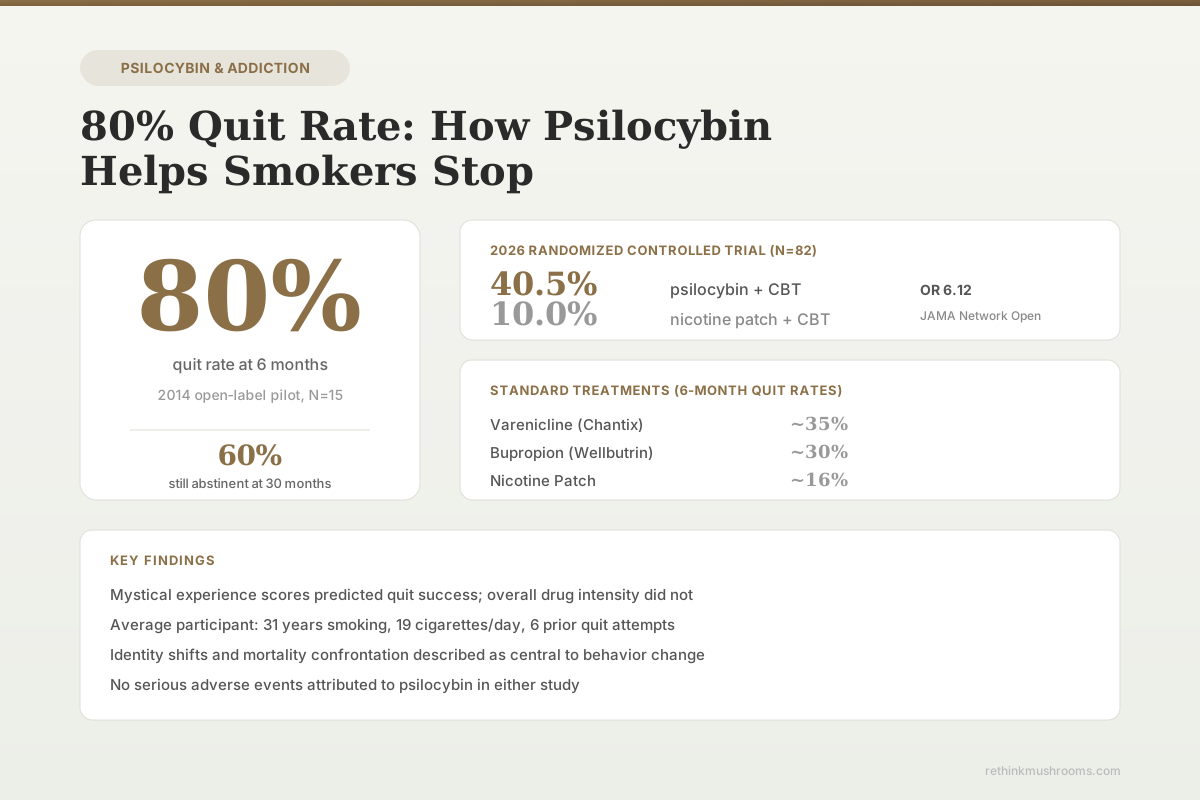
In a 2014 open-label pilot study at Johns Hopkins, 12 of 15 long-term smokers achieved verified abstinence at 6 months after psilocybin-assisted therapy. A 2026 randomized trial confirmed: psilocybin outperformed nicotine patches with 6x greater odds of quitting.
Johnson et al., Journal of Psychopharmacology, 2014
60% at 30 Months
long-term follow-up abstinence
6.12x Better Odds
vs nicotine patch in 2026 RCT
31 Years Smoking
average duration for pilot participants
Johnson et al., Journal of Psychopharmacology, 2014
 View as image ↗
The headline number is real: 80% of participants in the original Johns Hopkins psilocybin smoking cessation study were verified as abstinent from cigarettes at 6 months. That number comes from a 2014 open-label pilot study of 15 long-term smokers who had tried and failed to quit an average of 6 times before.[1] Standard smoking cessation treatments, including nicotine patches, bupropion, and varenicline, typically achieve 6-month quit rates between 16% and 35%.
The catch: the original study had no control group, only 15 participants, and combined psilocybin with cognitive behavioral therapy (CBT). Twelve years of follow-up research since then has addressed some of those limitations. A 2026 randomized controlled trial published in JAMA Network Open finally compared psilocybin directly to nicotine patches, and the results confirmed what the pilot suggested.
For a closer look at the specific Johns Hopkins study results and how the mechanisms of action work at the receptor level, those topics are covered separately. The head-to-head comparison with standard treatments goes deeper into how psilocybin stacks up.
Key Takeaways
- 12 of 15 long-term smokers (80%) showed biologically verified seven-day point-prevalence abstinence at 6 months in the original 2014 open-label pilot at Johns Hopkins (Johnson et al., Journal of Psychopharmacology, 2014)
- At long-term follow-up (mean 30 months, range 16–57), 9 of 15 participants (60%) remained biologically verified abstinent (Johnson et al., American Journal of Drug and Alcohol Abuse, 2017)
- A 2026 unblinded pilot RCT of 82 smokers compared a single 30 mg/70 kg psilocybin session plus 13 weeks of manualized CBT against a standard nicotine-patch course plus the same CBT; 6-month prolonged abstinence was 40.5% versus 10.0% (OR 6.12, 95% CI 1.99–23.26, P = .003), but the psilocybin arm received far more treatment-visit contact time and the trial could not blind expectancy (Johnson et al., JAMA Network Open, 2026)
- Mystical experience scores during psilocybin sessions significantly predicted quit success; overall drug intensity did not (Garcia-Romeu et al., Current Drug Abuse Reviews, 2015)
- Participants described psychological insights during sessions as central to behavior change, including re-evaluating their identity as smokers (Noorani et al., Journal of Psychopharmacology, 2018)
- Standard pharmacotherapies achieve 6-month quit rates of 16-35% (nicotine patch ~16%, bupropion ~30%, varenicline ~35%)
The Original 2014 Pilot Study
Matthew Johnson and colleagues at the Johns Hopkins University School of Medicine designed the first study testing psilocybin for nicotine addiction.[1] The 15 participants were not casual smokers. They smoked an average of 19 cigarettes per day. They had been smoking for an average of 31 years. They had tried to quit an average of 6 times. By any clinical standard, these were entrenched smokers with severe nicotine dependence.
The treatment protocol was not psilocybin alone. It was a 15-week structured program:
- Weeks 1-4: Four weekly preparatory meetings using cognitive behavioral therapy, mindfulness training, and guided imagery for smoking cessation
- Week 5: First psilocybin session at a moderate dose (20 mg/70 kg body weight), with the target quit date set for the day of this session
- Week 7 (approximately): Second psilocybin session at a high dose (30 mg/70 kg)
- Week 13: Optional third psilocybin session at the high dose
- Ongoing support meetings throughout
At 6-month follow-up, smoking status was verified with biomarkers. Biomarkers and self-report measures together demonstrated that 12 of 15 participants (80%) showed seven-day point-prevalence abstinence at 6 months. This was not just self-reported — it was biochemically anchored — though "seven-day point-prevalence" specifically means no smoking in the seven days before the visit, not continuous abstinence over the full 6 months.
The 80% figure is striking because it substantially exceeds any existing smoking cessation treatment. Nicotine replacement therapy achieves approximately 16% abstinence at 6 months. Varenicline (Chantix), the most effective approved medication, reaches approximately 35%. The psilocybin pilot more than doubled the best available treatment.
Long-Term Follow-Up: 60% at 30 Months
The obvious question: does it last? Johnson and colleagues published long-term follow-up data in 2017.[2]
At 12-month follow-up, 10 of 15 participants (67%) remained abstinent. At a mean of 30 months after the target quit date (range: 16-57 months), 9 of 15 participants (60%) were confirmed abstinent by biological verification. Three participants who had initially quit and then relapsed attempted re-cessation; two of those three succeeded.
A 60% quit rate at 2.5 years is remarkable for any smoking cessation intervention. For context, most pharmaceutical trials measure outcomes at 6 or 12 months because rates decline sharply over time. The fact that psilocybin-treated participants maintained 60% abstinence at 30 months, with biological verification, puts this result in a category of its own.
The participants also rated their psilocybin experiences as among the most personally meaningful and spiritually significant of their lives. Those ratings correlated with long-term outcomes. Participants who reported stronger mystical experiences during their psilocybin sessions were more likely to remain abstinent at follow-up.
Why Mystical Experience Matters
Garcia-Romeu, Griffiths, and Johnson explored the relationship between the quality of the psilocybin experience and quit success in a companion analysis.[3]
They found something specific: smoking cessation outcomes were significantly correlated with measures of mystical experience during psilocybin sessions. But overall intensity of drug effects was not correlated with outcomes. In other words, having a stronger psychedelic experience in general did not predict quitting. Having a specific type of experience, one characterized by unity, sacredness, transcendence of time and space, and deep positive mood, did predict quitting.
This distinction matters because it separates the pharmacological effect (getting high) from the psychological effect (having a transformative experience). The drug opens a window. What happens during that window appears to determine whether lasting behavior change occurs.
No existing smoking cessation treatment involves anything resembling this mechanism. Nicotine patches address withdrawal symptoms. Bupropion modulates dopamine and norepinephrine. Varenicline blocks nicotine receptors. Psilocybin appears to work through an entirely different pathway: catalyzing a psychological shift in how people relate to their addiction.
What Participants Actually Said
Noorani and colleagues published a qualitative analysis of participant accounts in 2018.[4] This study gave voice to what the numbers cannot capture.
Participants described several recurring themes:
Identity shift: Multiple participants reported that psilocybin sessions helped them stop seeing themselves as smokers. The addiction was not just a chemical dependency; it was woven into their identity. The psilocybin experience allowed them to step outside that identity and see it as something they could let go of.
Perspective on mortality: Several participants described visceral confrontations with death and disease during their sessions. One participant described seeing himself in a coffin. Another described watching his lungs heal. These experiences were not pleasant, but participants reported them as motivating. They made the abstract consequences of smoking feel real and immediate.
Interconnection: Participants described feeling deeply connected to family members, to nature, and to something larger than themselves. This sense of connection appeared to counteract the isolation and self-focus that often sustain addiction.
Cognitive flexibility: Participants reported that psilocybin sessions broke rigid thought patterns. The automatic "I need a cigarette" response that had been reinforced thousands of times over decades was temporarily disrupted, allowing them to choose a different response.
The 2026 Randomized Trial
The pilot study's primary limitation was its open-label design with no control group. Twelve years later, Johnson and colleagues addressed this with a pilot randomized controlled trial published in JAMA Network Open in 2026.[5]
The trial enrolled 82 psychiatrically healthy adult smokers and was an unblinded pilot RCT. Participants were randomized to either:
- Psilocybin arm: One 30 mg/70 kg psilocybin session plus 13 weeks of manualized smoking-cessation CBT
- Nicotine patch arm: Standard nicotine patch course plus the same manualized CBT
At 6 months, prolonged abstinence was 40.5% (17 of 42) in the psilocybin arm and 10.0% (4 of 40) in the nicotine-patch arm — odds ratio 6.12 (95% CI, 1.99–23.26; P = .003). Seven-day point-prevalence abstinence at 6 months was 52.4% versus 25.0% (OR 3.30, 95% CI, 1.32–8.70; P = .01).
Important caveats from the authors themselves: the psilocybin arm received far more treatment-visit contact time than the patch arm, the active comparator was a standard patch course rather than a best-in-class regimen, and the trial could not blind participant or facilitator expectancy. The 40.5% abstinence rate is lower than the 80% in the original pilot, consistent with the expected attenuation of effect sizes when moving from open-label highly self-selected populations to randomized samples — but the contact-time imbalance complicates how much of the 40.5% versus 10.0% gap is psilocybin-specific.
No serious adverse events were attributed to psilocybin. Expected side effects included temporary headache, blood pressure elevation, nausea, and visual disturbance, all managed within supervised clinical sessions.
How This Compares to Standard Treatments
| Treatment | 6-Month Quit Rate | Study Design |
|---|---|---|
| Psilocybin + CBT (2014 pilot) | 80% | Open-label, N=15 |
| Psilocybin + CBT (2026 RCT) | 40.5% | Randomized, N=82 |
| Varenicline (Chantix) | ~35% | Multiple large RCTs |
| Bupropion (Wellbutrin) | ~30% | Multiple large RCTs |
| Nicotine patch | ~16% | Multiple large RCTs |
| Nicotine patch (2026 RCT control) | 10% | Randomized, N=82 |
| Placebo | ~10-16% | Multiple large RCTs |
The comparison comes with caveats. Psilocybin therapy requires multiple supervised sessions in a clinical setting with trained facilitators. Nicotine patches are available over the counter. Varenicline requires a prescription but no supervised sessions. The cost, accessibility, and scalability of psilocybin therapy are fundamentally different from pharmaceutical options.
The Limitations That Still Exist
The evidence is compelling but not definitive. Important limitations remain:
Sample size: The combined human evidence is still small. Fifteen participants in the pilot, 82 in the RCT. For comparison, varenicline was approved based on trials involving thousands of participants.
Population diversity: The study populations were predominantly white, educated, and psychologically healthy. Whether psilocybin-assisted cessation works across demographic groups, for people with co-occurring psychiatric conditions, or in community (non-university) settings is unknown.
CBT confound: Both psilocybin studies included intensive CBT alongside psilocybin. It is not possible to separate the effects of psilocybin from the effects of the therapy program. The 2026 RCT controlled for this by giving both groups the same CBT, which helps isolate psilocybin's contribution, but the absolute contribution of each component remains uncertain.
Mechanism: The mystical experience correlation is intriguing but does not constitute a causal mechanism. Why some people have mystical experiences on psilocybin and others do not is not fully understood, and whether the mystical experience is the cause of cessation or simply a marker of another process is unresolved.
Regulatory status: Psilocybin remains a Schedule I substance in the United States. These studies were conducted under strict FDA authorization. Clinical availability depends on regulatory approval that has not been granted for this indication.
The Bottom Line
The psilocybin smoking cessation research spans from a 2014 open-label pilot (80% quit rate at 6 months, 60% at 30 months) through a 2026 randomized controlled trial (40.5% vs 10% for nicotine patch, OR 6.12). The quality of the psilocybin experience, specifically mystical-type experiences rather than overall drug intensity, predicts quit success. Qualitative data shows participants experienced identity shifts, perspective changes on mortality, and cognitive flexibility that disrupted decades-old smoking patterns. The evidence is stronger than for any existing cessation treatment by quit rate, but the sample sizes remain small and the intervention requires supervised clinical settings.
Frequently Asked Questions
Sources & References
- 1RTHM-00328·Johnson, Matthew W et al. (2014). “Pilot study of the 5-HT2AR agonist psilocybin in the treatment of tobacco addiction..” Journal of psychopharmacology (Oxford.Study breakdown →PubMed →↩
- 2RTHM-00475·Johnson, Matthew W et al. (2017). “Long-term follow-up of psilocybin-facilitated smoking cessation..” The American journal of drug and alcohol abuse.Study breakdown →PubMed →↩
- 3RTHM-00321·Garcia-Romeu, Albert et al. (2014). “Psilocybin-occasioned mystical experiences in the treatment of tobacco addiction..” Current drug abuse reviews.Study breakdown →PubMed →↩
- 4RTHM-00523·Noorani, Tehseen et al. (2018). “Psychedelic therapy for smoking cessation: Qualitative analysis of participant accounts..” Journal of psychopharmacology (Oxford.Study breakdown →PubMed →↩
- 5RTHM-00960·Johnson, Matthew W et al. (2026). “Psilocybin or Nicotine Patch for Smoking Cessation: A Pilot Randomized Clinical Trial..” JAMA network open.Study breakdown →PubMed →↩