Regulatory notice: Both ibogaine and psilocybin are classified as Schedule I controlled substances in the United States. Neither is FDA-approved for treating opioid use disorder. This article discusses published clinical and preclinical research. Nothing here constitutes medical advice or encouragement to use controlled substances outside of legitimate clinical trial or supervised research settings.
Psilocybin and Addiction
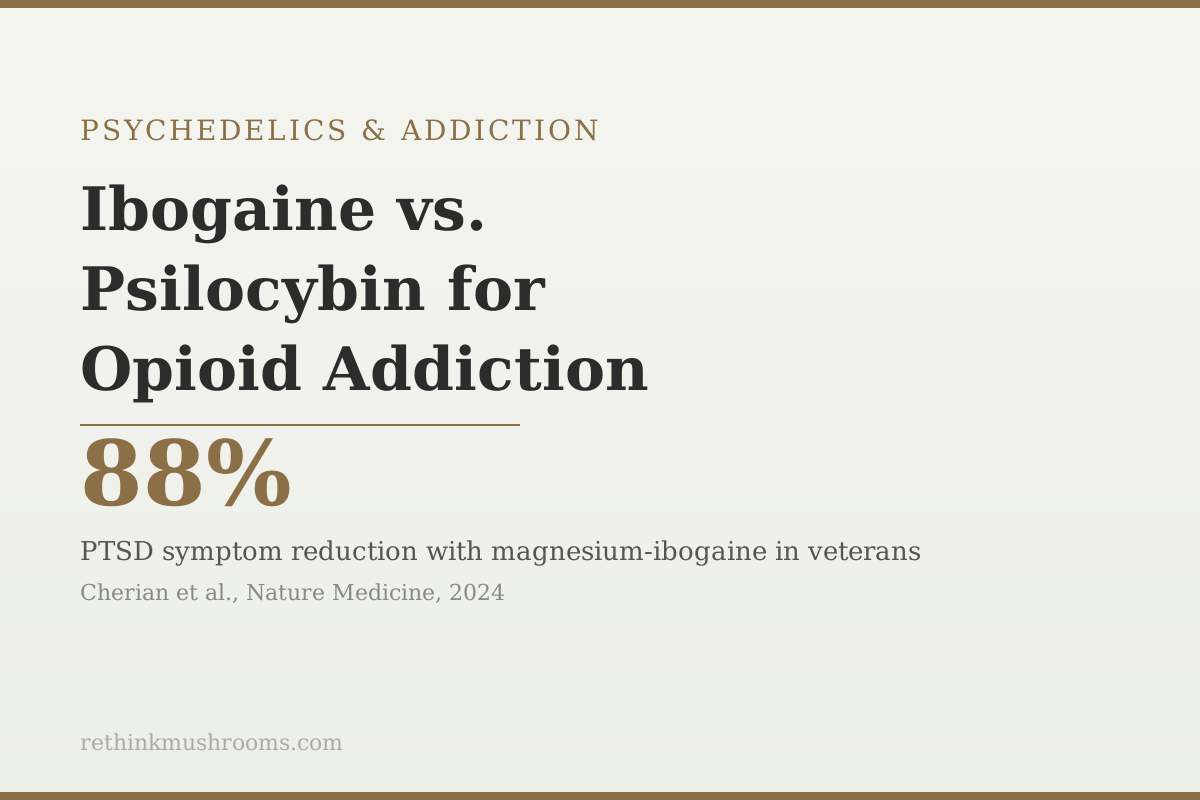
88% PTSD symptom reduction with magnesium-ibogaine treatment in veterans
Thirty veterans with traumatic brain injury and PTSD received magnesium-ibogaine treatment at a clinic in Mexico. PTSD symptoms decreased 88% at one-month follow-up, disability from cognitive and neurological symptoms dropped 87%. This is the strongest human evidence yet published for ibogaine's clinical effects.
Cherian et al., Nature Medicine, 2024
Opioid receptors
ibogaine directly modulates mu, kappa, and delta opioid receptors, which is why it can interrupt acute withdrawal within hours; psilocybin has no opioid receptor activity
Cardiac risk
ibogaine causes QT interval prolongation, requiring cardiac monitoring; psilocybin has no significant cardiac safety concerns at clinical doses
Neither FDA-approved
for opioid use disorder; both are in active clinical research; the comparison reflects current evidence, not regulatory status
Cherian et al., Nature Medicine, 2024
 View as image ↗
Ibogaine and psilocybin are both Schedule I substances under US federal law. Both are being studied for addiction treatment. Both show promising preliminary results. Beyond these similarities, they are pharmacologically different compounds that address opioid addiction through mechanisms that barely overlap.
This matters for anyone comparing them, because the comparison that most retreat centers and advocacy groups produce is not a fair one. Ibogaine-adjacent sources oversell ibogaine's uniqueness without mentioning the cardiac risks. Psilocybin advocates ignore ibogaine almost entirely. The honest comparison requires understanding that ibogaine works on opioid receptors directly while psilocybin does not, that ibogaine can interrupt acute withdrawal while psilocybin cannot, and that ibogaine carries genuine cardiac risks that require monitoring while psilocybin does not. Neither compound has completed the Phase 3 RCTs required for FDA approval for opioid use disorder. Both are legitimately interesting. They are not interchangeable.
For broader context on psilocybin's addiction mechanisms, see psilocybin for alcohol addiction: the NYU clinical trial results.
Key Takeaways
- Ibogaine directly modulates opioid receptors (mu, kappa, delta), NMDA receptors, and serotonin receptors simultaneously; this multi-receptor action allows ibogaine to interrupt acute opioid withdrawal within hours, something psilocybin cannot do
- Magnesium-ibogaine treatment of 30 veterans with TBI and PTSD produced 88% reduction in PTSD symptoms and 87% reduction in cognitive disability at one-month follow-up in the Stanford Nature Medicine study (Cherian et al., 2024)
- Psilocybin does not act on opioid receptors; its proposed mechanism for opioid use disorder involves disrupting entrenched behavioral patterns via 5-HT2A activation, promoting neuroplasticity, and creating a therapeutic window for habit reconsolidation
- Psilocybin reduced heroin-seeking behavior and modulated inflammatory gene expression in the nucleus accumbens and prefrontal cortex of rats in a 2025 preclinical study, providing mechanistic evidence for a neurobiological pathway
- Ibogaine carries significant cardiac risk (QT prolongation and potential arrhythmia) requiring cardiac monitoring, magnesium supplementation, and physician supervision; psilocybin has no significant cardiovascular safety concerns at clinical doses
- A 2025 systematic review found psilocybin shows preliminary efficacy across multiple substance use disorders with favorable safety profiles; no comparable head-to-head comparison trial with ibogaine exists
How Ibogaine Works on Opioid Addiction
Ibogaine's mechanism of action in opioid addiction is pharmacologically distinct from any other substance used in addiction treatment. It acts simultaneously on at least five different receptor systems: opioid receptors (mu, kappa, delta), NMDA glutamate receptors, sigma receptors, nicotinic acetylcholine receptors, and serotonin receptors including 5-HT2A and 5-HT3.
The opioid receptor action is what makes ibogaine unique for opioid use disorder. Ibogaine functions as a low-affinity antagonist at mu opioid receptors (the same receptors that heroin and opioid painkillers activate). By blocking or modulating these receptors, ibogaine can interrupt the physical withdrawal syndrome that makes opioid cessation so difficult. Within hours of administration, acute withdrawal symptoms frequently resolve or substantially diminish.
Mash and colleagues studied ibogaine detoxification in a clinical observational series published in 2018, documenting that ibogaine transitions opioid and cocaine-dependent patients between dependence and abstinence with rapid interruption of acute withdrawal.[2] This withdrawal interruption effect has no parallel in psilocybin treatment.
Noribogaine, ibogaine's primary active metabolite, has a longer half-life and continues the opioid receptor modulation for days after the ibogaine dose clears. This extended action may contribute to reduced craving in the weeks following treatment.
The Stanford Study: Best Human Evidence for Ibogaine
The most compelling human evidence for ibogaine comes from a 2024 Nature Medicine study by Cherian and colleagues at Stanford, conducted in collaboration with a clinic in Mexico where ibogaine treatment is legal.[1]
Thirty US veterans with traumatic brain injury (TBI) and co-occurring PTSD, depression, and anxiety received a single session of magnesium-ibogaine treatment. Magnesium was added to reduce the cardiac arrhythmia risk that ibogaine carries. All participants were followed for one month post-treatment.
The results were striking across multiple outcomes:
- PTSD symptoms (CAPS-5 scale) decreased 88% from baseline to one-month follow-up
- Disability from cognitive and neurological TBI symptoms decreased 87%
- Depression scores decreased significantly
- Anxiety scores decreased significantly
- Alcohol and drug use decreased across the group
This was not a randomized controlled trial; it was an open-label observational study without a control group. The absence of a control arm means placebo effects, expectancy, and the broader therapeutic context cannot be separated from the pharmacological effects. These are significant methodological limitations. But the magnitude of the effects across diverse outcomes in a treatment-resistant population is notable enough that the study has generated substantial scientific attention.
How Psilocybin Addresses Opioid Addiction
Psilocybin's proposed mechanism for opioid addiction is categorically different from ibogaine's. Psilocybin does not act on opioid receptors at all. It cannot interrupt acute withdrawal. Its anti-addiction effects, where they exist, appear to come from different pathways entirely.
The primary psilocybin mechanisms relevant to addiction are 5-HT2A receptor activation (which disrupts default mode network activity and fixed behavioral patterns) and neuroplasticity (particularly the dendritic spine density increase documented in mouse models). These mechanisms are hypothesized to disrupt the rigid habitual patterns and cognitive tunneling that characterize addiction, creating a window in which previously entrenched associations can be rewritten.
A 2025 preclinical study examined psilocybin specifically in an opioid addiction model, finding that psilocybin reduced heroin-seeking behavior in rats and modulated inflammatory gene expression in the nucleus accumbens and prefrontal cortex.[3] The nucleus accumbens is central to the brain's reward circuitry; changes in inflammatory gene expression there following psilocybin treatment suggest neurobiological mechanisms affecting the reward valuation of the drug.
This is preclinical rodent data, not human trial data. Psilocybin's evidence base for opioid use disorder specifically is considerably weaker than its evidence base for alcohol and tobacco addiction.
For the mechanism of psilocybin in addiction more broadly, see how psilocybin breaks addiction: the neuroscience explained.
Evidence Quality: Where Each Drug Stands
A 2025 systematic review of psilocybin's efficacy and safety for substance use disorders synthesized available evidence across alcohol, tobacco, cocaine, and opioid use disorders.[4] The review found preliminary evidence for efficacy across multiple substances with a favorable safety profile, though acknowledging the limitations of small, mostly open-label trials.
A 2022 systematic review of psilocybin's potential therapeutic effects more broadly confirmed the pattern: promising results, significant methodological limitations, need for larger randomized trials.[5]
For ibogaine, the Stanford Nature Medicine study represents the highest-quality human evidence published to date for any specific outcome. The broader ibogaine literature includes observational studies and case series, but no randomized controlled trials for opioid use disorder have been completed. The cardiac safety requirement means any future clinical trial will require cardiac screening and monitoring, adding complexity and cost.
The honest comparison:
- Best evidence for ibogaine: Stanford Nature Medicine 2024 (n=30, no control group, TBI/PTSD population rather than primary opioid addiction)
- Best evidence for psilocybin in OUD: 2025 preclinical heroin study, plus indirect support from alcohol and tobacco human trials
- Neither has: a Phase 3 RCT for opioid use disorder
- Neither is: FDA-approved for OUD
Safety Comparison: Cardiac Risk vs. Psychological Risk
The safety profiles of ibogaine and psilocybin differ fundamentally.
Ibogaine safety concerns: Ibogaine causes QT interval prolongation, an electrical change in the heart that can predispose to potentially fatal arrhythmias. This cardiac risk is well documented and has been associated with deaths in unmonitored settings. The Stanford protocol used magnesium supplementation specifically to reduce this risk, alongside cardiac screening and monitoring during treatment. Any medically responsible ibogaine treatment requires cardiac evaluation before administration, magnesium protocol, and monitoring during the session. Ibogaine is also a long-acting substance; the active treatment window lasts 12-36 hours.
Ibogaine also interacts with numerous medications and is contraindicated in patients with certain cardiac conditions. Liver disease affects noribogaine metabolism and increases risk. These requirements mean ibogaine is not appropriate for all patients with opioid use disorder.
Psilocybin safety concerns: At clinical doses, psilocybin does not carry significant cardiovascular risk. Its primary safety concerns are psychological: anxiety, confusion, and rarely panic during the experience, particularly without appropriate set, setting, and psychological support. In clinical trials with proper screening and support, serious adverse events have been uncommon. Psilocybin is contraindicated in personal or family history of psychosis and requires careful screening for this risk.
The practical implication: psilocybin's safety profile is more permissive in terms of medical risk but requires psychological support and preparation. Ibogaine's safety profile requires medical infrastructure and cardiac monitoring, limiting where and to whom it can be safely administered.
Why Ibogaine Is Schedule I Despite Evidence
The question of why ibogaine remains Schedule I in the United States despite evidence of clinical efficacy is common among those researching the comparison.
The primary reasons are historical and medical: ibogaine was scheduled in 1967 as part of the broader criminalization of psychedelic and dissociative substances, before any rigorous addiction research had been conducted. Unlike LSD or psilocybin, ibogaine also has genuine acute safety risks (the cardiac arrhythmia risk) that complicate regulatory review. FDA approval requires demonstrated safety at a population level, and ibogaine's cardiac profile means it would require a risk management strategy (REMS program) at minimum.
There is active research and political momentum for changing ibogaine's legal status. A 2026 executive order accelerated research pathways for psychedelic treatments in the US context of veteran mental health. Several states have moved toward ibogaine decriminalization or supervised access frameworks, paralleling the psilocybin regulatory developments in Oregon and Colorado.
Both ibogaine and psilocybin remain Schedule I federally in the United States. Access to either, outside of legitimate clinical trials, requires traveling internationally or violating federal law.
The Bottom Line
Ibogaine and psilocybin address opioid addiction through fundamentally different mechanisms. Ibogaine directly modulates opioid receptors and can interrupt acute withdrawal within hours; psilocybin has no opioid receptor activity and works through neuroplasticity and behavioral pattern disruption. The Stanford Nature Medicine study (Cherian et al., 2024) represents the strongest human evidence for ibogaine, showing 88% PTSD symptom reduction in 30 veterans. Psilocybin's evidence base for opioid use disorder specifically is weaker, consisting primarily of a 2025 preclinical heroin study and extrapolation from alcohol and tobacco trials. Ibogaine carries cardiac arrhythmia risk requiring medical monitoring; psilocybin carries no significant cardiovascular risk. Neither is FDA-approved for opioid use disorder and neither has completed a Phase 3 RCT for this specific indication.
Frequently Asked Questions
Sources & References
- 1RTHM-01873·Cherian, Kirsten N et al. (2024). “Magnesium-ibogaine therapy in veterans with traumatic brain injuries..” Nature medicine.Study breakdown →PubMed →↩
- 2RTHM-00985·Mash, Deborah C et al. (2018). “Ibogaine Detoxification Transitions Opioid and Cocaine Abusers Between Dependence and Abstinence: Clinical Observations and Treatment Outcomes..” Frontiers in pharmacology.Study breakdown →PubMed →↩
- 3. Source details for this reference are not yet available.
- 4. Source details for this reference are not yet available.
- 5. Source details for this reference are not yet available.