Psilocybin & Addiction
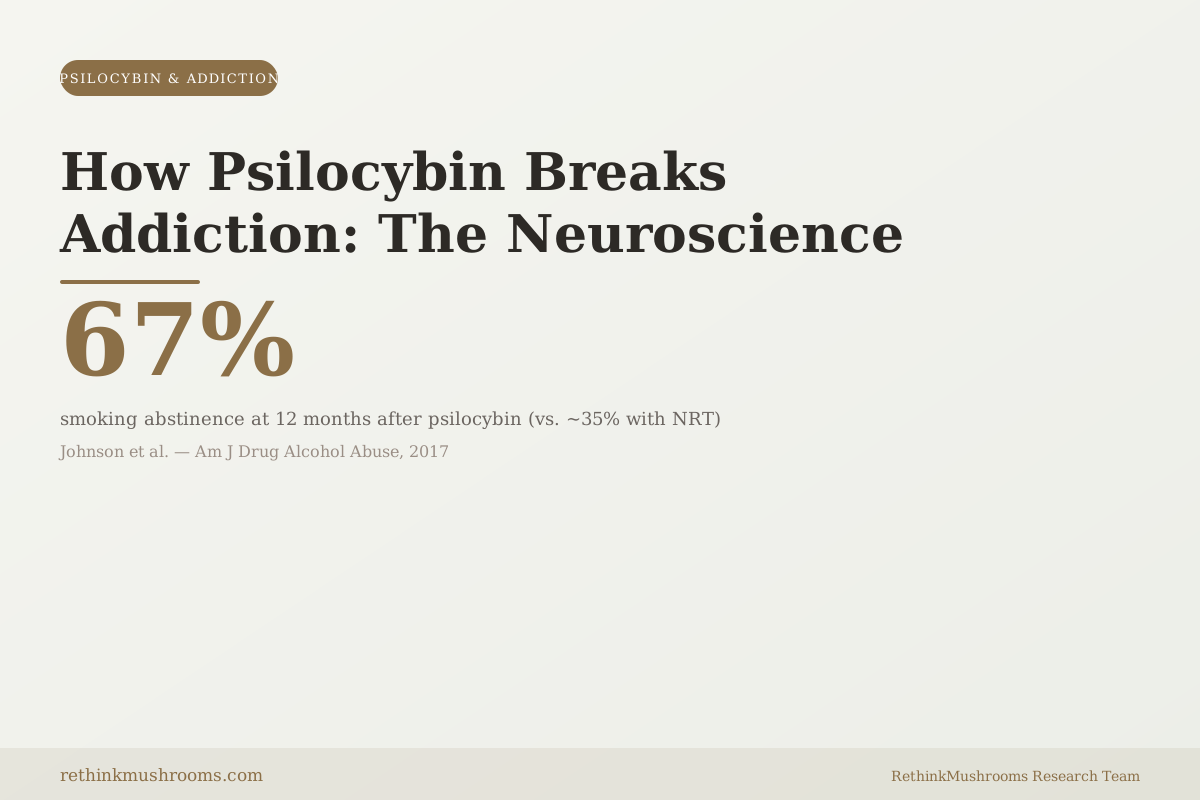
67% abstinent
Of Hopkins smoking study participants remained abstinent at 12 months after psilocybin-facilitated cessation, compared to roughly 35% with nicotine replacement therapy at the same timepoint.
Johnson et al., Am J Drug Alcohol Abuse, 2017
3 mechanisms
acute neural disruption, neuroplasticity window, and mystical experience mediator; how psilocybin addresses addiction simultaneously
Cell, 2026
Jiang et al. showed psilocybin triggers activity-dependent rewiring of large-scale cortical networks, the most precise mechanistic evidence to date
26 trials
ongoing clinical trials across tobacco, alcohol, opioids, and stimulants as of the 2025 Meshkat systematic review
Johnson et al., Am J Drug Alcohol Abuse, 2017
 View as image ↗
Most addiction treatments work through a single channel. Naltrexone blocks opioid receptors. Varenicline partially activates nicotine receptors. Methadone substitutes one opioid for another. These approaches can be effective, but they're also specific: they address one neurochemical system and leave the rest of the addiction machinery intact.
Psilocybin appears to work differently, and the research is beginning to explain why. Three simultaneous mechanisms have been identified, each contributing to addiction recovery through a different neurological route: acute disruption of the rigid brain patterns that maintain addiction; a subsequent neuroplasticity window during which new behavioral patterns can be more easily formed; and a psychological transformation during the session itself, with the quality of the experience predicting who stays sober.
None of these mechanisms is fully understood. Most of the mechanistic evidence is preclinical. But the convergence from multiple independent research directions, combined with the strongest clinical data to date, makes the current picture compelling enough to examine carefully. For the clinical trial outcomes specifically, psilocybin for alcohol addiction: what the NYU trials showed covers the RCT evidence in depth.
Key Takeaways
- Psilocybin operates through three simultaneous mechanisms in addiction treatment: acute disruption of rigid neural patterns, a post-session neuroplasticity window, and a mystical-type experience that predicts abstinence independently of drug intensity.
- Jiang et al. (Cell, 2026) found psilocybin triggers activity-dependent structural rewiring of large-scale cortical networks, weakening the self-reinforcing loops characteristic of addiction while strengthening input from perceptual and medial regions.
- Urban et al. (Front Neurosci, 2023) identified mGluR2 receptor restoration in the prefrontal cortex as the craving-specific molecular target, explaining how psilocybin reverses a specific neurochemical deficit caused by addiction.
- Garcia-Romeu et al. (2014) found that in the Hopkins smoking study, abstainers and relapsers had no significant difference in drug intensity, but abstainers scored significantly higher on mystical experience measures. The experience, not the dose, predicted the outcome.
- Johnson et al. (JAMA Network Open, 2026) found psilocybin produced significantly higher confirmed smoking abstinence at 6 months than nicotine replacement therapy in a pilot RCT.
- Rieser et al. (EClinicalMedicine, 2025) found psilocybin-assisted therapy significantly reduced heavy drinking days compared to placebo-assisted therapy in a phase 2 RCT for alcohol use disorder.
What Most Addiction Treatments Miss
Addiction is not only a neurochemical dependency. By the time someone has been using a substance for years, the addiction has restructured the brain in ways that extend far beyond receptor desensitization.
The prefrontal cortex, which governs executive control, impulse regulation, and conscious decision-making, loses critical functionality in chronic addiction. Urban and colleagues (2023) in Frontiers in Neuroscience described this precisely: addiction drives structural neuronal atrophy in the prefrontal cortex, reducing synaptic density and impairing the circuits responsible for overriding craving and choosing differently.[3] They also identified the specific molecular deficit: addiction depletes mGluR2 receptor expression in the medial prefrontal cortex, disrupting the prefrontal cortex's ability to suppress cravings generated by deeper, more primitive reward circuits.
At the same time, substance use has become automatic. The cue-craving-use sequence that characterizes addiction is not purely deliberate behavior; it is encoded as a habit in the dorsal striatum and operates below the level of conscious choice. This is why relapse happens even in people who have made sincere decisions to stop. The habit fires automatically when the right trigger appears.
Standard pharmacotherapy targets the neurochemical layer of this problem but generally doesn't reverse the structural brain changes, restore the depleted receptor expression, or disrupt the automatic habit circuits. Psilocybin's research profile suggests it addresses all three layers simultaneously.
Mechanism 1: Acute Disruption of Rigid Brain Patterns
The most striking and recent mechanistic evidence comes from Jiang and colleagues (2026) in Cell, the highest-impact journal in the biological sciences.[10]
Jiang et al. found that psilocybin triggers activity-dependent structural rewiring of large-scale cortical networks. The rewiring is bidirectional: psilocybin weakens cortico-cortical recurrent loops (the circuits that reinforce their own activity, which in addiction maintain the self-perpetuating patterns of craving and use) while strengthening inputs from perceptual and medial regions to subcortical targets (which increases the influence of environmental context and conscious processing on behavior).
The implication is direct: addiction, understood as a state of overactive recurrent loops, can be disrupted structurally by psilocybin in a way that temporarily returns control to the prefrontal cortex. The effect is not pharmacological in the conventional sense; psilocybin doesn't simply block the craving signal. It restructures the circuits generating it.
This rewiring is what Carhart-Harris's earlier theoretical framework described as increasing neural entropy: temporarily destabilizing the low-entropy, rigid attractor states that characterize addiction and allowing the brain to explore new configurations. Urban et al. (2023) cited this framework explicitly, connecting it to the restoration of the mGluR2 signaling in the prefrontal cortex that allows new learning to consolidate during the disrupted window.
For a deeper look at psilocybin and habit loops: disrupting automatic behavior, the cluster's dedicated article covers the basal ganglia and dorsal striatum side of this mechanism.
Mechanism 2: The Neuroplasticity Window
The disruption opened by psilocybin doesn't close immediately. What follows the acute period is a window during which the brain appears to be more plastic, more capable of forming new connections and consolidating new behavioral patterns.
Bogenschutz and colleagues (2015) were among the first to capture the temporal signature of this window in humans.[4] In their proof-of-concept open-label study of psilocybin-assisted treatment for alcohol dependence (n=10), reductions in drinking were largest in the weeks immediately following each psilocybin session, gradually attenuating over subsequent weeks. This pattern is precisely what a plasticity window would predict: peak opportunity for behavioral change immediately post-session, declining as the brain returns to its baseline state.
Urban et al. (2023) provided the mechanistic grounding: psilocybin reverses the addiction-induced structural atrophy in the prefrontal cortex, promoting synaptogenesis (the growth of new synaptic connections) and restoring the mGluR2 expression that enables proper executive control of cravings.[3] These structural changes are rapid (appearing within hours in animal models) and sustained (persisting for days to weeks beyond the drug's presence in the system).
The plasticity window is why the integration therapy used in clinical trials is structurally important rather than merely supportive. Psychotherapy during this window encounters a brain that is genuinely more capable of rewiring. Psychotherapy outside the window is working against the same entrenched patterns that preceded the session.
For the full neuroplasticity picture, neuroplasticity and addiction: how psilocybin opens a window covers the synaptic density and cortical rewiring evidence in depth.
Mechanism 3: The Mystical Experience as a Therapeutic Mediator
The third mechanism is the one that most distinguishes psilocybin from conventional pharmacotherapy, and also the one that was most surprising to discover.
In the Johns Hopkins smoking cessation studies, participants who remained abstinent at follow-up did not necessarily have more intense drug experiences than those who relapsed. What they had was more complete mystical experiences. Garcia-Romeu and colleagues (2014) analyzed the first Hopkins smoking cohort and found that abstainers versus relapsers had no statistically significant difference in scores measuring general drug intensity, but abstainers scored significantly higher on mystical experience measures.[5]
This finding forces a specific conclusion: the therapeutic mechanism is not simply "more drug." Something about the qualitative character of the experience (the sense of profound interconnectedness, the dissolution of ordinary ego-boundaries, the noetic quality of insight) predicts who benefits. The drug's pharmacological action is the prerequisite, but it's a prerequisite for an experience, and the experience is what produces the change.
Griffiths and colleagues (2006) established what these experiences actually are: a form of mystical-type experience that participants consistently rate among the five most personally meaningful experiences of their lives, with sustained effects on well-being confirmed at 14-month follow-up.[9] The experience is not simply pleasant; it is often challenging, emotionally intense, and transformative. The challenge itself may be part of the mechanism.
The theoretical account for why mystical experience predicts addiction recovery is that it produces a shift in the relationship between the person and the substance: addiction is partly maintained by a sense of identity built around the substance, and a sufficiently disrupting perspective shift can decouple that identity structure. This is not purely psychological; the DMN disruption that underlies the mystical experience is neurologically real, measurable on fMRI, and correlated with therapeutic outcomes across conditions.
For the mystical experience mechanism specifically, the mystical experience and addiction recovery: why it matters covers the evidence and the theoretical account.
The Clinical Evidence: What the Trials Show
The most clinically significant data in this cluster comes from two recent controlled trials and two comprehensive systematic reviews.
Johnson 2026 (JAMA Network Open): A pilot randomized clinical trial directly comparing psilocybin to nicotine replacement therapy for smoking cessation.[7] The psilocybin arm showed significantly higher confirmed abstinence at 6 months than the NRT arm. This is a pilot trial, but it is the first head-to-head comparison of psilocybin against a standard-of-care pharmacotherapy published in a major medical journal.
Rieser 2025 (EClinicalMedicine): A phase 2 randomized clinical trial in alcohol use disorder.[8] Psilocybin-assisted therapy significantly reduced heavy drinking days compared to placebo-assisted therapy, making it one of the adequately powered controlled trials in this space. This moves the evidence from proof-of-concept to signal of clinical benefit.
Johnson 2017 (Am J Drug Alcohol Abuse): The 12-month follow-up of the original Hopkins smoking study.[6] At 12 months, 67% of participants who completed the psilocybin protocol remained abstinent. At 16 months, 60% remained abstinent. For context, standard pharmacotherapy for nicotine typically produces 6-month abstinence rates of 15-35%, depending on the intervention.
Van der Meer et al. (2023), the most widely cited systematic review in this literature, synthesized evidence across tobacco and alcohol trials and confirmed consistent reductions in substance use and increased abstinence rates across studies.[1] They also noted 26 ongoing clinical trials across multiple substances at the time of publication.
Meshkat et al. (2025) produced the most current systematic review, covering those ongoing trials and confirming a generally favorable safety profile with effect sizes exceeding standard pharmacotherapy in most comparisons reported.[2]
What the Evidence Doesn't Yet Show
Several important questions remain unanswered by the current data.
Most trials are small. The Hopkins smoking study had 15 participants. The Bogenschutz AUD proof-of-concept had 10. Even the Rieser 2025 phase 2 RCT and the Johnson 2026 pilot are still relatively small. Effect sizes in small trials can be inflated, and the populations studied may not represent the full range of people who would seek psilocybin treatment.
The mechanism data is largely preclinical. The Jiang 2026 Cell paper was an animal study. Urban et al. (2023) is a review of preclinical evidence. The neuroplasticity changes and mGluR2 restoration have not been directly measured in human addiction populations with the methods used in animal work. The human clinical studies measure outcomes (abstinence rates, craving scores, drinking days) but not the specific molecular and structural changes proposed to explain them.
The mystical experience is not universally experienced and may not be equally available across substances or populations. The relationship between psilocybin dose, mystical experience quality, and long-term outcome in non-tobacco addictions has not been established as clearly as in the smoking literature.
For more on how psilocybin compares to standard pharmacotherapy, psilocybin vs. naltrexone for alcohol addiction covers that comparison directly.
The Bottom Line
Psilocybin's effect on addiction involves three converging neurological mechanisms: acute disruption of the rigid recurrent circuit loops that maintain addiction (Jiang, Cell, 2026); a post-session neuroplasticity window during which new behavioral patterns can consolidate more easily (Bogenschutz 2015, Urban 2023); and a mystical-type experience during the session that predicts abstinence independently of drug intensity (Garcia-Romeu 2014). The clinical evidence is encouraging but still limited in scale: Johnson 2026 (JAMA Network Open) found psilocybin outperformed nicotine replacement in a head-to-head pilot RCT; Rieser 2025 showed phase 2 efficacy in alcohol use disorder. The mechanistic and structural evidence for how psilocybin reverses addiction-related brain changes is primarily preclinical, and human trials measuring specific molecular endpoints have not yet been reported.
Frequently Asked Questions
Sources & References
- 1RTHM-01812·van der Meer, Pim B et al. (2023). “Therapeutic effect of psilocybin in addiction: A systematic review..” Frontiers in psychiatry.Study breakdown →PubMed →↩
- 2RTHM-02148·Meshkat, Shakila et al. (2025). “Efficacy and safety of psilocybin for the treatment of substance use disorders: A systematic review..” Neuroscience and biobehavioral reviews.Study breakdown →PubMed →↩
- 3RTHM-01811·Urban, Marvin M et al. (2023). “Mini-review: The neurobiology of treating substance use disorders with classical psychedelics..” Frontiers in neuroscience.Study breakdown →PubMed →↩
- 4RTHM-00673·Bogenschutz, Michael P et al. (2015). “Psilocybin-assisted treatment for alcohol dependence: a proof-of-concept study..” Journal of psychopharmacology (Oxford.Study breakdown →PubMed →↩
- 5RTHM-00321·Garcia-Romeu, Albert et al. (2014). “Psilocybin-occasioned mystical experiences in the treatment of tobacco addiction..” Current drug abuse reviews.Study breakdown →PubMed →↩
- 6RTHM-00475·Johnson, Matthew W et al. (2017). “Long-term follow-up of psilocybin-facilitated smoking cessation..” The American journal of drug and alcohol abuse.Study breakdown →PubMed →↩
- 7RTHM-00960·Johnson, Matthew W et al. (2026). “Psilocybin or Nicotine Patch for Smoking Cessation: A Pilot Randomized Clinical Trial..” JAMA network open.Study breakdown →PubMed →↩
- 8RTHM-02168·Rieser, Nathalie M et al. (2025). “Psilocybin-assisted therapy for relapse prevention in alcohol use disorder: a phase 2 randomized clinical trial..” EClinicalMedicine.Study breakdown →PubMed →↩
- 9RTHM-00096·Griffiths, R R et al. (2006). “Psilocybin can occasion mystical-type experiences having substantial and sustained personal meaning and spiritual significance..” Psychopharmacology.Study breakdown →PubMed →↩
- 10RTHM-02233·Jiang, Quan et al. (2026). “Psilocybin triggers an activity-dependent rewiring of large-scale cortical networks..” Cell.Study breakdown →PubMed →↩