Psilocybin & Alcohol Addiction
83% vs. 51% reduction in heavy drinking days
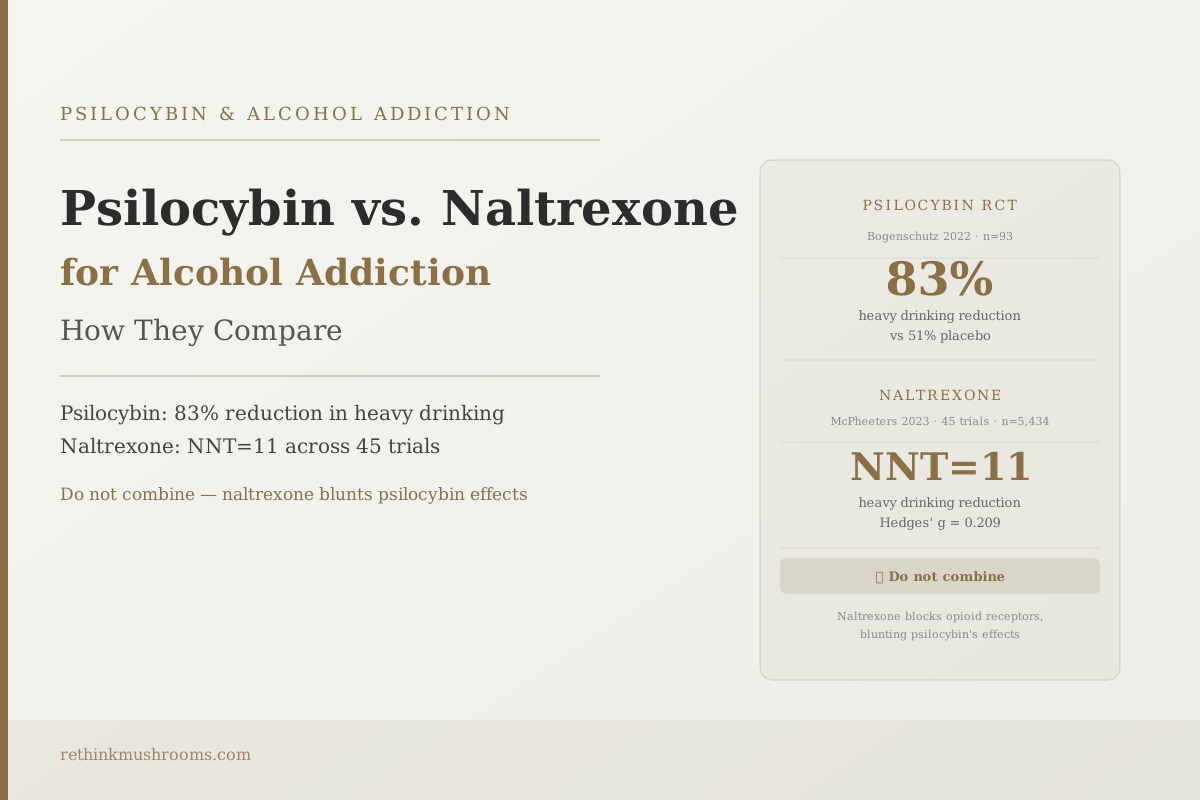
In the landmark psilocybin alcohol RCT, two psilocybin sessions reduced heavy drinking days by 83% compared to 51% in the placebo group. Naltrexone, across 45 trials, produces smaller but well-established and FDA-approved effects.
Bogenschutz et al., JAMA Psychiatry, 2022 | McPheeters et al., JAMA, 2023
NNT=11
number of patients who need naltrexone for one to achieve meaningful heavy drinking reduction (McPheeters 2023, 45 trials)
48% vs 24%
complete abstinence at 8 months: psilocybin vs placebo in the NYU RCT (Bogenschutz 2022)
Do not combine
naltrexone blocks opioid receptors and likely blunts psilocybin's therapeutic effects — the two treatments are pharmacologically incompatible
Bogenschutz et al., JAMA Psychiatry, 2022 | McPheeters et al., JAMA, 2023
 View as image ↗
Naltrexone and psilocybin both reduce heavy drinking in clinical trials. That's where the similarity ends. They work on different brain systems, require radically different levels of patient involvement, produce effects that last through different time scales, and — critically — should not be combined, because naltrexone blocks the brain system that psilocybin uses to produce its effect.
If you're researching options for alcohol use disorder, comparing these two treatments is less like comparing two versions of the same medication and more like comparing physical therapy to surgery. Both can address the same underlying problem, but through fundamentally different mechanisms, for different types of patients at different stages of their situation.
This article compares the clinical evidence using actual data from the best available trials, covers the drug interaction, and describes which patient profile each treatment is designed for. For the full picture of psilocybin's alcohol evidence including how the mechanism works, see the overview of psilocybin for alcohol addiction.
Key Takeaways
- Bogenschutz 2022 JAMA Psychiatry (n=93 double-blind): two psilocybin sessions reduced heavy drinking days by 83% vs 51% in placebo; 48% achieved complete abstinence vs 24% at 8 months
- McPheeters 2023 JAMA (45 naltrexone trials, n=5,434): NNT=11 for meaningful heavy drinking reduction; Hedges' g=0.209 (small but consistent effect); requires daily dosing to maintain benefit
- Critical pharmacology: naltrexone blocks opioid receptors throughout the brain and likely blunts psilocybin's therapeutic effects; combining them is pharmacologically contraindicated and these treatments require separate treatment windows
- Rieser 2025 Phase 2 RCT (n=37): a single psilocybin dose found no significant difference from placebo in the primary abstinence outcome, showing results depend heavily on protocol — one session differs meaningfully from two
- Naltrexone is FDA-approved and available through any prescriber; psilocybin is not FDA-approved for alcohol use disorder and remains available only in research settings in the United States
- These treatments are not head-to-head competitors: naltrexone fits patients managing ongoing drinking; psilocybin fits patients motivated for a more fundamental change in their relationship with alcohol
Why "Which Is Better" Is the Wrong Question
The comparison that seems obvious, psilocybin or naltrexone, turns out to be the wrong framing when you look at how each treatment is actually used.
Naltrexone is a daily medication. It works by blocking opioid receptors in the brain, which reduces the reward of drinking. When you drink while taking naltrexone, alcohol releases less dopamine into the brain's reward circuits, making the drinking experience less pleasurable. Patients who continue drinking while taking naltrexone find that the pleasure-to-harm ratio shifts, making it easier to reduce consumption over time. It is a management tool for ongoing behavior.
Psilocybin is an episodic experience. A patient attends one or two supervised sessions in a clinical setting, each lasting 6-8 hours, with preparation sessions before and integration sessions afterward. The goal is not ongoing pharmacological management but a lasting shift in motivation, self-perception, and relationship to alcohol. It is, pharmacologically, a serotonergic compound with a half-life measured in hours. Its therapeutic effect is not produced by the drug being in the body — it is produced by the experience the drug facilitates.
These are different tools designed for different moments in treatment. Someone who is not yet ready to stop drinking but wants to reduce harm may benefit most from naltrexone. Someone who is motivated to stop but unable to break the pattern through conventional means may be a candidate for psilocybin therapy. Many patients would fall clearly into one category or the other rather than facing a genuine either-or choice.
The Naltrexone Evidence: What 45 Trials and 5,434 Patients Show
The most comprehensive synthesis of naltrexone's efficacy for alcohol use disorder comes from McPheeters and colleagues, published in JAMA in 2023 — a systematic review and meta-analysis of 45 randomized trials with 5,434 participants.[2]
The primary finding: naltrexone achieves an NNT (number needed to treat) of 11 for meaningful heavy drinking reduction. An NNT of 11 means that for every 11 patients treated with naltrexone, one achieves a clinically meaningful reduction in heavy drinking days that would not have occurred with placebo. By comparison, the NNT for aspirin preventing a second heart attack is around 50 — so NNT=11 is a clinically respectable result for a chronic behavioral condition.
The standardized effect size (Hedges' g) was 0.209. In clinical psychology benchmarks, an effect below 0.2 is negligible and above 0.8 is large. Naltrexone's effect at 0.209 falls in the small range — consistent, real, and statistically robust across thousands of patients, but modest in absolute magnitude.
For acamprosate, another FDA-approved alcohol medication, the NNT was 11 for supporting abstinence.
What these numbers mean practically: naltrexone reliably helps a meaningful minority of patients reduce heavy drinking. It does not produce dramatic reversal of alcohol use disorder in most patients. It is a maintenance medication that works while it is taken and requires continued use to sustain benefit.
The Psilocybin Evidence: The RCT Data — Including the Null Result
The most rigorous psilocybin data for alcohol use disorder comes from Bogenschutz and colleagues' double-blind randomized controlled trial published in JAMA Psychiatry in 2022, which enrolled 93 participants with alcohol use disorder.[1]
Participants received either two psilocybin sessions or two diphenhydramine (active placebo) sessions, alongside psychotherapy throughout. At 8 months after the first session: the psilocybin group reduced heavy drinking days by 83% versus 51% in the placebo group. Complete abstinence was achieved by 48% of the psilocybin group versus 24% in the placebo group.
These are striking absolute numbers. But they require context from a different trial that reported a very different outcome.
Rieser and colleagues conducted a Phase 2 randomized controlled trial in Switzerland, published in eClinicalMedicine (Lancet) in 2025, enrolling 37 patients with alcohol use disorder.[3] Participants received a single 25mg psilocybin dose plus five psychotherapy sessions. The primary outcome — abstinence duration — showed no significant difference from placebo at either the 4-week or 6-month follow-up. Secondary outcomes showed positive trends, but the main result was null.
These two RCTs appear to contradict each other. The methodological difference that most likely explains the gap: Bogenschutz 2022 used two psilocybin sessions; Rieser 2025 used one. Two sessions with full psychotherapy support produced effects that one session did not reliably replicate. For the sustained abstinence data comparing protocols in detail, see psilocybin and alcohol use disorder: long-term results.
Bogenschutz's earlier pilot (2015, n=10) had found sustained gains maintained through a 36-week follow-up from a shorter protocol.[5] Van der Meer and colleagues' 2023 systematic review confirmed a consistent benefit signal for alcohol across the broader psilocybin addiction literature.[6]
The Head-to-Head Data You Can't Find: Nobody Has Run That Trial
No published trial has directly compared psilocybin to naltrexone in the same study with randomized assignment. The comparison this article presents is indirect: each treatment's best data against its own control. This matters for interpreting the numbers. The 83% heavy drinking reduction in Bogenschutz 2022 comes from comparison to an active placebo in a clinical trial population motivated enough to enroll in a psilocybin study. Naltrexone's NNT=11 comes from 45 heterogeneous trials across many patient populations with varying levels of motivation and treatment engagement.
| Factor | Psilocybin | Naltrexone |
|---|---|---|
| Mechanism | Serotonin 5-HT2A agonism, altered self-perception, motivational shift | Opioid receptor blockade, reduces alcohol reward |
| FDA status | Not approved for AUD | FDA-approved since 1994 |
| Dosing | 1-2 sessions total in clinical trial protocols | Daily oral tablet or monthly injectable |
| Best RCT outcome | 83% vs 51% heavy drinking reduction (Bogenschutz 2022) | NNT=11, Hedges' g=0.209 (McPheeters 2023) |
| Complete abstinence | 48% vs 24% at 8 months (Bogenschutz 2022) | Not a primary endpoint in most naltrexone trials |
| Effect durability | 8 months sustained post-session | Requires ongoing daily dosing; relapse typical on cessation |
| Availability (US) | Research settings only | Any prescriber |
| Patient effort required | High: preparation, sessions, integration | Low: daily pill |
Why You Cannot Combine Them: The Pharmacological Conflict
If you're currently taking naltrexone and considering psilocybin therapy — or vice versa — the drug interaction matters and is not widely discussed.
Naltrexone's primary mechanism is blocking opioid receptors (specifically mu-opioid receptors) throughout the central nervous system. Psilocybin's therapeutic effects are mediated primarily through 5-HT2A serotonin receptors, but the full experience involves interactions across multiple receptor systems, including opioid pathways that contribute to the experiential and emotional dimensions of the session.
Clinical evidence and pharmacological reasoning both suggest that naltrexone significantly reduces or eliminates psilocybin's psychedelic effect. The therapeutic mechanism of psilocybin in alcohol use disorder likely depends on having a full, meaningful experience during the session — not just serotonin receptor stimulation, but the psychological experience that psilocybin facilitates. Blunting that experience with naltrexone may eliminate the therapeutic benefit entirely while keeping the risks.
No randomized trial has directly tested the psilocybin-naltrexone combination, so this is based on mechanistic reasoning and clinical observation rather than controlled data. The practical implication: anyone considering psilocybin therapy should work with their clinician to establish an appropriate washout period from naltrexone before any psilocybin session. And anyone being offered naltrexone as ongoing management should understand that it creates a barrier to future psilocybin therapy as long as it is continued.
Which Treatment Fits Which Patient
The clinical profiles that fit each treatment don't overlap as much as the comparison framing suggests.
Naltrexone is appropriate for: patients who want to reduce drinking without committing to complete cessation, patients who want a low-engagement pharmacological support, patients in high-stress situations where the cognitive demands of psilocybin preparation and integration are not feasible, and patients who have not yet had the motivational threshold shift that makes intensive treatment worthwhile.
Psilocybin is appropriate for (in research settings): patients who are highly motivated to stop drinking, who are willing to engage with a multi-session therapeutic process over weeks, who have adequate psychological stability to manage an intense altered-state experience, and who have not achieved lasting change through conventional approaches including naltrexone. The Luquiens 2025 feasibility trial explored psilocybin specifically in patients with AUD and comorbid depression — a complex population where the dual diagnosis may make psilocybin's broader psychological effects particularly relevant.[4]
Some patients may use these treatments sequentially rather than choosing between them: naltrexone to reduce drinking to a safer level while building readiness, then psilocybin therapy as a more intensive intervention. These are not mutually exclusive in principle, only in timing — the washout requirement means they cannot be active simultaneously.
The Access Reality in 2026
Naltrexone has been FDA-approved for alcohol dependence since 1994. Any physician or prescriber can prescribe it. It is available in generic form. Monthly injectable naltrexone is available for patients who have difficulty with daily adherence.
Psilocybin is not FDA-approved for alcohol use disorder. It remains a Schedule I controlled substance in the United States. Access exists only through research trials or, for patients willing to travel, through clinical programs in countries with different regulatory frameworks (Australia approved psilocybin for treatment-resistant depression and PTSD but not specifically for alcohol use disorder under current TGA indications). Phase 3 trials for alcohol use disorder in the US have not yet begun.
For patients who want psilocybin's effects but face legal or access barriers, psilocybin's broader anti-addiction signal across other substances — including the strong smoking cessation data — suggests the mechanism is generalizable. For context on that evidence, see how psilocybin helps smokers quit.
Honest Summary of Where the Evidence Leaves Us
The data comparison favors psilocybin's maximum effect size in the best available trial, with naltrexone's advantage in regulatory status, access, and evidence depth from decades of post-approval data. Neither answer is complete, and the Rieser 2025 null result is a real finding that should prevent overconfidence in psilocybin's alcohol use disorder data.
The most defensible conclusion: psilocybin at optimal protocol (two sessions plus full psychotherapy support) showed larger effects than naltrexone in the best available RCTs, but the evidence base is smaller, the treatment is unavailable outside research settings in the US, and results are not reliable with less intensive protocols. Naltrexone is available today, has real effects, and is appropriate for patients at many different stages of treatment readiness. For the detailed mechanism behind psilocybin's approach, see how psilocybin helps people stop drinking.
The Bottom Line
Psilocybin and naltrexone both reduce heavy drinking in clinical trials but through entirely different mechanisms and for different patient populations. Bogenschutz 2022 found two psilocybin sessions produced 83% reduction in heavy drinking days and 48% abstinence at 8 months; McPheeters 2023 found naltrexone across 45 trials produced an NNT of 11 with a small effect size (Hedges' g=0.209). They cannot be combined because naltrexone likely blunts psilocybin's therapeutic effect. Naltrexone is FDA-approved and widely available; psilocybin is not approved for alcohol use disorder. Neither is clearly superior — they are designed for different clinical situations.
Frequently Asked Questions
Sources & References
- 1. Source details for this reference are not yet available.
- 2. Source details for this reference are not yet available.
- 3. Source details for this reference are not yet available.
- 4. Source details for this reference are not yet available.
- 5. Source details for this reference are not yet available.
- 6. Source details for this reference are not yet available.