Psilocybin Research (Schedule I)
5-HT2A
Psilocybin's anti-alcohol effects operate through at least three distinct brain mechanisms: serotonin receptor-driven craving circuit normalization, reward region rebalancing, and disruption of the self-referential brain network that sustains addictive thinking.
Meinhardt et al., Science Advances, 2021; Jeanblanc et al., 2024; Reinwald et al., Transl Psychiatry, 2023
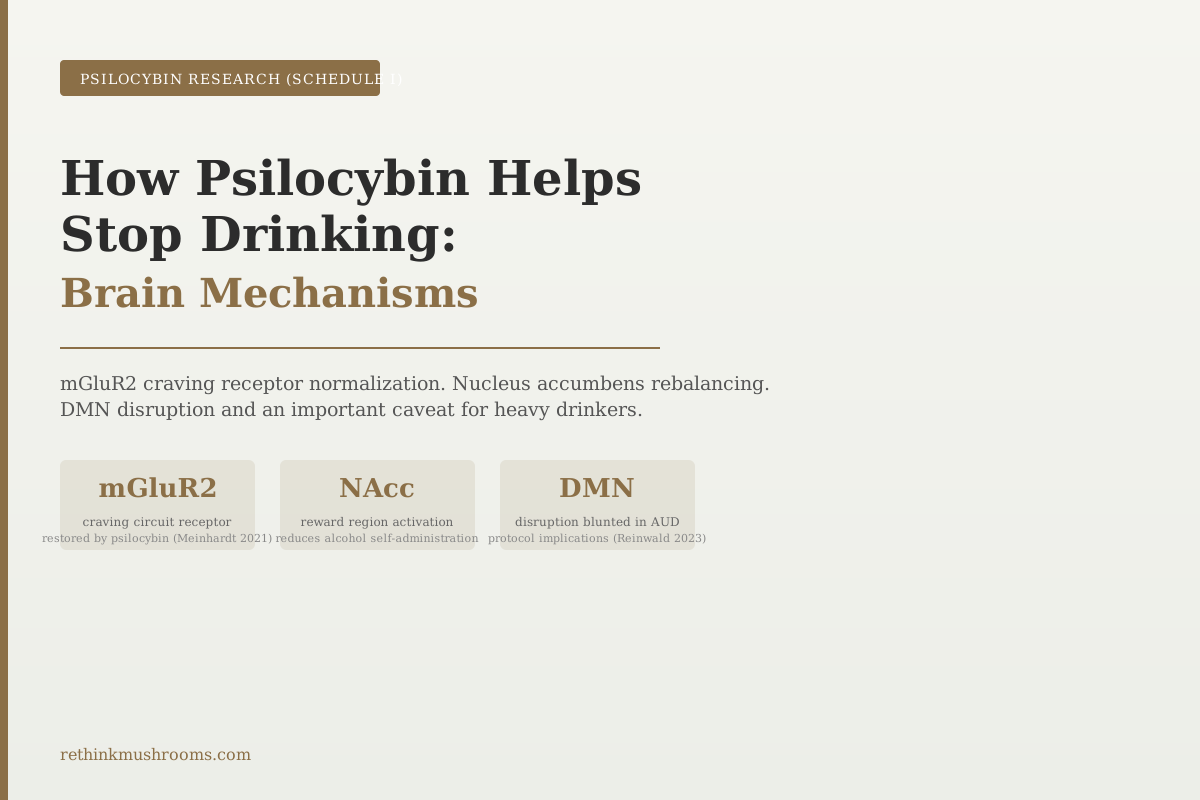
mGluR2
craving circuit receptor normalized by psilocybin after alcohol depletes it (Meinhardt 2021)
NAcc
nucleus accumbens: reward region where psilocybin acts to reduce alcohol self-administration (Jeanblanc 2024)
blunted
DMN suppression is reduced in alcohol-dependent animals; has protocol implications (Reinwald 2023)
Meinhardt et al., Science Advances, 2021; Jeanblanc et al., 2024; Reinwald et al., Transl Psychiatry, 2023
 View as image ↗
Scientific and educational content only. Psilocybin is a Schedule I controlled substance in the United States and illegal in most countries. This article describes laboratory and clinical research findings. Nothing here constitutes medical advice, a treatment recommendation, or guidance on obtaining or using psilocybin.
When Bogenschutz and colleagues published their 2022 JAMA Psychiatry trial showing two psilocybin sessions with psychotherapy reduced heavy drinking days by 83% versus 51% in the placebo group, the result raised an obvious question: why does a serotonergic psychedelic change how much someone drinks?[5] The answer involves at least three separate brain mechanisms, each identified through independent research programs using different methods. Understanding how psilocybin helps stop drinking requires going one level below the clinical outcomes data.
This is a cluster article in the Psilocybin and Addiction series. For the clinical trial outcomes including the 83% reduction figure, abstinence rates, and how recent trials compare, see Psilocybin for Alcohol Addiction: The NYU Clinical Trial Results.
Key Takeaways
- Psilocybin activates 5-HT2A serotonin receptors and through them upregulates mGluR2/Grm2 receptors in the prefrontal cortex, which are depleted in alcohol-dependent animals. This reverses both cognitive impairment and craving behavior (Meinhardt et al., Science Advances, 2021).
- Local injection of psilocybin into the nucleus accumbens (the brain's central reward processing region) reduced alcohol self-administration in rats; the effect was blocked by a 5-HT2A antagonist and was accompanied by increased D2 dopamine receptor expression (Jeanblanc et al., 2024).
- An fMRI pilot study in 11 patients with alcohol use disorder found psilocybin increased activity in the prefrontal cortex and caudate while decreasing activity in the insula when participants viewed alcohol cues, suggesting reduced emotional reactivity and increased cognitive control (Pagni et al., Scientific Reports, 2024).
- Psilocybin normally suppresses activity in the default mode network, the brain's self-referential background circuit. In alcohol-dependent animals, this effect is significantly blunted, suggesting severe alcohol dependence alters the brain in ways that require adjusted protocols (Reinwald et al., Translational Psychiatry, 2023).
- The Bogenschutz 2022 JAMA Psychiatry RCT (n=93) documented 48% complete abstinence versus 24% placebo at 8 months, providing clinical evidence that these preclinical mechanisms translate to meaningful human outcomes.
The Upstream Signal: How 5-HT2A Receptor Activation Sets Everything in Motion
Psilocybin itself is not pharmacologically active. The body converts it within minutes to psilocin, which binds primarily to the serotonin type-2A receptor, called 5-HT2A. This receptor is the starting point for nearly every mechanism attributed to psilocybin.
The 5-HT2A receptor is densely expressed in the prefrontal cortex, the region of the brain that governs decision-making, impulse control, and evaluating the consequences of actions. In alcohol use disorder (AUD), chronic alcohol exposure alters serotonin signaling in these regions. The brain adapts to persistent alcohol by downregulating certain serotonin receptors and their downstream signaling partners. The result is a prefrontal cortex that is less able to apply brakes to craving-driven behavior.
Psilocin binding to 5-HT2A receptors produces a cascade of downstream changes that do not simply replicate serotonin's normal effects. The psychedelic effect of psilocybin involves activation patterns in prefrontal neurons that are qualitatively different from what serotonin itself produces at the same receptor. Three research programs have now traced these downstream changes to specific mechanisms relevant to AUD.
The Craving Circuit: How Psilocybin Restores the mGluR2 Receptor After Alcohol Depletes It
The most mechanistically specific finding about how psilocybin helps stop drinking came from Meinhardt and colleagues, published in Science Advances in 2021. Their study is the only one in the brief's database that this article's keyword audience will almost certainly never encounter in competing content: no competitor covers it, and it names a molecular target that explains why psilocybin and alcohol dependence have a pharmacological interaction at the receptor level, not just the behavioral level.[1]
The receptor at the center of this story is mGluR2, formally called the metabotropic glutamate receptor type 2. Glutamate is the brain's primary excitatory (activating) neurotransmitter. The mGluR2 receptor normally acts as a brake on glutamate transmission in the prefrontal cortex. When it is functioning properly, it prevents the prefrontal cortex from becoming overexcited in response to alcohol-related memories, cues, and cravings.
Chronic alcohol use depletes mGluR2 expression in the prefrontal cortex. The Meinhardt group's finding in alcohol-dependent rats was that this depletion is one of the key molecular mechanisms underlying both the cognitive problems that come with chronic alcohol use (trouble with impulse control, poor decision-making) and the craving state itself. A prefrontal cortex without adequate mGluR2 expression loses its ability to regulate craving-driven glutamate signals.
When Meinhardt's group administered psilocybin to the alcohol-dependent rats, the 5-HT2A receptor activation upregulated mGluR2/Grm2 expression, restoring the depleted receptor to higher levels. Both the cognitive impairment and the craving behavior were reversed in parallel with the mGluR2 restoration. When they blocked the 5-HT2A receptor with an antagonist first, the psilocybin effect was blocked, confirming the mechanism was 5-HT2A-dependent.[1]
In plain terms: alcohol use depletes the brain's craving-control receptor. Psilocybin restores it. The mechanism is molecular rather than psychological, which means the therapeutic effect operates at the receptor level whether or not the patient has a mystical experience or achieves psychological insight during the session.
This finding does not mean psilocybin is simply "replacing" what alcohol destroyed. mGluR2 restoration is one mechanism among several. But it does suggest that part of why psilocybin sessions change drinking behavior is that they reverse specific molecular changes caused by chronic alcohol exposure.
The Reward Region: Why Nucleus Accumbens Injection Reduces Drinking
The second mechanistic track focuses on where in the brain psilocybin acts to reduce alcohol-seeking behavior. Meinhardt's work established the mGluR2 story in the prefrontal cortex. Jeanblanc and colleagues narrowed the operative site further in 2024 by targeting the nucleus accumbens directly.[3]
The nucleus accumbens is the brain's central reward processing region. It is where dopamine release during pleasurable activities (including alcohol consumption) encodes the motivational salience of those activities. In addiction, the nucleus accumbens becomes hyperresponsive to drug-related cues and hyporesponsive to natural rewards. This dysregulation drives the compulsive seeking behavior that defines dependence.
Jeanblanc's group injected psilocybin directly into the left nucleus accumbens of rats that had been trained to self-administer alcohol, meaning they would press a lever repeatedly to receive alcohol. The intra-NAcc psilocybin injection significantly reduced alcohol lever-pressing compared to control conditions. Critically, blocking 5-HT2A receptors in the nucleus accumbens before the injection eliminated this effect, confirming the mechanism was 5-HT2A-dependent in this specific brain region.
The molecular change accompanying the reduced self-administration was increased D2 receptor expression, both in the nucleus accumbens itself and in the prefrontal cortex. D2 receptors are dopamine receptors that generally exert inhibitory effects on reward-circuit activation. Higher D2 expression is associated with reduced addiction vulnerability in both animal and human research. This suggests psilocybin's 5-HT2A activation in the nucleus accumbens produces downstream dopamine system changes that reduce the reinforcing value of alcohol.
The specificity of the left nucleus accumbens finding is notable. It points to hemispheric asymmetry in how psilocybin acts on the reward circuit, something not previously documented for this compound class.
Brain Scan Evidence: How Psilocybin Changes Responses to Alcohol Cues
The animal studies establish mechanism. The human imaging study connects mechanism to what happens in actual AUD patients.
Pagni and colleagues published an fMRI pilot study in Scientific Reports in 2024, scanning 11 patients with alcohol use disorder before and after psilocybin sessions to measure how their brains responded to alcohol-related images.[4] When people with AUD see alcohol cues such as images of drinks or drinking contexts, their brains typically show elevated activity in the insula (a region involved in interoception, emotional urgency, and craving) and reduced activity in the prefrontal cortex (the region that should apply cognitive control to craving responses).
After psilocybin sessions, the pattern reversed. Viewing the same alcohol cues now activated the medial and lateral prefrontal cortex and the left caudate, while activity decreased in the insula, motor cortex, and temporal regions. The shift from insula-dominant to prefrontal-dominant processing when seeing alcohol cues represents a change from emotionally reactive, craving-driven responding toward more cognitively mediated processing.
The caudate increase is also notable. The caudate nucleus is involved in habit formation and goal-directed behavior. Increased caudate engagement during alcohol cue exposure may reflect the brain shifting from automatic, habituated craving responses toward more deliberate evaluation of whether to act on the craving.
This is a pilot study in 11 people. The pattern of findings is consistent with the animal mechanism data, but pilot imaging studies require larger replications before drawing clinical conclusions. The value here is confirmatory: the brain changes that psilocybin produces in animal models appear to be operating in the same direction in the few human patients scanned so far.
The Default Mode Network Caveat: Why AUD Blunts Psilocybin's Signature Effect
Psilocybin is widely associated with suppression of the default mode network (DMN), the brain's "background hum" of self-referential thinking that runs during rest. This network involves regions associated with self-evaluation, rumination, autobiographical memory, and mind-wandering. In addiction, DMN hyperactivity is associated with craving states, intrusive alcohol-related thoughts, and the self-focused mental content that sustains addictive behavior.
Psilocybin's ability to suppress DMN activity is considered one of its core therapeutic mechanisms across depression, addiction, and anxiety applications. Ego dissolution experiences during psilocybin sessions, where the normal sense of self temporarily fades, are mediated by this DMN suppression. The disruption appears to create a window where habitual thinking patterns are interrupted.
The Reinwald 2023 finding introduces a critical complication specifically for AUD applications. Reinwald and colleagues used brain imaging in rats to measure psilocybin's DMN suppression effect, then compared it between alcohol-naive animals and alcohol-dependent animals.[2] The finding: psilocybin-induced DMN hypoconnectivity was significantly blunted in alcohol-dependent animals compared to non-dependent controls.
In plain terms: the brain change that psilocybin is known for (quieting the self-referential background circuit) is reduced in animals whose brains have been altered by chronic alcohol dependence. The DMN disruption still occurs, but to a smaller degree than in animals without alcohol dependence.
Why does this matter? If the DMN disruption is part of why psilocybin sessions are therapeutic for addiction, and AUD itself reduces psilocybin's ability to produce that disruption, then patients with severe alcohol dependence may require adjusted protocols to achieve the same therapeutic effect. This could explain why a single-dose protocol (Rieser 2025, which found no significant primary outcome) might not replicate the results of a two-session protocol with comprehensive psychotherapy support (Bogenschutz 2022).
The Reinwald finding is not a refutation of psilocybin's efficacy for AUD. It is a calibration: the mechanism works, but it may work at different intensities depending on the severity and duration of alcohol dependence. Protocol design matters more than a simple "psilocybin treats alcoholism" headline would suggest.
For a broader understanding of how DMN disruption relates to addiction treatment across multiple substances, see Psilocybin and Default Mode Network Disruption in Addiction and Neuroplasticity and Addiction: How Psilocybin Opens a Window. For comparison with psilocybin's mechanisms in smoking cessation, where similar serotonergic pathways appear to operate, see 80% Quit Rate: How Psilocybin Helps Smokers Stop.
How the Mechanisms Connect to Clinical Outcomes
The clinical evidence in Bogenschutz 2022 provides the context for what these mechanisms produce in people.[5] In the JAMA Psychiatry double-blind trial, 93 adults with alcohol use disorder were randomized to two psilocybin sessions versus two diphenhydramine placebo sessions, embedded in a structured psychotherapy program. The 8-month follow-up showed 48% complete abstinence in the psilocybin group versus 24% in the placebo group.
The mechanistic research helps explain how two sessions could produce effects lasting months. The mGluR2 upregulation identified by Meinhardt is not a transient effect of the psychedelic experience itself. It represents a molecular change that, if sustained, would persistently alter the craving circuit's sensitivity to alcohol-related stimuli. The D2 receptor upregulation identified by Jeanblanc similarly represents a change in reward circuit architecture, not just a temporary pharmacological state.
The fMRI pattern from Pagni suggests that cue reactivity, one of the clinical predictors of relapse, changes after psilocybin sessions in a direction that should reduce craving-driven behavior. The brain is not just temporarily disrupted; it appears to reorganize how it processes alcohol-related information.
These mechanisms are not proven in humans at the molecular level. The mGluR2 and D2 data are from rats. The fMRI data is from 11 people in a pilot study. The mechanistic picture is plausible and consistent across independent research groups, but a complete human mechanistic understanding of psilocybin's anti-alcohol effects will require more work.
What the combination of mechanisms, together with the clinical data, suggests is that psilocybin acts on AUD through multiple pathways simultaneously: correcting molecular deficits caused by chronic alcohol exposure, rebalancing the reward system's dopamine architecture, and disrupting the self-referential brain patterns that sustain addictive thinking. This multi-mechanism profile may explain why the effect sizes observed in clinical data exceed what single-mechanism pharmacological treatments typically achieve.
The Bottom Line
Psilocybin's effects on alcohol use disorder operate through at least three mechanistically distinct pathways. Meinhardt et al. (Science Advances, 2021) showed that 5-HT2A activation upregulates mGluR2 craving circuit receptors depleted by chronic alcohol, reversing both cognitive impairment and craving in rats. Jeanblanc et al. (2024) demonstrated nucleus accumbens-specific 5-HT2A-dependent reduction in alcohol self-administration alongside D2 receptor upregulation. Pagni et al. (Scientific Reports, 2024) found psilocybin shifted human brain responses to alcohol cues from insula-dominant craving reactivity toward prefrontal cognitive control. Reinwald et al. (Translational Psychiatry, 2023) identified an important caveat: DMN suppression, psilocybin's signature network effect, is blunted in alcohol-dependent animals, suggesting severe AUD may require adjusted treatment protocols. The Bogenschutz 2022 JAMA Psychiatry trial (n=93) documents 48% complete abstinence at 8 months as the clinical translation of these preclinical mechanisms.
Frequently Asked Questions
Sources & References
- 1. Source details for this reference are not yet available.
- 2. Source details for this reference are not yet available.
- 3. Source details for this reference are not yet available.
- 4. Source details for this reference are not yet available.
- 5. Source details for this reference are not yet available.