Psilocybin & Addiction
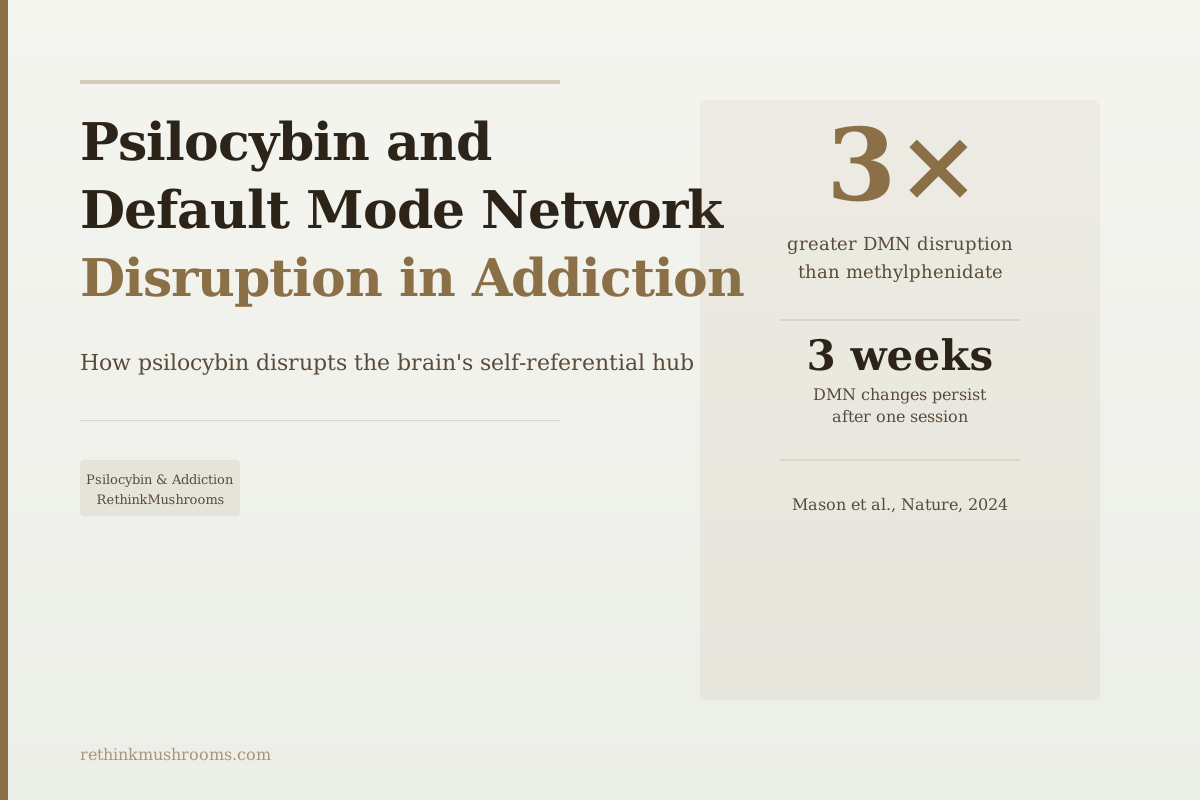
3× greater DMN disruption than methylphenidate
A single psilocybin dose disrupted the brain's default mode network more than three times as powerfully as Ritalin, with a key memory-to-DMN connection remaining altered for up to three weeks after the session.
Mason et al., Nature, 2024
3 weeks
hippocampal-DMN connectivity altered after one session
2025 RCT
confirmed in alcohol use disorder patients specifically
Cell, 2026
brain actively rewires during the disruption window
Mason et al., Nature, 2024
 View as image ↗
In 2024, Mason and colleagues at Oxford published what may be the cleanest direct comparison of psilocybin's brain effects ever run. They gave volunteers a psilocybin session and a methylphenidate (Ritalin) session, then mapped brain network activity in both conditions. Psilocybin disrupted brain network synchrony more than three times as powerfully as the stimulant drug. The default mode network, the brain's self-referential hub, showed the strongest effects of any network measured. A key connection between the memory system and the DMN stayed disrupted for up to three weeks after the session ended.[1]
That finding, published in Nature, is the clearest neuroscience evidence available for how psilocybin default mode network disruption in addiction works at the brain level. This article focuses specifically on the DMN: what it is, why its overactivity drives craving, and what the current evidence shows about how psilocybin disrupts it. For the broader clinical picture of treatment outcomes, see the full guide to psilocybin and alcohol addiction.
Key Takeaways
- The default mode network (DMN) is the brain's self-referential circuit; it generates craving thoughts, rumination, and compulsive self-narrative and is overactive in people with addiction
- Mason et al. (Nature, 2024) found psilocybin disrupted DMN connectivity more than 3× as powerfully as Ritalin in a direct head-to-head comparison[1]
- A key connection between the memory system (anterior hippocampus) and the DMN remained altered for up to 3 weeks after one session, the neurological basis for the behavioral change window[1]
- A 2025 study confirmed single-dose psilocybin alters resting-state DMN networks specifically in patients diagnosed with alcohol use disorder, not just healthy volunteers[2]
- A 2026 Cell paper found psilocybin triggers activity-dependent rewiring of cortical networks during the disruption window, meaning therapy interactions write new neural patterns into a brain that is structurally plastic[3]
- In animal models, psilocybin reduced alcohol self-administration via specific frontal cortex changes, suggesting a parallel reward-circuit mechanism alongside DMN disruption[5]
The Default Mode Network That Addiction Hijacks
The default mode network (DMN) is a set of brain regions that activate when a person is not focused on an external task. It fires during daydreaming, personal memory retrieval, imagining future events, and thinking about oneself in relation to others. Neuroscientists call it "default" because it turns on by default when attention is not actively directed outward. It is overactive in addiction, depression, and anxiety.
The function that makes the DMN central to addiction is self-referential thought: mental activity where the brain represents and narrates the self. When someone lies awake rehearsing past decisions, anticipating future events, or constructing a mental model of who they are and what they need, the DMN is the network doing that work.
In addiction research, the DMN has drawn attention because craving is not a neutral biological signal. The brain builds a full self-referential scenario: memories of past use, anticipation of relief or pleasure, a narrative about need and identity. That construction happens primarily in the DMN. When researchers scan the brains of people with addiction, the DMN shows abnormal patterns, including altered resting-state connectivity and poor regulation of default activity when a task demands focus elsewhere.
The rumination and negative self-referential thought that both precede and follow addictive behavior also live here: the self-critical loop, the sense of powerlessness, the compulsive mental rehearsal of drug-seeking. These are not separate from addiction. They are part of the same self-narrative architecture that the DMN maintains.
This is what makes psilocybin's effect on the DMN directly relevant to addiction treatment. It is not a generic brain disruption. It targets the specific network that constructs and sustains the craving narrative.
3× More Powerful Than Ritalin: The 2024 Nature Measurement
Mason and colleagues designed their study to produce a direct, quantitative comparison of two drugs with opposite reputations. Ritalin (methylphenidate) is a stimulant that sharpens focus and increases brain network synchrony. Psilocybin generates profound changes in consciousness and perception. The question: what do these drugs actually do to brain network organization when measured head-to-head?
The result was not close. Psilocybin desynchronized brain networks to a degree that methylphenidate did not approach. The total disruption of functional connectivity across the brain was more than three times greater with psilocybin, and the DMN showed the strongest effects of any network in the study.[1]
The mechanism during the session is worth understanding correctly. When someone is on psilocybin, the brain does not go quiet. It enters a state of dynamic disruption: regions that normally fire together begin to desynchronize, while regions that do not normally communicate start to exchange signals.[4] Blood levels of psilocybin's active metabolite partially predict the degree of this acute hyperconnectivity, which confirms that the disruption is pharmacologically driven, not a random artifact.[4] The usual boundaries between brain networks dissolve during the experience.
For the DMN specifically, this means the tightly coordinated self-referential circuit, the network that runs the craving narrative loop, is disrupted at its foundations during the session.
After the drug clears, the acute disruption resolves. What Mason's team documented next is the finding that changes the treatment picture: certain connectivity changes do not fully return to baseline. The anterior hippocampus maintained altered connectivity with the DMN for up to three weeks after a single psilocybin session.[1]
Three Weeks After the Session, the Brain Is Still Different
The anterior hippocampus is the part of the memory system most involved in contextual retrieval: the "when and where" of episodic memory. When someone experiences a craving, the hippocampus supplies associated context: the specific location, emotional state, and physical sensation associated with past use. This context feeds into the DMN's self-referential narrative, giving the craving thought its richness and urgency.
When hippocampal-DMN connectivity is reduced, that context-to-narrative pipeline weakens. The craving thought has less contextual scaffolding to draw on. The compulsive memory loop — context triggers recall, recall triggers craving, craving triggers behavior — is harder to execute in a brain where the hippocampus and DMN are not operating in their normal coordinated pattern.
The three-week persistence of this change is the neurological foundation for the behavioral change window. Psilocybin's half-life is roughly three to four hours. The acute pharmacological effects are gone within eight hours. But the brain change it triggered continues for weeks after the drug is gone. That extended period is when the clinical value of therapy is believed to be greatest.
One important precision: "altered connectivity" does not mean the hippocampus and DMN stopped communicating. It means their resting-state coordination shifted away from its baseline. Whether the direction of that shift matters as much as the disruption itself remains an active area of investigation.
Confirmed in Alcohol Use Disorder Patients, Not Just Healthy Volunteers
The Mason 2024 study used healthy volunteers, which is standard for mechanistic neuroscience research but raises an obvious question: does psilocybin produce the same DMN disruption in brains that have been chronically altered by heavy substance use?
Chronic alcohol use changes brain structure and function. Patients with alcohol use disorder do not start with typical DMN architecture. If the disruption mechanism depends on a neurologically typical starting state, it might not function the same way in the actual population being treated.
A 2025 study addressed this directly. Researchers gave a single dose of psilocybin to patients diagnosed with alcohol use disorder and measured resting-state functional network changes.[2] The result: psilocybin produced meaningful alterations in resting-state functional networks in AUD patients, consistent with the healthy-volunteer data.
This bridges the mechanistic research to the clinical population. The DMN disruption mechanism does not require a neurologically typical baseline. In brains that chronic alcohol use has already altered, a single psilocybin session still produces measurable network-level shifts. The mechanism survives the changed starting state.
The 2025 finding adds a layer of specificity that the Mason 2024 paper could not provide. The imaging evidence now exists not just for healthy volunteers but for the actual patients whose treatment is being studied.
The Brain Doesn't Just Disrupt. It Rewires During the Window.
A 2026 study published in Cell added a mechanistic layer that reframes what the disruption window actually is. Psilocybin does not simply disrupt network organization and wait for the brain to recover. It triggers activity-dependent rewiring of large-scale cortical networks.[3]
"Activity-dependent" is the phrase that matters. It means the rewiring that occurs during the plasticity window is shaped by what the brain is actually doing during that period. Neural pathways that are activated and reinforced in the weeks following a psilocybin session are the ones that get physically strengthened. Pathways that are not reinforced do not.
This reframes the treatment model in a specific way. The psilocybin session creates a window of heightened brain plasticity. The DMN is disrupted and the craving narrative loses its normal structural support. During those weeks, the brain is more receptive to structural change than it normally is. But the change that occurs is not automatic. It is written by what happens during that window.
In addiction treatment, this means that therapy sessions, behavioral practices, and new coping strategies administered after dosing are not just psychologically supportive. They interact with a brain that is in a state of active structural reorganization, and the patterns they introduce are more likely to become part of the brain's new connectivity architecture. The Cell 2026 finding provides the structural rationale for why psilocybin-assisted treatment protocols include intensive therapeutic work in the weeks following a dosing session.
The Reward Circuit: A Parallel Mechanism
The DMN disruption story is central, but it is not the only brain system that psilocybin affects in the context of addiction.
In a 2024 animal study, psilocybin reduced alcohol self-administration via selective left lateralization of frontal cortex activity.[5] The frontal cortex is the brain's top-down inhibitory control center: the region responsible for overriding impulses and suppressing automatic behavior. The nucleus accumbens, the brain's reward anticipation center, was also modulated.
This suggests psilocybin may address addiction through at least two parallel systems. The DMN mechanism disrupts the self-referential craving narrative at the network level. The frontal-reward mechanism simultaneously strengthens the inhibitory control system that resists acting on impulses.
The important caveat: this is preclinical animal data. Alcohol self-administration in rats is a useful behavioral model, but the specific frontal cortex lateralization finding has not yet been confirmed in human brain imaging studies. Animal models predict human outcomes directionally, not quantitatively. The DMN mechanism has human brain imaging confirmation; the frontal cortex mechanism is a well-supported preclinical hypothesis.
The picture emerging from the collective research is of a compound that addresses addiction through multiple simultaneous channels: disrupting the self-referential craving architecture in the DMN, weakening contextual memory triggers via hippocampal-DMN connectivity changes, creating a window for structural brain rewiring, and potentially strengthening inhibitory control over the reward circuit. The complete neuroscience of psychedelic-assisted addiction treatment integrates all these pathways, including the serotonin receptor mechanisms that initiate the cascade.
For context on why this same mechanism appears to work across tobacco, alcohol, and opioids, see psilocybin for addiction: why it works across substances. The shared pathology across addictions — DMN overactivity, rigid habit circuits — is why a single mechanism can address such different substances. For the overlap between addiction's DMN overactivity and depression's, see default mode network and depression: why psilocybin's DMN effect matters.
The Bottom Line
The strongest mechanistic evidence for psilocybin in addiction treatment now centers on the default mode network. A single dose disrupts DMN connectivity more powerfully than Ritalin, and a key memory-to-DMN connection stays altered for up to three weeks. This has been confirmed in alcohol use disorder patients, not just healthy volunteers. The disruption window appears to be a period of genuine structural brain plasticity, with activity-dependent rewiring documented in a 2026 Cell paper. A parallel frontal-reward circuit mechanism provides additional preclinical support but awaits human confirmation.
Frequently Asked Questions
Sources & References
- 1. Source details for this reference are not yet available.
- 2. Source details for this reference are not yet available.
- 3. Source details for this reference are not yet available.
- 4. Source details for this reference are not yet available.
- 5. Source details for this reference are not yet available.