Psilocybin & Addiction
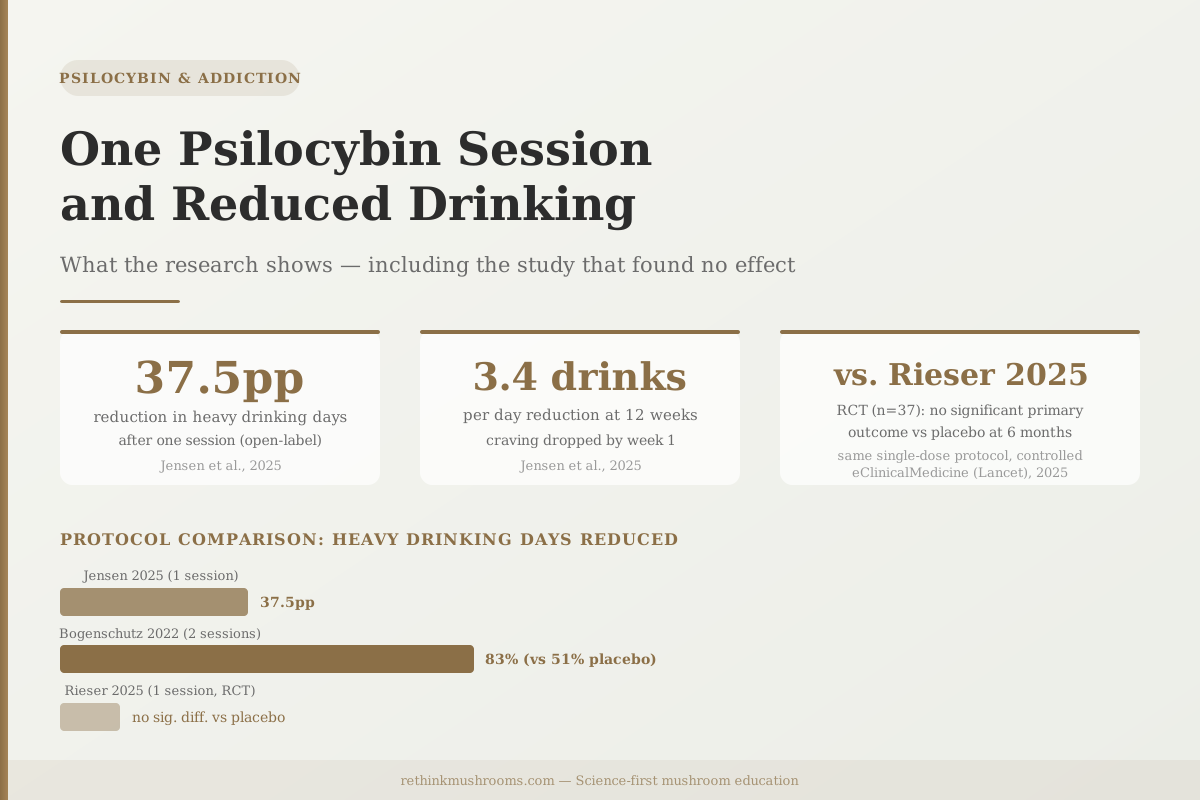
37.5pp reduction
A 2025 open-label study found a 37.5 percentage-point drop in heavy drinking days after one psilocybin session with psychotherapy, with craving scores dropping within the first week and remaining lower at 12 weeks.
Jensen et al., 2025.
3.4 drinks
reduction in drinks per day at 12-week follow-up (Jensen 2025)
Week 1
craving scores dropped within one week of the session
Rieser 2025
a different single-dose RCT found no significant primary outcome vs placebo
Jensen et al., 2025.
 View as image ↗
In a 2025 open-label study, 10 people with alcohol use disorder received one psilocybin session alongside psychotherapy. Over the following 12 weeks, their heavy drinking days dropped by 37.5 percentage points. Drinks per day fell by 3.4. Within one week of the session, craving scores were measurably lower and stayed there through follow-up.[1]
That same year, a different phase 2 randomized controlled trial tested a single dose of psilocybin in 37 people with alcohol use disorder. It found no statistically significant difference from placebo in abstinence duration at the 6-month primary outcome.[5]
Two single-session studies in the same year. Different results. Both results matter, and explaining the difference is most of what this article does.
For a full overview of the clinical trial landscape including the landmark two-session NYU trial, see Psilocybin for Alcohol Addiction: The NYU Clinical Trial Results.
Key Takeaways
- Jensen 2025 (n=10, open-label) found one psilocybin session with psychotherapy reduced heavy drinking days by 37.5 percentage points and drinks per day by 3.4 at 12 weeks
- Craving scores dropped within one week of the Jensen 2025 session and remained lower throughout follow-up, suggesting the effect begins before any behavioral reinforcement cycle
- Pagni 2024 (n=11, fMRI) found that after one psilocybin session, prefrontal cortex activity increased and insula activity decreased in response to alcohol cues, providing a neural mechanism for the behavioral change
- Rieser 2025 (n=37, phase 2 RCT, Switzerland) found no significant difference from placebo in abstinence duration with a single 25mg psilocybin dose; protocol differences may explain the divergent result
- Bogenschutz 2022 (n=93, JAMA Psychiatry) used two psilocybin sessions and produced much stronger outcomes: 83% reduction in heavy drinking days vs 51% placebo, and 48% complete abstinence vs 24%
- The evidence suggests one session produces measurable effects in open-label conditions, but two-session protocols with comprehensive psychotherapy show substantially stronger sustained outcomes
The Strongest Single-Session Evidence: Jensen 2025 Found a 37.5 Percentage-Point Drop
Jensen and colleagues' 2025 study is the most recent and specific data on what one psilocybin session does to alcohol consumption. The design was an open-label feasibility study, meaning there was no placebo group and both participants and researchers knew what was being given. This is an important limitation, but it is also an honest starting point for a new protocol.
Ten participants with alcohol use disorder received a single dose of psilocybin alongside five psychotherapy sessions spanning before and after the drug administration. The psychotherapy sessions weren't incidental preparation; they were part of the protocol, including integration sessions after the psilocybin experience.
The primary outcomes at 12 weeks:[1]
- Heavy drinking days fell by 37.5 percentage points
- Median drinks per day dropped by 3.4
- Self-efficacy scores (confidence in staying sober) were elevated throughout the follow-up period
The craving data is particularly notable. Craving scores began dropping within the first week after the session, before the behavioral reinforcement that comes from sustained abstinence could take hold. This early onset suggests psilocybin is doing something neurologically distinct from behavioral therapy alone, not simply augmenting the motivation that therapy provides.
The pharmacokinetics were also documented. Psilocybin peak plasma concentrations occurred at 1.5 to 2 hours after dosing, with psilocin (the active metabolite) detectable for approximately 4-8 hours. The drug is cleared well before the craving reduction becomes apparent, which means the behavioral effect is not pharmacological in a direct sense; the session experience is doing the work.
Ten participants is too small to draw firm conclusions from, and the open-label design means expectation effects cannot be separated from drug effects. Jensen 2025 is best read as a feasibility signal: one session appears to produce measurable effects, and the protocol is safe enough to warrant larger trials.
What Changed in the Brain After One Session: The Pagni 2024 fMRI Data
For clinical outcomes, one question immediately follows: what is actually happening neurologically after a single session that would explain reduced craving?
Pagni and colleagues' 2024 fMRI study enrolled 11 people with alcohol use disorder and measured brain activity in response to alcohol cue images before and after psilocybin treatment. Eleven participants is a small sample and the study was described as a pilot, but it is one of the few studies to use functional brain imaging in this specific population.[2]
After psilocybin, brain activity in response to alcohol cues shifted in two directions simultaneously. The medial and lateral prefrontal cortex (the brain's executive control and decision-making region) showed increased activity. The insula (a region linked to interoception, cue-driven craving, and the physical urgency of addiction) showed decreased activity.
This pattern is exactly what addiction researchers would predict from a treatment that reduces compulsive craving while improving volitional control. The insula is heavily implicated in the bodily sensation of craving, sometimes described as the felt need for a substance rather than the cognitive desire for it. Reducing insular activity in response to alcohol cues means the automatic urgency of craving is blunted. Increasing prefrontal activity means the regulatory circuitry that can evaluate and override that craving is more active.
The temporal and motor cortex activity also decreased after psilocybin, which Pagni and colleagues interpreted as reduced preparation and anticipation responses to alcohol cues. Together the pattern suggests psilocybin reorganizes how the brain processes alcohol-associated stimuli, shifting from reactive craving responses toward more deliberative processing.
This neural reorganization occurred after one session. Whether it persists at 3 or 6 months, and how it relates to sustained behavioral outcomes, is not yet established from imaging data.
For the deeper mechanistic story including the mGluR2 craving circuit and nucleus accumbens specificity, see How Psilocybin Helps People Stop Drinking: Mechanisms.
The Honest Counterpoint: Rieser 2025 Found No Significant Effect from a Single Dose
In the same year as Jensen, Rieser and colleagues published the most rigorous single-session test to date: a phase 2 randomized controlled trial in Switzerland with 37 participants.
The Rieser 2025 protocol: participants received either 25mg psilocybin (the therapeutic dose also used in Bogenschutz 2022) or a 1mg active placebo dose, alongside five psychotherapy sessions. This is essentially a blinded, randomized version of the Jensen protocol, with a larger sample.
The primary outcome was abstinence duration over the 6-month follow-up period. The result: no statistically significant difference between psilocybin and placebo.[5]
Rieser and colleagues noted positive secondary outcomes: some drinking reduction measures showed favorable trends in the psilocybin group, but these did not meet the threshold for statistical significance against the placebo condition. The trial was not powered as a definitive efficacy test (phase 2 trials typically focus on feasibility and signal detection), but the null primary outcome is real and matters.
This is not a study to explain away. It is the most methodologically credible single-session data point available, and it found no significant effect on its primary measure. That needs to be reported honestly, which is why it is here.
What Explains the Conflicting Results
Two single-session studies, two different outcomes. Several factors likely account for the difference.
Sample size and design. Jensen 2025 enrolled 10 participants in an open-label design. Open-label studies are subject to expectation effects and investigator bias. Rieser 2025 enrolled 37 participants with an active placebo and double-blind design. When you remove expectation effects from the analysis, the signal weakens.
Participant population. Jensen 2025 enrolled participants with alcohol use disorder; the severity distribution is not fully described in the brief summary available. Rieser 2025 enrolled participants in Switzerland in a healthcare setting that may have selected for more treatment-refractory cases or different baseline severity. Population selection substantially affects outcomes in addiction trials.
Protocol intensity and context. Jensen 2025's psychotherapy structure may have been more intensive or differently timed relative to the drug session than Rieser 2025's protocol. The interaction between psilocybin and psychotherapy quality is likely not trivial. Both protocols used five psychotherapy sessions, but the content, therapist training, and preparation/integration structure could differ meaningfully.
Single dose vs. dose-response. Bogenschutz 2022 used two psilocybin sessions and produced substantially stronger results in a larger RCT. The comparison between one-session and two-session protocols suggests that the dose-response relationship matters. One session may produce detectable effects in some conditions; two sessions with full protocol produce more consistent and robust outcomes.[4]
The Early Signal: What Bogenschutz 2015 Showed About First Sessions
A necessary piece of context: the first rigorous psilocybin alcohol study, Bogenschutz 2015, was an open-label pilot with 10 participants that helped establish whether psilocybin was worth studying in this indication at all.
Bogenschutz and colleagues found significant increases in abstinence following psilocybin sessions, and importantly, these gains were maintained through the 36-week follow-up period. This was not a single-dose study in the later sense; participants received two psilocybin sessions as part of the protocol. But it established the long-term signal that motivated the larger NYU trial.[3]
The Bogenschutz 2015 data also documents what happened after the first session specifically. Participants showed substantial drinking reductions after the first psilocybin administration, with further improvement after the second. This session-by-session analysis — while not the primary focus of the published paper — is the clearest evidence that the first session does something real, and that the second session adds to it rather than being redundant.
Where Two Sessions Outperform One: The Bogenschutz 2022 Benchmark
The most important reference point for understanding what one session can and cannot achieve is the two-session NYU trial.
Bogenschutz and colleagues published their randomized, double-blind controlled trial in JAMA Psychiatry in 2022 with 93 participants. Participants received two psilocybin sessions or two placebo sessions, embedded in a 12-week behavioral therapy protocol with trained therapists.
Results at 8 months:[4]
- Heavy drinking days: reduced 83% in the psilocybin group vs 51% in placebo
- Complete abstinence: 48% in psilocybin vs 24% in placebo
- The double-blind design with active placebo makes these the most credible absolute numbers available
The contrast with single-session outcomes is informative. Jensen 2025 found a 37.5 percentage-point reduction in heavy drinking days with one session. Bogenschutz 2022 found an 83% reduction with two sessions, against a placebo that itself achieved 51%. The signal is clearly present in single-session data; the magnitude and durability appear substantially stronger with two sessions and comprehensive psychotherapy.
For the long-term sustained abstinence data and the protocol-outcome pattern across all trials, see Psilocybin and Alcohol Use Disorder: Sustained Abstinence Data. For a comparison of psilocybin against naltrexone (the current first-line medication), see Psilocybin vs. Naltrexone for Alcohol Addiction: How They Compare.
For parallel evidence from tobacco addiction, where psilocybin has produced an approximately 80% quit rate in Hopkins trials, see 80% Quit Rate: How Psilocybin Helps Smokers Stop.
The Bottom Line
One psilocybin session combined with psychotherapy produces measurable reductions in heavy drinking and craving in open-label studies, with Jensen 2025 showing a 37.5 percentage-point reduction in heavy drinking days over 12 weeks. Brain imaging data from Pagni 2024 shows that a single session reorganizes how the brain responds to alcohol cues, increasing prefrontal activity and decreasing insula activity. However, Rieser 2025, a randomized controlled trial, found no significant difference from placebo on the primary abstinence outcome at 6 months. The two-session Bogenschutz 2022 JAMA Psychiatry trial (n=93) remains the most credible evidence, showing 83% reduction in heavy drinking and 48% complete abstinence at 8 months. The data as a whole suggests one session may produce initial effects but that two sessions with comprehensive psychotherapy produce more consistent and durable outcomes.
Frequently Asked Questions
Sources & References
- 1. Source details for this reference are not yet available.
- 2. Source details for this reference are not yet available.
- 3. Source details for this reference are not yet available.
- 4. Source details for this reference are not yet available.
- 5. Source details for this reference are not yet available.