Psilocybin & Addiction
4 craving mechanisms
A 2021 study in Science Advances identified mGluR2 receptor restoration in the prefrontal cortex as psilocybin's first specific molecular target in the addiction craving circuit.
Meinhardt et al., Science Advances, 2021
fMRI-confirmed
psilocybin reduces alcohol cue reactivity in the addicted human brain
26 ongoing trials
across tobacco, alcohol, opioids, and stimulants as of the 2023 systematic review
First in 2025
preclinical evidence psilocybin blunts heroin seeking and reduces brain inflammation
Meinhardt et al., Science Advances, 2021
 View as image ↗
The science of psilocybin craving reduction centers on a question about brain circuitry: why do some people who take psilocybin stop wanting substances when nothing else has worked? For decades, addiction researchers focused on dopamine, the reward system's on-switch. That framing isn't wrong, but a 2021 study in Science Advances showed it's incomplete. Meinhardt and colleagues identified that alcohol dependence strips away a specific molecular brake in the prefrontal cortex, the region that suppresses urges. Psilocybin, the same study found, restores it.
That finding sits at the center of four mechanisms now described in the research literature. Together they sketch a coherent biological story for how one compound can reduce craving across multiple substances and addiction types.
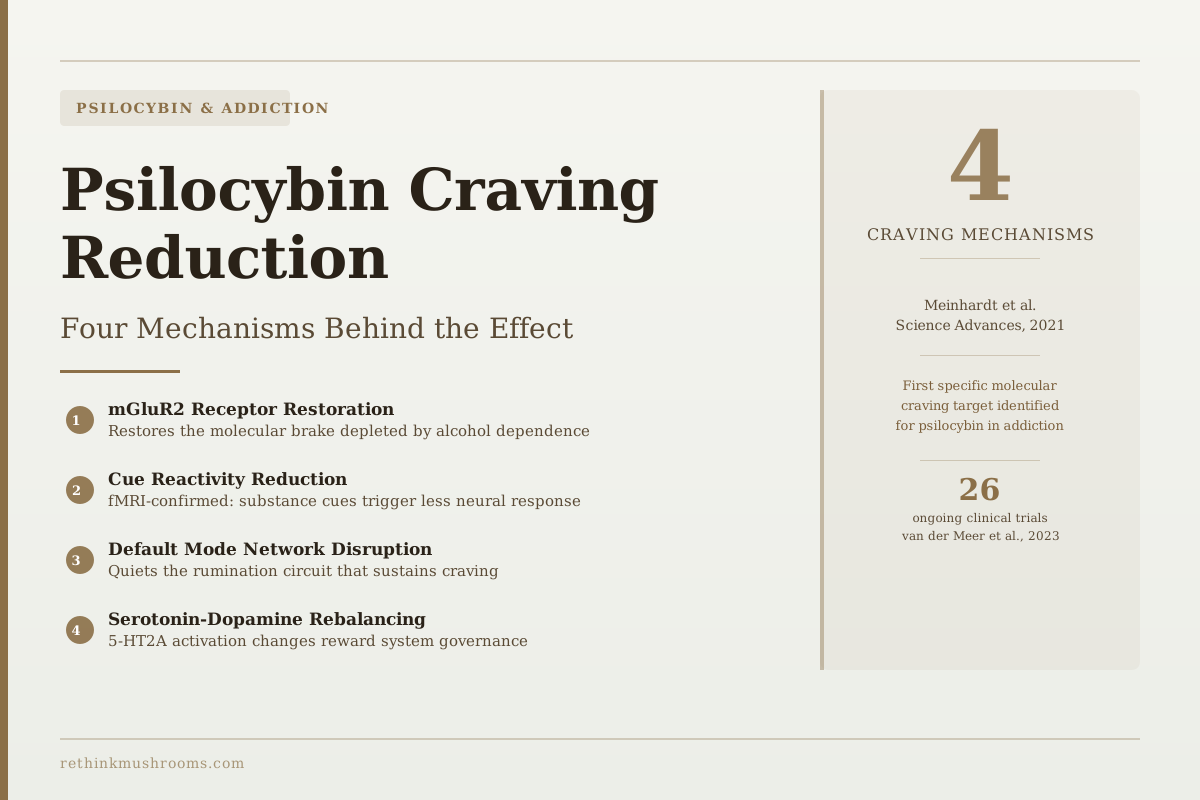
Researchers have now identified four distinct pathways through which psilocybin affects craving:
- Molecular receptor restoration: Psilocybin restores a receptor called mGluR2 in the prefrontal-to-reward circuit, which is the molecular brake that alcohol dependence erodes.
- Cue reactivity reduction: Functional MRI scans show psilocybin dampens how strongly the addicted brain responds to substance-related stimuli.
- Default mode network disruption: Psilocybin quiets the self-referential rumination circuit that sustains craving between exposures.
- Serotonin-dopamine rebalancing: By activating the brain's primary serotonin receptor, psilocybin changes how the reward system's dopamine output is governed.
Each mechanism is partially understood. Most of the evidence is preclinical or comes from small human imaging studies. But for the first time, researchers can point to specific molecular and circuit-level targets rather than observing that psilocybin helps and guessing why. For the full clinical picture of what this looks like in controlled human trials, the psilocybin for alcohol addiction clinical trial results covers the outcome data.
Key Takeaways
- Alcohol dependence depletes a prefrontal receptor called mGluR2 that normally suppresses craving. Psilocybin restored mGluR2 function and reduced relapse behavior in rats (Meinhardt et al., Science Advances, 2021).
- A 2024 fMRI pilot study directly showed psilocybin reduced activity in reward and craving circuits when people with alcohol use disorder were shown alcohol-related images (Pagni et al., Scientific Reports, 2024).
- Psilocybin disrupts the default mode network, the brain's self-referential rumination circuit. A 2023 systematic review across nine studies confirmed this disruption correlates with therapeutic improvement (Gattuso et al., 2023).
- Rat brains in alcohol dependence showed blunted DMN disruption from psilocybin compared to healthy rat brains, raising questions about whether addicted people need different dosing protocols (Reinwald et al., Translational Psychiatry, 2023).
- In 2025, a single psilocybin dose significantly blunted cue-induced heroin seeking and reduced inflammatory gene expression in the brain's reward center in male rats (Floris et al., Molecular Psychiatry, 2025).
- A 2025 phase 2 randomized controlled trial found psilocybin-assisted therapy significantly reduced heavy drinking days compared to placebo-assisted therapy in alcohol use disorder (Rieser et al., EClinicalMedicine, 2025).
The Broken Brake: How Addiction Disables Craving Control
The prefrontal cortex handles inhibitory control: the ability to recognize an urge and not act on it. That function depends in part on a class of signaling molecule called glutamate, and on a receptor called mGluR2 (metabotropic glutamate receptor 2) that governs how glutamate is processed in the prefrontal cortex.
In alcohol dependence, mGluR2 availability in the prefrontal cortex drops significantly. Meinhardt and colleagues documented this depletion in 2021, showing that losing mGluR2 disrupts the circuit connecting the prefrontal cortex to the nucleus accumbens, the brain's primary reward center. When that connection weakens, the prefrontal cortex loses its ability to override signals from the reward circuit.
This is why craving in alcohol use disorder is not simply about wanting a drink. The reward system's accelerator — dopamine-driven motivation — remains functional. The brake — prefrontal mGluR2-dependent inhibitory control — becomes progressively less effective as the disease progresses. The person may be fully aware that drinking will harm them and still find the urge impossible to override, not because of a failure of character but because the biology that makes override possible has been degraded. [1]
Psilocybin Restores the Molecular Brake: Evidence from Science Advances
Meinhardt's 2021 paper went further than describing the deficit. The researchers gave psilocybin to alcohol-dependent rats and measured what happened to mGluR2 expression afterward. The receptor recovered toward normal levels. And critically, relapse behavior — measured by how much alcohol the rats sought after a period of forced abstinence — decreased alongside the receptor recovery. [1]
This is the first specific molecular craving-circuit target ever identified for psilocybin in addiction. It is important for several reasons. First, it connects a receptor-level measurement to a behavioral outcome, not just a pharmacological effect. Second, it raises the possibility that some of psilocybin's benefit in alcohol use disorder might come from direct receptor pharmacology, not only from the acute psychedelic experience.
The limitation is significant and worth being explicit about: this is animal data. Whether mGluR2 depletion drives craving in humans with alcohol use disorder to the same extent, and whether psilocybin restores it, has not been directly measured in human tissue. The mechanism is biologically plausible — the receptor and circuit are well-characterized in human neuroscience — but the human evidence is inferential.
Urban and colleagues confirmed mGluR2 restoration in the prefrontal cortex as the craving-specific molecular target for psilocybin in a 2023 mechanistic mini-review, calling it the most precise claim available in the current literature. [2] For the broader picture of how this molecular mechanism fits within the full neuroplasticity story, Neuroplasticity and Addiction: How Psilocybin Opens a Window covers the synaptic and structural evidence in depth.
What the Brain Scanner Shows: Reduced Reactivity to Substance Cues
In 2024, Pagni and colleagues published a small but methodologically important study in Scientific Reports. They recruited 14 people with alcohol use disorder and scanned their brains using functional MRI before and after psilocybin-assisted therapy. During each scan, participants viewed alcohol-related images and emotionally negative images, the kind of stimuli that reliably trigger craving in people with alcohol dependence.
After psilocybin treatment, those same images produced less activity in the brain's reward and craving circuits. Reduced reactivity was observed in the amygdala, the region that processes threatening or motivationally significant stimuli, including cues that signal an opportunity to use. [3]
This is the most direct human evidence available that psilocybin changes how the addicted brain processes substance cues at the neural level. Prior evidence came from self-report (participants saying they craved less) or animal models. Pagni's study shows the circuit-level change directly.
The limitation here is also significant. Fourteen participants is a small sample. The study did not include an active control group, making it impossible to rule out that the therapy component, rather than psilocybin specifically, drove the change. These caveats are standard for early-stage imaging work and do not invalidate the finding, but they do constrain how much weight to place on it.
The result connects naturally to the automatic behavior research: substance cues trigger craving before conscious awareness can intervene precisely because the brain has learned to respond to them automatically. Reducing that automatic neural response is the behavioral change measured here at the imaging level. For the habit-circuit explanation of how that automaticity forms and how psilocybin might disrupt it, Psilocybin and Habit Loops: Disrupting Automatic Behavior covers the basal ganglia and dorsal striatum evidence.
For alcohol-specific clinical mechanisms, how psilocybin helps people stop drinking covers the alcohol use disorder literature in more detail.
The Self-Talk Network and Cravings: Why Quieting the DMN Matters
The default mode network (DMN) is a set of brain regions that become active when the mind is not focused on an external task. It is the neural substrate of self-referential thinking, autobiographical memory recall, and what most people experience as the inner monologue or mind-wandering.
In addiction, the DMN plays a specific role in sustaining craving. The mental replay of past substance experiences, the internal negotiation ("just once more"), the automatic retrieval of substance-related memories when external cues are absent — these are DMN-driven processes. A hyperactive or over-engaged DMN sustains craving between physical exposures, keeping the urge alive through rumination.
Gattuso and colleagues published a systematic review in 2023 specifically analyzing how psychedelics affect the DMN across multiple studies. The evidence consistently pointed in one direction: psychedelics reduce DMN connectivity during their acute effects, and those reductions correlate with therapeutic outcomes across conditions. [4]
That last point is notable. The correlation between DMN disruption and therapeutic improvement showed up not just in addiction but in depression and anxiety as well. This raises the possibility that the DMN is a general amplifier of psychological suffering, and that quieting it temporarily — regardless of the underlying diagnosis — creates a window for therapeutic change. The data doesn't prove that interpretation, but it is consistent with it.
For readers interested in how the same DMN disruption mechanism explains psilocybin's effects in depression, psilocybin and default mode network changes in depression examines the overlapping evidence.
A Complication Worth Knowing: Addicted Brains May Resist the Effect
In 2023, Reinwald and colleagues published a finding that complicates the straightforward picture. They gave psilocybin to two groups of rats: one alcohol-dependent and one healthy. Both groups received the same dose. Both groups were then measured for DMN disruption.
The alcohol-dependent rats showed significantly less DMN disruption from psilocybin than the healthy controls. [5]
If this translates to humans — and that translation is uncertain — it carries real implications for clinical practice. The brain that most needs DMN disruption to break craving patterns may be the brain least capable of producing it at standard doses. Chronic alcohol dependence may partially protect the DMN from psilocybin's network effects, potentially through the same receptor-level changes that make the craving so persistent.
No clinical trial has directly tested whether higher doses or multiple sessions correct for this blunted response in human addiction treatment. This is the kind of finding that informs the next generation of trial design rather than current clinical practice. But it is a finding that honest reporting on psilocybin and craving should include, because it tells a more complete story than the straightforwardly optimistic one.
Beyond Alcohol: Psilocybin, Heroin Seeking, and Brain Inflammation
Until 2025, the mechanistic literature on psilocybin and craving was almost entirely limited to alcohol and tobacco. Floris and colleagues extended it. They published the first preclinical evidence for psilocybin in opioid addiction: a single dose given to male rats 4 to 24 hours before a test session significantly reduced cue-induced heroin seeking. [6]
The mechanism they found extends beyond serotonin receptor pharmacology. Psilocybin also modified inflammatory gene expression in two key brain regions: the nucleus accumbens, the primary reward center, and the prefrontal cortex, the craving control region. This adds a third mechanistic lane: psilocybin as a neuroimmune modulator.
Neuroinflammation in addiction circuitry is an underappreciated driver of compulsive drug seeking. Chronic opioid use triggers an inflammatory response in the brain that worsens craving and impairs the function of the regions that would normally suppress it. If psilocybin modulates that inflammatory state, it may reduce opioid craving through a mechanism entirely separate from the mGluR2 pathway or the DMN pathway.
This is preclinical data in male-only subjects and has not been replicated. The finding should be read as hypothesis-generating, not as established mechanism. But it is the first connection between psilocybin and neuroinflammatory craving pathways, and it opens a legitimate scientific question about whether opioid use disorder, where inflammation plays a particularly significant role, might respond to psilocybin differently than alcohol or tobacco use disorder.
Serotonin, Dopamine, and Craving: How Receptor Activation Links Them
Psilocybin acts primarily on a serotonin receptor dense in the prefrontal cortex, called 5-HT2A. The subjective psychedelic experience, including the perceptual changes and dissolution of normal self-boundaries, is produced by how much psilocybin occupies this receptor. More occupancy produces a more intense experience.
Madsen and colleagues demonstrated this dose-response relationship directly in 2019. Using radioactive tracers with PET imaging in 29 participants, they measured how much of the brain's 5-HT2A receptors psilocybin occupied at various concentrations in the blood, then correlated that with the subjective experience intensity. The relationship was direct: receptor occupancy predicted experience quality. [7]
Why does this matter for craving? Because 5-HT2A activation in the prefrontal cortex does more than produce altered perception. It modulates glutamate release in the prefrontal-to-nucleus accumbens circuit — the same circuit where mGluR2 depletion creates the craving problem. The two receptors sit in overlapping prefrontal circuits. Activating 5-HT2A changes glutamate dynamics in ways that could directly support the mGluR2 restoration observed in Meinhardt's work.
The serotonin-dopamine relationship matters here as well. Urban and colleagues described in their 2023 mechanistic review how 5-HT2A activation in the prefrontal cortex changes how that region governs dopamine release from the reward circuit. This is not a direct block on dopamine, which is how traditional antipsychotics work. It is a change in the prefrontal cortex's supervisory function over the reward system's output — a more targeted and arguably more functional intervention. [2]
This serotonergic mechanism may also explain why craving effects persist after psilocybin clears the bloodstream. The receptor-level and structural changes triggered by 5-HT2A activation last longer than the drug's presence in the body. For the full pharmacology of how 5-HT2A agonism produces these downstream effects, how 5-HT2A agonism creates the psychedelic experience covers the molecular biology in depth.
What Controlled Trials Show About Psilocybin Craving Reduction
The mechanistic evidence above is predominantly preclinical or correlational. Two clinical data points from 2025 move the picture closer to human validation.
Rieser and colleagues published a phase 2 randomized controlled trial in EClinicalMedicine in 2025, enrolling people with alcohol use disorder and randomly assigning them to psilocybin-assisted therapy or placebo-assisted therapy. The psilocybin group had significantly fewer heavy drinking days. [9]
The trial measures behavior, not craving as a neurological variable. But reduced heavy drinking is downstream of reduced craving. Phase 2 designation matters here: this was a properly controlled trial, not an open-label proof-of-concept study. Open-label studies are susceptible to expectation effects, in which participants improve because they believe the treatment will work. A randomized controlled design, with a placebo-assisted therapy arm receiving the same therapeutic attention, attributes the behavioral difference to psilocybin specifically.
Van der Meer and colleagues published the most comprehensive systematic review of the available literature in 2023, covering results from tobacco and alcohol trials and identifying 26 ongoing clinical trials across multiple substances. Their synthesis found consistent reductions in substance use and increases in abstinence across available studies, with craving reduction, motivation, neuroplasticity, and mystical experience all identified as likely contributing mechanisms. [8] The mystical experience mechanism, and why researchers think it mediates addiction recovery outcomes, is examined separately in The Mystical Experience and Addiction Recovery: Why It Matters.
The honest state of the literature: most trials remain small, most are not adequately powered to detect dose-response relationships in craving outcomes, and long-term neuroimaging follow-up is largely absent. The Rieser 2025 RCT provides confidence that the behavioral outcome is real. The mechanism data gives plausible biology for why. The direct link from molecular mechanism to clinical outcome, measured in the same human participants over time, is the remaining open frontier. For the full three-mechanism overview of how psilocybin works in addiction, How Psilocybin Breaks Addiction: The Neuroscience Explained places these craving mechanisms in the broader context.
The Bottom Line
Four mechanisms have been identified for psilocybin's effects on craving: mGluR2 receptor restoration in the prefrontal craving circuit (Meinhardt 2021), direct reduction of cue-induced neural reactivity confirmed via fMRI in humans (Pagni 2024), default mode network disruption reducing craving rumination (Gattuso 2023), and 5-HT2A-driven modulation of serotonin-dopamine signaling (Madsen 2019, Urban 2023). A 2023 animal finding complicates the picture: alcohol-dependent brains show blunted DMN response to psilocybin, with possible implications for human dosing. A 2025 preclinical study extended the evidence to opioids, identifying a neuroinflammatory mechanism distinct from the alcohol pathways. A 2025 phase 2 RCT found psilocybin-assisted therapy significantly reduced heavy drinking days compared to placebo. The mechanistic picture is emerging and largely preclinical; connecting molecular targets to clinical outcomes through direct human neuroimaging is the field's next step.
Frequently Asked Questions
Sources & References
- 1RTHM-01403·Meinhardt, Marcus W et al. (2021). “Psilocybin targets a common molecular mechanism for cognitive impairment and increased craving in alcoholism..” Science advances.Study breakdown →PubMed →↩
- 2RTHM-01811·Urban, Marvin M et al. (2023). “Mini-review: The neurobiology of treating substance use disorders with classical psychedelics..” Frontiers in neuroscience.Study breakdown →PubMed →↩
- 3RTHM-01964·Pagni, B A et al. (2024). “Psilocybin-induced changes in neural reactivity to alcohol and emotional cues in patients with alcohol use disorder: an fMRI pilot study..” Scientific reports.Study breakdown →PubMed →↩
- 4RTHM-01697·Gattuso, James J et al. (2023). “Default Mode Network Modulation by Psychedelics: A Systematic Review..” The international journal of neuropsychopharmacology.Study breakdown →PubMed →↩
- 5RTHM-01775·Reinwald, Jonathan R et al. (2023). “Psilocybin-induced default mode network hypoconnectivity is blunted in alcohol-dependent rats..” Translational psychiatry.Study breakdown →PubMed →↩
- 6RTHM-02082·Floris, Gabriele et al. (2025). “Psilocybin reduces heroin seeking behavior and modulates inflammatory gene expression in the nucleus accumbens and prefrontal cortex of male rats..” Molecular psychiatry.Study breakdown →PubMed →↩
- 7RTHM-00578·Madsen, Martin K et al. (2019). “Psychedelic effects of psilocybin correlate with serotonin 2A receptor occupancy and plasma psilocin levels..” Neuropsychopharmacology : official publication of the American College of Neuropsychopharmacology.Study breakdown →PubMed →↩
- 8RTHM-01812·van der Meer, Pim B et al. (2023). “Therapeutic effect of psilocybin in addiction: A systematic review..” Frontiers in psychiatry.Study breakdown →PubMed →↩
- 9RTHM-02168·Rieser, Nathalie M et al. (2025). “Psilocybin-assisted therapy for relapse prevention in alcohol use disorder: a phase 2 randomized clinical trial..” EClinicalMedicine.Study breakdown →PubMed →↩