Psilocybin & Addiction
5 documented brain mechanisms behind psilocybin's anti-addiction effects
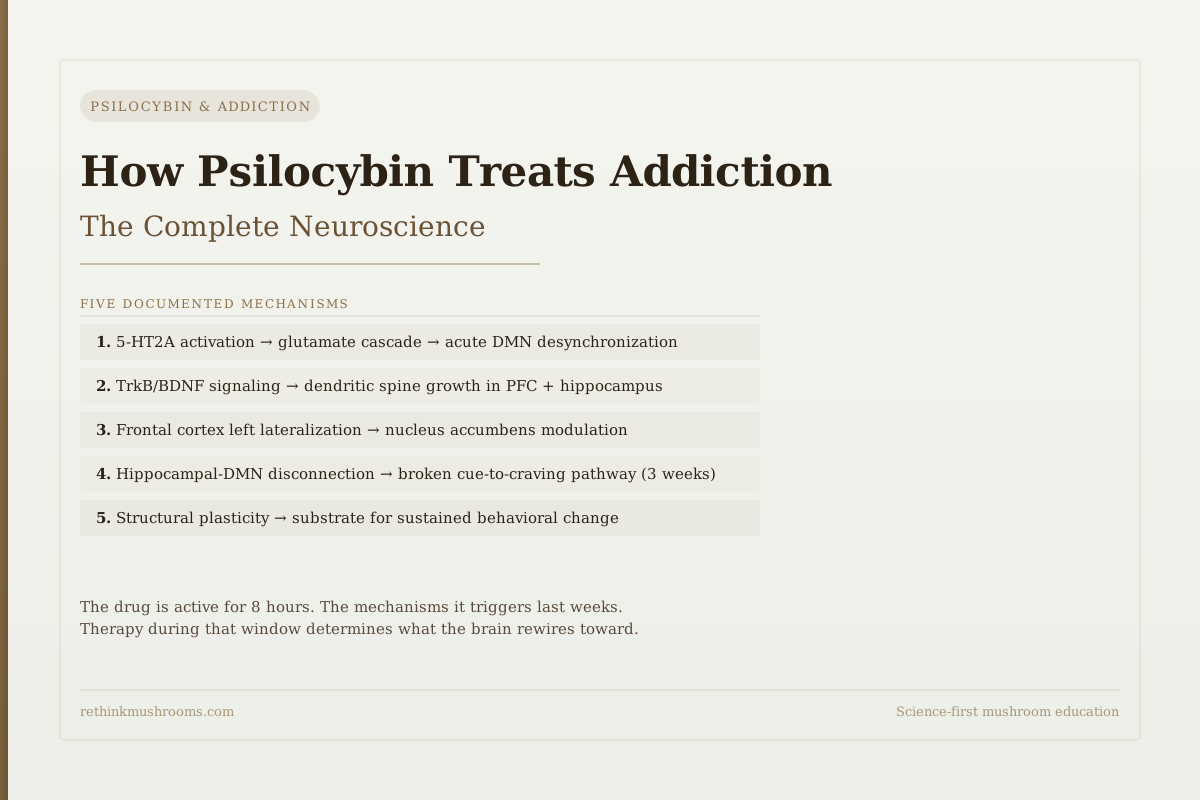
Psilocybin's addiction effects are a cascade, not a single mechanism: 5-HT2A activation, network desynchronization, TrkB-driven structural plasticity, a lateralized reward-circuit effect, and persistent hippocampal-DMN disconnection — each contributing something the others do not.
Siegel et al., Nature, 2024 / Jeanblanc et al., Brain, 2024
3×
greater functional connectivity disruption than methylphenidate; hippocampus-DMN decoupling still present at 3 weeks (Siegel et al., Nature 2024)
TrkB
a non-serotonergic target implicated alongside 5-HT2A in psilocybin's plasticity effects (2025 mechanism review)
Left NAc
psilocybin injected into the left nucleus accumbens — but not the right — halved rat alcohol self-administration (Jeanblanc et al., Brain 2024)
Siegel et al., Nature, 2024 / Jeanblanc et al., Brain, 2024
 View as image ↗
Psilocybin-assisted therapy for addiction is not a single-mechanism intervention. The way it works involves a cascade of brain changes: an acute disruption, a plasticity window, circuit-level recalibration, and structural change that persists after the drug has fully metabolized. Each stage overlaps and builds on the previous one.
This is different from how most addiction medications work. Buprenorphine occupies opioid receptors throughout the day. Naltrexone blocks alcohol's reward signal every time the person drinks. These are continuous pharmacological interventions where the drug must be present for the effect to occur.
Psilocybin is different. Its active duration is approximately six to eight hours. Its therapeutic effects, where they have been observed, persist for weeks to months. The disconnect between pharmacological duration and therapeutic duration points to a mechanism that goes beyond receptor occupancy — and that mechanism is why the science of psychedelic-assisted addiction treatment is more complex, and more contested, than it appears.
This article lays out that mechanism in full: what happens at each stage, what the research actually shows at each level, and where the evidence runs out. A recurring theme is worth flagging up front — most of the mechanistic detail below comes from rodent and pig studies, while most of the human data is about depression rather than addiction. The bridge between them is an inference, not a finding.
For the clinical outcomes across addiction types, see Psilocybin for Addiction: Why It Works Across Substances. For the overall safety profile, see Psilocybin for Alcohol Addiction: The NYU Clinical Trial Results.
Key Takeaways
- Psilocybin binds 5-HT2A receptors on cortical pyramidal cells, triggering glutamate release and initiating a cascade of acute network disruption followed by structural neuroplasticity
- Siegel et al. 2024 (Nature) measured more than threefold greater functional connectivity disruption than methylphenidate, with anterior hippocampus-to-DMN connectivity still reduced at the end of a 3-week tracking window
- Madsen et al. 2021 found that the acute network changes track plasma psilocin level — the acute brain state is pharmacologically driven, so the changes that outlast the drug must be structural rather than pharmacological
- A 2025 mechanism review identifies TrkB alongside 5-HT2A as a plausible driver of psilocybin's structural effects, and Vargas et al. 2023 (Science) showed the relevant 5-HT2A receptors are intracellular — location, not just occupancy, determines whether plasticity follows
- Jeanblanc et al. 2024 (Brain) found psilocybin injected directly into the left nucleus accumbens halved rat alcohol self-administration; the right nucleus accumbens and the left ventral tegmental area did nothing. This is a lateralized reward-hub effect, not a prefrontal one
- Whether the subjective psychedelic experience is required remains genuinely unsettled — and the meta-analytic correlation between experience intensity and outcome is substantially weaker in addiction (r = .19) than in mood disorders (r = .41)
Step 1: 5-HT2A Activation and the Acute Brain Disruption
Everything begins with a single receptor. Psilocybin is dephosphorylated to psilocin in the body, and psilocin binds the 5-HT2A serotonin receptor — a receptor concentrated on the apical dendrites of cortical pyramidal cells, particularly in the prefrontal cortex and association areas.
The 5-HT2A receptor triggers Gq protein signaling, which activates phospholipase C, releasing calcium and diacylglycerol inside the cell. This depolarizes the pyramidal cell and causes it to fire, releasing glutamate into the synapse. The glutamate then drives excitation downstream and activates GABAergic interneurons — the interplay between excitation and inhibition that produces the altered oscillatory patterns visible on EEG and fMRI during psilocybin sessions.
One detail here turned out to matter more than anyone expected. Vargas and colleagues, publishing in Science in 2023, demonstrated that it is intracellular 5-HT2A receptors that mediate the plasticity-promoting properties of psychedelics.[12] This explains a longstanding puzzle: serotonin itself binds 5-HT2A receptors constantly, yet does not produce the same cortical growth. Serotonin is poor at crossing the cell membrane; psychedelics are lipophilic and get inside. The authors describe this as location bias — the same receptor produces different downstream consequences depending on where in the cell it is engaged.
The acute brain state that results is not random chaos. Madsen and colleagues tracked fifteen healthy volunteers across five hours of scanning after an oral dose and found that plasma psilocin level and subjective drug intensity both correlated with reduced integrity within brain networks — including the default mode network — and reduced segregation between them.[8] Networks that normally maintain separate functional compartments began communicating more broadly, and the degree to which they did so tracked the drug concentration in the blood.
A separate 2024 study using 7T imaging characterized this state further, identifying a recurrent hyperconnected pattern with low BOLD signal amplitude during the peak drug effect. In that dataset, the hyperconnectivity was most strongly associated with the experiential dimension of oceanic boundlessness rather than with any single pharmacological measure.[6]
Both findings point the same direction: the acute brain state is pharmacologically driven and experientially expressed, and it ends. As psilocin is metabolized and cleared over the subsequent hours, the acute pattern subsides. Anything that persists past that point requires a different explanation.
The Timescale Mismatch
The Drug Leaves in Hours. The Claim Is Measured in Weeks.
Each bar spans only the period its source actually observed. Bars ending in a fade mean the study stopped looking — not that the effect stopped. Solid-edged bars in brown were measured in humans; hatched bars in amber were measured in animals.
Why this shape matters: if the therapeutic effect ran through receptor occupancy, the effect bars would end where the drug bar ends. They do not. That gap is the entire reason the field looks to structural plasticity for an explanation — and it is also why the gap is filled largely with animal data. The two longest human observations here stop at three weeks because that is when the scanner time ran out.
The time axis is compressed and not linear; bar lengths show observation periods, not effect sizes, and are not comparable across rows. Human bands come from healthy volunteers, not people with addiction. The mouse spine-growth band is from a preprint that has not completed peer review.
Refs 1, 3, 6, 8, 9, 13
Step 2: DMN Disruption and the 3-Week Window
The default mode network — the brain's resting-state circuit for self-referential thinking — is both the most strongly affected network during psilocybin sessions and the one where changes persist longest.
Siegel and colleagues published the most rigorous measurement of this in Nature in 2024.[1] Using longitudinal precision functional mapping — roughly eighteen MRI visits per participant — they tracked healthy adults before, during, and for three weeks after a 25 mg dose of psilocybin, with 40 mg methylphenidate as an active comparator. Psilocybin disrupted functional connectivity in cortex and subcortex more than threefold beyond what methylphenidate produced. The changes were driven by desynchronization across spatial scales, dissolving the distinctions between networks by reducing correlations within them and anticorrelations between them. The DMN was the most strongly affected network.
Siegel, Subramanian, Perry, and colleagues (2024) · Nature
- Population
- Healthy adults, tracked with longitudinal precision functional mapping (~18 MRI visits per participant)
- Intervention
- 25 mg psilocybin, with an additional dose 6–12 months later
- Comparator
- 40 mg methylphenidate, an active stimulant control
- Finding
- Psilocybin produced more than threefold greater functional connectivity change than methylphenidate, driven by desynchronization across spatial scales. Effects were strongest in the default mode network. A persistent decrease in anterior hippocampus-to-DMN connectivity lasted weeks. Performing a perceptual task during the session reduced the drug-driven connectivity changes.
narrow-scope Rigorous design with an active comparator and dense repeat sampling — but healthy volunteers, not people with addiction, and a small precision-mapping sample rather than a large cohort.
Siegel JS, Subramanian S, Perry D, et al. Psilocybin desynchronizes the human brain. Nature. 2024;632(8023):131-138.
The persistence finding is the one that matters for addiction. Psilocybin caused a decrease in connectivity between the anterior hippocampus and the default mode network that was still measurable weeks later — specifically, it was still present at the end of the three-week tracking window. It is worth being precise about what that does and does not establish: three weeks is how long the researchers looked, not a measured point at which the effect resolved. The honest statement is that the effect outlasts the drug by weeks and that nobody has established where it ends.
In addiction, the DMN carries the compulsive self-narrative — the looping internal monologue of craving that primes and maintains drug-seeking behavior. A person who has smoked for twenty years has a DMN partially organized around smoking cues and the behavioral patterns surrounding them. A person dependent on alcohol has DMN activity heavily biased toward drink-related self-reference.
An extended period of disrupted DMN connectivity is, in neurological terms, a period of weakened infrastructure for those compulsive loops. This is the behavioral change window. The inferential step to keep visible: Siegel's participants were healthy volunteers. The mapping from "DMN connectivity is disrupted in healthy adults" to "craving circuits are weakened in people with addiction" is a reasonable hypothesis that this study did not test.
For more on how the window maps to therapy timing, see How Psilocybin Creates a Window for Behavioral Change.
Step 3: TrkB, BDNF, and Structural Neuroplasticity
While the DMN is disrupted at the network level, structural changes are occurring at the cellular level.
A 2025 review in Trends in Pharmacological Sciences synthesizing the emerging mechanisms of psilocybin-induced neuroplasticity found that the picture is more complicated than 5-HT2A alone.[2] The authors describe a pharmacological profile involving multiple serotonin receptor subtypes plus non-serotonergic targets, of which TrkB — the receptor for brain-derived neurotrophic factor — is the most prominent. BDNF signaling through TrkB is a well-established trigger for structural synaptic growth: dendritic spine formation, increased spine density, new synaptic connections.
The structural claim itself has support in a large-brained animal model. Raval and colleagues gave twenty-four awake pigs a single intravenous psychedelic dose of psilocybin and used autoradiography to measure synaptic vesicle protein 2A, a marker of synaptic density, in hippocampus and prefrontal cortex.[13] They also measured 5-HT2A receptor density, which decreased — the receptor down-regulates after the dose even as synaptic density changes.
The more consequential question is whether the spine growth actually causes the behavioral change or merely accompanies it. A 2024 preprint addressed this causally in mice, using chemogenetic silencing to switch off specific pyramidal cell populations in medial frontal cortex.[3] Psilocybin increased spine density in both pyramidal tract and intratelencephalic cell types, but silencing the pyramidal tract neurons eliminated psilocybin's ability to improve stress-related behavior, while silencing intratelencephalic neurons did nothing. Knocking out 5-HT2A receptors abolished the behavioral effect entirely. This is the closest thing in the literature to a demonstration that the structural change is load-bearing rather than incidental — with the significant caveat that it is a preprint, and in mice.
The prefrontal cortex, which typically loses regulatory control over habit circuits and reward-seeking in addiction, is the region where this new structural capacity would matter most. That is the mechanistic story. What has not been done is the study that would confirm it: nobody has measured dendritic spine density in the prefrontal cortex of a human being with an addiction before and after psilocybin therapy, because there is no way to do that.
For more on the neuroplasticity angle in addiction specifically, see Neuroplasticity and Addiction: How Psilocybin Opens a Window.
Step 4: A Lateralized Reward-Circuit Effect
The most specific circuit-level finding relevant to addiction is also the most frequently garbled one, so it is worth stating exactly.
Jeanblanc and colleagues, publishing in Brain in 2024, trained male Long Evans rats on chronic operant ethanol self-administration and then delivered psilocybin either systemically or directly into specific brain structures.[4] Psilocybin reduced ethanol self-administration by roughly 50% when given intraperitoneally at 1 mg/kg — and, critically, produced the same reduction when 0.15 μg was injected directly into the left nucleus accumbens core. Injection into the right nucleus accumbens did not work. Injection into the left ventral tegmental area did not work.
Correcting A Common Misreading
The Laterality Is in the Accumbens, Not the Cortex
This study is often summarised as psilocybin lateralizing frontal cortex activity. What it actually tested was where you have to put the drug for the effect to appear — and the answer was one specific side of one specific subcortical structure.
GENE EXPRESSION
Dopamine receptor mRNA after psilocybin
D2 rose in both regions; D1 rose only in prefrontal cortex.
REWARD SPECIFICITY
Only the alcohol-experienced rats responded
The transcriptional changes appeared in rats self-administering ethanol but not in rats self-administering saccharin. Whatever psilocybin did to the dopamine system, it did it to a system already reshaped by alcohol — not to reward processing in general.
Why the null results are the finding: a drug that worked by broadly resetting brain networks should not care which hemisphere of the accumbens it reaches. This one did. The right-side and VTA failures are what turn a correlational story about global connectivity into a claim about a specific circuit node.
Male Long Evans rats only; no female animals were tested. Hemispheric asymmetry in the rodent accumbens does not translate directly to humans, and no human study has tested site-specific or lateralized psilocybin delivery. The ~50% figure is the reduction in operant ethanol self-administration reported in the source, not a clinical abstinence rate.
Ref 4
Two further results pin down the mechanism. First, injecting ketanserin — a 5-HT2A receptor antagonist — into the left nucleus accumbens prevented the effect of a systemic psilocybin dose, establishing that 5-HT2A signaling at that specific site is required. Second, the gene expression analysis found that in rats self-administering ethanol, but not in rats self-administering saccharin, psilocybin increased dopamine D2 receptor mRNA in both the nucleus accumbens and prefrontal cortex, while D1 receptor mRNA increased only in the prefrontal cortex. The transcriptional response was specific to the alcohol-experienced animals.
Jeanblanc and colleagues (2024) · Brain
- Population
- Male Long Evans rats with chronic operant ethanol self-administration history
- Intervention
- Psilocybin 1 mg/kg intraperitoneally, or 0.15 μg injected directly into left nucleus accumbens core, right nucleus accumbens, or left ventral tegmental area
- Comparator
- Contralateral and alternative-site injections; saccharin self-administering rats as a reward-specificity control
- Finding
- Ethanol self-administration fell ~50% with systemic psilocybin and with left nucleus accumbens injection only. Ketanserin into the left nucleus accumbens blocked the systemic effect. D2 receptor mRNA rose in nucleus accumbens and prefrontal cortex; D1 rose in prefrontal cortex only — in ethanol but not saccharin animals.
positive Unusually well-controlled causal design for a preclinical study. But it is a rat model of self-administration, not a model of human addiction, and hemispheric laterality in rodents does not straightforwardly map onto humans.
Jeanblanc J, et al. Psilocybin reduces alcohol self-administration via selective left nucleus accumbens activation in rats. Brain. 2024;147(11):3780-3788.
This is a genuinely surprising result, and the surprise is the point. A brain-wide serotonergic drug produced an effect that depended on which side of one small subcortical structure it reached. That is not what a diffuse "resets the brain" mechanism looks like. It suggests that at least part of psilocybin's anti-addiction effect runs through a specific, anatomically constrained node in the reward circuit rather than through global network reorganization alone.
It also sits somewhat awkwardly alongside the DMN story. The network-level account is about large-scale cortical dynamics in humans; the accumbens account is about a millimetre-scale injection site in rats. Both are well-evidenced. Nobody has shown how they connect.
Step 5: The Hippocampal-DMN Disconnection and Craving Memory
The change that persists longest in the Siegel data involves the hippocampus directly.[1]
The anterior hippocampus is central to contextual memory — the brain's record of where and when things happened. In addiction, it becomes a key component of cue-induced craving: environmental contexts such as the bar, the morning routine, or the party trigger hippocampal memory retrieval, which then activates DMN craving narratives and primes the habit circuits to seek the substance.
The anterior hippocampus-to-DMN decoupling that Siegel measured is the single change that outlasted the dose by weeks. The mechanistic proposal the authors themselves offer is that this persistent reduction may represent the neuroanatomical correlate of the proplasticity and therapeutic effects of psychedelics. If the hippocampus is less tightly coupled to the DMN, the pathway from environmental cue to contextual memory retrieval to craving narrative is, in principle, weakened. The context still exists in memory, but its route to the compulsive loop is attenuated.
This is one of the more specific circuit-level explanations for why patients in psilocybin therapy often report that cravings in the weeks after a session feel different — less automatic, less overwhelming — even before behavioral strategies are firmly in place. It should be labeled honestly as a mechanistic hypothesis that fits the imaging data and the clinical reports, not as a demonstrated causal chain. The study that would close the loop — measuring hippocampus-DMN connectivity and cue-induced craving in the same addicted patients over the same weeks — has not been published.
One further detail from Siegel deserves more attention than it usually gets: performing a perceptual task during the session measurably reduced the drug-driven connectivity changes. What the person is doing during the dose alters the neural effect. That is a mechanistic argument for why set and setting are not merely a comfort measure.
The Open Question: Does the Psychedelic Experience Itself Matter?
The mechanisms described above could in principle operate without the patient having a full psychedelic experience. The 5-HT2A receptor can be activated, TrkB can signal, and dendritic spines can grow without the person necessarily experiencing ego dissolution or altered perception. If that is true, lower-dose protocols producing structural benefit without experiential intensity become plausible — which would remove the largest practical obstacle to scaling this treatment.
A 2025 narrative review in Molecular Psychiatry examined this question directly and found the field unresolved.[5] The review's framing is worth quoting in substance: while psychedelics are generally agreed to work by inducing rapid and sustained neuroplasticity, the molecular mechanisms are widely debated, and studies "remain in conflict" on whether 5-HT2A receptor action is actually required for the neuroplastic effects. The authors critically assess the studies testing that necessity rather than declaring the question answered. Anyone citing this literature as having established that sub-hallucinogenic dosing produces the therapeutic mechanism is reading a conclusion the review does not reach.
The clinical side of the question has a specific and under-reported answer. A 2025 meta-analysis pooled studies correlating psychedelic experience intensity with clinical outcome and found a significant positive association overall — but with a large difference between conditions.[11] For mood disorders, the correlation between mystical experience intensity and improvement was r = .41. For addictions, it was r = .19.
Splitting A Pooled Result
The Trip Predicts Outcome Much Less Well in Addiction
“Experience intensity correlates with outcome” is usually quoted from the pooled figure. Romeo et al. also reported it by diagnosis, and the subgroup difference was statistically significant (p = .02). The number that applies to addiction is the smallest of the three.
How to read r = .19: it is a real, positive association, and it is weak. Squared, it corresponds to roughly 3.6% of the variation in addiction outcomes. That leaves the overwhelming majority of the difference between people who recover and people who do not unexplained by how intense their session felt. It is evidence against treating experience intensity as the active ingredient in addiction — not evidence that it does nothing.
Correlations are pooled across heterogeneous studies, substances, and settings, and correlation between experience intensity and outcome does not establish that the experience caused the outcome — people who respond to treatment may rate their session more favourably in retrospect. Variance percentages are r² computed from the reported coefficients.
Ref 11
Fact Check
Is the intensity of the trip what drives the addiction outcome?
The claim
“The stronger and more mystical the psychedelic experience, the better the addiction outcome — the experience is the active ingredient.”
Early psilocybin smoking-cessation work reported strong associations between mystical-experience scores and abstinence, and those findings were widely generalized into a rule about psychedelic therapy as a whole.
What research shows
OverstatedRomeo et al. 2025 meta-analyzed the intensity-outcome relationship across diagnoses. The overall correlation was r = .33 (p < .0001), but subgroup analysis found a significantly stronger association for mood disorders (r = .41) than for addictions (r = .19), with the difference itself reaching significance (p = .02).
An r of .19 is a real but weak association — it accounts for a few percent of the variance in outcome. The experience is not irrelevant in addiction, but it is a much poorer predictor there than in depression, and the confident claim that experience intensity drives addiction outcomes rests mostly on evidence from a different diagnosis.
Romeo B, et al. The intensity of the psychedelic experience is reliably associated with clinical improvements: A systematic review and meta-analysis. Neurosci Biobehav Rev. 2025;172:106086.
There is a real tension here that the field has not resolved. The largest headline result in psilocybin addiction research — 12 of 15 participants, 80%, biologically verified as abstinent from tobacco at six-month follow-up — came from a full-dose protocol.[10] That study was an open-label pilot with fifteen participants and no control group, and its authors explicitly stated that the design does not permit conclusions about efficacy. It is the number most often cited to argue that the full experience matters; it is not a number that can carry that argument.
The defensible position is narrower than either camp usually states. Mechanistic evidence suggests plasticity induction is at least partly separable from subjective intensity. Clinical evidence suggests intensity correlates with outcome, weakly in addiction. Neither body of evidence establishes that the experience is necessary, and neither establishes that it is dispensable.
Why Therapy Is the Other Half of the Mechanism
The neuroplasticity window is not self-directing. A brain with increased dendritic spine density and weakened DMN-hippocampus connectivity is more structurally capable of changing — but what gets changed depends on what happens during and after the session.
The strongest mechanistic support for this arrived in Cell in 2026.[9] Using monosynaptic rabies tracing to map brain-wide inputs to frontal cortical pyramidal neurons in mice, Jiang and colleagues found that psilocybin's effect on connectivity is network-specific rather than global: it strengthened the routing of inputs from perceptual and medial regions — the rodent homolog of the default mode network — to subcortical targets, while weakening inputs belonging to cortico-cortical recurrent loops. The decisive experiment came next. Silencing a presynaptic region during psilocybin administration disrupted the rewiring of that pathway. The synaptic reorganization depends on drug-evoked spiking activity, which means the pattern of activity during the dose determines the pattern of rewiring that follows.
That is a mouse study using a technique with no human equivalent, and the inferential leap to human psychotherapy is substantial. But it is the clearest available mechanistic argument that the content of the experience — what circuits are actually active while the brain is plastic — shapes the structural outcome rather than merely accompanying it.
- Receptor and cellular mechanismcompleted
Intracellular 5-HT2A receptors mediate plasticity (Vargas 2023, Science); TrkB implicated alongside 5-HT2A (Sonda 2025).
- Animal structural and behavioral causationcompleted
Left nucleus accumbens site-specificity in rats (Jeanblanc 2024); PT-neuron silencing abolishes behavioral effect in mice (Shao 2024, preprint); activity-dependent rewiring in mice (Jiang 2026, Cell).
- Human brain-imaging evidencecompleted
Siegel 2024 (Nature) in healthy volunteers; Madsen 2021 dose-tracking; Mortaheb 2024 at 7T. All in healthy or depressed samples, not addiction.
- Human addiction trials with mechanistic endpointscurrent
Meshkat 2025 reviewed 16 published studies across substance use disorders — only one double-blind RCT, and one pilot fMRI study among them.
- Mechanism measured in addicted humans and linked to outcomemissing
No study has measured hippocampus-DMN connectivity or plasticity markers in people with addiction and linked those changes to abstinence.
Every rung below human addiction trials is well populated. The top rung is empty: the mechanism described in this article has been demonstrated in rodents, pigs, and healthy human volunteers, and the clinical outcomes have been observed in people with addiction — but no study has yet connected the two ends in the same patients.
Vargas 2023 (Science); Sonda 2025 (Trends Pharmacol Sci); Jeanblanc 2024 (Brain); Shao 2024 (bioRxiv preprint); Jiang 2026 (Cell); Siegel 2024 (Nature); Madsen 2021 (Eur Neuropsychopharmacol); Meshkat 2025 (Neurosci Biobehav Rev).
The clinical literature is consistent with the therapy-matters position without proving it. A 2025 systematic review of psilocybin for substance use disorders identified sixteen published studies, of which ten used psilocybin-assisted psychotherapy rather than psilocybin alone, and reported that this combination was associated with reductions in alcohol consumption and with smoking cessation.[7] The same review is explicit that overall efficacy and safety remain uncertain: of those sixteen studies, only one was a double-blind randomized controlled trial, with the remainder open-label trials, observational studies, and qualitative analyses. Cocaine and opioid use disorder were represented by a single study each. The review counted twenty-six further trials registered and ongoing — which is the accurate summary of where this field is.
So the mechanistic claim and the clinical claim are asymmetric. The mechanistic case that activity during the plastic window shapes the rewiring is strong, and it comes from mice. The clinical case that structured therapy improves psilocybin outcomes in addiction is plausible and consistent with the trial record, but has not been isolated by any trial that randomized psilocybin with therapy against psilocybin without it.
This is still the neurobiological basis for treating "taking psilocybin" and "psilocybin-assisted therapy" as different things. The first opens a window. The second is a bet — well-motivated by mechanism, not yet settled by trial — that what you do with the window determines what it is worth.
For more on how psilocybin disrupts the specific habit loops of addiction, see Psilocybin and Habit Loops: Disrupting Automatic Behavior. For the cross-pillar connection between addiction and depression neuroscience, see Default Mode Network and Depression: Why Psilocybin's DMN Effect Matters.
Important Context
ModerateWhat this article is and is not
Concern
This is a mechanism explainer, and mechanism explainers can read as endorsements. Psilocybin remains a Schedule I controlled substance in the United States, and every human study described here administered it in a supervised clinical setting with medical screening, preparation, and monitoring. The doses discussed — 25 mg in the Siegel imaging study, 20–30 mg/70 kg in the Johnson smoking trial — are full psychedelic doses with real cardiovascular and psychiatric risk profiles.
What the research says
The clinical evidence base in addiction is genuinely early: the 2025 systematic review found only one double-blind RCT among sixteen published studies, and the most-quoted 80% smoking abstinence figure comes from an uncontrolled pilot of fifteen people. Ongoing trials may change this picture substantially in either direction.
Particularly relevant for: Anyone with a personal or family history of psychosis or bipolar disorder, significant cardiovascular disease, or who is taking serotonergic medication — psilocybin trials routinely exclude these groups, and the safety data therefore does not describe them.
What to do
This is not medical advice and is not a recommendation to use psilocybin. Addiction is a treatable condition with established therapies available now. Talk to a physician or a licensed addiction specialist about evidence-based options, and about clinical trial eligibility if psychedelic-assisted therapy is of interest.
Siegel JS, et al. Nature. 2024;632(8023):131-138; Johnson MW, et al. J Psychopharmacol. 2014;28(11):983-92; Meshkat S, et al. Neurosci Biobehav Rev. 2025;173:106163.
The Bottom Line
Psilocybin's anti-addiction effects are described through five overlapping mechanisms, each with a different evidentiary footing. Psilocin binds 5-HT2A receptors on cortical pyramidal cells, and Vargas et al. 2023 (Science) showed it is the intracellular receptor pool that mediates plasticity — explaining why serotonin itself does not do this. Siegel et al. 2024 (Nature) measured more than threefold greater functional connectivity disruption than methylphenidate in healthy volunteers, strongest in the default mode network, with anterior hippocampus-to-DMN connectivity still reduced at the end of a three-week tracking window. Madsen et al. 2021 showed the acute network state tracks plasma psilocin level and resolves with it, which is why the persistent effects require a structural rather than pharmacological explanation. A 2025 Trends in Pharmacological Sciences review implicates TrkB alongside 5-HT2A; Raval et al. 2021 found increased synaptic density in pig hippocampus and prefrontal cortex; and a 2024 mouse preprint showed that silencing pyramidal tract neurons abolishes psilocybin's behavioral effect, the closest causal evidence available. Jeanblanc et al. 2024 (Brain) found that psilocybin injected into the left nucleus accumbens — but not the right, and not the ventral tegmental area — halved rat alcohol self-administration, an effect blocked by local ketanserin; this is a lateralized reward-hub finding, not a prefrontal one. Jiang et al. 2026 (Cell) demonstrated that the resulting rewiring is activity-dependent in mice, the strongest mechanistic argument that what happens during the session shapes the structural outcome. Whether the subjective experience is required remains unsettled: a 2025 Molecular Psychiatry review found studies in conflict over whether 5-HT2A action is even necessary for plasticity, and Romeo et al. 2025 found the intensity-outcome correlation substantially weaker in addiction (r = .19) than in mood disorders (r = .41). The critical gap is that no study has measured these mechanisms in people with addiction and linked them to abstinence.
Frequently Asked Questions
Sources & References
- 1RTHM-00911·Siegel, Joshua S et al. (2024). “Psilocybin desynchronizes the human brain..” Nature.Study breakdown →PubMed →↩
- 2RTHM-02182·Sonda, Sonia et al. (2025). “Emerging mechanisms of psilocybin-induced neuroplasticity..” Trends in pharmacological sciences.Study breakdown →PubMed →↩
- 3RTHM-00906·Shao, Ling-Xiao et al. (2024). “Pyramidal cell types and 5-HT2A receptors are essential for psilocybin's lasting drug action..” bioRxiv : the preprint server for biology.Study breakdown →PubMed →↩
- 4RTHM-01908·Jeanblanc, Jérôme et al. (2024). “Psilocybin reduces alcohol self-administration via selective left nucleus accumbens activation in rats..” Brain : a journal of neurology.Study breakdown →PubMed →↩
- 5RTHM-02078·Drewko, Adam J et al. (2025). “Above the threshold, beyond the trip: the role of the 5-HT2A receptor in psychedelic-induced neuroplasticity and antidepressant effects..” Molecular psychiatry.Study breakdown →PubMed →↩
- 6RTHM-01951·Mortaheb, Sepehr et al. (2024). “Dynamic Functional Hyperconnectivity After Psilocybin Intake Is Primarily Associated With Oceanic Boundlessness..” Biological psychiatry. Cognitive neuroscience and neuroimaging.Study breakdown →PubMed →↩
- 7RTHM-02148·Meshkat, Shakila et al. (2025). “Efficacy and safety of psilocybin for the treatment of substance use disorders: A systematic review..” Neuroscience and biobehavioral reviews.Study breakdown →PubMed →↩
- 8RTHM-01400·Madsen, Martin K et al. (2021). “Psilocybin-induced changes in brain network integrity and segregation correlate with plasma psilocin level and psychedelic experience..” European neuropsychopharmacology : the journal of the European College of Neuropsychopharmacology.Study breakdown →PubMed →↩
- 9RTHM-02233·Jiang, Quan et al. (2026). “Psilocybin triggers an activity-dependent rewiring of large-scale cortical networks..” Cell.Study breakdown →PubMed →↩
- 10RTHM-00328·Johnson, Matthew W et al. (2014). “Pilot study of the 5-HT2AR agonist psilocybin in the treatment of tobacco addiction..” Journal of psychopharmacology (Oxford.Study breakdown →PubMed →↩
- 11RTHM-02171·Romeo, B et al. (2025). “The intensity of the psychedelic experience is reliably associated with clinical improvements: A systematic review and meta-analysis..” Neuroscience and biobehavioral reviews.Study breakdown →PubMed →↩
- 12RTHM-01813·Vargas, Maxemiliano V et al. (2023). “Psychedelics promote neuroplasticity through the activation of intracellular 5-HT2A receptors..” Science (New York.Study breakdown →PubMed →↩
- 13RTHM-00714·Raval, Nakul Ravi et al. (2021). “A Single Dose of Psilocybin Increases Synaptic Density and Decreases 5-HT2A Receptor Density in the Pig Brain..” International journal of molecular sciences.Study breakdown →PubMed →↩