Psilocybin & Addiction
3 substance use disorders with clinical RCT evidence
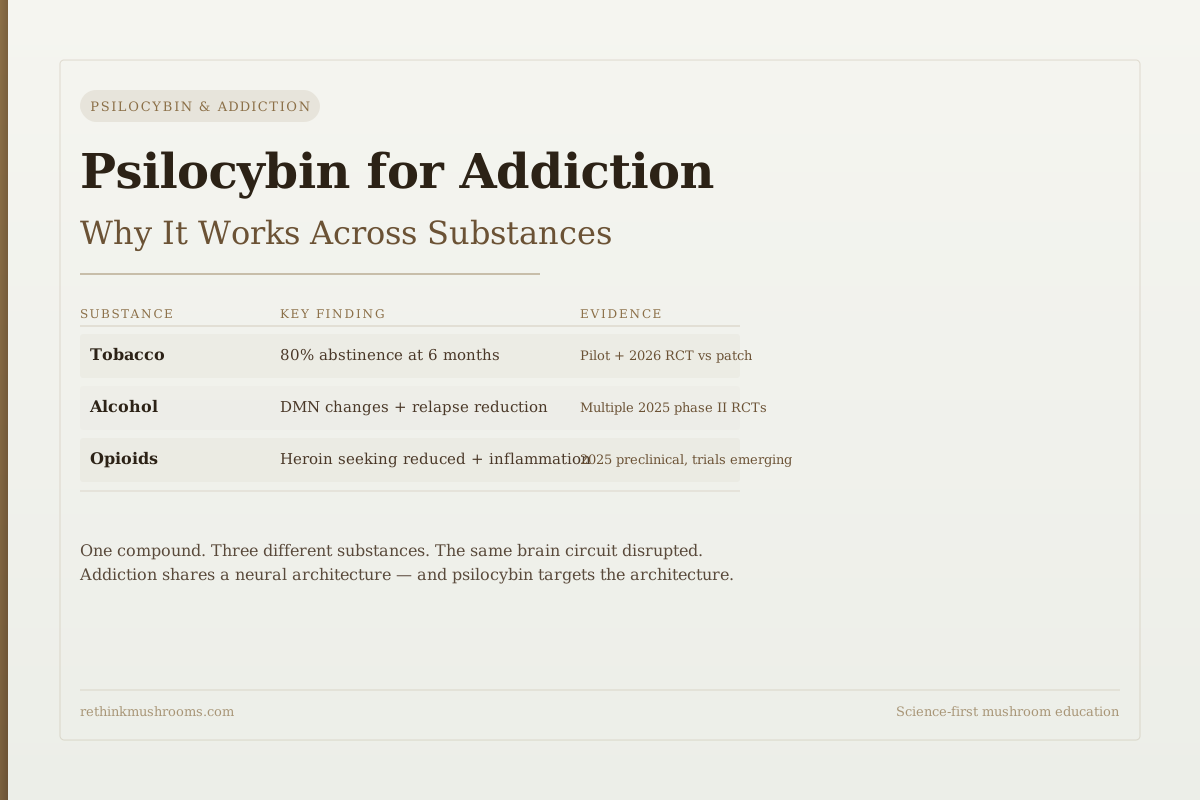
A 2025 systematic review found psilocybin has clinical trial evidence across tobacco, alcohol, and opioid addiction — substances with completely different pharmacologies, addressed by the same intervention.
2025 systematic review, efficacy and safety of psilocybin for substance use disorders
80%
tobacco abstinence at 6 months vs. 20–35% with nicotine replacement (Johnson et al. 2014)
AUD + depression
psilocybin addressed both simultaneously in a 2025 RCT — conditions share overlapping brain pathology
2026
first pilot RCT comparing psilocybin directly to nicotine patch for smoking cessation
2025 systematic review, efficacy and safety of psilocybin for substance use disorders
 View as image ↗
Pharmacological addiction treatments are generally substance-specific. Buprenorphine targets opioid receptors. Naltrexone blocks alcohol's reward signal. Nicotine replacement substitutes one nicotine delivery mechanism for another. The approach is built on the assumption that addiction is defined by what substance is being used.
Psilocybin doesn't follow this logic. A 2025 systematic review covering psilocybin across substance use disorders found evidence of clinical benefit for tobacco, alcohol, and opioid addiction — substances with completely different mechanisms, different receptor systems, and different conventional treatments.[1] The compound that produces this cross-substance effect has no pharmacological relationship to any of them.
The explanation requires a different frame: that addiction is not primarily a substance-specific disorder but a shared brain circuit disorder. The habit circuits that encode compulsive drug-seeking, the default mode network that runs craving narratives, and the impaired prefrontal control over both — these are common across addiction types regardless of substance. Psilocybin targets the circuit architecture, not the specific chemical.
This article covers the evidence across substances, what each data point shows, and the unifying mechanism that makes the cross-substance picture coherent.
For the clinical evidence on alcohol specifically, see Psilocybin for Alcohol Addiction: The NYU Clinical Trial Results.
Key Takeaways
- A 2025 systematic review found clinical evidence for psilocybin across tobacco, alcohol, and opioid addiction — the first comprehensive cross-substance synthesis
- Johnson et al. 2014 reported 80% tobacco abstinence at six months after psilocybin-assisted therapy in 15 smokers; a 2026 pilot RCT was the first to compare psilocybin directly to nicotine patch
- An fMRI pilot study of alcohol use disorder patients found single-dose psilocybin altered neural reactivity to alcohol cues — increasing prefrontal control activity — while a separate 2025 phase 2 trial targeted AUD relapse prevention
- A 2025 RCT found psilocybin addressed both alcohol use disorder and comorbid depression simultaneously — conditions that share overlapping default mode network pathology
- A 2025 preclinical study found psilocybin reduced heroin-seeking behavior in animal models and also modulated inflammatory and oxidative stress markers — an anti-addiction mechanism distinct from DMN disruption
- The cross-substance evidence suggests addiction's common neural substrate (habit circuits + DMN + impaired prefrontal control) is what psilocybin targets, not any substance-specific receptor
The Puzzle: Why Would One Compound Work for Tobacco, Alcohol, and Opioids?
Tobacco, alcohol, and opioids produce addiction through different pharmacological mechanisms. Nicotine acts primarily on acetylcholine receptors and triggers dopamine release in reward circuits. Alcohol modulates GABA and glutamate systems, reducing anxiety while activating reward circuits. Opioids bind directly to mu-opioid receptors, producing strong reward and physical dependence.
Their overlap is not pharmacological. Their overlap is neurological, at the circuit level.
Every substance addiction, regardless of the drug involved, leads to similar structural changes in how the brain processes decisions and habits. The prefrontal cortex loses regulatory control over impulse and habit. The habit circuits in the basal ganglia become over-trained, encoding drug-seeking as automatic behavior. The default mode network becomes biased toward self-referential craving thoughts. These changes occur across addictions because they reflect the brain's adaptation to chronic reward circuit stimulation, whatever the specific signal.
This shared circuit pathology is why behavioral treatments — cognitive behavioral therapy, motivational interviewing — can address multiple addiction types even though they contain no pharmacology. The intervention targets the habit pattern, not the substance.
Psilocybin appears to target the same shared circuit pathology, but through a biological rather than a purely behavioral route: disrupting the default mode network, opening a neuroplasticity window, and temporarily dismantling the neural infrastructure that sustains compulsive use. If that infrastructure is similar across addiction types, the same intervention can produce effects across substances.
For a detailed look at how psilocybin disrupts habit circuits, see Why One Psilocybin Session Can Disrupt Addiction.
The Tobacco Evidence: 80% Abstinence and a 2026 Head-to-Head Trial
Of all addiction types, tobacco is particularly well-suited to test the cross-substance argument. Nicotine is among the most physically mild addictive substances — the physiological dependence resolves within weeks of stopping. What makes tobacco addiction persistent is the habit circuit: the deeply encoded automatic behavior that fires in response to environmental cues dozens of times per day.
If psilocybin's mechanism is primarily about disrupting habit circuits rather than addressing pharmacological dependence, tobacco should show one of the strongest responses.
Johnson and colleagues published the first systematic test of this at Johns Hopkins in 2014.[2] Fifteen smokers received two to three psilocybin sessions alongside cognitive behavioral therapy. Eighty percent were abstinent at six-month follow-up. Nicotine replacement therapy typically achieves 20 to 35 percent abstinence at that interval. The magnitude of difference — roughly two to four times the standard treatment rate in a habit-dominated addiction — was the strongest early signal that psilocybin was doing something qualitatively different from pharmacological substitution.
The sample was small and the design was open-label without a control group. The finding required replication. In 2026, the first pilot randomized controlled trial comparing psilocybin directly to nicotine patch was published in JAMA Network Open.[3] This design — head-to-head against a standard-of-care intervention — is a significant methodological step beyond placebo comparison. Nicotine patch is an active behavioral and physiological intervention with documented efficacy. Comparing psilocybin to it directly tests not just whether psilocybin works, but whether it works better than what clinicians already have. In the randomized comparison, psilocybin plus cognitive behavioral therapy produced a biochemically verified abstinence rate roughly four times that of the nicotine-patch arm — a controlled contrast that is far more conservative than the uncontrolled 80% headline, yet still well above the ceiling of standard cessation therapies.
Six-Month Abstinence In Context
The 80% Headline vs. the Randomized 40.5%
2014 pilot — psilocybin
Open-label, no control group (n=15)
2026 RCT — psilocybin
Randomized vs. active comparator (n=42)
2026 RCT — nicotine patch
Randomized comparator arm (n=40)
Typical cessation therapies
Behavioral / pharmacological benchmark
The 80% bar comes from an uncontrolled pilot of 15 unusually motivated smokers. The randomized 40.5% vs. 10.0% contrast is the more trustworthy figure — lower than the headline, but still roughly six times the odds of its active comparator and above the field's usual ceiling.
Sources: Johnson et al., Journal of Psychopharmacology, 2014 (pilot, 80%); Johnson et al., JAMA Network Open, 2026 (RCT, 40.5% vs. 10.0%); <35% benchmark as reported in Johnson et al., 2014.
The Alcohol Evidence: Network Changes, Relapse Prevention, and the Depression Overlap
Alcohol use disorder has accumulated the most clinical trial data among the three substance categories in the cross-substance picture.
An fMRI pilot study drawn from a phase II randomized psilocybin trial examined what a single 25 mg dose does to brain activity in patients who have alcohol use disorder specifically.[4] The focus on AUD patients, rather than healthy volunteers, is significant: it directly connects the neuroimaging data to the population whose addiction the intervention is meant to treat. In this eleven-patient pilot — psilocybin against an active control — those who received psilocybin showed altered neural reactivity to alcohol and emotional cues before versus after dosing, with increased activity in the prefrontal cortex, the region that exerts regulatory control over craving, and reduced reactivity in sensory and habit-associated regions. This is the neuroimaging signature of the circuit-level shift the cross-substance model predicts, observed in the clinical population itself.
A separate 2025 trial specifically targeted relapse prevention in AUD, a major clinical challenge.[5] Most people who achieve initial abstinence from alcohol relapse within the first year. The trial examined whether psilocybin-assisted therapy could extend the window of maintained abstinence, and specifically whether the neuroplasticity window it creates is useful for building new behavioral responses to alcohol cues — the situation where relapse most commonly begins.
A third 2025 RCT addressed a common comorbidity that complicates alcohol addiction treatment: depression.[6] Alcohol use disorder and depression co-occur at high rates. The study found psilocybin addressed both simultaneously — reducing alcohol use and depressive symptoms in the same intervention. The researchers noted that both conditions share overlapping default mode network pathology: in both, the DMN is overactive and biased toward negative self-referential content. The same disruption that interrupts the craving narrative also interrupts the depressive rumination loop.
This comorbidity finding is not incidental. It reinforces the circuit-level explanation for cross-substance efficacy: psilocybin addresses the underlying neural pattern, and that pattern appears across more than just different substance addictions — it extends to overlapping psychiatric conditions.
For more on psilocybin and depression, see How Psilocybin Breaks Addiction: The Neuroscience Explained.
The Opioid Evidence: Heroin-Seeking Reduction and the Inflammation Angle
The opioid evidence is less clinically developed than tobacco and alcohol, but a 2025 preclinical study adds a mechanistic angle that goes beyond what the habit-circuit model alone predicts.
A 2025 preclinical study found psilocybin reduced heroin-seeking behavior in an animal model.[7] This replicates the cross-substance pattern in the opioid context: the compound with no opioid pharmacology reduced the behavior driven by opioid dependence. But the study found a second effect that goes beyond the DMN and habit circuit narrative: psilocybin also modulated inflammatory and oxidative stress markers in the animals.
Neuroinflammation is increasingly recognized as a component of addiction pathology, particularly in opioid dependence. Chronic opioid use triggers microglial activation and neuroinflammatory signaling that contributes to tolerance and withdrawal severity. The finding that psilocybin reduces inflammatory markers alongside craving behavior suggests an anti-addiction mechanism that extends beyond network-level disruption into cellular biology.
This is a preclinical finding — animal models of heroin seeking, not human clinical data. The translation to human opioid use disorder requires clinical trials that are still in development. But it adds a dimension to the cross-substance story: psilocybin may address multiple components of addiction biology simultaneously, including neuroinflammation that is especially relevant in opioid dependence.
Importantly, this positions psilocybin as an adjunct to — not a replacement for — medication-assisted treatment. Opioid dependence has two distinct layers, and psilocybin research targets only one of them.
Two layers, two tools
Why Psilocybin Is Studied Alongside MAT, Not Instead of It
Opioid use disorder has a physical layer and a psychological layer. They respond to different tools, which is why the clinical hypothesis places psilocybin after medication-assisted treatment, not in place of it.
Physical dependence layer
Addressed by medication-assisted treatment
Established, first-line
Biology
Opioid receptor desensitization and withdrawal
Tool
Methadone (agonist) or buprenorphine (partial agonist)
Acts on
Opioid receptors
Evidence
Robust: reduces overdose mortality and stabilizes lives
Behavioral & psychological layer
Targeted by psilocybin research
Investigational, early evidence
Biology
Habit patterns, craving, self-narrative, reward-circuit dysfunction
Tool
Psilocybin-assisted therapy (studied as an adjunct)
Acts on
Serotonin 2A receptors, not opioid receptors
Evidence
Preclinical and population signals only; no completed opioid trial
The proposed sequence is medication-assisted treatment first to stabilize physical dependence, then psilocybin-assisted sessions for the behavioral and psychological dimensions. No completed trial has yet tested this in opioid patients.
Sources: Meshkat et al., Neuroscience & Biobehavioral Reviews 2025 (RTHM-02148, PMID 40245969); Floris et al., Molecular Psychiatry 2025 (RTHM-02082, PMID 39433903)
What the 2025 Systematic Review Shows
The 2025 systematic review of psilocybin for substance use disorders synthesized the cumulative evidence across tobacco, alcohol, opioids, and other substances.[1]
The cross-substance evidence base at this point reflects the asymmetric pace of research: tobacco has the oldest data, starting with the Johnson 2014 pilot; alcohol has the most recent clinical trial volume; opioid evidence remains primarily preclinical. The systematic review provides the most current synthesis of this accumulating evidence.
The picture that emerges from the review supports the circuit-level hypothesis: psilocybin's effects are not substance-specific, and they cannot be explained by pharmacological competition with the addictive substance. The evidence points instead to a mechanism that addresses the shared neural architecture of compulsive behavior regardless of what triggers that behavior.
The pattern also points to an important limitation of conventional substance-specific addiction treatment: it manages the chemical relationship between the person and the substance but does not address the habit circuits and DMN patterns that maintain compulsive use. Psilocybin's cross-substance efficacy may reflect precisely this gap.
For more on how the neuroplasticity mechanism creates the therapeutic window, see Neuroplasticity and Addiction: How Psilocybin Opens a Window. For the mystical experience component that may amplify outcomes across addiction types, see The Mystical Experience and Addiction Recovery: Why It Matters.
Legal & Clinical Status
ModeratePsilocybin for addiction is investigational across every substance discussed here
Concern
Psilocybin is a Schedule I controlled substance in the United States and is not FDA-approved for tobacco, alcohol, opioid, or any other substance use disorder. The cross-substance results described here come from supervised clinical trials — with screening, preparation, in-session monitoring, and integration therapy — and, for opioids, largely from preclinical animal models. None of it reflects self-administration.
What the research says
The outcomes summarized above depend on psilocybin being delivered inside a structured psychotherapy protocol by trained clinicians. Outside that setting the safety and efficacy data do not apply, and unsupervised use carries legal and psychological risk. Psilocybin is studied as an adjunct to established addiction care, not a replacement for it.
Particularly relevant for: People considering psilocybin for any substance use disorder
What to do
This article is educational and is not medical advice. Discuss any addiction treatment with a qualified clinician, and look for regulated clinical trials rather than unsupervised use.
Meshkat et al., systematic review, 2025 (RTHM-02148); US DEA Schedule I classification
The Bottom Line
A 2025 systematic review confirmed psilocybin has clinical evidence across tobacco, alcohol, and opioid addiction. The tobacco data includes Johnson et al. 2014's 80% abstinence rate and a 2026 head-to-head RCT against nicotine patch. The alcohol data spans an fMRI study of psilocybin-induced neural changes in AUD patients, a 2025 phase 2 relapse-prevention trial, and a 2025 trial treating AUD plus comorbid depression simultaneously. The opioid data includes a 2025 preclinical study showing heroin-seeking reduction alongside neuroinflammation modulation. The cross-substance pattern is best explained by psilocybin targeting the shared neural architecture of addiction — habit circuits, default mode network, and impaired prefrontal control — rather than any substance-specific mechanism.
Frequently Asked Questions
Sources & References
- 1RTHM-02148·Meshkat, Shakila et al. (2025). “Efficacy and safety of psilocybin for the treatment of substance use disorders: A systematic review..” Neuroscience and biobehavioral reviews.Study breakdown →PubMed →↩
- 2RTHM-00328·Johnson, Matthew W et al. (2014). “Pilot study of the 5-HT2AR agonist psilocybin in the treatment of tobacco addiction..” Journal of psychopharmacology (Oxford.Study breakdown →PubMed →↩
- 3RTHM-00960·Johnson, Matthew W et al. (2026). “Psilocybin or Nicotine Patch for Smoking Cessation: A Pilot Randomized Clinical Trial..” JAMA network open.Study breakdown →PubMed →↩
- 4RTHM-01964·Pagni, B A et al. (2024). “Psilocybin-induced changes in neural reactivity to alcohol and emotional cues in patients with alcohol use disorder: an fMRI pilot study..” Scientific reports.Study breakdown →PubMed →↩
- 5RTHM-02168·Rieser, Nathalie M et al. (2025). “Psilocybin-assisted therapy for relapse prevention in alcohol use disorder: a phase 2 randomized clinical trial..” EClinicalMedicine.Study breakdown →PubMed →↩
- 6RTHM-02135·Luquiens, Amandine et al. (2025). “Psilocybin in alcohol use disorder and comorbid depressive symptoms: Results from a feasibility randomized clinical trial..” Addiction (Abingdon.Study breakdown →PubMed →↩
- 7RTHM-02082·Floris, Gabriele et al. (2025). “Psilocybin reduces heroin seeking behavior and modulates inflammatory gene expression in the nucleus accumbens and prefrontal cortex of male rats..” Molecular psychiatry.Study breakdown →PubMed →↩
- 8RTHM-00911·Siegel, Joshua S et al. (2024). “Psilocybin desynchronizes the human brain..” Nature.Study breakdown →PubMed →↩
- 9RTHM-02233·Jiang, Quan et al. (2026). “Psilocybin triggers an activity-dependent rewiring of large-scale cortical networks..” Cell.Study breakdown →PubMed →↩