Psilocybin & Addiction
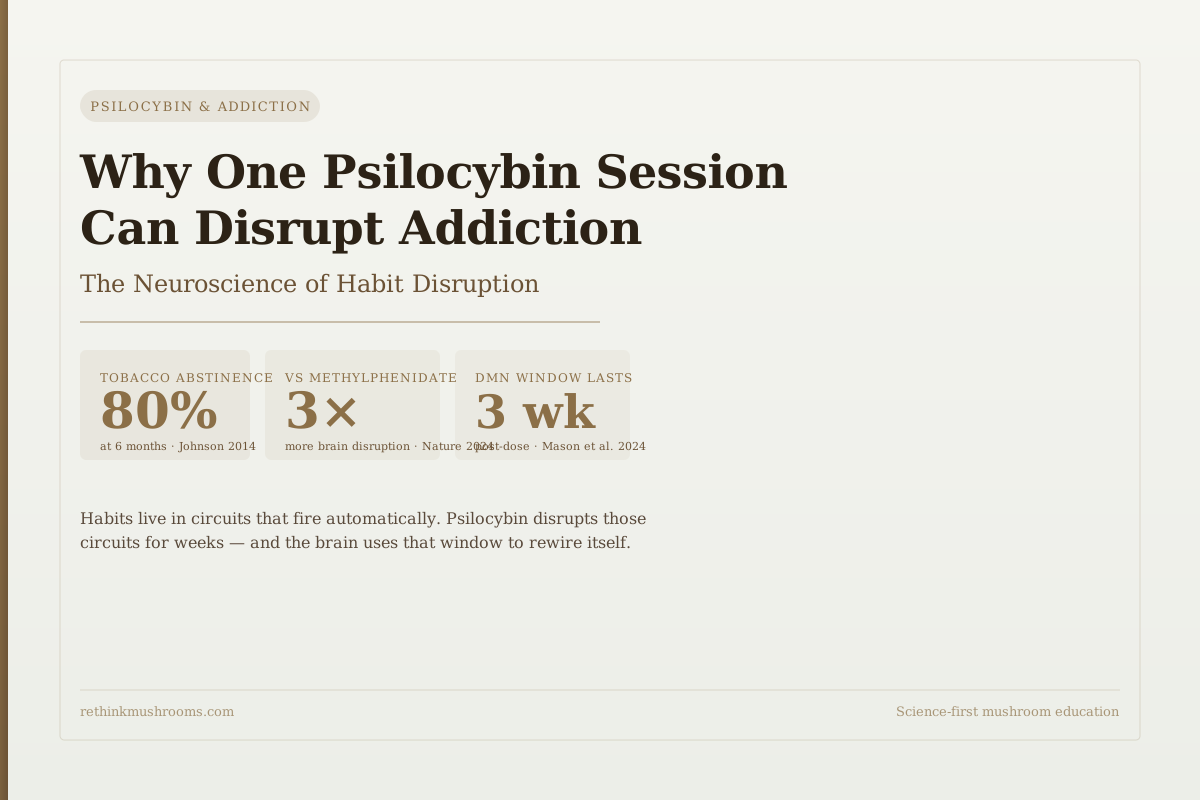
80% tobacco abstinence at 6 months
In Johnson and colleagues' 2014 pilot study, 80% of smokers given psilocybin-assisted therapy were abstinent at six-month follow-up. Standard nicotine replacement therapy achieves roughly 20–35% at that interval.
Johnson et al., Journal of Psychopharmacology, 2014
3×
greater brain network disruption than methylphenidate, strongest in DMN (Mason et al., Nature 2024)
3 weeks
DMN changes persisted post-psilocybin, the biological basis for the behavioral change window (Mason 2024)
2026
first pilot RCT directly comparing psilocybin to nicotine patch for smoking cessation
Johnson et al., Journal of Psychopharmacology, 2014
 View as image ↗
Addiction treatment tends to focus on the substance: what the drug does pharmacologically, what drives craving, and how to block or substitute for the reward it produces. This framing explains why treatments are often substance-specific — a medication for opioid dependence doesn't help with tobacco, and a nicotine patch doesn't address alcohol.
Psilocybin works differently across addictions, and the reason points to a different understanding of what addiction is. Across tobacco, alcohol, and opioid research, the same compound — with no pharmacological relationship to any of these substances — reduces compulsive use. This cross-substance effect is better explained by thinking about addiction as a habit-circuit disorder than as a substance-specific disorder.
The habit circuit maintains addiction. Psilocybin disrupts the habit circuit. That disruption persists for weeks after a single session, creating a window where the automatic pattern can be interrupted before it fires.
This article explains the neuroscience of that mechanism: what habit circuits are, how psilocybin disrupts them, and what the evidence shows about the duration and depth of that disruption.
For the clinical evidence on specific addictions, see Psilocybin for Alcohol Addiction: The NYU Clinical Trial Results.
Key Takeaways
- Addiction involves not just reward circuits but habit circuits in the basal ganglia — behaviors that have become automatic and self-executing, independent of conscious decision
- Mason et al. 2024 (Nature) found psilocybin produced more than 3x greater brain network disruption than methylphenidate (Ritalin), with DMN changes persisting up to 3 weeks
- A 2026 Cell paper found psilocybin triggers activity-dependent rewiring of large-scale cortical networks — the disruption opens a window in which the brain actively restructures itself
- A 2025 neuroplasticity review found dendritic spine density increases in the prefrontal cortex and hippocampus lasting weeks after psilocybin, with TrkB signaling as the structural driver
- Johnson et al. 2014 reported 80% tobacco abstinence at six months after psilocybin-assisted therapy — in a population whose habit circuits are among the most deeply encoded
- A 2026 pilot RCT compared psilocybin directly to nicotine patch for smoking cessation — the first head-to-head trial against a standard intervention
What Makes Addiction a Habit Problem, Not Just a Reward Problem
Most discussions of addiction center on dopamine: the brain releases it during drug use, reinforcing the behavior, and the person becomes dependent on the chemical reward. This is accurate, but it is incomplete.
Reward and habit are handled by different brain systems. The reward system, centered on dopamine pathways from the ventral tegmental area to the nucleus accumbens, evaluates whether an action produced a good outcome and adjusts future motivation accordingly. It answers the question: was that worth doing?
The habit system, centered on the basal ganglia, automates behaviors that have been repeated often enough. It compresses deliberate actions into automatic routines that execute without requiring conscious oversight. Tying shoelaces, driving a familiar route, reaching for a coffee cup — these are basal ganglia habits. They fire without needing the prefrontal cortex to decide anything.
Early in addiction, drug use is reward-driven: the person decides to use because it feels good. The dopamine signal reinforces the behavior. As the behavior is repeated, the habit system takes over. The drug-seeking behavior gets encoded as a basal ganglia routine. It becomes automatic, compulsive, and to a significant degree independent of whether the person still finds it rewarding.
This is why addiction becomes hard to stop even when the drug no longer produces pleasure. The habit fires anyway. The person finds themselves in the familiar environment, with the familiar cues, and the behavior has already initiated before they have consciously decided anything. The brain treats drug-seeking like tying shoelaces: something the body knows how to do without being asked.
Breaking addiction at the habit level requires disrupting the neural infrastructure of the automatic pattern — not just blocking the reward, but interrupting the circuit that executes the behavior automatically.
The Two Networks at the Core of Every Addiction
Habit circuits are not the only system maintaining addiction. A second network — the default mode network (DMN) — runs the internal narrative that makes habits feel necessary.
The DMN is the brain's resting-state network. It is most active during self-referential thinking: when the mind is not engaged with a specific task and turns inward. It generates the running commentary of the self: plans, worries, memories, and the continuous internal monologue about what we want and why.
In addiction, the DMN is chronically overactive and heavily biased toward the substance. The internal monologue becomes a craving loop: "I need a drink," "I could use a cigarette," "it would be easier with something to take the edge off." These are not random thoughts. They are self-referential DMN outputs that prime and amplify the habit circuits. The DMN creates the intention; the basal ganglia execute it automatically.
Treating addiction effectively requires disrupting both: the automatic execution in the habit circuits and the craving narrative in the DMN. Psilocybin acts on both systems simultaneously.
For a deeper look at DMN disruption specifically, see Psilocybin and Default Mode Network Disruption in Addiction and Default Mode Network and Depression: Why Psilocybin's DMN Effect Matters.
3x Greater Disruption Than Ritalin: What the Nature 2024 Paper Found
In 2024, Mason and colleagues published a study in Nature comparing psilocybin and methylphenidate (Ritalin) on brain network disruption.[1] Methylphenidate is a stimulant that increases dopamine and norepinephrine — a drug known to produce significant brain activity changes. The comparison was designed to test whether psilocybin's brain effects were merely non-specific arousal, or something categorically different.
Psilocybin produced more than three times greater disruption of brain network functional connectivity than methylphenidate. The effect was not uniform across the brain: the default mode network was most strongly affected. The key persistence finding: anterior hippocampus connectivity with the DMN remained altered for up to three weeks after the psilocybin dose.
Three weeks. The psilocybin molecule is pharmacologically active for approximately six to eight hours. Its half-life is a few hours longer. Yet the changes in how the DMN connects to the hippocampus — a key structure in contextual memory and craving retrieval — persisted for weeks.
This three-week window is the biological basis for what clinicians describe as the "therapeutic window" after psilocybin. The brain networks that maintain addiction habits are disrupted, and the disruption is not transient. The circuits that normally execute automatic behavior and generate the craving narrative are destabilized.
For more on this window and why therapy timing matters, see How Psilocybin Creates a Window for Behavioral Change.
The Structural Evidence: The Brain Literally Rewires During the Window
Disruption of existing connectivity is one part of the mechanism. What happens inside the disruption window is the other part.
A 2025 review of emerging psilocybin neuroplasticity mechanisms synthesized structural brain change data across multiple studies.[3] It found that psilocybin increases dendritic spine density — the number and size of connection points on neurons — in the medial prefrontal cortex and hippocampus. These increases appear within hours and last for weeks. The structural driver is TrkB signaling: psilocybin activates TrkB, the receptor for BDNF (brain-derived neurotrophic factor), which is the molecular trigger for new synaptic growth.
More dendritic spines in the prefrontal cortex means more connectivity available for new behavioral patterns to wire into. The prefrontal cortex, which normally loses top-down control over habit circuits and craving responses in addiction, gains structural capacity during the plasticity window.
A 2026 paper published in Cell confirmed that the disruption is not merely functional — it is structural and activity-dependent.[2] Psilocybin triggers activity-dependent rewiring of large-scale cortical networks: the brain uses the plasticity state opened by psilocybin to literally restructure its connectivity based on what activities and experiences occur during the window.
This is the mechanistic foundation for why psilocybin-assisted therapy requires intensive follow-up sessions in the weeks after the psilocybin dose. The brain is not just disrupted — it is actively building new connections during the window. Every therapeutic interaction during this period shapes what gets built.
For more on neuroplasticity in addiction recovery, see Neuroplasticity and Addiction: How Psilocybin Opens a Window.
Smoking and the Habit-Circuit Test: What the Tobacco Data Shows
Of all substance addictions, tobacco may be the most dominated by habit circuits. Nicotine produces relatively modest reward compared to opioids or alcohol, yet nicotine addiction is among the hardest to break. The reason is that smoking behavior becomes deeply encoded in the basal ganglia: the environmental cues (morning coffee, a car journey, after meals), the motor routine of the cigarette, and the brief sensory experience become a tightly wired automatic pattern.
The habit fires in response to triggers that have nothing to do with the pharmacological reward. Quitting smoking is difficult not primarily because of nicotine withdrawal but because the habit circuit fires automatically dozens of times per day in response to ubiquitous environmental cues.
This is why smoking cessation is an ideal test case for the habit-disruption theory of psilocybin.
Johnson and colleagues published a pilot study in 2014 at Johns Hopkins involving 15 smokers who received two to three psilocybin sessions alongside cognitive behavioral therapy.[4] Eighty percent of participants were abstinent at six-month follow-up. Standard nicotine replacement therapy — patches, gum, lozenges — achieves roughly 20 to 35 percent abstinence at that interval. The psilocybin group showed abstinence rates approximately two to four times higher than what standard interventions typically produce.
This was a small pilot study and the design had limitations. But the magnitude of the effect, in a population whose habit circuits are among the most deeply encoded, attracted widespread attention and led to multiple follow-up trials.
In 2026, the first pilot randomized controlled trial directly comparing psilocybin to nicotine patch for smoking cessation was published.[5] This head-to-head comparison design — psilocybin against the standard intervention rather than against placebo — represents a significant step in determining whether the habit-circuit disruption mechanism produces benefits beyond what pharmacological substitution can achieve.
For the full picture of psilocybin's cross-substance evidence, see Psilocybin for Addiction: Why It Works Across Substances.
An Open Question: Does the Psychedelic Experience Itself Matter?
The evidence above supports a neurobiological account: psilocybin disrupts habit circuits and opens a structural plasticity window. This raises a specific question that the research has not yet fully resolved.
Is the full psychedelic experience — the ego dissolution, the altered perceptual state, the emotional intensity — necessary for the therapeutic effect? Or does the 5-HT2A receptor activation alone produce the habit-circuit disruption, independent of whether the person undergoes a full psychedelic experience?
A 2025 systematic review of the 5-HT2A receptor's role in psilocybin's therapeutic effects specifically addressed this question.[6] The review found evidence that therapeutic neuroplastic effects may occur through 5-HT2A receptor signaling pathways that do not strictly require a full psychedelic experience. Sub-hallucinogenic doses can produce measurable neuroplastic changes in animal models.
This finding has clinical relevance: it suggests that the mechanism does not require high-dose psychedelic sessions, and that some therapeutic benefit might be achievable without the subjective intensity that makes psilocybin inaccessible or daunting for some patients.
However, the clinical evidence showing the largest effects — the 80% tobacco abstinence in Johnson 2014, the most striking depression outcomes — comes from full psychedelic dose protocols. The mystical experience component correlates with better outcomes in multiple studies. The full resolution of this question is ongoing, and the current answer is that both pathways likely contribute: the neuroplasticity mechanism is probably not purely experience-dependent, but the full psychedelic experience may amplify and extend it.
For a discussion of habit loops specifically, see Psilocybin and Habit Loops: Disrupting Automatic Behavior. For the neuroscience of psychedelic-assisted addiction treatment in full, see The Neuroscience of Psychedelic-Assisted Addiction Treatment.
The Bottom Line
Addiction is maintained by two systems: habit circuits in the basal ganglia that execute drug-seeking automatically, and DMN loops that generate craving narratives. Mason et al. 2024 (Nature) found psilocybin disrupted brain networks more than 3x as powerfully as methylphenidate, with DMN changes persisting for up to three weeks. A 2026 Cell paper confirmed that psilocybin triggers activity-dependent structural rewiring during this window, and a 2025 neuroplasticity review documented the dendritic spine growth that underlies it. Johnson et al. 2014 showed 80% tobacco abstinence at six months — the archetypal habit-dominated addiction responding to a single mechanism — and a 2026 head-to-head RCT compared psilocybin directly to nicotine patch. Whether the full psychedelic experience is required remains an open question, but current evidence points to contributions from both neuroplasticity and the subjective experience itself.
Frequently Asked Questions
Sources & References
- 1. Source details for this reference are not yet available.
- 2. Source details for this reference are not yet available.
- 3. Source details for this reference are not yet available.
- 4. Source details for this reference are not yet available.
- 5. Source details for this reference are not yet available.
- 6. Source details for this reference are not yet available.