Psilocybin & Addiction
3 weeks of DMN disruption
A single psilocybin dose produced more than 3x greater brain network disruption than methylphenidate, with anterior hippocampus-DMN connectivity remaining altered for up to 3 weeks post-dosing.
Mason et al., Nature, 2024
>3x
greater brain disruption from psilocybin vs methylphenidate (Ritalin) in the landmark Nature 2024 study
Dendritic spines
density increases in prefrontal cortex and hippocampus that persist for weeks after a single session (2025 neuroplasticity review)
Activity-dependent
rewiring: the brain uses psilocybin-induced plasticity to write new connectivity patterns during the window (Cell, 2026)
Mason et al., Nature, 2024
 View as image ↗
Psilocybin is metabolized within hours. The acute psychedelic experience lasts roughly six to eight hours. The drug itself is effectively gone from the bloodstream within a day. Yet the antidepressant and anti-addiction effects documented in clinical trials persist for weeks, months, and in some cases years. This is the central puzzle of psilocybin therapy, and its solution turns out to be the most important thing to understand about why these treatments work.
The drug doesn't stay. The brain changes that it triggers do. This article explains those changes, how long they last, and why the timing of therapy relative to the psilocybin session determines whether those changes become permanent.
For the full picture of psilocybin in addiction treatment, see the guide to psilocybin for alcohol addiction. For the general neuroscience overview, see how psilocybin breaks addiction: the neuroscience explained.
Key Takeaways
- A single psilocybin dose produced more than 3x greater disruption of brain network connectivity than methylphenidate; the DMN was most strongly affected, and anterior hippocampus-DMN connectivity remained altered for up to 3 weeks (Mason et al., Nature, 2024)
- Psilocybin promotes neuroplasticity and produces rapid, sustained therapeutic effects; the benefits appear within hours and persist for months, outlasting the drug's pharmacological presence by orders of magnitude (2024)
- Structural neuroplasticity mechanisms include increased dendritic spine density in medial prefrontal cortex and hippocampus lasting weeks, and elevated synaptic protein levels driven by 5-HT2A receptor to TrkB signaling (2025 neuroplasticity review)
- Psilocybin triggers activity-dependent rewiring of large-scale cortical networks, meaning the brain uses the plasticity window to actively write new connectivity patterns based on what experiences occur during it (Cell, 2026)
- A Phase II trial of psilocybin-assisted therapy specifically for alcohol use disorder relapse prevention demonstrates that therapy delivered during the neuroplasticity window reduces relapse rates (2025)
- The window is not just open for recovery; it is open for any strong experience. The intensive therapy protocol in psilocybin trials is designed to ensure the new experiences filling the window are therapeutically beneficial rather than neutral or harmful
The Paradox: A Drug That Leaves in Hours but Changes the Brain for Months
The pharmacology is straightforward: psilocybin is converted to psilocin in the body, which binds primarily to serotonin 5-HT2A receptors. Plasma levels of psilocin peak within 90 minutes of ingestion and return to baseline within 6-8 hours. The psychedelic experience tracks this pharmacokinetic curve closely. By the next morning, the drug is gone.
The clinical outcomes tell a different story. A 2024 study published in a peer-reviewed journal documented that psilocybin promotes neuroplasticity and induces rapid and sustained therapeutic effects: benefits appeared within hours and remained meaningfully elevated at follow-up assessments weeks and months later.[3] The drug clearance and the therapeutic duration are separated by a factor of hundreds.
This dissociation is not unique to psilocybin among antidepressants (ketamine shows a similar pattern of rapid onset and delayed offset), but psilocybin's version is more pronounced and has now been documented with more structural detail than any other compound in this class. The reason the therapeutic effects outlast the pharmacology is that the drug triggers biological changes in brain structure and network organization that continue operating long after the drug itself has cleared.
The 3-Week Window: What the Nature Paper Found
The clearest neurobiological evidence for the timing of this window comes from Mason and colleagues' 2024 study published in Nature (the highest-impact scientific journal), examining what psilocybin does to brain network organization.[1]
Using neuroimaging in a randomized controlled design, Mason et al. compared a single dose of psilocybin to methylphenidate (Ritalin, a stimulant used as an active comparator because it also alters brain function but without the same connectivity effects). Psilocybin produced more than three times greater disruption of functional brain network connectivity than methylphenidate. The default mode network (DMN) was the most strongly affected circuit.
The durability finding is the key one for understanding the therapeutic window. Anterior hippocampus connectivity with the DMN remained statistically altered at the scan performed approximately three weeks after the dosing session. The DMN had not returned to its pre-dose connectivity pattern three weeks later.
For context on why DMN disruption specifically matters for addiction, see psilocybin and default mode network disruption in addiction.
The Structural Substrate: What the Brain Physically Changed
DMN connectivity disruption measured by fMRI shows that brain networks reorganized. A 2025 comprehensive review of psilocybin's neuroplasticity mechanisms documents the structural events that explain this reorganization at the cellular level.[2]
In medial prefrontal cortex and hippocampus (two regions central to self-referential thought, memory, and behavioral flexibility), psilocybin produced increases in dendritic spine density lasting weeks. Dendritic spines are the structural units through which neurons form synapses with each other. More spines means more potential connection points: the brain becomes more physically capable of forming new circuits and weakening old ones.
The mechanism runs through 5-HT2A receptor activation to TrkB signaling (TrkB is the primary receptor for brain-derived neurotrophic factor, BDNF, the molecular signal that drives new synaptic growth). When psilocybin activates 5-HT2A receptors, it activates TrkB, which triggers the growth of new dendritic spines. The result is a period of increased structural plasticity during which the brain can more readily form new connections and prune established but unhealthy patterns.
Elevated synaptic protein levels confirmed the structural nature of these changes; this is not just functional connectivity reorganization but measurable differences in the physical composition of synaptic tissue.
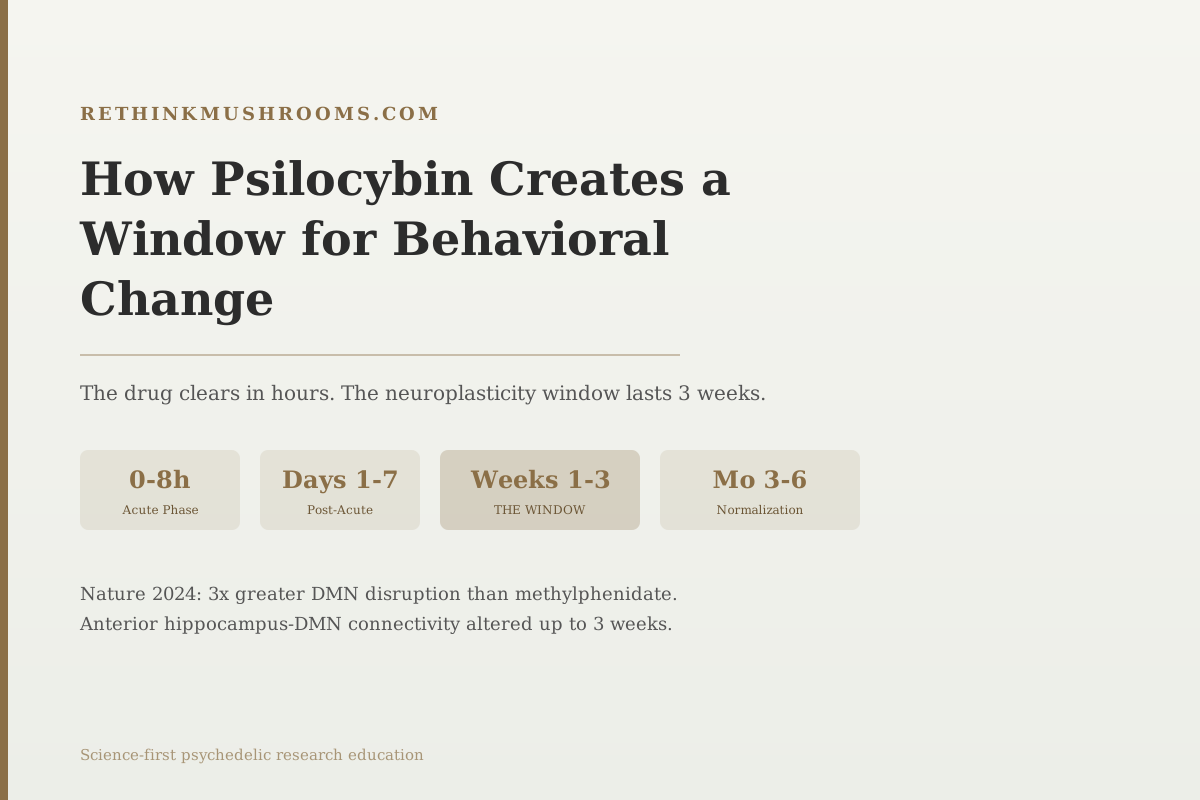
The Phase-by-Phase Timeline
The evidence assembles into a phase structure for the psilocybin therapeutic window:
Acute phase (0-8 hours): Psilocybin is pharmacologically active. Intense disruption of brain network connectivity occurs acutely, with the psychedelic experience driven by psilocin binding at 5-HT2A receptors. DMN undergoes maximal disruption. This phase is the entry point, but it is not where the therapeutic work primarily happens; it is where the window is opened.
Post-acute phase (days 1-7): Psilocybin has cleared, but the cascade of structural changes is underway. Dendritic spine growth is occurring. The DMN remains disrupted. Patients often report a period of unusual clarity, openness, and reduced craving during this phase. Mood elevation is common. The brain is physically more plastic than baseline.
Window period (weeks 1-3): The anterior hippocampus-DMN connectivity disruption documented in the Mason 2024 Nature study persists throughout this period. New dendritic spines are present and available for consolidation. The window is open. Therapeutic interactions during this period have the greatest potential to write new behavioral and cognitive patterns into the structurally plastic brain.
Normalization (months 3-6): Connectivity patterns gradually return toward baseline. This does not mean the therapy window's effects are lost; new patterns that were consolidated during the window period are now encoded in circuits that are returning to normal stability. What persists is what was established during the window, not the window itself.
Activity-Dependent Rewiring: Why What Happens During the Window Matters
A 2026 paper published in Cell (another top scientific journal) documented a mechanism that makes the timing question clinically critical.[4] Psilocybin triggers activity-dependent rewiring of large-scale cortical networks.
"Activity-dependent" is the critical term. It means the rewiring is not random or predetermined; it is driven by the neural activity that occurs during the plasticity window. The brain is not just more plastic in the abstract; it is literally using incoming experiences and behaviors to determine which new connections to strengthen and which old ones to weaken. Neurons that fire together during the window wire together more readily than they would otherwise.
This is the mechanistic explanation for why psilocybin-assisted therapy consistently outperforms psilocybin alone in clinical trials. The drug opens the window. What happens inside the window determines the architecture of the new connectivity patterns that get consolidated. Therapeutic work (processing the session experience, building new behavioral intentions, practicing new coping responses) is the content that fills the window with constructive patterns.
The inverse is also implied: if nothing therapeutic happens during the window, the plasticity is still there, but it may consolidate neutral or even counterproductive patterns based on whatever experiences fill that time. This is the neurobiological rationale for the intensive integration protocol used in psilocybin clinical trials, where therapy sessions are scheduled in the days and weeks immediately following the dosing session.
For more on the neuroplasticity mechanisms specifically, see neuroplasticity and addiction: how psilocybin opens a window.
Clinical Evidence: Therapy Timed to the Window
A 2025 Phase II randomized controlled trial of psilocybin-assisted therapy specifically for relapse prevention in alcohol use disorder provides the most direct clinical evidence that this framework matters in practice.[5] The trial design embedded structured therapy sessions in the days and weeks immediately following psilocybin administration, explicitly exploiting the neuroplasticity window rather than treating psilocybin and therapy as two independent interventions.
The trial documented reduced relapse rates with this protocol compared to standard treatment. Relapse prevention is specifically about whether behavioral changes established during the window persist when the patient returns to an environment full of addiction cues; the neuroplasticity framework predicts this should be the primary test of whether the window was used effectively, and the trial result is consistent with that prediction.
For the neuroscience of how psilocybin disrupts habitual addictive behavior circuits, see psilocybin and the neuroscience of habit: why one session can disrupt addiction. For the evidence on why psilocybin shows effects across different substances, see psilocybin for addiction: why it works across substances.
Why the DMN Connection Matters Specifically for Addiction
The default mode network is where self-referential thought lives. Autobiographical memory retrieval, mental projection into future scenarios, internal monologue, and rumination all rely heavily on DMN activity. In addiction, the DMN is implicated in the persistent self-referential craving cycle: the internal narrative of need ("I need a drink," "just one cigarette") that precedes compulsive use.
When psilocybin disrupts DMN connectivity for up to three weeks, it weakens the neural infrastructure of this craving narrative. The thoughts still occur, but they fire through a network that is temporarily less rigid, less automatically connected to the habitual behavioral response of seeking. This is the gap that therapy fills: if the cue-to-craving-to-use chain is momentarily weakened, and therapy provides new response options during that weakened period, those new responses get written into the brain during the window of heightened plasticity.
For readers interested in how the same DMN mechanism applies to depression, see default mode network and depression: why psilocybin's DMN effect matters. For the full neuroscience of psychedelic-assisted addiction treatment, see the neuroscience of psychedelic-assisted addiction treatment.
The Bottom Line
Psilocybin clears the body within hours but creates a neuroplasticity window that persists for weeks, documented in the Mason et al. 2024 Nature paper as up to 3 weeks of altered DMN connectivity after a single dose. The structural substrate includes increased dendritic spine density in medial prefrontal cortex and hippocampus, driven by 5-HT2A to TrkB signaling. A 2026 Cell paper established that the rewiring is activity-dependent: the brain uses incoming experiences during the window to determine which new connectivity patterns to consolidate. This is why therapy must be timed to the window rather than separated from the psilocybin session, and why a 2025 Phase II trial found reduced relapse rates when therapy was explicitly structured around the neuroplasticity period.
Frequently Asked Questions
Sources & References
- 1. Source details for this reference are not yet available.
- 2. Source details for this reference are not yet available.
- 3. Source details for this reference are not yet available.
- 4. Source details for this reference are not yet available.
- 5. Source details for this reference are not yet available.