Psilocybin for Smoking Cessation
80% quit rate
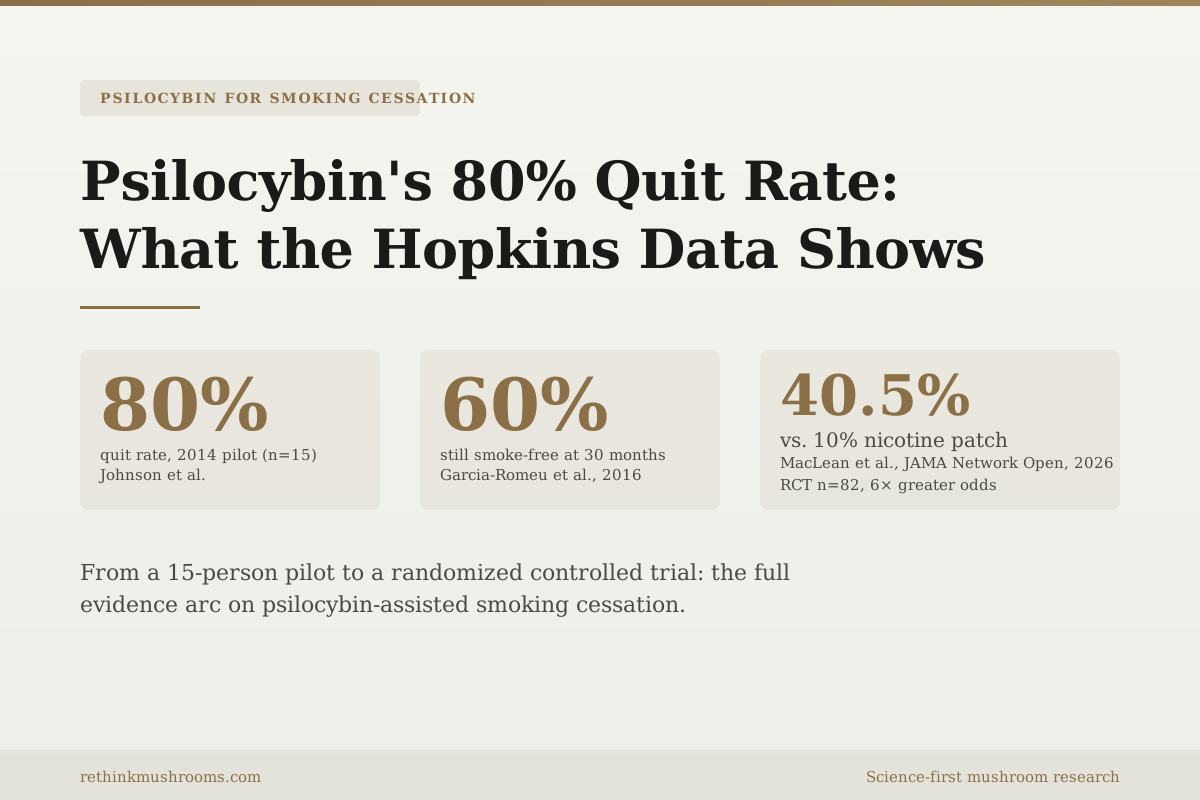
In 2014, Johns Hopkins researchers documented the highest smoking quit rate ever recorded in a clinical trial, using psilocybin combined with structured behavioral support.
Johnson et al., Journal of Psychopharmacology, 2014
15
participants in the original pilot study
60%
still smoke-free at 30-month follow-up
6×
greater quit odds vs. nicotine patch in 2026 RCT
Johnson et al., Journal of Psychopharmacology, 2014
 View as image ↗
When Matthew Johnson published his 2014 pilot study, smoking researchers encountered something they had no framework for. Twelve of 15 heavy smokers, people who had averaged 31 years of daily smoking and six failed quit attempts, were biochemically confirmed smoke-free at their 6-month follow-up. That figure, 80 percent, is real.[1]
The criticisms came quickly, and some were valid. Fifteen people is not a clinical trial. There was no control group. Participants received intensive therapeutic support that no standard cessation program could match. Those facts matter and this article addresses each of them directly. But what happened in the decade that followed the 2014 study is why researchers have not moved on. For a broader look at how psilocybin is being studied across addiction types, see Psilocybin for Alcohol Addiction: The NYU Clinical Trial Results.
Key Takeaways
- The 2014 Johns Hopkins pilot study found 80% of participants (12/15) were biochemically verified smoke-free at 6 months, the highest quit rate ever documented in a smoking cessation trial
- Participants had smoked an average of 31 years with 6 prior failed quit attempts before enrolling
- The 2016 long-term follow-up found 60% still abstinent at a mean of 30 months, a durability figure no standard treatment has replicated
- The 2026 JAMA Network Open RCT (n=82) found 40.5% prolonged abstinence with psilocybin versus 10.0% with nicotine patch at 6 months, 6 times greater odds
- The 80% figure is from a small uncontrolled pilot; the 40.5% from the randomized trial is the more scientifically reliable estimate of psilocybin's specific contribution
- All studies used psilocybin combined with cognitive behavioral therapy and professional therapeutic support, not psilocybin alone
The 80% That Started Everything: Inside the 2014 Johns Hopkins Pilot
In 2014, Matthew Johnson and colleagues at Johns Hopkins enrolled 15 adults who had smoked heavily for an average of 31 years. Each had tried to quit at least six times before. These were not casual smokers who had recently decided to try something new. They were people for whom every standard approach, including nicotine replacement therapy, prescription medication, and behavioral counseling, had already failed.[1]
The intervention was not psilocybin alone. Participants went through a 15-week program combining cognitive behavioral therapy for smoking cessation with two supervised psilocybin sessions. The first session, at week 5, used a moderate dose (20mg per 70kg of body weight). The second session, at week 7, used a higher dose (30mg per 70kg). Each session ran the full day at a clinical facility, with trained facilitators present throughout. The drug and the therapeutic context were deliberately combined from the start.[1]
At the 6-month follow-up, researchers verified abstinence using cotinine tests on urine or saliva, not self-report. Eighty percent of participants, 12 of 15, had no detectable evidence of smoking. The previous high for any pharmacological smoking cessation intervention was around 30 to 35 percent, achieved with varenicline (Chantix), which requires months of daily dosing.[1]
For a deeper look at the complete Hopkins research program, including the role of the therapeutic relationship and what participants described during their sessions, see Psilocybin for Smoking Cessation: The Johns Hopkins Results.
What a 15-Person Pilot Study Does and Doesn't Prove
Pilot studies are designed to assess feasibility and signal, not to establish efficacy. A study of 15 people cannot support confident claims about what will happen across a general population of smokers. Three specific limitations apply to Johnson 2014.
First, there was no control group. Without a group receiving a different treatment or a placebo, it is impossible to separate psilocybin's contribution from the contribution of the intensive 15-week CBT program, participant motivation, the expectation of a significant experience, or the simple effect of being closely monitored and supported by Johns Hopkins researchers over four months. Any of these could meaningfully improve quit rates on their own.[1]
Second, a sample of 15 produces a very wide statistical confidence range. If the true sustained quit rate for this protocol were 40 percent, you could easily observe 12 successes out of 15 attempts through chance alone. The 80% observation is consistent with a true effect size anywhere from roughly 50 to 95 percent. The number is real; what it predicts about a larger population is not yet established.
Third, the study population was selected for motivation. Enrolling in a 15-week research protocol at Johns Hopkins, involving multiple full-day psilocybin sessions, is not something most smokers will do. The participants were highly committed to quitting before they enrolled, and high motivation alone improves outcomes in any cessation program.
None of this means the result is wrong. It means the result needed replication. To understand the mechanisms proposed to explain why psilocybin appears effective for nicotine addiction, see Psilocybin and Nicotine Addiction: Mechanisms of Action.
The Long-Term Follow-Up: 60% Still Smoke-Free at 30 Months
Two years after the pilot, Albert Garcia-Romeu and colleagues tracked down the original 15 participants to see whether the 6-month abstinence had lasted. The follow-up was not originally planned in the study design. Researchers organized it because the baseline outcomes were striking enough to warrant checking whether they persisted.[2]
At 12 months, 10 of 15 participants, 67 percent, remained biochemically confirmed smoke-free. At a mean follow-up of 30 months, ranging from 14 to 38 months across participants, 9 of 15 remained confirmed nonsmokers. The abstinence rate at 2.5 years was 60 percent.[2]
For context: in standard smoking cessation research, most people who achieve 6-month abstinence with nicotine replacement therapy have relapsed by 12 months. The relapse curve after NRT is steep. A 60 percent rate at a mean of 30 months, in people who had averaged six prior failed quit attempts, has no precedent in smoking cessation research.
The Garcia-Romeu follow-up also recorded something about the subjective quality of the psilocybin experience. At their follow-up interviews, 86.7 percent of participants, 13 of 15, rated their psilocybin session as among the five most meaningful experiences of their entire lives. This was not a drug experience that faded from memory in weeks. It remained a defining personal event, and many participants connected the decision to stop smoking to what they encountered during those sessions.[2]
The quit rate captures the outcome. The durability of that quit, across 2.5 years in a population that had failed to quit six times before, is the more compelling piece of evidence. For research on why the depth of the psychedelic experience appears to predict lasting behavior change, see The Mystical Experience and Addiction Recovery: Why It Matters.
The 2026 Randomized Trial: Psilocybin vs. Nicotine Patch in 82 People
The move from a pilot study to a randomized controlled trial took over a decade, in part because regulatory and institutional barriers to psychedelic research made large trials difficult to design and fund. In March 2026, Mary MacLean and colleagues published results in JAMA Network Open: the first RCT comparing psilocybin directly to an active smoking cessation treatment, not a placebo.[3]
The trial enrolled 82 adults who smoked at least 10 cigarettes per day. Forty-two were randomized to psilocybin plus CBT. Forty received nicotine patch plus CBT. Both groups received the same behavioral support structure throughout the trial. The design choice to match therapeutic support across groups was critical: it isolated the pharmacological intervention, psilocybin versus nicotine patch, as the variable being tested.[3]
At 6-month follow-up, the primary outcome was sustained smoke-free status, biochemically verified. In the psilocybin group, 40.5 percent achieved this outcome. In the nicotine patch group, 10.0 percent achieved it. That difference corresponded to approximately 6 times greater odds for psilocybin (p less than 0.001).[3]
Secondary measures followed the same direction. A shorter-term check asked whether participants had gone 7 days without smoking at the time of assessment. On that measure, 52.4 percent of the psilocybin group was abstinent versus 25.0 percent of the nicotine patch group, approximately 3 times greater odds. Among participants who did not achieve full abstinence, those in the psilocybin group reduced their daily cigarette count by 53.7 percent more than those in the nicotine patch group. No serious adverse events were reported in either group.[3]
The trial was conducted at a single site with 82 participants, which limits generalizability. Replication across multiple sites and larger samples is still needed before confident population-level conclusions are possible. For a full side-by-side comparison of psilocybin against all current first-line smoking cessation treatments, including varenicline and bupropion, see Psilocybin-Assisted Smoking Cessation vs. Standard Treatments.
Why 40.5% Is Actually the More Important Number
This requires brief explanation, because 40.5% looks like a step back from 80%.
The 2014 pilot had no comparator. It cannot tell us how much of the 80% quit rate came from psilocybin specifically versus the intensive 15-week CBT program, the participant selection, or the general effect of close therapeutic attention over months. An ambitious program delivered by Hopkins researchers to highly motivated quitters would produce above-average results with or without psilocybin. The 80% result tells us the combination worked. It cannot isolate which part of the combination was responsible.[1]
The 2026 RCT addressed exactly this. Both groups received CBT. Both received professional therapeutic support. The only structural difference between groups was whether the pharmacological intervention was psilocybin or nicotine patch. In that controlled context, psilocybin produced 40.5% sustained abstinence. Nicotine patch, the most widely used pharmacological cessation aid in the world, produced 10.0%.[3]
The 40.5% is not a deflated version of 80%. It is a cleaner measurement of psilocybin's specific contribution to the outcome, isolated from the CBT, measured against a real alternative, in a larger sample, using random assignment. That methodological improvement matters enormously for what researchers can actually claim.
The consistent thread across all three studies is that psilocybin-assisted cessation produces outcomes that existing first-line treatments have not matched on durability: 80% quit at 6 months in the pilot, 60% still quit at 30 months in the follow-up, and 40.5% versus 10.0% in the randomized trial. Each study tests the claim more rigorously than the last, and the direction of the evidence has not changed.[1][2][3]
For how psilocybin's effects on addictive behavior extend beyond tobacco to other substances, see Psilocybin for Addiction: Why It Works Across Substances.
The Protocol That Made It Possible: 15 Weeks, Two Sessions, Behavioral Support
Neither the pilot study nor the 2026 RCT tested psilocybin in isolation. Both paired the drug with structured cognitive behavioral therapy and clinical oversight. That combination is not incidental to the results.
In the Johnson 2014 pilot, the 15-week program used a well-established CBT protocol specifically designed for smoking cessation, the kind that, on its own, is expected to produce better-than-average quit rates. Psilocybin sessions were scheduled at weeks 5 and 7, after preparatory CBT work had already begun. The first session used a moderate dose (20mg per 70kg of body weight) and the second a higher dose (30mg per 70kg). Each full-day session was conducted with trained facilitators present throughout, providing psychological support as the experience unfolded.[1]
Participants continued in CBT through week 15 after both sessions. This integration period, where therapists helped participants connect their session experience to their intention to quit smoking, is considered by researchers to be a core component of the protocol, not optional support. The psilocybin experience did not stand alone; it was embedded in a therapeutic process designed to support behavior change before, during, and after each session.[1]
The 2026 RCT replicated this structure and matched it across both groups. Participants in the nicotine patch arm received CBT and therapeutic support on the same schedule as those in the psilocybin arm. This matching is what makes the RCT comparison meaningful: any difference in outcomes between groups reflects the psilocybin-specific effect, with the behavioral and relational elements held constant.[3]
What remains unclear is how necessary the intensive CBT component is, whether a briefer preparation and integration model would produce comparable outcomes, and whether the full protocol effect generalizes to populations with less motivation than research trial enrollees. These questions point toward the next phase of research. Psilocybin for smoking cessation is still an experimental intervention; it is not available outside clinical trials, and the existing trials, however promising, have involved relatively small samples at research centers with specialized training. For the neuroscience of how psilocybin disrupts the brain patterns underlying addiction, see How Psilocybin Breaks Addiction: The Neuroscience Explained.
The Bottom Line
The 80% quit rate from the 2014 Johns Hopkins pilot study is real and documented, from a 15-person uncontrolled study that establishes a signal without proving a population-level effect. The 2016 long-term follow-up showed 60% of that same cohort remained smoke-free at 30 months, a durability figure that has no match in standard cessation research. The 2026 randomized controlled trial found 40.5% sustained abstinence versus 10.0% for nicotine patch in 82 participants. Each study is more rigorous than the last. Each points in the same direction.
Frequently Asked Questions
Sources & References
- 1. Source details for this reference are not yet available.
- 2. Source details for this reference are not yet available.
- 3. Source details for this reference are not yet available.