Psilocybin Pharmacokinetics
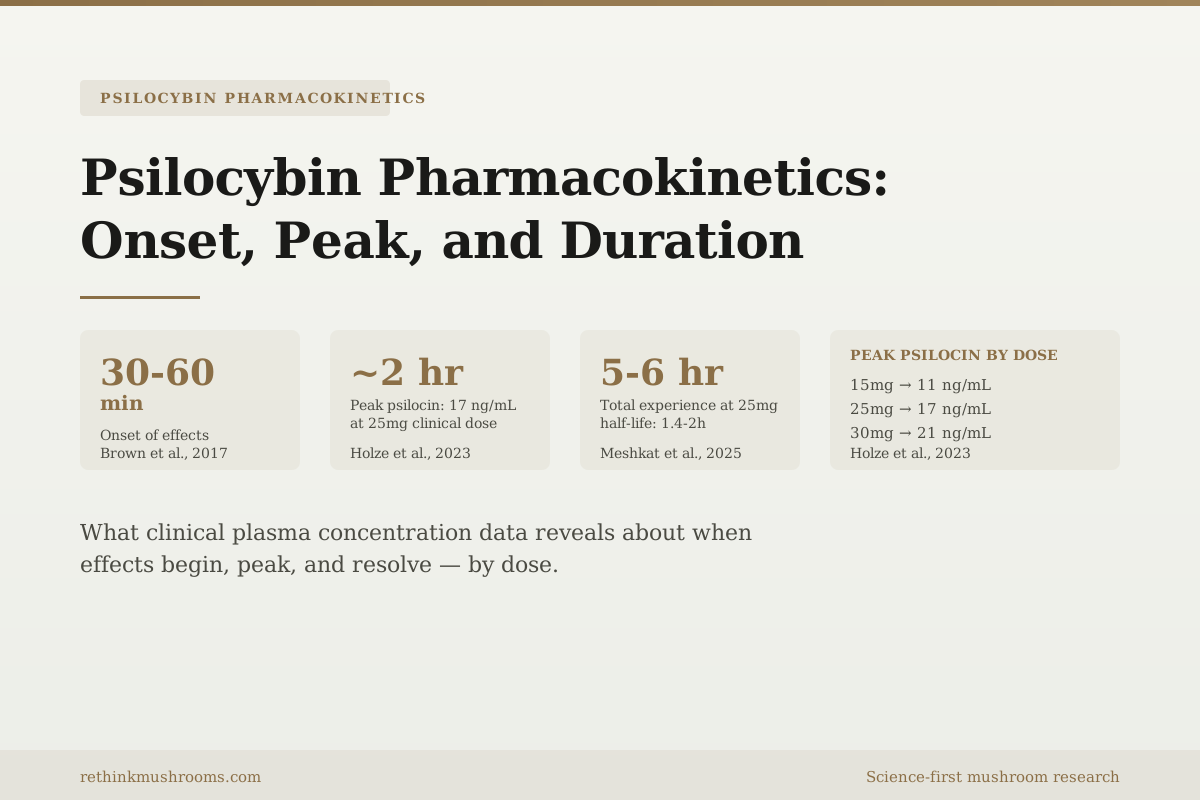
~2 hr to peak psilocin
At a 25mg fixed clinical dose, psilocin plasma concentrations peak at a mean of 17 ng/mL about 2 hours after ingestion — measured alongside subjective effect ratings in 23 healthy participants.
Holze et al., Clinical Pharmacology & Therapeutics, 2023
20-40 min
onset of action after oral ingestion
1.4-1.8h
psilocin half-life at fixed 15-30mg doses
5.5-6.4h
mean duration of subjective effects
Holze et al., Clinical Pharmacology & Therapeutics, 2023
 View as image ↗
The psilocybin you swallow never reaches your brain. Your body strips a phosphate tag from it, converting it into psilocin, and that transformed compound is what crosses into the brain, activates serotonin receptors, and produces the psychedelic experience. The conversion is fast but not instant, which is why effects don't arrive immediately, and why people sometimes re-dose too soon believing the first dose failed. The full pharmacokinetic picture — how the body absorbs, converts, distributes, and eventually clears the drug — is now documented in precise numerical terms by clinical research. Those numbers, and the places where they are more variable than the popular summaries admit, are the subject of this article.
If you only read one thing
At a fixed 25mg oral dose, psilocin plasma levels peak at a mean of 17 ng/mL about 2 hours after ingestion, and mean subjective effects last 5.5 hours. But the averages hide the real story: in one clinical cohort, the same 25mg dose produced peak psilocin concentrations ranging from 14 to 59 µg/L across ten patients. Body weight — the variable most people assume matters — has repeatedly failed to predict either psilocin clearance or subjective response.
For the broader picture of how psilocybin works pharmacologically, see How Psilocybin Works: The Complete Pharmacology Guide.
Key Takeaways
- Psilocybin is a prodrug: it is dephosphorylated to psilocin so completely that a 2017 pharmacokinetic study using validated LC-MS/MS assays found no psilocybin at all in plasma or urine at any timepoint
- At fixed oral doses, mean peak psilocin plasma concentrations are 11 ng/mL (15mg), 17 ng/mL (25mg), and 21 ng/mL (30mg), all reached at an average of 2 hours after ingestion
- Psilocin pharmacokinetics are dose-proportional, but subjective effects are not: doubling the dose from 15mg to 30mg roughly doubles peak plasma concentration while increasing peak subjective intensity only from 58% to 80% of scale maximum
- Reported psilocin elimination half-life ranges from 1.5 to 4 hours across the literature — 1.4 to 1.8 hours in the fixed-dose study, but 3 hours in the weight-based dosing study
- Mean duration of subjective effects is 5.6, 5.5, and 6.4 hours at 15, 25, and 30mg respectively, with standard deviations of 1.6 to 2.2 hours — a spread wide enough that individual sessions routinely run past 8 hours
- Time to peak psilocin ranges from 1.8 to 4 hours across studies; gastric state and CYP2D6/CYP3A4 metabolism are plausible contributors, while body weight has repeatedly failed to predict psilocin clearance or response
This article summarises pharmacokinetic research findings. It is not medical advice and is not a dosing guide.
Why There's Always a Delay: The Prodrug Conversion Before Onset
When someone takes oral psilocybin, the delay before effects begin is not simply a matter of the drug taking time to be absorbed. Psilocybin is water-soluble and absorption from the gut begins quickly — a 2022 clinical review describes it as detectable in plasma within 20 to 40 minutes.[5] The delay exists because what is absorbed is pharmacologically inactive until the body modifies it.
Brown and colleagues' 2017 pharmacokinetic study demonstrated how complete this conversion is. Twelve healthy adults received escalating oral doses of 0.3, 0.45, and 0.6 mg/kg at approximately monthly intervals, with blood and urine sampled over 24 hours and assayed by validated liquid chromatography–tandem mass spectrometry. No psilocybin was found in plasma or urine at all. Psilocin was the only measurable species in circulation.[1]
The two sources are not quite in agreement here, and the disagreement is worth naming. The clinical review describes psilocybin as detectable in plasma within 20 to 40 minutes; the dedicated pharmacokinetic study, using a validated LC-MS/MS assay and sampling over 24 hours, found none at any timepoint.[1][5] What both agree on is the practical consequence: whatever brief window parent psilocybin occupies in circulation, it is short, and psilocin is the compound that actually accumulates and acts.
That study was conducted using weight-based dosing, which was standard at the time. Its authors simulated fixed dosing from the derived pharmacokinetic parameters and concluded that an oral dose of 25 mg should approximate the drug exposure of a 0.3 mg/kg dose — the calculation that underlies the 25mg fixed dose now used in most clinical trials.[1]
Brown, Nicholas, Cozzi et al. (2017) · Clinical Pharmacokinetics
- Population
- 12 healthy adults, open-label, monitored 24 hours per session
- Intervention
- Escalating oral psilocybin at 0.3, 0.45, and 0.6 mg/kg, given at approximately monthly intervals
- Finding
- No psilocybin was detectable in plasma or urine. Renal clearance of intact psilocin accounted for under 2% of total clearance. Psilocin elimination half-life averaged 3 hours (SD 1.1), and variation in psilocin clearance was not predicted by body weight.
positive Small open-label sample (n=12), all healthy volunteers, weight-based rather than fixed dosing.
Brown RT, et al. Clinical Pharmacokinetics. 2017;56(12):1543-1554. NCT02163707.
The practical implication: the gap between ingestion and first effects is the prodrug conversion and distribution window, not a sign that the dose failed. Taking a second dose during this window, assuming the first didn't work, is a recognised dosing error in non-supervised contexts. By the time a second dose converts to psilocin, the first has as well.
For more on the prodrug mechanism specifically, see Why Psilocybin Is a Prodrug: What That Means for Effects.
The Numbers: Plasma Concentrations at 15mg, 25mg, and 30mg
The 2023 study by Holze and colleagues is the most precise pharmacokinetic and pharmacodynamic dataset available for fixed oral dosing. It characterised 15, 25, and 30 mg of oral psilocybin in 28, 23, and 28 healthy participants respectively, repeatedly measuring unconjugated psilocin plasma levels and corresponding subjective effects for up to 24 hours, then modelling the concentration–effect relationship directly.[2]
Timeline for a 25mg oral dose (the standard clinical therapeutic dose). Concentration and duration values are from Holze 2023; onset of action is from the 2022 clinical review.[2][5]
| Time after ingestion | What is happening |
|---|---|
| 0-40 min | GI absorption; psilocybin is rapidly dephosphorylated to psilocin; psilocin begins rising |
| 20-40 min | Onset of action — earliest perceptible effects |
| 40-120 min | Psilocin rising toward peak; effects intensifying |
| ~120 min | Mean peak psilocin concentration of 17 ng/mL; peak subjective effects |
| 120-330 min | Psilocin eliminating; effects gradually decreasing |
| ~330 min | Mean end of subjective effects (5.5 hours) |
| 330 min+ | Wide individual spread; standard deviation of 1.6 hours means many sessions run considerably longer |
Mean peak psilocin concentrations by dose, with 95% confidence intervals, from the Holze 2023 study:[2]
- 15mg dose: 11 ng/mL (95% CI 10–13)
- 25mg dose: 17 ng/mL (95% CI 16–19)
- 30mg dose: 21 ng/mL (95% CI 19–24)
Independent estimates converge on this range. A model-based analysis of the weight-based dosing data put mean psilocin Cmax at 18.7 ng/mL for a 25 mg clinical dose, and a 2022 clinical review cites a separate report of 20 ng/mL at 120 minutes.[4][5]
Holze, Becker, Kolaczynska et al. (2023) · Clinical Pharmacology & Therapeutics
- Population
- 79 healthy participants across three fixed-dose groups (n=28, 23, 28)
- Intervention
- Single oral psilocybin doses of 15, 25, or 30 mg, with plasma psilocin and subjective effects assessed repeatedly for 24 hours
- Finding
- Mean peak psilocin was 11, 17, and 21 ng/mL, all reached at an average of 2 hours. Elimination half-lives were 1.8, 1.4, and 1.8 hours. Mean effect durations were 5.6, 5.5, and 6.4 hours. Psilocin showed dose-proportional pharmacokinetics, and body weight did not influence pharmacokinetics or response.
positive Healthy volunteers in a controlled setting; findings may not transfer directly to patient populations.
Holze F, et al. Clinical Pharmacology & Therapeutics. 2023;113(4):822-831.
Dose-proportional in the blood, not in the experience
Psilocin exhibits dose-proportional pharmacokinetics: going from 15mg to 30mg — a doubling — raised mean peak concentration from 11 to 21 ng/mL, which is very nearly double.[2]
The subjective experience does not scale the same way. Across the same 15mg-to-30mg doubling, maximal "any drug" effect ratings rose from 58% ± 25% to 80% ± 18% of scale maximum — an increase of roughly 1.4-fold, not 2-fold.[2] Holze and colleagues describe the duration and intensity of subjective effects as dose-dependent, which they are; but dose-dependent is not the same as dose-proportional, and the widely repeated claim that twice the dose produces twice the experience is not what the data show.
How Effects Track Blood Levels: The Concentration-Response Relationship
The subjective intensity of the experience tracks psilocin blood levels. This is not merely an assumption — Holze and colleagues measured both simultaneously in the same participants and described the relationship using explicit pharmacokinetic-pharmacodynamic modelling, which is what makes their dataset the reference for the concentration–effect relationship at fixed doses.[2]
This matters for understanding why the same oral dose can produce very different experiences in different people. If your body converts, absorbs, and clears psilocybin differently, you reach a different peak plasma concentration from the identical swallowed dose — and the concentration, not the label on the capsule, is what the brain responds to.
The cardiac safety question, answered with numbers
A separate analysis addressed whether psilocin affects cardiac repolarisation. Dahmane and colleagues performed a concentration-QTc analysis using data from an open-label single ascending dose study of psilocybin at 0.3 to 0.6 mg/kg. The analysis found a statistically significant but shallow concentration-QTc relationship.[4]
The magnitudes matter more than the significance. At the clinical 25 mg dose, with a mean psilocin Cmax of 18.7 ng/mL, the associated mean change in QTcF was 2.1 milliseconds, with an upper 90% confidence bound of 6.6 milliseconds. The upper bound of the model-predicted mean change crossed the 10 millisecond regulatory threshold of concern only at a psilocin concentration of 31.1 ng/mL — well above clinical exposure. Even at a supraclinical psilocin concentration of roughly 60 ng/mL, predicted QTcF change remained modest, at a mean of 9.1 milliseconds with an upper bound of 17.9 milliseconds.[4]
The accurate summary is therefore not that psilocin has no effect on QTc, but that it has a small, measurable, concentration-dependent effect that stays well below thresholds of clinical concern at therapeutic exposures. The same analysis noted that psilocin's short half-life means no accumulation across the monthly dosing intervals used in clinical trials.[4]
Duration: What Actually Determines How Long It Lasts
The total duration of a psilocybin experience is governed primarily by how fast psilocin is cleared. Here the literature is less unanimous than most summaries suggest.
In the fixed-dose study, psilocin elimination half-life was 1.8 hours (95% CI 1.7–2.0) at 15mg, 1.4 hours (1.2–1.7) at 25mg, and 1.8 hours (1.6–1.9) at 30mg.[2] In the weight-based escalating-dose study, average psilocin half-life was 3 hours with a standard deviation of 1.1 hours, and some subjects showed an extended elimination phase attributed to hydrolysis of the psilocin glucuronide metabolite.[1] The concentration-QTc analysis worked from a psilocin half-life of about 4 hours.[4] A 2025 systematic review of fourteen pharmacokinetic studies reported the full published range as 1.5 to 4 hours.[3]
That spread — a nearly threefold range across credible studies using validated assays — is itself a finding. Differences in assay method, whether conjugated psilocin metabolites are measured, sampling duration, and dosing regimen all shift the estimate. Any single half-life figure quoted without a source is likely to be wrong for some population.
What was measured directly, rather than inferred from half-life, is duration of subjective effects: mean 5.6 ± 2.2 hours at 15mg, 5.5 ± 1.6 hours at 25mg, and 6.4 ± 2.2 hours at 30mg.[2] Two things stand out. First, 15mg and 25mg produced essentially indistinguishable mean durations — the common claim that lower doses reliably produce shorter experiences is not supported at this dose range, though 30mg was clearly longer. Second, the standard deviations are large relative to the means. A standard deviation of 1.6 hours around a 5.5-hour mean implies that a substantial minority of 25mg sessions exceed 7 hours.
For a detailed breakdown of duration at each dose level, see How Long Does Psilocybin Last? Duration by Dose.
What Shifts the Timeline — and What Doesn't
The timeline above is a population average. Individual experiences vary substantially, and the sources of that variation are not the ones most people assume. A 2025 systematic review found time to peak psilocin ranging from 1.8 to 4 hours across published studies.[3]
Within a single clinical cohort the spread is starker still. Jensen and colleagues gave a single fixed 25 mg dose to ten treatment-seeking adults with severe alcohol use disorder and measured peak plasma psilocin concentrations ranging from 14 to 59 µg/L — a more than fourfold range from an identical dose.[6]
Gastric state. The majority of psilocybin efficacy and pharmacokinetic studies fast participants for an average of 2 to 4 hours beforehand, water permitted. A 2022 clinical review recommends that good clinical practice include instructions to take psilocybin on an empty stomach, specifically in order to make kinetics more predictable — a rationale for standardisation rather than a report of measured onset differences between fed and fasted participants, which has not been formally studied in a dedicated food-effect trial. The same review observes clinically that varying sensitivity to psilocybin is associated with lack of fasting, reduced gastric acid, altered gastric motility, and liver dysfunction.[5]
Hepatic metabolism. Psilocin metabolism is primarily mediated by the liver enzymes CYP2D6 and CYP3A4, with a secondary contribution from monoamine oxidase A, before further biotransformation into 4-hydroxyindole-3-acetic acid and 4-hydroxytryptophol.[3] Both enzymes are genetically polymorphic, and the systematic review flags this as a mechanism for drug-drug interactions. It is a reasonable expectation that fast metabolisers clear psilocin more quickly and slow metabolisers more slowly — but that expectation has not been demonstrated in a genotype-stratified clinical pharmacokinetic trial, and no published study has linked CYP2D6 phenotype to measured psilocin exposure or subjective duration in humans. Treat it as a plausible mechanism, not an established one.
Distribution. Psilocin distributes extensively into tissue, with reported volumes of distribution ranging from 277 ± 92 L to 1016 L, and oral bioavailability reported at 52.7% ± 20% in one study.[3] A volume of distribution in the hundreds of litres — far exceeding total body water — means plasma concentration is governed by tissue partitioning rather than by simple dilution into body mass, which is directly relevant to the next point.
Fact Check
Does body size change how much psilocybin you feel?
The claim
“A bigger person needs more psilocybin, because the same dose is diluted into a larger body and produces a lower blood concentration.”
Intuitive dose-per-kilogram reasoning, reinforced by the fact that early psilocybin trials did use weight-based mg/kg dosing.
What research shows
UnsupportedThree independent lines of evidence contradict it. The 2017 escalating-dose study found that variation in psilocin clearance was not predicted by body weight. The 2023 fixed-dose study explicitly reported that body weight did not influence pharmacokinetics or the response to psilocybin. And a secondary analysis of prior trial data found no significant differences in psychedelic effects between a fixed dose and weight-based doses of 0.29 and 0.43 mg/kg.
This is why the field moved away from mg/kg dosing rather than toward it: current clinical trial protocols use a fixed dose, most commonly 25 mg, chosen to approximate the exposure of the older 0.3 mg/kg regimen. Real inter-individual variation in psilocin exposure is large — but body weight is not the variable that explains it.
Brown RT, et al. Clinical Pharmacokinetics. 2017; Holze F, et al. Clin Pharmacol Ther. 2023; MacCallum CA, et al. Front Psychiatry. 2022.
For more on individual variation and what drives it, see Psilocin Pharmacokinetics: Half-Life, Peak Effects, and Individual Variation.
Why Sessions Are Scheduled Longer Than the Average Effect Window
Clinical psilocybin sessions are scheduled to run well past the mean pharmacokinetic window. The justification is visible directly in the dispersion of the published data rather than in any single recommended number.
The mean duration of subjective effects at 25mg was 5.5 hours — but with a standard deviation of 1.6 hours, and 6.4 ± 2.2 hours at 30mg.[2] Time to peak psilocin spans 1.8 to 4 hours across studies, and reported half-life spans 1.5 to 4 hours.[3] A participant at the slow end of both distributions — peaking at hour 4 with a 4-hour half-life — is on a materially different clock from one peaking at hour 1.8. A schedule built around the mean would discharge that person mid-experience.
Published safety guidelines resolve this by gating the end of a session on the participant's state rather than on the clock. At least two monitors are involved, one of whom should always be present in the session room during drug action, and the participant is released into the care of a friend or family member only after the effects of the hallucinogen have resolved.[7] The escalating-dose pharmacokinetic study monitored its subjects for a full 24 hours after each administration.[1]
Beyond pharmacokinetics, the therapeutic model requires time on either side of drug action. Preparation in the Johns Hopkins protocol involves at least eight contact hours across at least four meetings, typically over a month, before the first session — and psychological support continues into the return-to-baseline period, when cognitive clarity returns and much of the psychologically significant material is discussed.[7]
- In vitro metabolismcompleted
CYP2D6 and CYP3A4 identified as primary metabolising enzymes, with secondary monoamine oxidase A contribution.
- Animal modelscompleted
Eight of the fourteen studies in the 2025 systematic review were laboratory-based, using animal models or in vitro systems.
- Healthy-volunteer PK trialscompleted
Six clinical studies totalling 112 healthy human participants, including fixed-dose (n=79) and weight-based escalating-dose (n=12) designs.
- Systematic reviewcurrent
Meshkat 2025 synthesised fourteen studies, establishing Tmax 1.8-4 h, half-life 1.5-4 h, and bioavailability of 52.7% ± 20%.
- Genotype-stratified PK in patientsmissing
No large pharmacokinetic study in clinical patient populations, and no trial stratifying psilocin exposure by CYP2D6 or CYP3A4 phenotype.
Psilocybin's pharmacokinetics are well characterised in healthy volunteers and have been formally synthesised. What is missing is the study that would explain the four-fold inter-individual spread in psilocin exposure at a fixed dose: a genotype-stratified pharmacokinetic trial in the patient populations actually being treated.
Meshkat S, et al. Pharmaceutics. 2025;17(4); Holze F, et al. Clin Pharmacol Ther. 2023; Brown RT, et al. Clin Pharmacokinet. 2017.
Safety
CriticalPharmacokinetic data is not a self-dosing protocol
Concern
The plasma concentrations and timings on this page were generated under medical supervision, in screened participants, with monitors present throughout drug action and psychological support before and after. Psilocin is metabolised by CYP2D6 and CYP3A4, creating potential for drug-drug interactions, and inter-individual exposure at a fixed dose has been measured to vary more than four-fold.
What the research says
These figures describe what has been measured in controlled research settings. They do not establish a safe dose for any individual, do not account for concurrent medications, and do not transfer to unsupervised use. Published safety guidance specifies participant screening, at least two trained monitors, continuous presence during drug action, and discharge gated on resolution of effects.
Particularly relevant for: Anyone reading pharmacokinetic figures as dosing guidance, particularly people taking serotonergic or CYP-metabolised medications
What to do
Discuss psilocybin with a qualified healthcare professional. This article is research summary, not medical advice.
Johnson MW, Richards WA, Griffiths RR. J Psychopharmacol. 2008;22(6):603-620; Meshkat S, et al. Pharmaceutics. 2025.
For how pharmacokinetic data translates into clinical dose selection, see Psilocybin Dosing Guide: Low, Medium, and High Doses Explained.
The Bottom Line
Clinical pharmacokinetic studies have defined psilocybin's timeline in precise numerical terms. Psilocybin is converted to psilocin so completely that no parent compound is detectable in plasma; psilocin appears within 20 to 40 minutes, peaks at a mean of 17 ng/mL around 2 hours for a fixed 25mg dose, and produces mean subjective effects lasting 5.5 hours. Those means, however, sit on wide distributions: reported half-life spans 1.5 to 4 hours across studies, time to peak spans 1.8 to 4 hours, and a single clinical cohort given identical 25mg doses showed peak psilocin concentrations ranging from 14 to 59 µg/L. Psilocin pharmacokinetics are dose-proportional while subjective intensity is not. Body weight — the variable most often assumed to drive this variation — has repeatedly failed to predict either clearance or response, which is why the field moved from mg/kg dosing to a fixed 25mg standard.
Frequently Asked Questions
Sources & References
- 1RTHM-00461·Brown, Randall T et al. (2017). “Pharmacokinetics of Escalating Doses of Oral Psilocybin in Healthy Adults..” Clinical pharmacokinetics.Study breakdown →PubMed →↩
- 2RTHM-00830·Holze, Friederike et al. (2023). “Pharmacokinetics and Pharmacodynamics of Oral Psilocybin Administration in Healthy Participants..” Clinical pharmacology and therapeutics.Study breakdown →PubMed →↩
- 3RTHM-00945·Meshkat, Shakila et al. (2025). “Pharmacokinetics of Psilocybin: A Systematic Review..” Pharmaceutics.Study breakdown →PubMed →↩
- 4RTHM-01341·Dahmane, Elyes et al. (2021). “Exposure-Response Analysis to Assess the Concentration-QTc Relationship of Psilocybin/Psilocin..” Clinical pharmacology in drug development.Study breakdown →PubMed →↩
- 5RTHM-01580·MacCallum, Caroline A et al. (2022). “Therapeutic use of psilocybin: Practical considerations for dosing and administration..” Frontiers in psychiatry.Study breakdown →PubMed →↩
- 6RTHM-02099·Jensen, Mathias Ebbesen et al. (2025). “Single-dose psilocybin therapy for alcohol use disorder: Pharmacokinetics, feasibility, safety and efficacy in an open-label study..” Journal of psychopharmacology (Oxford.Study breakdown →PubMed →↩
- 7RTHM-00259·Johnson, Mw et al. (2008). “Human hallucinogen research: guidelines for safety..” Journal of psychopharmacology (Oxford.Study breakdown →PubMed →↩