Psilocybin for Smoking Cessation
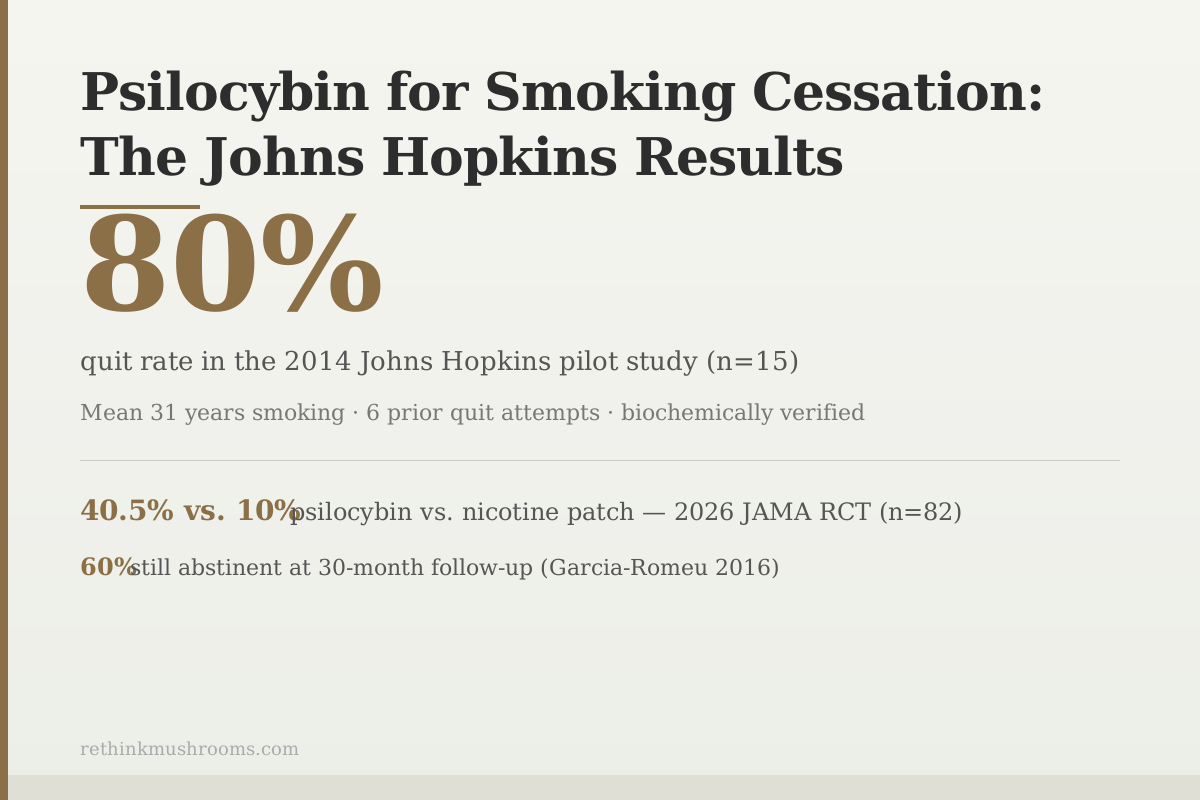
80% quit rate
In the 2014 Johns Hopkins pilot study, 12 of 15 long-term smokers achieved biochemically verified abstinence at 6 months. The highest quit rate ever recorded in a clinical trial for smoking cessation.
Johnson et al., Journal of Psychopharmacology, 2014
60%
still abstinent at 30-month follow-up (Johnson et al., 2017)
40.5% vs. 10%
psilocybin vs. nicotine patch in 2026 JAMA RCT
31 years
mean smoking duration of pilot study participants
Johnson et al., Journal of Psychopharmacology, 2014
 View as image ↗
In 2014, a team at Johns Hopkins published results that seemed almost impossible. Fifteen people who had smoked for an average of 31 years, and who had tried to quit an average of six times before, entered a 15-week outpatient program. The program included two sessions with psilocybin. At 6-month follow-up, 12 of the 15 had quit: 80%, verified by urine cotinine testing.[1]
That is the highest quit rate ever recorded in a clinical trial for smoking cessation. Nicotine replacement therapy typically achieves around 15-20% at 6 months. Varenicline (Chantix), the most effective pharmaceutical option, reaches 30-35%.
The 80% figure has spent the past decade being cited, questioned, and contextualized. By 2026, Hopkins researchers had run a randomized trial against an active comparator and produced more modest but still striking results: 40.5% in the psilocybin group versus 10.0% in the nicotine patch group at 6 months.[2]
This article covers the full Hopkins research arc from the 2014 pilot to the 2026 randomized trial, and explains what the Hopkins protocol actually involved. For the broader picture of psilocybin across addiction types, see Psilocybin & Addiction: The Evidence.
Key Takeaways
- In Johnson's 2014 Hopkins pilot (n=15), 80% of participants achieved biochemically verified smoking abstinence at 6 months, the highest rate ever recorded in a clinical trial
- Participants were long-term heavy smokers: mean 31 years of smoking and 6 prior failed quit attempts before entering the study
- The depth of the psilocybin experience predicted outcomes: higher scores on the Mystical Experience Questionnaire correlated with better quit success (Garcia-Romeu et al., 2014)
- At long-term follow-up (Johnson et al., 2017), 67% were still abstinent at 12 months and 60% at a mean of 30 months
- The 2026 JAMA Network Open RCT (Johnson et al., n=82) confirmed the effect in a randomized trial: 40.5% vs. 10.0% prolonged abstinence at 6 months for psilocybin vs. nicotine patch, representing six times greater odds (OR 6.12)
- In qualitative follow-up interviews, participants described quitting as an identity shift (no longer seeing themselves as "a smoker") rather than a craving reduction (Noorani 2018)
The 2014 Pilot: How Hopkins Tested Psilocybin on 15 Long-Term Smokers
Matthew Johnson, a behavioral pharmacologist at the Johns Hopkins Center for Psychedelic and Consciousness Research, designed the pilot study. The Hopkins center had already published research establishing that psilocybin could produce profound and lasting changes in psychological outlook among healthy volunteers — work led by Roland Griffiths, one of the most prominent psychopharmacologists of his generation. The smoking study was built on the hypothesis that those same changes in perspective could be channeled therapeutically toward addiction.
The team recruited 15 participants who met a specific profile: motivated to quit, in good physical and mental health, with a history of smoking that had resisted prior treatment.
The average participant had smoked for 31 years and attempted to quit six times. These were not casual smokers who had tried a patch and given up. They were people for whom nicotine had become a decades-long fixture of daily life.
The intervention was a 15-week outpatient program built around two elements: cognitive behavioral therapy for smoking cessation, and two psilocybin sessions embedded within that therapeutic framework. The first session used a moderate dose (20mg per 70kg of body weight) and the second used a higher dose (30mg/70kg) two weeks later. Sessions lasted approximately 6-8 hours, conducted at Hopkins, with trained guides present throughout.
At 6 months post-quit date, 80% of participants were verified abstinent through urine cotinine testing, a biomarker that confirms actual tobacco exposure rather than self-report.[1]
For a focused examination of what the 80% figure does and doesn't prove, including the caveats around sample size and study design, see Psilocybin for Smoking Cessation: The 80% Quit Rate Explained.
What Predicted Who Quit: The Mystical Experience Finding
A companion paper from the same Hopkins cohort examined a different question: was there something about the psilocybin session itself that predicted who would succeed?
Garcia-Romeu and colleagues measured the quality of the psychedelic experience using the Mystical Experience Questionnaire, a validated scale developed from William James's early accounts of religious experience. The scale captures feelings of unity, transcendence of time and space, deeply felt positive mood, and a sense of sacredness.[3]
The finding: higher scores on this scale during the psilocybin sessions correlated with better smoking cessation outcomes. Participants who rated their session among the most personally meaningful experiences of their lives were more likely to quit and stay quit.
This was not a subtle effect. Participants were not describing a pleasant afternoon; they were describing something that felt transformative.
What this suggests mechanistically is that the depth of the experience was not incidental to the quit outcome. Shallow sessions that produced no profound shift may not generate the change in self-perception associated with quitting. The experience of the session and the cessation outcome were intertwined, not separate. For the full mechanistic story, see Psilocybin and Nicotine Addiction: Mechanisms of Action. For the broader significance of mystical experiences in addiction recovery, see The Mystical Experience and Addiction Recovery: Why It Matters.
Two Years Later, Still Not Smoking: The 30-Month Follow-Up Data
Johnson and colleagues published a long-term follow-up of the 2014 pilot cohort in 2017. The question was simple: how many of the original 15 participants were still abstinent months and years later?[4]
At 12 months, 67% of the original participants remained abstinent. At a mean follow-up of 30 months, 60% remained abstinent.
These numbers deserve comparison context. With nicotine replacement therapy, roughly half of 6-month quitters have relapsed by 12 months. Most cessation treatments show their steepest relapse curve in that first year. The Hopkins cohort was not showing that pattern. Quit rates declined only slightly over time, and the majority of participants who quit were still not smoking more than two and a half years later.
86.7% of participants rated the psilocybin experience among the five most personally meaningful experiences of their lives. This rating held at the 12-month follow-up interview, not just immediately after the session.[4]
The durability question is one of the most important differences between psilocybin-facilitated cessation and standard pharmacotherapy. Nicotine patches and varenicline work while being taken; the craving suppression fades when the medication stops. Psilocybin appears to produce a change that outlasts the drug's presence in the body by years.
What Participants Said Changed: An Identity Shift, Not Craving Suppression
Noorani and colleagues conducted qualitative interviews with the Johnson 2014 cohort to understand not just whether the treatment worked, but how participants experienced the change from the inside.[5]
Three major themes emerged from the analysis:
Identity shift. The most consistent theme was a change in self-perception. Participants described no longer being "a smoker," not as a goal they were working toward, but as a description of how they already felt after the sessions. Smoking belonged to who they used to be. This is different from craving reduction: participants were not describing victories over urges; they were describing a change in what they wanted.
Heightened body awareness. Participants reported a new sensitivity to how smoking made their body feel. Where before they had smoked automatically without attending to physical sensations, after the sessions they noticed those sensations and found them meaningful. The body's signals became relevant in a way they had not been before.
Increased motivation experienced as externally imposed. Several participants described feeling driven to quit in a way that felt less like willpower and more like an obvious conclusion they had somehow arrived at. The decision to remain smoke-free felt clear and stable rather than effortful and fragile.
These accounts align with the quantitative data but provide an explanation the numbers alone cannot. Standard cessation pharmacology targets cravings at the neurochemical level. Psilocybin, in this cohort, appeared to work at the level of identity and meaning. For the neuroscience behind this, see How Psilocybin Breaks Addiction: The Neuroscience Explained.
The 2026 Randomized Trial: Psilocybin vs. Nicotine Patch in 82 Smokers
The Hopkins pilot was compelling but had a fundamental design limitation: no control group. All 15 participants received psilocybin. There was no way to isolate the effect of psilocybin from the effect of the therapeutic support, the CBT program, or the motivation of people who volunteer for unusual clinical research.
The 2026 JAMA Network Open trial, led by Matthew Johnson and colleagues, addressed this directly. The study randomized 82 motivated smokers to either psilocybin-assisted therapy (n=42) or nicotine patch (n=40), both embedded within an identical 13-week manualized CBT program. This is the most rigorous smoking cessation study involving psilocybin published to date, though the authors are careful to describe it as a pilot randomized trial in which participants and investigators were unblinded to treatment assignment.[2]
Results at 6 months:
- Prolonged abstinence: 40.5% (17 of 42) for psilocybin vs. 10.0% (4 of 40) for nicotine patch, giving psilocybin roughly six times greater odds of success (OR 6.12; 95% CI, 1.99–23.26; P = .003)
- Short-window abstinence at the 7-day point-prevalence mark: 52.4% vs. 25.0%, roughly three times greater odds (OR 3.30; 95% CI, 1.32–8.70; P = .01)
- No serious adverse events were attributed to psilocybin or the nicotine patch
The 40.5% figure is lower than the 80% from the 2014 pilot. This is expected and appropriate. Pilot studies tend to recruit unusually motivated participants, deliver intensive support, and have no comparison group to show how similar people perform without the treatment. A 40.5% vs. 10% result in a properly randomized trial with an active comparator is, if anything, a more persuasive demonstration of efficacy than an 80% rate with no control condition.
Six-Month Abstinence In Context
The 80% Headline vs. the Randomized 40.5%
2014 pilot — psilocybin
Open-label, no control group (n=15)
2026 RCT — psilocybin
Randomized vs. active comparator (n=42)
2026 RCT — nicotine patch
Randomized comparator arm (n=40)
Typical cessation therapies
Behavioral / pharmacological benchmark
The 80% bar comes from an uncontrolled pilot of 15 unusually motivated smokers. The randomized 40.5% vs. 10.0% contrast is the more trustworthy figure — lower than the headline, but still roughly six times the odds of its active comparator and above the field's usual ceiling.
Sources: Johnson et al., Journal of Psychopharmacology, 2014 (pilot, 80%); Johnson et al., JAMA Network Open, 2026 (RCT, 40.5% vs. 10.0%); <35% benchmark as reported in Johnson et al., 2014.
For a direct comparison of psilocybin against all standard treatments, including varenicline and bupropion, with specific efficacy rates, see Psilocybin-Assisted Smoking Cessation vs. Standard Treatments.
- Open-label pilotcompleted
Johnson 2014 (n=15): 80% abstinence at 6 months; Johnson 2017 follow-up: 60% at a mean of 30 months. No control group.
- Randomized controlled trialcurrent
Johnson 2026 (n=82): the first randomized comparison, 40.5% vs. 10.0% against nicotine patch — but a single-site, unblinded pilot RCT.
- Multi-site replication / meta-analysismissing
No large multi-site RCT or pooled analysis yet exists. The effect is consistent but rests on small samples from one center.
Every study points the same direction, but the strongest evidence is still a single small, single-site randomized trial. The field has not yet reached large multi-site replication.
Johnson et al., J Psychopharmacol, 2014; Johnson et al., Am J Drug Alcohol Abuse, 2017; Johnson et al., JAMA Netw Open, 2026
The Protocol: What These Studies Actually Required of Participants
It is worth being specific about what the Hopkins protocol involved, because "psilocybin for smoking cessation" can sound like a simple drug substitution. It is not.
The full intervention was a 15-week outpatient program structured around preparation, session, and integration. The psilocybin sessions themselves were one part of a larger system.
Participants attended multiple CBT sessions before any psilocybin exposure. These sessions established a quit date, developed cessation skills, and prepared participants mentally for the experience ahead. The psilocybin sessions — two, with an optional third booster in the original pilot — were conducted in a clinical setting with participants lying on a couch, wearing eye shades, listening to music, with trained monitors present throughout the 6-8 hour experience. After each session, integration meetings helped participants process what they had experienced and connect it to their cessation work.
This structure is important for two reasons.
First, it means the 80% and 40.5% figures are not results of psilocybin alone. They are results of psilocybin embedded in a therapeutic program that included preparation, professional support, and structured integration. Removing any of those components could change the outcomes, and the evidence does not currently say which components are essential.
Second, it means that translating these results to clinical practice would require more than regulatory approval of psilocybin. It would require therapist training pipelines and the clinical infrastructure to deliver sessions safely. The Hopkins protocol is intensive in a way that a nicotine patch prescription is not.
What happens to quit rates when the therapeutic support is reduced remains unanswered by published data.
It is also worth noting what this treatment is not. Standard cessation pharmacology works by suppressing cravings: nicotine patches deliver nicotine without the behavioral ritual; bupropion and varenicline act on brain receptors to reduce the reward signal from smoking. These treatments target the neurochemical machinery of addiction directly.
Psilocybin, at least as Hopkins administers it, does not suppress cravings in the same way. The participants in Noorani's qualitative study were not describing reduced urges to smoke; they were describing a changed relationship to the identity of being a smoker. The intervention appears to work at a different level. Whether that distinction matters for long-term outcomes, and whether it explains the durability advantage, are questions that current data support but do not conclusively answer.
Important Context
ModerateThis is investigational research, not an available treatment
Concern
Psilocybin remains a Schedule I substance in the United States and is not an approved smoking-cessation therapy. Every result described here comes from supervised clinical trials in which trained monitors were present throughout multi-hour dosing sessions.
What the research says
The Hopkins effects depend on medical screening, high-dose sessions under professional supervision, and structured psychological support — none of which apply to unsupervised use. Self-treating with psilocybin carries psychological and physical risks and does not replicate the trial protocol.
Particularly relevant for: People with a personal or family history of psychosis, bipolar disorder, or certain cardiovascular conditions were excluded from these trials.
What to do
Anyone considering psilocybin should speak with a qualified clinician and look for regulated clinical trials rather than attempting self-treatment. This article is educational and is not medical advice.
Johnson et al., J Psychopharmacol, 2014; Johnson et al., JAMA Netw Open, 2026
The Bottom Line
Johns Hopkins has produced the strongest clinical evidence base for psilocybin in smoking cessation: an 80% quit rate in a 2014 uncontrolled pilot (n=15), 60% abstinence at 30-month follow-up, and a 2026 JAMA Network Open randomized trial showing 40.5% vs. 10.0% prolonged abstinence against nicotine patch. All results come from programs pairing psilocybin with structured cognitive behavioral therapy and professional therapeutic support. The evidence consistently points in the same direction, but the trials are small, the protocol is intensive, and translation to standard clinical practice would require substantial infrastructure.
Frequently Asked Questions
Sources & References
- 1RTHM-00328·Johnson, Matthew W et al. (2014). “Pilot study of the 5-HT2AR agonist psilocybin in the treatment of tobacco addiction..” Journal of psychopharmacology (Oxford.Study breakdown →PubMed →↩
- 2RTHM-00960·Johnson, Matthew W et al. (2026). “Psilocybin or Nicotine Patch for Smoking Cessation: A Pilot Randomized Clinical Trial..” JAMA network open.Study breakdown →PubMed →↩
- 3RTHM-00321·Garcia-Romeu, Albert et al. (2014). “Psilocybin-occasioned mystical experiences in the treatment of tobacco addiction..” Current drug abuse reviews.Study breakdown →PubMed →↩
- 4RTHM-00475·Johnson, Matthew W et al. (2017). “Long-term follow-up of psilocybin-facilitated smoking cessation..” The American journal of drug and alcohol abuse.Study breakdown →PubMed →↩
- 5RTHM-00523·Noorani, Tehseen et al. (2018). “Psychedelic therapy for smoking cessation: Qualitative analysis of participant accounts..” Journal of psychopharmacology (Oxford.Study breakdown →PubMed →↩