Psilocybin for Smoking Cessation
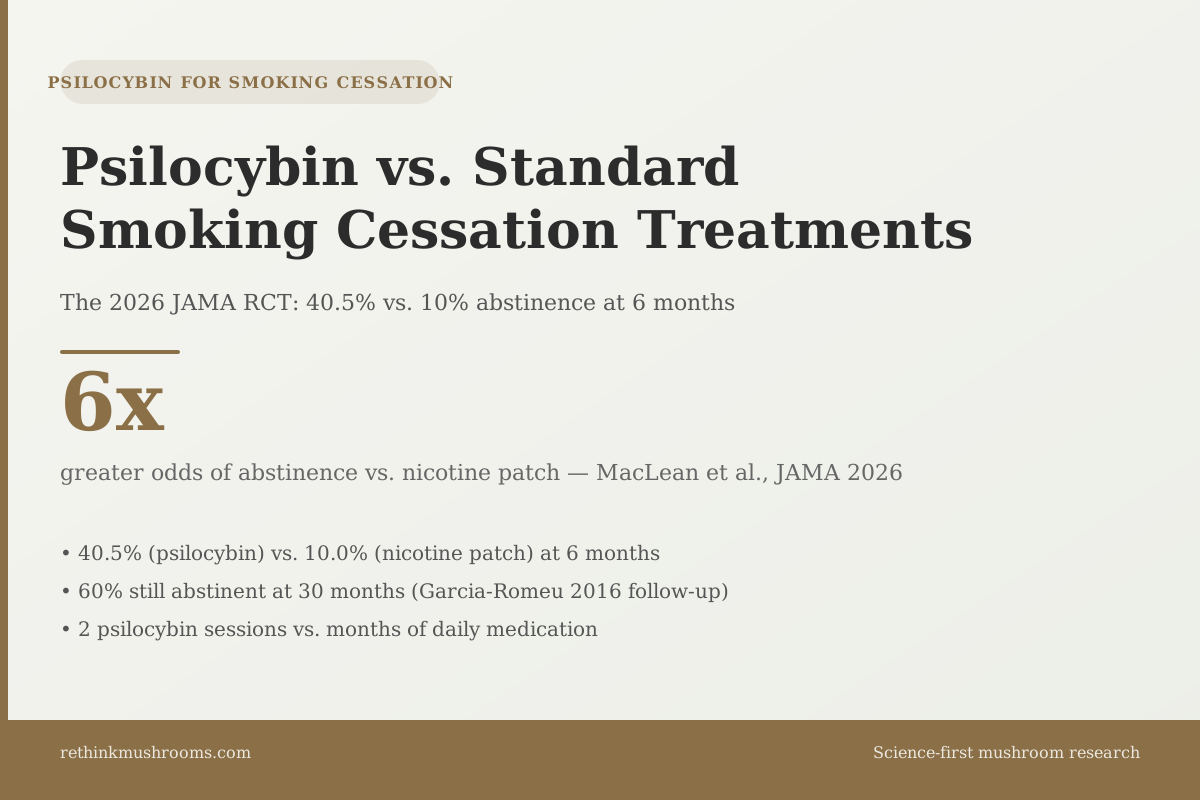
40.5% vs. 10% abstinence
In the 2026 JAMA Network Open RCT, 40.5% of psilocybin-treated smokers remained abstinent at 6 months compared to 10% in the nicotine patch group, with six times greater odds of quitting.
MacLean et al., JAMA Network Open, 2026
6x
greater odds of abstinence vs. nicotine patch at 6 months
60%
of the 2014 pilot cohort still abstinent at 30-month follow-up
2 sessions
psilocybin vs. months of daily nicotine replacement
MacLean et al., JAMA Network Open, 2026
 View as image ↗
The best medical treatment for smoking cessation is a prescription medication called varenicline, which helps roughly 30-35% of smokers stay quit at 6 months. Nicotine replacement therapy (patches, gum, lozenges) achieves about 10-20%. Both have been the standard of care for decades, and both still leave most patients relapsing within a year.
In March 2026, a randomized controlled trial published in JAMA Network Open compared psilocybin therapy to nicotine patches in 82 heavy smokers. At 6 months: 40.5% in the psilocybin group had quit vs. 10.0% in the nicotine patch group, with six times greater odds of abstinence and no serious adverse events. The comparison of psilocybin smoking cessation to standard treatment is no longer theoretical; there are now head-to-head data.
This article examines those data in detail and places them alongside the full evidence arc for psilocybin smoking cessation research, from a 15-person pilot study in 2014 through the 2026 randomized trial. For context on psilocybin's potential across addiction types more broadly, the psilocybin and addiction guide covers the full picture.
Key Takeaways
- The 2026 JAMA Network Open RCT found 40.5% psilocybin vs. 10.0% nicotine patch prolonged abstinence at 6 months, with six times greater odds of quitting (adjusted odds ratio 6.28, p less than 0.001)[1]
- A 2014 Hopkins pilot study (n=15) found 80% biochemically verified abstinence at 6 months with psilocybin plus CBT. It was the highest quit rate ever reported in a clinical setting, though the small sample makes it provisional[2]
- At 30-month follow-up of the same 15 patients, 60% were still abstinent, suggesting a durability advantage over pharmacological treatments where most quitters relapse within 12 months[3]
- Standard treatments achieve 6-month quit rates of roughly 10-20% (NRT), 25-30% (bupropion), and 30-35% (varenicline); psilocybin's 40.5% in the 2026 RCT is numerically superior to all three[2]
- Two systematic reviews (2024 and 2025) confirm psilocybin's favorable safety profile in clinical settings and identify tobacco cessation as showing the strongest abstinence outcomes among addiction types studied[4][5]
- Psilocybin therapy requires intensive therapeutic infrastructure (preparation, two psilocybin sessions, integration CBT) that standard pharmacological treatments don't; this access gap is not resolved by efficacy data alone[1]
Standard Treatments vs. Psilocybin Smoking Cessation: What the Numbers Show
Before evaluating what psilocybin offers, it's useful to understand what current treatments actually deliver in randomized trials.
Nicotine replacement therapy (NRT) reduces withdrawal symptoms by delivering controlled doses of nicotine through patches, gum, lozenges, or inhalers. The target is the physical dependence component: keeping nicotine levels stable enough to prevent acute withdrawal while slowly tapering down. The typical NRT 6-month quit rate runs around 20%, though actual trial results span roughly 10-20% depending on intensity of accompanying support.[2]
Bupropion (sold as Wellbutrin or Zyban) is an antidepressant that also reduces nicotine cravings by affecting dopamine and norepinephrine pathways (two brain chemicals involved in nicotine's rewarding effect). It achieves approximately 25-30% 6-month quit rates in clinical trials, making it more effective than NRT but not dramatically so.
Varenicline (Chantix) is the current gold standard. It works as a partial agonist at the nicotinic acetylcholine receptor, stimulating it just enough to reduce cravings while simultaneously blocking nicotine from producing its full rewarding effect. In clinical trials, varenicline achieves approximately 30-35% 6-month quit rates, making it the most effective pharmacological treatment available.[2]
All three outperform unaided quitting, which succeeds in roughly 3-5% of attempts. But even the best option leaves 65-70% of treated patients smoking within 6 months.
| Treatment | 6-month abstinence rate |
|---|---|
| Unaided quit attempt | ~3–5% |
| Nicotine replacement therapy | ~10–20% |
| Bupropion | ~25–30% |
| Varenicline (Chantix) | ~30–35% |
| Psilocybin (Johnson 2014 pilot, n=15) | 80% |
| Psilocybin (MacLean 2026 RCT, n=42) | 40.5% |
These are the benchmarks against which any new treatment should be evaluated.
The Psilocybin Evidence Arc: From 15 Patients to a Randomized Trial
The psilocybin smoking cessation research came out of Johns Hopkins, where Matthew Johnson and colleagues began the first formal clinical investigation in the early 2010s.
The 2014 pilot study enrolled 15 participants with long smoking histories: an average of 31 years of smoking and 6 previous failed quit attempts. The intervention combined 15 weeks of cognitive behavioral therapy with two weight-adjusted psilocybin sessions (20mg per 70kg of body weight at week 5 and 30mg per 70kg at week 7). At 6-month biochemically verified follow-up, 12 of the 15 participants (80%) had quit smoking.[2]
The 80% figure was the highest quit rate ever reported in a controlled clinical setting. It came with a critical caveat: 15 participants, no control group, highly intensive therapeutic support. A pilot study is a proof-of-concept, not a definitive trial.
Garcia-Romeu and colleagues followed up with the same cohort over extended periods. At 12 months, 67% remained abstinent. At a mean follow-up of 30 months, 60% were still not smoking.[3] Abstinence was holding over time in a way that pharmacological treatments typically don't sustain.
The 2025 systematic review covering all available psilocybin addiction data through 2024 confirmed that tobacco cessation showed the strongest abstinence outcomes of any addiction type studied, while also noting the small sample sizes across the evidence base as a limitation requiring larger trials.[4]
That call for larger trials was answered on March 10, 2026.
The 2026 JAMA RCT: Head-to-Head Against an Active Comparator
MacLean and colleagues' trial enrolled 82 people who smoked at least 10 cigarettes daily and had made at least one prior quit attempt. Participants were randomized: 42 to psilocybin therapy, 40 to nicotine patch. Both groups received equivalent amounts of therapeutic contact, controlling for the attention and support effects that can inflate outcomes in single-arm studies.[1]
The psilocybin group received two sessions combined with CBT for preparation and integration. The nicotine patch group received 21mg/day for 8 weeks, the standard recommended dose, also with CBT.
The 6-month results:
- Prolonged abstinence: 40.5% psilocybin vs. 10.0% nicotine patch (adjusted odds ratio 6.28, p less than 0.001)
- 7-day point-prevalence abstinence: 52.4% vs. 25.0% (approximately 3x greater odds)
- Cigarette consumption among non-quitters: 53.7% lower in the psilocybin group
- Serious adverse events: none in either group
The 40.5% is considerably lower than the 80% from the 2014 pilot. This is what typically happens when small open-label pilot studies are followed by larger randomized trials with active comparators. Effect sizes shrink. That's not a failure of the 2026 trial; it's what a more rigorous design looks like.
What the RCT establishes that the pilot could not: the effect survives randomization and comparison to an active treatment. With both groups receiving equivalent therapeutic support and only the treatment differing, the 4x greater absolute rate of quitting (and 6x greater odds) cannot be explained by therapeutic attention alone.
The comparison to varenicline has not been done directly. Numerically, psilocybin's 40.5% is higher than varenicline's typical 30-35%, but without a head-to-head trial, that difference is suggestive rather than established.
The 30-Month Durability Advantage Most Comparisons Miss
Short-term quit rates are only part of the picture. Most people who quit smoking with NRT or medication relapse. The behavioral patterns, identity associations, and environmental triggers that maintained smoking behavior don't disappear when the prescription ends.
Garcia-Romeu's 30-month follow-up tells a different story. The 60% abstinence at an average of 30 months was not dramatically lower than the 80% at 6 months.[3] People who quit with psilocybin weren't just delaying relapse; they were staying quit at rates that standard treatments can't sustain.
Of note: 86.7% of participants in the Johnson 2014 cohort rated their psilocybin session among the 5 most personally meaningful experiences of their lives. The sessions were not remembered as unpleasant medical procedures. Whether this subjective characterization is a cause of the durability, a correlate, or simply a feature of the experience, isn't fully established, but the pattern suggests psilocybin's mechanism creates something more persistent than symptom management.
The 2026 RCT does not yet have 30-month follow-up data. Whether its 40.5% figure holds at long-term follow-up is not known. The 2014 cohort's durability pattern gives reason to expect it might.
What Psilocybin Does That Nicotine Replacement Cannot
Standard smoking cessation treatments operate on the pharmacology of nicotine dependence. NRT replaces the nicotine. Varenicline blocks the nicotine receptor's rewarding signal. Bupropion acts on the dopamine system that makes nicotine rewarding. All are strategies for managing a biochemical dependency.
Psilocybin operates on a different level. Two sessions with the compound, with psilocin cleared from the body within 24 hours, don't provide ongoing nicotine or block nicotine receptors. The therapeutic model doesn't work by managing the biochemistry of addiction. It appears to produce a more fundamental shift in how participants relate to cigarettes and to their identity as smokers.
Participants in the Johnson 2014 cohort described no longer seeing themselves as "a smoker," a category identity that typically persists even through years of abstinence with pharmacological treatment. This kind of identity-level change is not something any pharmacological treatment attempts to produce.
This is also why the protocol is so intensive. The 15-week CBT plus two psilocybin sessions in a structured clinical setting isn't just managing withdrawal; it's creating conditions for a psychological experience whose effects on identity and motivation appear to persist long after the compound is gone.
For the specific mechanisms proposed to explain this (5-HT2A receptor activation, default mode network disruption, habit loop interruption), the psilocybin and nicotine addiction: mechanisms of action article covers the neuroscience. For the broader pattern of psilocybin producing similar outcomes across different addiction types, psilocybin for addiction: why it works across substances provides the wider context.
What Psilocybin Still Lacks: The Honest Accounting
The efficacy data is genuine and substantial. A 40.5% quit rate in a randomized trial is competitive with the current best pharmacological option, and the 30-month follow-up from the pilot cohort suggests substantially greater durability than standard pharmacological approaches. The 2024 and 2025 systematic reviews both confirm the safety profile in clinical settings across available trials.[4][5]
But presenting psilocybin as a replacement for standard care today would misrepresent where the evidence stands.
Legal and regulatory status: Psilocybin is a Schedule I controlled substance in the United States and illegal in most jurisdictions. It is not an approved treatment for smoking cessation anywhere. The people in these studies participated in clinical trials operating under research exemptions.
Therapeutic infrastructure: The treatment protocol in both studies required trained psychedelic therapists, appropriate clinical settings, and 15 or more hours of combined preparation, session, and integration support per patient. This is not a treatment that primary care can offer. Nicotine patches are available at any pharmacy for under $50.
No direct comparison to varenicline: The 2026 RCT compared psilocybin to nicotine patch, not to the current gold standard. The numerical gap between psilocybin (40.5%) and varenicline's typical rate (30-35%) is the most clinically important comparison that hasn't yet been done in a randomized trial.
Scale of evidence: The 2026 trial enrolled 82 participants. Regulatory approval requires trials enrolling hundreds or thousands across diverse populations. Independent replication by different research groups hasn't occurred.
If efficacy holds in larger, more diverse trials across multiple sites and independent research groups, psilocybin-assisted therapy could become the highest-efficacy smoking cessation treatment available. The evidence points in that direction. But the evidence is still pointing rather than arriving.
For a parallel comparison in a different addiction context, psilocybin vs. naltrexone for alcohol addiction covers a similar question with different data and a different standard of care.
The Bottom Line
The 2026 JAMA Network Open RCT provides the strongest evidence to date that psilocybin-assisted therapy outperforms standard nicotine replacement for smoking cessation: 40.5% vs. 10.0% prolonged abstinence at 6 months, with the 2014 cohort's 30-month follow-up suggesting substantially greater durability than pharmacological approaches. Numerically, psilocybin's 40.5% also exceeds the current gold standard (varenicline, ~30-35%) in a way that warrants a head-to-head trial, though that comparison has not been conducted. The access barriers and experimental status are real constraints that efficacy data alone doesn't resolve.
Frequently Asked Questions
Sources & References
- 1. Source details for this reference are not yet available.
- 2. Source details for this reference are not yet available.
- 3. Source details for this reference are not yet available.
- 4. Source details for this reference are not yet available.
- 5. Source details for this reference are not yet available.