Psilocybin Fundamentals
4-8 hours total
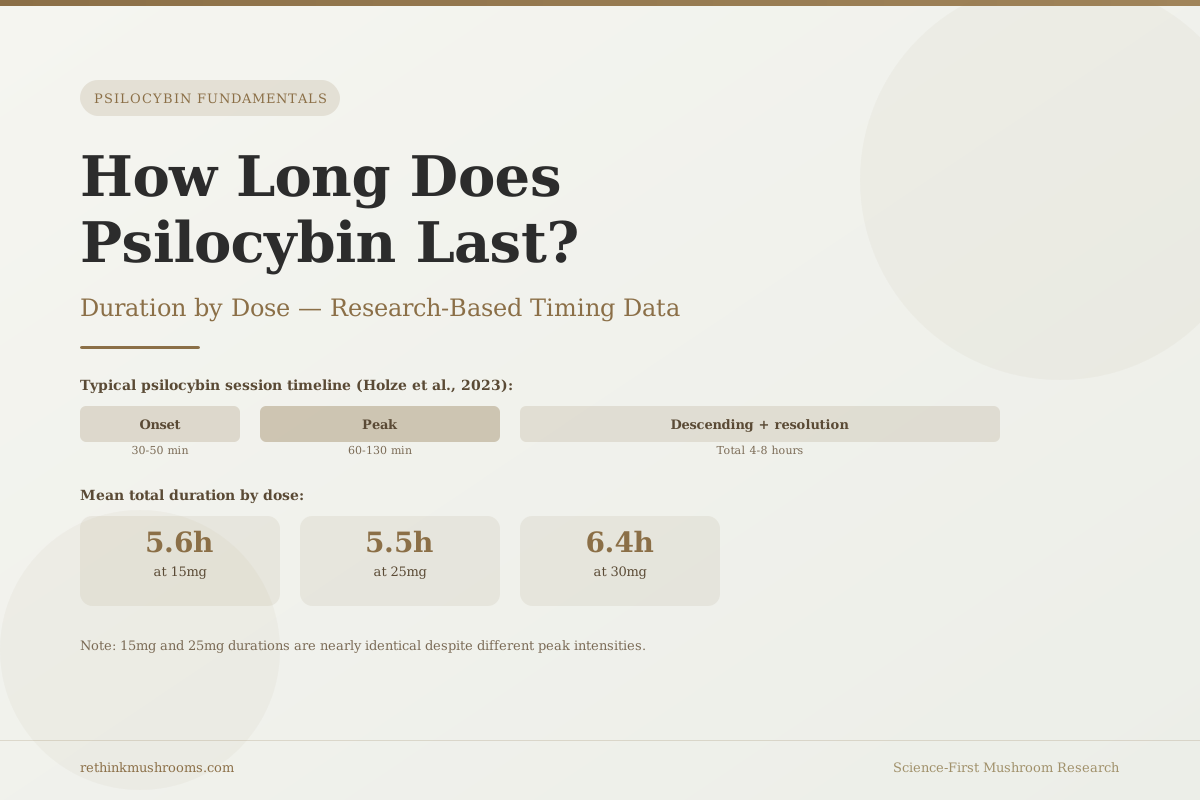
A 2023 pharmacokinetic study measured psilocybin duration across three doses: 15mg lasted an average of 5.6 hours, 25mg lasted 5.5 hours, and 30mg lasted 6.4 hours. Effects began in 30-50 minutes and peaked at 60-130 minutes across all doses.
Holze et al., Clinical Pharmacology and Therapeutics, 2023
30-50 min
onset of effects, when the experience typically begins
60-130 min
peak effects window (Holze 2023)
5.5 vs 5.6h
mean duration at 25mg vs 15mg, nearly identical (Holze 2023)
Holze et al., Clinical Pharmacology and Therapeutics, 2023
 View as image ↗
The internet's standard answer to how long psilocybin lasts is "4-6 hours." That's in the right neighborhood, but it's not the whole picture. The actual data shows onset between 30 and 50 minutes, a peak experience window from 60 to 130 minutes, and a total duration that ranges from 4 to 8 hours depending on dose and individual biology. The counterintuitive finding: doubling the dose from 15mg to 25mg barely extends the duration at all, while jumping to 30mg adds about an hour. For the broader pharmacological context, see our complete psilocybin pharmacology guide.
This article covers the precise timing data: when effects begin, when they peak, and what drives the variation in duration across different people taking identical doses.
Key Takeaways
- Holze et al. (2023) measured psilocybin timing across three doses: onset at 30-50 minutes (0.5-0.8h), peak effects at 60-130 minutes (1.0-2.2h), total duration 4-8 hours
- Duration by dose in Holze 2023: 15mg averaged 5.6 hours, 25mg averaged 5.5 hours, 30mg averaged 6.4 hours; the 15mg and 25mg durations are nearly identical despite meaningfully different peak intensities
- Psilocybin is a prodrug: it must be converted to psilocin before producing effects, which explains the 30-50 minute delay between ingestion and onset (Hasler et al., 1997)
- Brown et al. (2017) confirmed dose-proportional pharmacokinetics: higher doses produce proportionally higher plasma psilocin levels and AUC, explaining the dose-response in intensity even when duration barely changes
- Stenbæk et al. (2021, n=30) found that pre-existing 5-HT2A receptor density predicts the duration of the psilocybin experience; this is the main reason two people on identical doses can have meaningfully different trip lengths
- Clinical protocols (MacCallum et al., 2022) plan 6-8 hour sessions and recommend waiting at least 24 hours before driving, reflecting the full range of individual variability in elimination
The Timing Data: What Holze 2023 Found Across Three Doses
The most precise pharmacokinetic and pharmacodynamic study of psilocybin timing currently published is Holze et al.'s 2023 study in Clinical Pharmacology and Therapeutics.[1]
The study measured psilocybin's temporal effects across three doses (15mg, 25mg, and 30mg) in healthy adults under controlled conditions. These are the numbers most relevant to clinical and therapeutic use.
Onset: Effects begin approximately 30-50 minutes after ingestion (0.5-0.8 hours). This is when most participants first notice perceptual changes.
Peak: Subjective effects reach their maximum intensity between 60 and 130 minutes after ingestion (1.0-2.2 hours). The peak window is wide, reflecting both individual variability in absorption and conversion speed.
Total duration: The full experience lasts between 4 and 8 hours, with most effects resolved by the end of that range.
Duration by dose: This is where the data becomes interesting.
- 15mg: mean duration 5.6 hours
- 25mg: mean duration 5.5 hours
- 30mg: mean duration 6.4 hours
The 15mg and 25mg mean durations are essentially identical: 5.6h vs 5.5h, a difference well within individual variability. The jump to 30mg adds about 0.9 hours on average. This is not what most people expect: doubling the dose from 15mg to 25mg does not meaningfully extend how long the experience lasts. It increases peak intensity, but the clock runs on roughly the same timeline.
For a comparison of these doses in the context of clinical trial outcomes, see our article on what doses clinical trials use for psilocybin.
Why There's a 30-50 Minute Delay: The Prodrug Chemistry
Psilocybin does not produce effects directly. It is a prodrug that must be converted to psilocin before it can act on serotonin receptors in the brain.
When psilocybin is swallowed, it is absorbed in the gut and then rapidly dephosphorylated, primarily by intestinal alkaline phosphatase, into psilocin. Psilocin is the compound that actually crosses the blood-brain barrier and binds to 5-HT2A receptors to produce psychedelic effects.
Hasler et al.'s foundational 1997 pharmacokinetic study in Pharmaceutica Acta Helvetiae established the basic human pharmacokinetic profile of this conversion process, measuring psilocin levels in plasma after oral and intravenous administration.[2] The oral route produces measurable plasma psilocin within 30-45 minutes of ingestion, which aligns precisely with the onset window Holze 2023 measured.
The conversion and absorption process accounts for the delay. Unlike a compound that acts directly, psilocybin requires the body to process it first. Food in the stomach slows this process by delaying gastric emptying; the Meshkat 2025 systematic review of psilocybin pharmacokinetics notes that taking psilocybin with food extends the time to peak plasma psilocin, which translates to a later and sometimes flatter onset of effects.[3]
For a deeper look at the psilocybin-to-psilocin conversion and why this distinction matters, see our article on psilocybin vs. psilocin.
Why Intensity and Duration Don't Scale the Same Way
The Holze 2023 finding that 15mg and 25mg produce nearly identical mean durations surprises people who assume more drug means more of everything. The pharmacokinetic explanation from Brown et al.'s 2017 escalating dose study in Clinical Pharmacokinetics helps clarify what is actually scaling.[4]
Brown's team confirmed that psilocybin pharmacokinetics are dose-proportional: higher doses produce proportionally higher peak plasma psilocin levels (Cmax) and greater total exposure (AUC, the area under the plasma concentration curve). So 25mg delivers more psilocin to the brain than 15mg, and produces it at a higher peak concentration.
But duration is not driven by peak plasma concentration alone. Duration is driven by how long plasma psilocin remains above the threshold needed to maintain receptor occupancy sufficient for perceptible effects. Once psilocin clears below that threshold, the experience ends.
The threshold-crossing dynamics mean that doubling from 15mg to 25mg raises the peak substantially but barely extends how long psilocin stays above the perceptual threshold; the concentration-time curve is shifted up in height more than it is extended in width. Only at 30mg does the curve widen enough to add a meaningful hour to average duration.
This has a practical implication: for people planning around schedule, the difference between 15mg and 25mg sessions is primarily about intensity, not time commitment.
What Makes Duration Vary So Much Between People: The Receptor Density Factor
The 4-8 hour total range in Holze's data is substantial. Two people taking identical 25mg doses could have experiences that differ by several hours. The pharmacokinetic data from Meshkat et al.'s 2025 systematic review confirms that inter-individual variability in psilocin exposure is high and does not reduce to simple factors like body weight.[3]
One of the most informative studies on why individual duration varies is Stenbæk et al.'s 2021 PET imaging study in the Journal of Psychopharmacology, which scanned 30 healthy participants before their psilocybin sessions.[5]
Stenbæk's team found that pre-existing 5-HT2A receptor density in the brain predicted both the duration and intensity of the psilocybin experience. People with higher baseline receptor binding potential had longer and more intense experiences at identical doses.
This is a significant finding for understanding duration variability. Receptor density is an individual biological variable that differs between people based on genetics, prior drug use, stress history, and other factors. It cannot be measured without PET imaging. It does not correlate with body weight in any clinically useful way.
The implication: the biggest predictor of how long a specific person's psilocybin experience will last is their brain's current 5-HT2A receptor profile, something entirely invisible from the outside. This is one reason why the 4-8h range is not simply noise; it reflects real biological differences in how people respond to the same drug level.
For more on how 5-HT2A receptor binding shapes psilocybin's effects, see our article on psilocybin receptor binding and 5-HT2A selectivity.
How Clinical Protocols Are Designed Around These Numbers
MacCallum et al.'s 2022 clinical guidance paper in Frontiers in Psychiatry is the most comprehensive dosing and logistics reference for healthcare professionals working with psilocybin.[6] It uses the PK data to inform session planning in ways that consumer guides typically don't address.
The recommended session length in clinical protocols is 6-8 hours. This is deliberately longer than the typical mean duration because: individual variability means some participants will have longer experiences; having therapists present beyond when effects resolve provides important post-experience processing time; and ensuring no one leaves while still impaired is a basic safety requirement.
MacCallum's guidance documents the typical experience phases from a clinical perspective: the ascending phase (onset to peak, roughly 30-130 minutes), the peak phase (maximum intensity, typically 1-3 hours), the descending phase (intensity slowly reducing, hours 3-6 typically), and the early afterglow (after primary psychedelic effects end but before full baseline return).
The afterglow period (a sense of clarity, openness, or emotional ease that follows the main experience) is documented in clinical observation and patient reports, though the Holze 2023 study's timing data covers the primary psychedelic period rather than post-experience states. Meshkat 2025 notes that plasma psilocin levels are typically near or below detection limits by 8-10 hours after oral dosing.
Practical Timing: Fasting, Food, and the Driving Question
Two practical timing questions come up frequently in clinical and therapeutic contexts: does food affect onset, and when is it safe to drive?
On food: the Meshkat 2025 systematic review documents that food delays gastric emptying and slows psilocin absorption, pushing onset later and potentially flattening the plasma concentration-time curve. Clinical protocols typically administer psilocybin in a fasted or light-fasting state to maintain predictable onset timing. For people using psilocybin in non-clinical settings, a heavy meal before dosing may delay onset by an additional 30-60 minutes beyond the standard 30-50 minute window.
On driving: clinical protocols universally recommend waiting until the following day before operating a vehicle. MacCallum 2022 documents this recommendation explicitly. While plasma psilocin is largely cleared by 8-10 hours, the early afterglow period can involve residual changes in perception and reaction time that are difficult to self-assess accurately. The 24-hour waiting recommendation reflects the full distribution of the population's elimination timeline, not just the mean.
For comparison across psychedelics and how psilocybin's tolerance curve affects session frequency, see our article on psilocybin tolerance and how fast it builds.
The Individual Variability Summary: Why "4-8 Hours" Is the Honest Answer
The Holze 2023 timing data and the Stenbæk 2021 receptor density finding together explain why giving a single number for psilocybin duration is inherently misleading.
The mean durations at clinical doses are 5.5-6.4 hours. But the distribution around those means is wide. A person with high 5-HT2A receptor density, slower gastric absorption, or both could have a primary experience approaching 8 hours at 25mg. A person with lower receptor density and faster absorption could be largely resolved by 4 hours at the same dose.
This is not a failure of the pharmacokinetic data. It is what the data accurately predicts: high inter-individual variability in a response that depends on receptor density, absorption speed, and individual metabolic factors. The 4-8 hour range in Holze 2023 captures this reality, and the Meshkat 2025 systematic review confirms it holds across the broader literature.
For clinical planning, the practical answer is to assume the longer end of the range and be pleasantly surprised by brevity rather than caught off-guard by length. For the dosing context around what makes 25mg the most commonly studied clinical dose, see our psilocybin dosing guide.
The Bottom Line
Holze et al.'s 2023 pharmacokinetic study provides the most precise timing data currently available: psilocybin effects begin in 30-50 minutes, peak at 60-130 minutes, and resolve in 4-8 hours. Mean duration by dose was 5.6 hours at 15mg, 5.5 hours at 25mg, and 6.4 hours at 30mg. The near-identical duration of 15mg and 25mg is explained by plasma concentration-time curve dynamics: higher doses raise peak intensity without proportionally extending how long psilocin stays above the perceptual threshold. Inter-individual variability is substantial and partly explained by pre-existing 5-HT2A receptor density (Stenbæk et al., 2021), which predicts both duration and intensity. Clinical protocols plan for 6-8 hour sessions and recommend waiting 24 hours before driving.
Frequently Asked Questions
Sources & References
- 1. Source details for this reference are not yet available.
- 2. Source details for this reference are not yet available.
- 3. Source details for this reference are not yet available.
- 4. Source details for this reference are not yet available.
- 5. Source details for this reference are not yet available.
- 6. Source details for this reference are not yet available.