Psilocybin Fundamentals
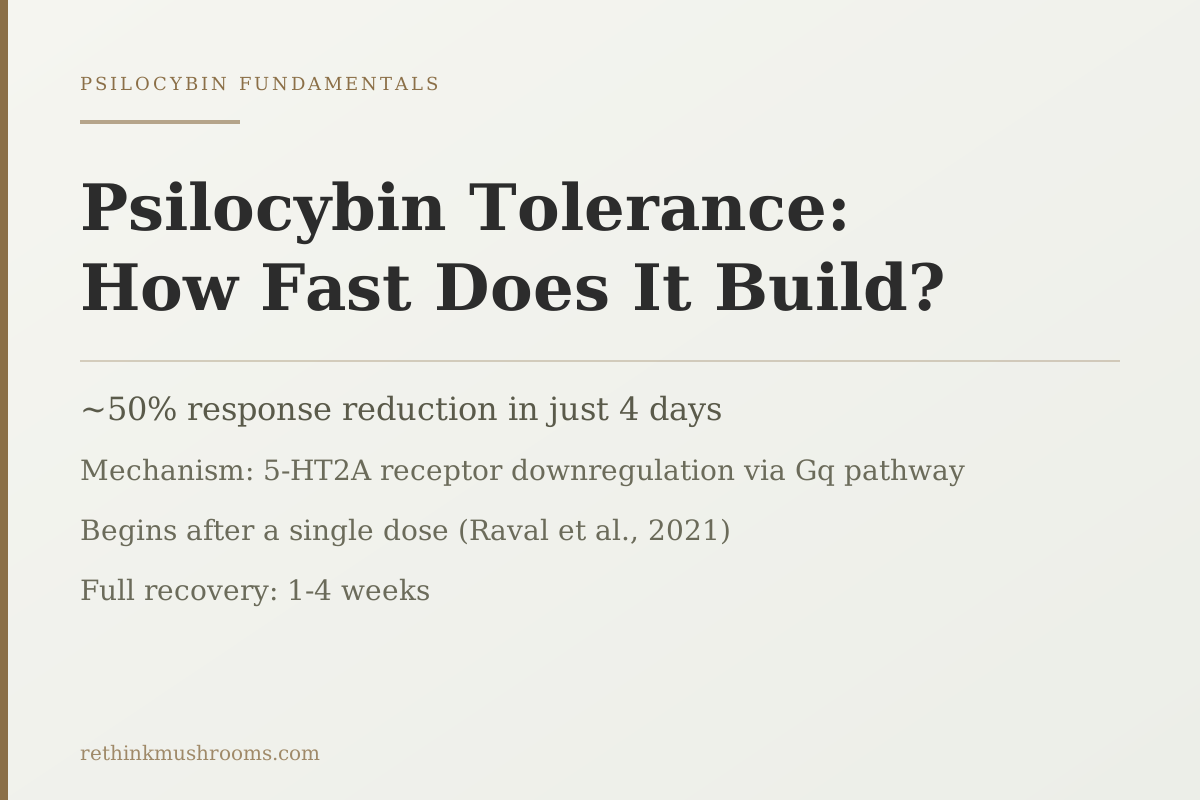
~50% response reduction in 4 days
De la Fuente Revenga et al. (2022) found that 4 consecutive days of psychedelic dosing reduced the behavioral proxy for psychedelic effects by approximately 50%. Even a single dose starts the process.
de la Fuente Revenga et al., ACS Chem Neurosci, 2022
Day 1
when 5-HT2A receptor downregulation begins; even one dose starts the clock (Raval 2021)
5-HT2A
the specific serotonin receptor subtype that downregulates; 5-HT2C does not (Smith 1999)
1-4 weeks
estimated time for full receptor density recovery to baseline
de la Fuente Revenga et al., ACS Chem Neurosci, 2022
 View as image ↗
One dose is enough to start the process. When Raval and colleagues scanned pig brains with PET imaging after a single psilocybin administration, they found that the density of the 5-HT2A receptor (the brain receptor responsible for the psychedelic experience) had already decreased.[5] Tolerance doesn't wait for a second or third dose. The biology begins with the first one.
Psilocybin tolerance builds faster than almost any other psychoactive substance. By the fourth consecutive day of use, the behavioral response in animal studies has dropped to roughly half the original intensity.[6] A 2019 human brain imaging study confirmed the connection directly: the more 5-HT2A receptor that psilocybin could occupy, the more intense the subjective experience.[3] When receptor density drops, so does the experience. The reduction is quantifiable, not just subjective. For the full pharmacology context, the complete guide to how psilocybin works covers the foundational mechanisms.
Key Takeaways
- A single psilocybin dose reduces 5-HT2A receptor density in brain imaging studies. Raval et al. (2021) documented this in pigs using PET scanning after just one administration, while simultaneously observing increased synaptic density.[5]
- De la Fuente Revenga et al. (2022) found that 4 consecutive days of psychedelic dosing reduced the animal behavioral proxy for psychedelic effects by approximately 50%. The tolerance trajectory is days, not weeks.[6]
- Madsen et al.'s 2019 human PET study found that the intensity of the subjective psychedelic experience directly correlates with 5-HT2A receptor occupancy. Fewer available receptors produce a proportionally weaker experience.[3]
- Smith et al. (1999) demonstrated that tolerance develops through downregulation of 5-HT2A receptors specifically, not 5-HT2C or other serotonin receptor subtypes. The mechanism is receptor-subtype precise.[1]
- De la Fuente Revenga et al. (2022) confirmed that tolerance was not prevented when β-arrestin-2 (a separate receptor signaling protein) was genetically removed, establishing that the Gq signaling pathway drives tolerance, not β-arrestin-2.[6]
- Full receptor recovery to baseline density takes approximately 1-4 weeks, which is why clinical trials and published harm-reduction frameworks consistently recommend waiting at least two weeks between psilocybin sessions.
One Dose Is Enough: What Brain Scans Reveal
The clearest demonstration of how quickly psilocybin tolerance begins comes from Raval and colleagues, who used PET (positron emission tomography) brain scanning to measure receptor density in pigs before and after a single psilocybin dose.[5] PET imaging can track the concentration of specific receptors across brain regions by measuring how much of a radioactive tracer, specifically designed to bind to the target receptor, accumulates in different areas.
Their result: after just one administration, 5-HT2A receptor density had measurably decreased in multiple brain regions. The receptor was pulling itself off the cell surface before any second dose had been given. The brain had already begun adapting to psilocybin's presence.
What makes the Raval finding particularly interesting is what else happened at the same time. While 5-HT2A receptor density was decreasing, synaptic density was increasing. Synaptic density is a measure of the number of connections between neurons. The two changes happened simultaneously: the receptor responsible for the acute psychedelic experience was coming offline, while the structural connections between neurons were expanding. This suggests that tolerance and the neuroplastic effects attributed to psilocybin are not competing processes but may be mechanistically linked. The same event that starts the tolerance clock also begins the structural brain changes researchers associate with lasting therapeutic benefit.
Animal models extend this picture. Halberstadt's 2020 meta-analysis of the head-twitch response, a specific rhythmic head movement that mice and rats display in response to psychedelics, validated that this behavioral marker reliably predicts psychedelic potency in humans across compound classes.[4] This cross-species validation matters because most tolerance research comes from rodents. When Halberstadt confirmed that the head-twitch response maps closely to human subjective potency, it gave researchers confidence that rodent tolerance findings apply to humans.
The direct answer for the featured snippet: psilocybin tolerance begins after a single dose. The 5-HT2A receptor starts downregulating before a second session ever occurs.
The Progressive Buildup: What Four Days of Dosing Shows
De la Fuente Revenga and colleagues (2022) ran a systematic investigation of how tolerance accumulates over consecutive days of psychedelic administration.[6] Using the head-twitch response as the behavioral readout of psychedelic effect intensity, they administered psychedelics on consecutive days and tracked how the response changed.
By the fourth consecutive day, the behavioral response had dropped to approximately 50% of its first-day intensity. The decline wasn't linear. The sharpest drop occurred in the first two days, with subsequent days showing a leveling off as the system approached its tolerance plateau. The data gives researchers (and anyone else curious) the first dose-timeline curve for psychedelic tolerance: significant blunting within 48 hours, near-complete tolerance by day 3-4.
This is the mechanism behind the common experience of second-day psilocybin use feeling dramatically reduced compared to day one. The receptor population available for psilocybin to activate has shrunk substantially overnight. The effect isn't psychological expectation or preparation. It's receptor pharmacology. For a focused examination of the two-day-in-a-row question, see psilocybin and tachyphylaxis: why you can't trip two days in a row.
Why It Happens: The 5-HT2A Receptor Mechanism
Understanding the timeline requires understanding what the 5-HT2A receptor actually does when psilocybin binds to it.
The 5-HT2A receptor is the serotonin receptor subtype that mediates psychedelic effects. When psilocybin (or more precisely, its active metabolite psilocin) binds to this receptor, it activates a signaling chain inside the cell called the Gq pathway. The Gq pathway is the cell's primary communication channel from the 5-HT2A receptor to the interior of the neuron. Activating it produces the cascade of signaling events that ultimately leads to altered perception, mood, and thought.
That same Gq activation also triggers a feedback process. The receptor, after being activated, undergoes a process called internalization: it physically moves off the cell surface and into the interior of the cell, where it is unavailable for future activation. The more frequently the receptor is activated, the more aggressively this internalization occurs. The result is a net decrease in the number of 5-HT2A receptors available at the cell surface. This is the receptor downregulation that PET imaging can directly observe.
Madsen and colleagues confirmed this receptor-occupancy-to-experience link directly in humans in 2019.[3] Using PET scanning in human participants who received psilocybin under controlled conditions, they measured 5-HT2A receptor occupancy (the percentage of available receptors that psilocybin was occupying) alongside subjective ratings of psychedelic intensity. The correlation was direct and robust: higher receptor occupancy predicted stronger subjective experience. This established in human neuroimaging that the effect of psilocybin is essentially proportional to how much 5-HT2A receptor it can access. When tolerance reduces the available receptor pool, the effect diminishes proportionally.
Smith and colleagues (1999) specified which receptor subtype drives tolerance.[1] They found that tolerance developed through 5-HT2A receptor downregulation but not through 5-HT2C receptor downregulation, even though psilocybin activates both subtypes. The tolerance mechanism is specific to the receptor subtype responsible for psychedelic effects. This receptor precision explains why tolerance to psychedelics doesn't carry over to serotonin-mediated functions like mood regulation or appetite, because those involve different receptor subtypes that are not affected.
López-Giménez and González-Maeso's 2018 review added the final mechanistic detail.[2] Psychedelics selectively activate the Gq pathway of the 5-HT2A receptor, not the alternative signaling route (the β-arrestin-2 pathway that the same receptor can also use). De la Fuente Revenga's 2022 study confirmed this experimentally: when mice were genetically engineered to lack β-arrestin-2, they still developed tolerance to psychedelics.[6] Removing the β-arrestin-2 signaling protein changed nothing about the tolerance trajectory. This confirmed the Gq pathway as the driver. That finding matters for the broader picture of how psilocybin's tolerance-inducing properties relate to its therapeutic properties.
For a deeper look at how the 5-HT2A receptor works across psilocybin's effects, see psilocybin and the 5-HT2A receptor: the key to psychedelic effects.
The Recovery Window: When Does Sensitivity Return?
Receptor downregulation is reversible. The 5-HT2A receptor, after being internalized in response to psilocybin, is gradually recycled back to the cell surface as the signaling stimulus fades. The rate of recovery determines how long a person needs to wait before a subsequent dose will produce its full effect.
Published estimates from the receptor pharmacology literature place partial recovery (approximately 50% of baseline receptor density) in the range of 3-7 days. Full recovery to baseline receptor density takes longer, typically in the range of 1-4 weeks depending on the dose used and individual variation in receptor resynthesis rates.
This recovery window is why clinical trials consistently space psilocybin sessions several weeks apart. In major psilocybin depression trials, inter-session intervals of 2-4 weeks are standard. The spacing isn't arbitrary. It reflects the receptor biology. At shorter intervals, the second session encounters a partially depleted receptor pool and produces a proportionally reduced experience. The Madsen 2019 human PET data explains why this matters therapeutically: if the intensity of the experience predicts outcome (as Garcia-Romeu's tobacco work suggests), then partial tolerance at session two could mean a weaker therapeutic effect, not just a less intense subjective experience.
For a detailed breakdown of session spacing, including what the clinical trial protocols actually use and what partial tolerance means for therapeutic outcomes, see how long between psilocybin sessions: the tolerance window.
How Psilocybin Tolerance Differs From Addictive Drug Tolerance
Most discussions of drug tolerance describe a problem: a person needs more of a substance to get the same effect, which drives escalation. This is the tolerance pattern behind opioid and stimulant escalation. Psilocybin tolerance works differently, and the difference is pharmacologically significant.
With opioids or stimulants, tolerance develops gradually over days to weeks of use. The person still experiences effects from each use: the effects are blunted but present. The remaining effect provides continued reinforcement, while the diminished effect motivates increasing the dose. The combination of continued reinforcement and reduced effect is what produces the escalation cycle.
Psilocybin tolerance develops so rapidly that this cycle cannot form. Within 3-4 days of consecutive use, the effect is reduced by approximately 50%. The escalation pattern that drives addiction (continued partial reinforcement that motivates higher doses) doesn't apply because the effect doesn't gradually diminish over weeks of use. It collapses in days. There is no range of "partial effect" over time that functions as a reinforcement bridge to higher doses. The experience simply stops working.
There is also no physical withdrawal syndrome associated with stopping psilocybin after even repeated use, because there is no physical dependence in the pharmacological sense. The receptor recovers. The brain returns to baseline. This is why the tolerance pattern in psychedelics, technically called tachyphylaxis (acute, pharmacological, rapid), is considered a biological barrier to compulsive use rather than a stepping stone toward it.
This distinction is important to state honestly. Low abuse potential is not zero abuse potential. Psychological habituation to the ritual of psychedelic use is theoretically possible even without physical dependence. And the tolerance mechanism that prevents daily compulsive use doesn't prevent less frequent problematic use patterns. The pharmacological picture is genuinely different from addictive drugs. The human behavioral picture is more complex. For the full analysis of why psychedelic tolerance is a safety feature rather than a risk, see why psychedelic tolerance is self-limiting.
The Bottom Line
Psilocybin tolerance begins with a single dose. PET imaging in pigs found that one administration reduces 5-HT2A receptor density, and human imaging confirmed that the intensity of the psychedelic experience directly tracks with how much of that receptor psilocybin can occupy. Animal models show approximately 50% blunting of psychedelic effects by the fourth consecutive day. The mechanism is specific: the Gq signaling pathway from the 5-HT2A receptor (not β-arrestin-2, not 5-HT2C) drives the tolerance. Recovery takes 1-4 weeks, which is why clinical trials space sessions 2-4 weeks apart. This rapid, complete tolerance is pharmacologically distinct from the gradual, partial tolerance that enables escalation and dependence in addictive substances.
Frequently Asked Questions
Sources & References
- 1RTHM-00069·Smith, R L et al. (1999). “Mechanism of tolerance development to 2,5-dimethoxy-4-iodoamphetamine in rats: down-regulation of the 5-HT2A, but not 5-HT2C, receptor..” Psychopharmacology.Study breakdown →PubMed →↩
- 2RTHM-00980·López-Giménez, Juan F et al. (2018). “Hallucinogens and Serotonin 5-HT2A Receptor-Mediated Signaling Pathways..” Current topics in behavioral neurosciences.Study breakdown →PubMed →↩
- 3RTHM-00578·Madsen, Martin K et al. (2019). “Psychedelic effects of psilocybin correlate with serotonin 2A receptor occupancy and plasma psilocin levels..” Neuropsychopharmacology : official publication of the American College of Neuropsychopharmacology.Study breakdown →PubMed →↩
- 4RTHM-01195·Halberstadt, Adam L et al. (2020). “Correlation between the potency of hallucinogens in the mouse head-twitch response assay and their behavioral and subjective effects in other species..” Neuropharmacology.Study breakdown →PubMed →↩
- 5RTHM-00714·Raval, Nakul Ravi et al. (2021). “A Single Dose of Psilocybin Increases Synaptic Density and Decreases 5-HT2A Receptor Density in the Pig Brain..” International journal of molecular sciences.Study breakdown →PubMed →↩
- 6RTHM-01502·de la Fuente Revenga, Mario et al. (2022). “Tolerance and Cross-Tolerance among Psychedelic and Nonpsychedelic 5-HT2A Receptor Agonists in Mice..” ACS chemical neuroscience.Study breakdown →PubMed →↩