Psilocybin Fundamentals
~50% effect reduction
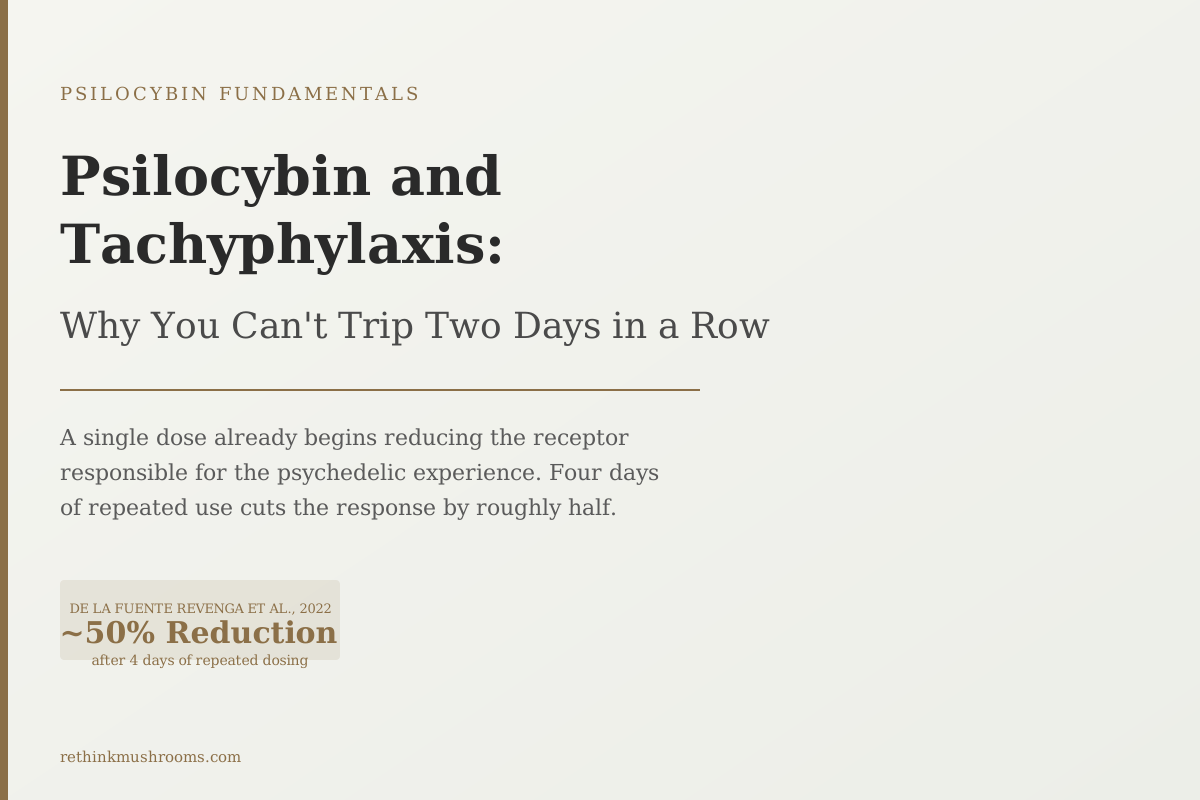
After 4 days of consecutive psilocybin dosing, the psychedelic response drops by roughly half. Brain scans show why: a single dose already begins reducing the receptor responsible for the experience.
de la Fuente Revenga et al., ACS Chemical Neuroscience, 2022
Day 1
when receptor downregulation already begins after one dose
1–2 weeks
approximate time for full tolerance reversal
No withdrawal
tachyphylaxis is not physical dependence
de la Fuente Revenga et al., ACS Chemical Neuroscience, 2022
 View as image ↗
If you took psilocybin yesterday and took the same dose today, the second experience would be dramatically weaker. Take it again on day three and you might feel almost nothing. This rapid loss of effect has a name: psilocybin tachyphylaxis. It is the pharmacological reason why consecutive-day use is essentially self-defeating, and it differs fundamentally from the slow-building tolerance that characterizes habit-forming drugs.
Tachyphylaxis is not unique to psilocybin, but psilocybin is one of its most dramatic examples. Understanding why it happens requires looking at the specific receptor through which psilocybin produces its effects, what happens to that receptor after it is activated, and what brain imaging and preclinical studies show about how quickly the effect disappears and how long recovery takes. The complete pharmacology of how psilocybin works is covered in our guide to psilocybin pharmacology. This article focuses specifically on tachyphylaxis: what it is, why it happens, and why it has significant implications for both safety and addiction potential.
Key Takeaways
- Tachyphylaxis is an acute, rapid form of tolerance that develops within days of repeated psilocybin use — distinct from the slow-building tolerance associated with addictive drugs
- A single psilocybin dose already begins reducing the density of 5-HT2A receptors in the brain, as shown by a pig brain PET imaging study (Raval et al., 2021)
- The subjective psychedelic experience directly correlates with the fraction of 5-HT2A receptors occupied by the drug — fewer available receptors means a weaker experience (Madsen et al., Neuropsychopharmacology, 2019)
- Four days of repeated dosing in animal models reduces the psychedelic response by approximately 50%; recovery takes 1-2 weeks (de la Fuente Revenga et al., ACS Chemical Neuroscience, 2022)
- The tolerance mechanism operates through the Gq signaling pathway, not the β-arrestin-2 pathway — confirmed by de la Fuente Revenga 2022 using genetic knockouts
- Tachyphylaxis is explicitly cited as a biological barrier to compulsive use in a comprehensive abuse potential analysis of psilocybin (Johnson et al., Neuropharmacology, 2018)
What Tachyphylaxis Means — and Why Psilocybin Is a Textbook Example
Tachyphylaxis refers to a rapid decrease in response to a drug that develops over short periods, sometimes within hours or days, rather than the weeks or months of gradual tolerance that develop with repeated exposure to alcohol or opioids.
The standard definition distinguishes two tolerance types by mechanism and timeline. Traditional tolerance occurs when the body gradually adapts to a drug's presence over repeated exposures — the classic pattern of needing progressively more opioids to achieve the same pain relief, or needing more coffee to feel awake. This kind of tolerance builds slowly and is often accompanied by physical dependence: the body requires the drug to function normally, and stopping it produces withdrawal symptoms.
Tachyphylaxis works differently. The response does not diminish gradually over weeks of use. It collapses rapidly over days. And it does not produce physical dependence: when the drug is stopped, the body does not enter withdrawal. The receptor recovers on its own timeline, and when it does, full sensitivity returns.
Psilocybin is a textbook example of tachyphylaxis because the receptor through which it works, the serotonin 5-HT2A receptor, is uniquely prone to rapid downregulation after activation. Taking psilocybin on day 1 produces a full psychedelic experience. On day 2, the experience is noticeably weaker. By days 3-4, the effect is minimal. This is not a subjective impression or anecdotal pattern. It is measurable in animal models using standardized behavioral assays, and the receptor mechanism is visible in brain imaging studies.
How Tachyphylaxis Differs From the Tolerance That Drives Addiction
The most important practical difference between tachyphylaxis and traditional addiction-linked tolerance is directional. Traditional tolerance drives escalation: you need more to get the same effect, so you take more, and the cycle builds. Tachyphylaxis blocks its own escalation: you take more but get less, and eventually get almost nothing, regardless of dose.
This makes tachyphylaxis a self-limiting phenomenon in a way that traditional tolerance is not.
With opioids, for example, tolerance develops slowly enough that escalating doses can chase the effect for extended periods. The tolerance and the craving both increase. With psilocybin, the complete loss of effect within 3-4 days makes any escalation strategy pharmacologically futile. You cannot chase the psilocybin high by taking more psilocybin the next day. The receptors required for the experience are simply not available in sufficient numbers.
This distinction is not merely semantic. It has regulatory and clinical implications, which is why the psilocybin research community explicitly distinguishes tachyphylaxis from addiction-relevant tolerance when discussing abuse potential. The pharmacological impossibility of maintaining a daily psilocybin habit is a direct consequence of tachyphylaxis.
Day 1 Is Already the Beginning: What Brain Imaging Shows After a Single Dose
The most striking evidence for how quickly tachyphylaxis begins comes from a 2021 study by Raval and colleagues. Using a pig brain model with PET imaging, they measured what happened to both 5-HT2A receptor density and synaptic connections after a single psilocybin dose.[4]
The PET scan results showed that 5-HT2A receptor density decreased after just one dose. The receptor responsible for psilocybin's psychedelic effects was already present in smaller numbers within hours of the first exposure. The tolerance clock does not start on day 2. It starts on day 1.
This is mechanistically important because it means any second-day experience is already running on a depleted receptor pool. The animal has taken one dose, and the brain has already begun protecting itself from the intensity of that activation by reducing the number of available receptors. This is receptor downregulation: when a receptor is strongly activated, the cell responds by internalizing and reducing the density of that receptor on its surface, making itself less sensitive to further stimulation.
The Raval study also found something that surprised the authors: simultaneously with the receptor downregulation, synaptic density increased after the single psilocybin dose. New synaptic connections formed even as receptor sensitivity dropped. This suggests that the tolerance mechanism and the neuroplasticity mechanism, the structural brain changes associated with psilocybin's potential therapeutic effects, are not the same process and do not share the same timeline. The receptor downregulates quickly; the new synaptic connections may persist for much longer.
This has implications for therapeutic use. It suggests that the window of reduced receptor sensitivity (tachyphylaxis) does not necessarily cancel out the therapeutic window, which may operate through different neural changes.
Why Fewer Available Receptors Mean a Weaker Experience: The Occupancy Link
Understanding why reduced receptor density produces a weaker experience requires understanding how psilocybin's effects are generated in the first place.
Psilocybin is converted in the body to psilocin, which binds to 5-HT2A receptors and activates them. The subjective psychedelic experience, the visual alterations, the changes in thought and emotion, the dissolution of ordinary self-awareness, is produced by this receptor activation. The stronger the activation, the more intense the experience.
Madsen and colleagues published a 2019 study using PET scanning in human participants that directly measured this relationship. They found that the intensity of the subjective psychedelic experience directly correlated with the fraction of 5-HT2A receptors occupied by psilocin at any given time.[3] More receptor occupancy meant more intense experience. Less occupancy meant less intense experience.
This finding makes the tolerance mechanism intuitive. If a single dose reduces available 5-HT2A receptors (Raval 2021), then a second dose of identical size now has fewer receptors to occupy. The same amount of drug produces less receptor occupancy, and therefore less psychedelic effect. The drug has not changed. The experience has diminished because the biological substrate of the experience, the available receptor population, has been reduced.
The human PET data from Madsen 2019 is particularly valuable because it confirms in humans what animal studies had suggested: receptor occupancy is the mechanistic lever that controls experience intensity, and anything that reduces available receptors will predictably reduce that occupancy and therefore the experience.
What 4 Days of Consecutive Use Does: The Progressive Reduction Data
The most detailed picture of how tachyphylaxis progresses over multiple days comes from a 2022 study by de la Fuente Revenga and colleagues, which used mouse models to measure the effect of repeated psychedelic dosing on a well-validated behavioral marker of psychedelic activity: the head-twitch response.[5]
The head-twitch response is a rapid, distinctive movement that rodents display when 5-HT2A receptors are activated by psychedelics. It is one of the most well-validated proxies for psychedelic potency in animal models, with strong correlations to human subjective psychedelic effects confirmed across many studies.
De la Fuente Revenga and colleagues dosed mice with psychedelics over 4 consecutive days and measured the head-twitch response at each time point. The response declined progressively. By day 4, it had dropped by approximately 50% compared to the first-day response. This directly quantifies what anecdotal accounts and theoretical predictions had suggested: four days of repeated use cuts the psychedelic response roughly in half.
The same study addressed a critical mechanistic question: which signaling pathway within the 5-HT2A receptor is responsible for the tolerance?[5]
When psilocybin activates the 5-HT2A receptor, two separate signaling cascades can be initiated. The first involves a protein called Gq, which drives the signaling cascade responsible for the psychedelic experience. The second involves a protein called β-arrestin-2, which is involved in receptor desensitization in some contexts. Researchers had hypothesized that β-arrestin-2 might be the mechanism through which tolerance develops.
De la Fuente Revenga and colleagues tested this by creating mice with a genetic knockout of β-arrestin-2, effectively removing that signaling pathway entirely. These mice still developed tolerance at the same rate as normal mice. The β-arrestin-2 pathway was not the mechanism. Tolerance is driven by the Gq pathway, the same one that produces the psychedelic experience. The receptor's own activation machinery both generates the effect and initiates the downregulation that ends it.
Which Receptor Carries the Tolerance — and Why the Specificity Matters
Tolerance is specific to 5-HT2A, not to all serotonin receptors. This specificity is important because psilocybin activates several serotonin receptor subtypes, and understanding which one drives tolerance clarifies why the tolerance timeline is what it is.
Smith and colleagues established this in 1999, using a psychedelic compound (a DOI-class psychedelic rather than psilocybin directly) to induce tolerance in rats and then measuring which receptors had downregulated.[1] They found that the 5-HT2A receptor specifically had downregulated. The 5-HT2C receptor, another serotonin subtype activated by some psychedelics, had not changed. The tolerance was receptor-subtype specific, not a general serotonergic effect.
De la Fuente Revenga 2022 added a further layer of specificity: tolerance develops with psychedelic 5-HT2A agonists, but not with non-psychedelic ones.[5] Some compounds activate 5-HT2A but do not produce psychedelic effects. These compounds did not produce tolerance. This suggests that the tolerance mechanism is linked specifically to the quality of receptor activation that produces the psychedelic experience, not simply to 5-HT2A occupancy in general.
For recovery: 5-HT2A receptor density recovers over 1-2 weeks once exposure stops. The published literature on receptor downregulation timelines for psychedelics consistently shows partial recovery within 3-7 days and near-full recovery within 2 weeks, consistent with clinical guidance that recommends a minimum two-week gap between psilocybin sessions. This links directly to the dosing advice in psilocybin dosing guide: low, medium, and high doses.
Why Tachyphylaxis Makes Psilocybin Addiction Biologically Difficult
The question of whether psilocybin is addictive is related to tachyphylaxis in a direct way: the same mechanism that prevents consecutive-day effects also prevents the pattern of escalating compulsive use that defines addiction.
Johnson and colleagues published a comprehensive 2018 analysis assessing psilocybin's abuse potential according to the 8 factors outlined in the Controlled Substances Act, the legal framework used to evaluate a substance's potential for scheduling.[2] The analysis concluded that psilocybin has low abuse potential across multiple factors. Rapid tachyphylaxis was explicitly cited as one of the biological barriers to compulsive use.
The reasoning is straightforward: addiction typically requires the ability to maintain reinforcing drug effects through repeated use. If repeated use produces no effect, the behavioral reinforcement loop that sustains addiction cannot be established. Psilocybin's tachyphylaxis makes this loop biologically impossible on the timescale that matters for addiction. There is no physical withdrawal syndrome when psilocybin use stops. The receptors recover. Sensitivity returns. But the pattern of escalating daily use that characterizes addictive drugs cannot develop because the drug stops working within days.
This does not mean psilocybin use is without any risk of problematic patterns. Psychological habituation, craving driven by the memory of intense experiences rather than current pharmacological effect, and misuse as a coping mechanism are all possible even without physical dependence. The Johnson 2018 analysis notes that low abuse potential is not zero abuse potential. But the specific addiction pathway involving tolerance, escalation, and physical dependence is pharmacologically blocked by tachyphylaxis in a way it is not for opioids, stimulants, or alcohol.
For more on the 5-HT2A receptor's central role in both psilocybin's effects and its tolerance, see psilocybin and the 5-HT2A receptor. For a related comparison, DMT's extremely brief receptor contact time prevents similar downregulation, making it an interesting contrast to psilocybin's extended engagement — explored in psilocybin vs. DMT. For session spacing recommendations drawing on this receptor recovery timeline, see how long between psilocybin sessions and psilocybin tolerance: how fast does it build.
Open Questions in the Tachyphylaxis Literature
The mechanistic picture of psilocybin tachyphylaxis is more complete than most consumer articles suggest, but several significant questions remain unresolved.
Most of the cellular and behavioral data comes from animal models. The head-twitch response in mice (de la Fuente Revenga 2022) is a well-validated proxy for human psychedelic effects, but it is not a perfect substitute for human data. Individual variation in 5-HT2A receptor density, receptor sensitivity, and downregulation rate is well documented but poorly characterized in humans with respect to tachyphylaxis specifically.
The Raval 2021 PET data comes from pigs, not humans. While pigs are a better brain model than rodents in several pharmacological respects, direct human PET imaging of 5-HT2A receptor density before and after psilocybin dosing on the day-by-day timeline would be the most informative study — and it has not yet been done in the tachyphylaxis context.
The Madsen 2019 human PET study shows the occupancy-to-effect correlation, but does not directly track receptor density over multiple sessions. It establishes the mechanism in a single-session context.
There is also an open question about whether therapeutic effects tolerate at the same rate as the acute psychedelic experience. The Raval 2021 finding that synaptic density increases simultaneously with receptor downregulation suggests that some downstream effects may persist even as the acute hallucinogenic response diminishes. Whether the antidepressant or anti-addictive effects of psilocybin also tolerate within the same 1-2 week window, or whether they are more durable, has not been systematically tested. This is a meaningful gap given the clinical interest in repeated or sequential therapeutic dosing.
The Bottom Line
Psilocybin tachyphylaxis is a well-characterized pharmacological phenomenon: a single dose begins 5-HT2A receptor downregulation, repeated use over 3-4 days reduces the psychedelic response by roughly half, and full receptor recovery takes 1-2 weeks. The mechanism operates through the Gq signaling pathway, is receptor-subtype specific to 5-HT2A, and does not produce physical dependence or withdrawal. These properties make psilocybin addiction biologically difficult in a way that most addictive drugs are not. Most of the mechanism data is from animal models; direct human neuroimaging of the day-by-day tachyphylaxis timeline has not yet been published.
Frequently Asked Questions
Sources & References
- 1RTHM-00069·Smith, R L et al. (1999). “Mechanism of tolerance development to 2,5-dimethoxy-4-iodoamphetamine in rats: down-regulation of the 5-HT2A, but not 5-HT2C, receptor..” Psychopharmacology.Study breakdown →PubMed →↩
- 2RTHM-00514·Johnson, Matthew W et al. (2018). “The abuse potential of medical psilocybin according to the 8 factors of the Controlled Substances Act..” Neuropharmacology.Study breakdown →PubMed →↩
- 3RTHM-00578·Madsen, Martin K et al. (2019). “Psychedelic effects of psilocybin correlate with serotonin 2A receptor occupancy and plasma psilocin levels..” Neuropsychopharmacology : official publication of the American College of Neuropsychopharmacology.Study breakdown →PubMed →↩
- 4RTHM-00714·Raval, Nakul Ravi et al. (2021). “A Single Dose of Psilocybin Increases Synaptic Density and Decreases 5-HT2A Receptor Density in the Pig Brain..” International journal of molecular sciences.Study breakdown →PubMed →↩
- 5RTHM-01502·de la Fuente Revenga, Mario et al. (2022). “Tolerance and Cross-Tolerance among Psychedelic and Nonpsychedelic 5-HT2A Receptor Agonists in Mice..” ACS chemical neuroscience.Study breakdown →PubMed →↩