Psilocybin vs. Other Psychedelics
1 shared receptor: 5-HT2A
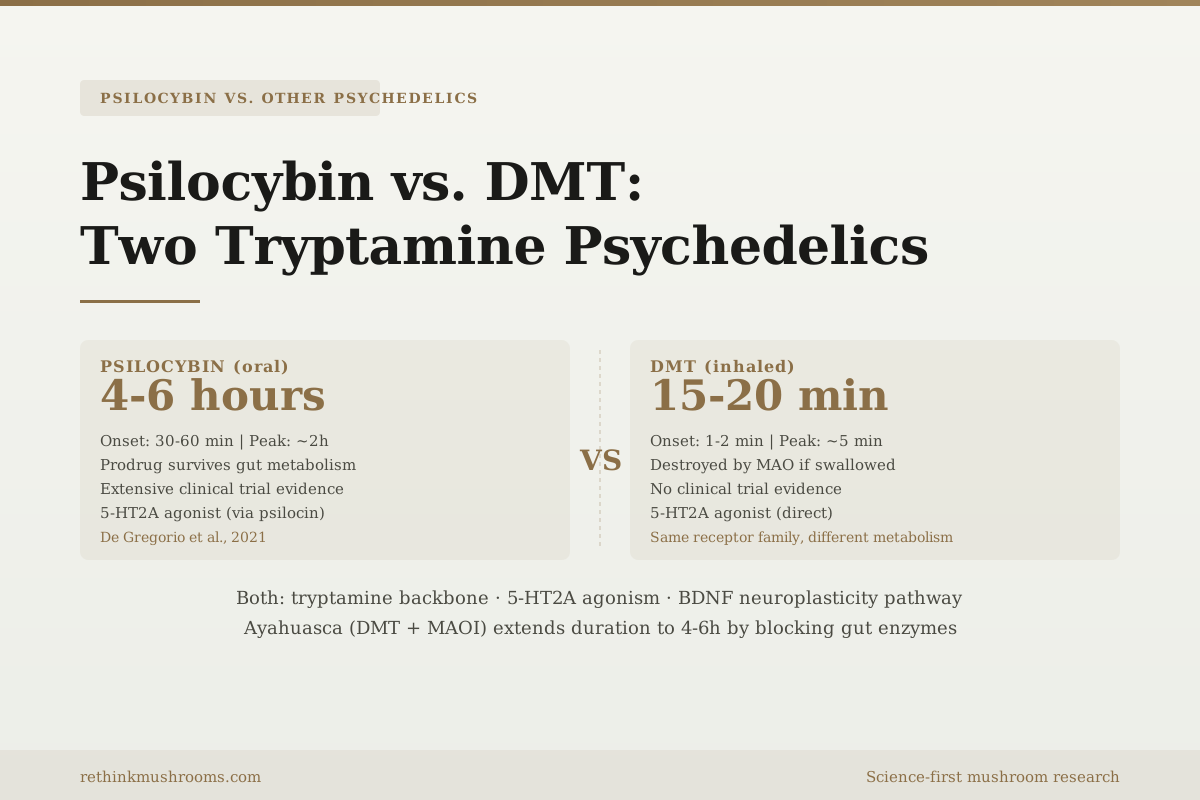
Psilocybin and DMT belong to the same tryptamine chemical family and both activate the serotonin 5-HT2A receptor — yet their experiences differ completely in duration, intensity, and route of administration.
De Gregorio et al., Journal of Neuroscience, 2021
~15 min
DMT duration when inhaled vs. 4-6h for psilocybin
Near zero
DMT clinical trial data for psychiatric use
Ayahuasca
traditional system extending DMT duration to 4-6h via MAO inhibition
De Gregorio et al., Journal of Neuroscience, 2021
 View as image ↗
Psilocybin and dimethyltryptamine (DMT) look nearly identical on paper. Both are tryptamines, both activate the same primary serotonin receptor, and both produce altered states of consciousness. Yet a psilocybin session unfolds over 4-6 hours in an inward, introspective arc. Inhaled DMT peaks within minutes and is over in 15-20. The molecules are nearly identical. The experiences are not.
Understanding why requires looking at what happens after each compound enters the body, and that difference turns out to be almost entirely a matter of metabolism. For the broader context on psilocybin's mechanism and how it compares across the psychedelic compound class, see How Psilocybin Works: The Complete Pharmacology Guide.
Key Takeaways
- Psilocybin and DMT share the tryptamine chemical backbone and both act primarily as 5-HT2A serotonin receptor agonists, placing them in the same pharmacological family as LSD
- When inhaled, DMT produces an experience lasting approximately 15-20 minutes; psilocybin taken orally produces an experience lasting 4-6 hours — not because the molecules are different, but because of how the body metabolizes each
- DMT is rapidly broken down by monoamine oxidase (MAO) enzymes in the gut and bloodstream, making it orally inactive when taken alone; psilocybin's prodrug structure allows it to survive gut metabolism and reach the brain slowly
- Ayahuasca, the traditional brew combining a DMT-containing plant with a monoamine oxidase inhibitor (MAOI), extends DMT's duration to 4-6 hours by blocking the enzymes that normally destroy it
- Psilocybin has extensive clinical trial data for depression, addiction, and end-of-life anxiety; DMT used as a standalone psychiatric therapy has almost no clinical trial evidence
- Both compounds activate the BDNF neuroplasticity pathway, which may explain why other serotonergic psychedelics share some therapeutic properties despite different pharmacokinetic profiles
One Chemical Family: The Molecular Overlap Between Psilocybin and DMT
Psilocybin, its active metabolite psilocin, and DMT all share the same structural core: a tryptamine backbone, meaning a two-ring structure with a nitrogen-containing ethylamine side chain attached. This makes them members of the same chemical family as serotonin itself, which has an almost identical structure.
The comparison matters because chemistry is destiny in pharmacology. Compounds with similar structures tend to fit similar receptor binding pockets. Psilocin and DMT both activate serotonin receptors, with the 5-HT2A subtype being the primary site responsible for their psychedelic effects. De Gregorio and colleagues' 2021 Journal of Neuroscience review of hallucinogens in mental health confirmed that 5-HT2A receptor agonism is the mechanism shared by the classical tryptamine and phenethylamine psychedelics, producing the altered state of consciousness common to this compound class.[1]
Where psilocybin differs structurally from DMT is in the addition of a phosphate group (making it a prodrug) and a hydroxyl group on the 4-position of the ring. DMT has no phosphate group and no 4-hydroxy modification. These differences do not dramatically change which receptors are hit. They change almost everything about how the compound behaves once inside the body.
Same Receptor, Different Qualities of Experience
Both psilocin and DMT are agonists at 5-HT2A receptors, but they don't produce identical experiences. DMT is often described as more abrupt, disorienting, and visually dramatic, frequently involving complete departure from ordinary perception. Psilocybin experiences are typically more gradual, introspective, and anchored — the environment remains recognizable even at high doses.
The mechanistic reason for these qualitative differences is not fully established. Part of it may be the dose-rate effect: DMT delivered by inhalation produces extremely rapid and high peak blood concentrations, whereas oral psilocybin produces a gradual rise to lower peak concentrations. When a receptor is flooded very quickly, the subjective experience may differ from the same receptor being activated more slowly, even if the total activation is comparable.
De Gregorio et al.'s 2021 review noted that classical tryptamine psychedelics also activate serotonin receptors beyond 5-HT2A, including 5-HT1A and 5-HT2C subtypes, as well as sigma-1 receptors. Receptor binding profiles across these subtypes differ between compounds in the tryptamine family, and these differences in secondary receptor activity likely contribute to the qualitative differences between DMT and psilocybin despite their shared primary mechanism.[1]
For the receptor-level detail on how 5-HT2A selectivity shapes psilocybin's specific effects, see Psilocybin Receptor Binding Affinity: Why 5-HT2A Selectivity Matters.
The Duration Gap: Why DMT Lasts Minutes and Psilocybin Lasts Hours
The most striking difference between psilocybin and DMT is duration. When inhaled, DMT produces peak effects within 2-5 minutes and is essentially over within 15-20 minutes. Psilocybin taken orally produces an experience lasting 4-6 hours. The same receptor. Vastly different timelines.
The explanation is metabolism.
DMT is highly susceptible to a class of enzymes called monoamine oxidases (MAO), specifically MAO-A, which oxidize it into inactive metabolites. MAO-A enzymes are present in the gut wall, liver, and bloodstream. When DMT is swallowed, it encounters this enzymatic gauntlet and is broken down before meaningful amounts can enter the circulation and reach the brain. This is why eating DMT-containing plant material produces no psychoactive effects: the compound is destroyed during digestion.
Inhalation bypasses the gut entirely. Inhaled DMT reaches the bloodstream through the lung lining and, critically, skips the intestinal and hepatic MAO that would otherwise destroy it. It floods the brain rapidly, producing the intense short-duration experience the compound is known for. As blood levels fall and MAO clears the remaining DMT within minutes, the experience ends.
Psilocybin's journey is completely different. It reaches the gut, is absorbed through the intestinal wall, and is converted to psilocin by alkaline phosphatase enzymes. Psilocin is less susceptible to immediate MAO destruction than DMT at the same concentration, and the prodrug conversion step creates a slow, sustained release of psilocin into circulation. The result is the gradual 4-6 hour arc. For the full pharmacokinetic timeline with plasma concentration data at each dose level, see Psilocybin Pharmacokinetics: Onset, Peak, and Duration.
Ayahuasca: The Traditional Workaround for DMT's Duration Problem
Indigenous communities in the Amazon basin apparently understood the MAO problem without knowing the biochemistry. The traditional psychedelic brew ayahuasca combines two plant sources: a DMT-containing plant (most commonly Psychotria viridis) with the Banisteriopsis caapi vine, which contains beta-carboline alkaloids that act as MAO inhibitors (MAOIs).
When the two plants are combined and consumed as a brew, the beta-carbolines from the vine temporarily block the MAO enzymes in the gut. With MAO inhibited, the DMT from the other plant survives digestion, enters the bloodstream, and reaches the brain. The resulting experience closely parallels a psilocybin session in duration: 4-6 hours.
This is essentially an ancient pharmaceutical solution to a pharmacokinetic problem. The MAO inhibitor functions as a bioavailability enhancer, transforming an orally inactive compound into an orally active one. The same effect can be achieved with synthetic MAO inhibitors, and this combination is sometimes referred to as "pharmahuasca" in contemporary psychedelic literature.
Ayahuasca has an enormous traditional use history across multiple cultures, and there is growing research interest in its therapeutic applications. However, the pharmacological complexity of ayahuasca (multiple alkaloids, variable plant preparation, MAO inhibition creating drug interaction risks) makes it challenging to study in the same controlled clinical trial framework as purified psilocybin.
The Endogenous DMT Question: What the Evidence Actually Shows
One widely repeated claim is that the brain naturally produces DMT, particularly during dreams or near-death experiences, and that this endogenous DMT is responsible for those states. This claim has a long popular history and a complicated scientific one.
What the evidence actually shows: trace amounts of DMT have been detected in human blood, urine, and cerebrospinal fluid. It has also been detected in human brain tissue in at least one study, suggesting the brain may have some capacity to synthesize DMT. The enzymes required to make DMT, indolethylamine N-methyltransferase (INMT) and aromatic L-amino acid decarboxylase (AADC), are present in the human brain.
What the evidence does not show: that the brain produces enough endogenous DMT to produce psychedelic effects under any normal physiological condition, or that endogenous DMT levels spike measurably during the states it is theorized to explain. The concentrations detected in human biological samples are generally far below what would be needed to activate 5-HT2A receptors at a psychedelic threshold. The hypothesis that endogenous DMT mediates dream states, near-death experiences, or mystical states remains speculative, with no controlled evidence supporting it. It is an interesting hypothesis that the evidence does not yet confirm.
For what the research actually shows about how psilocybin alters brain activity, see What Happens in Your Brain on Psilocybin? A Neuroscience Explainer.
The Clinical Evidence Divide
The most practically important difference between psilocybin and DMT, if you are approaching this as a question about therapeutic potential, is the evidence base.
Psilocybin has been tested in rigorously designed clinical trials across multiple indications. The 2025 review by Askariyan and colleagues covering psychedelic-assisted therapy found substantial evidence for psilocybin in depression, treatment-resistant depression, addiction, and end-of-life distress, with psilocybin holding FDA breakthrough therapy designation for major depressive disorder. The review placed psilocybin's evidence base in direct comparison to LSD (less data), MDMA (strong for PTSD, FDA-rejected in 2024 pending a new Phase 3 trial), and ketamine (approved as esketamine for treatment-resistant depression).[2]
A 2024 meta-analysis by Yao and colleagues synthesizing all available clinical data on psychedelic therapies identified psilocybin as the most evidence-dense compound for depression among the four most-studied psychedelics. Adverse events across all four compounds were predominantly mild and transient, though MDMA showed higher rates of cardiovascular effects than the other three.[3]
DMT as a standalone psychiatric therapy has no comparable clinical evidence. It is not FDA-designated for any indication, has not been the subject of Phase 2 or Phase 3 clinical trials for mental health conditions, and does not appear in any of the major psychedelic therapy evidence syntheses as a compound with clinical trial data. Ayahuasca has some observational and open-label data for depression and addiction, but the complex multi-compound preparation makes it difficult to attribute effects to DMT specifically or to study under controlled conditions.
The asymmetry is stark: psilocybin has a decade of rigorous clinical trial investment; DMT has compelling pharmacology and almost no clinical trial data. Whether DMT will ever receive the systematic clinical trial attention that psilocybin has is an open question. The 15-minute duration that makes DMT difficult to study clinically (it is very hard to do integration therapy in a 15-minute window) could be addressed with new delivery systems or the MAOI combination, but neither approach has advanced to major clinical trials.[2]
For comparisons with other psychedelics in the therapeutic evidence landscape, see Psilocybin vs. LSD: Similarities and Differences, Psilocybin vs. Ketamine: Different Mechanisms, Overlapping Applications, and Psilocybin vs. MDMA: Comparing Therapeutic Approaches.
The Bottom Line
Psilocybin and DMT share a tryptamine backbone and activate the same 5-HT2A serotonin receptor, making them close pharmacological relatives. Their experiences diverge radically because of metabolism: DMT is destroyed by MAO enzymes when ingested orally and lasts only 15-20 minutes when inhaled; psilocybin's prodrug structure allows slow, sustained psilocin release over 4-6 hours. Ayahuasca solves the duration problem by pairing DMT with an MAO inhibitor. The clinical evidence for the two compounds is not comparable — psilocybin has Phase 2 and Phase 3 trial data across multiple indications; DMT-standalone therapy has essentially none.
Frequently Asked Questions
Sources & References
- 1RTHM-01344·De Gregorio, Danilo et al. (2021). “Hallucinogens in Mental Health: Preclinical and Clinical Studies on LSD, Psilocybin, MDMA, and Ketamine..” The Journal of neuroscience : the official journal of the Society for Neuroscience.Study breakdown →PubMed →↩
- 2RTHM-02053·Askariyan, Kiana et al. (2025). “An overview of psilocybin, LSD, MDMA, and ketamine in revitalizing psychedelic-assisted therapy: Insights, limitations and future directions..” Progress in neuro-psychopharmacology & biological psychiatry.Study breakdown →PubMed →↩
- 3RTHM-02028·Yao, Yuan et al. (2024). “Efficacy and safety of psychedelics for the treatment of mental disorders: A systematic review and meta-analysis..” Psychiatry research.Study breakdown →PubMed →↩