Psilocybin vs. Other Psychedelics
2x longer
LSD binds the same serotonin receptor as psilocybin but lasts 8-12 hours compared to psilocybin's 4-6. The difference comes down to a physical mechanism at the receptor itself, not dose or potency.
De Gregorio et al., Journal of Neuroscience, 2021
5-HT2A
the primary serotonin receptor both compounds activate
D1-D3
additional dopamine receptors LSD binds that psilocybin does not
Phase 2-3
clinical trial stage reached by psilocybin for depression; LSD has less
De Gregorio et al., Journal of Neuroscience, 2021
 View as image ↗
Psilocybin and LSD are the two most studied classical psychedelics. They both work primarily through the same serotonin receptor, they both produce altered states of consciousness with overlapping qualities, and they are both under active clinical investigation for psychiatric conditions.
Yet they are not the same drug. LSD reliably lasts 8 to 12 hours. Psilocybin reliably lasts 4 to 6 hours. This difference was puzzling for decades, because both compounds bind the same receptor with similar affinity. The explanation, when it finally came from receptor crystallography research, turned out to be a structural quirk of how LSD physically fits inside the receptor. LSD gets trapped.
Beyond duration, LSD binds to dopamine receptors that psilocybin largely doesn't. This broader receptor profile is the most plausible explanation for the qualitative experiential differences that users and researchers consistently report between the two compounds.
For foundational context on how psilocybin works at the receptor level, see the complete psilocybin pharmacology guide.
Key Takeaways
- Both psilocybin and LSD act primarily as agonists at the 5-HT2A serotonin receptor, producing psychedelic effects via the same core mechanism
- LSD lasts 8-12 hours compared to psilocybin's 4-6 hours, explained by a kinetic trapping mechanism in which a receptor lid closes over LSD and holds it in place
- LSD also activates D1-D3 dopamine receptors; psilocybin's binding is more serotonin-selective, explaining the different experiential character (LSD more stimulating, psilocybin more inward)
- Both compounds produce similar increases in neural signal diversity on brain imaging, but LSD produces slightly stronger cortical entropy increases, per Schartner et al. 2017
- Psilocybin has more Phase 2-3 clinical trial data for depression; LSD has less, though 2025 meta-analysis data shows both are promising
- Cross-tolerance between LSD and psilocybin is well-documented: using one reduces sensitivity to the other for several days
The Quick Comparison: Psilocybin vs. LSD
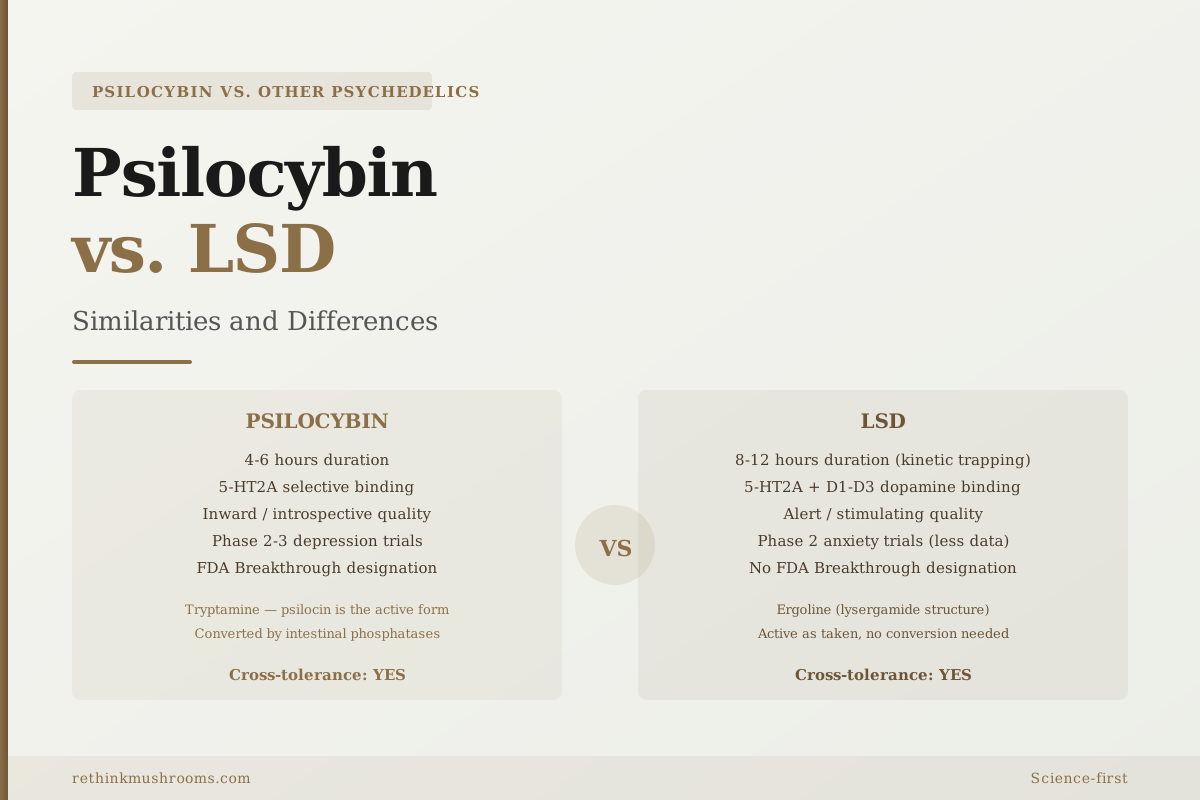
| Feature | Psilocybin | LSD |
|---|---|---|
| Chemical class | Tryptamine (indole alkaloid) | Ergoline (lysergamide) |
| Primary receptor | 5-HT2A (serotonin) | 5-HT2A (serotonin) |
| Secondary receptors | 5-HT2C, 5-HT1A | 5-HT2C, D1-D3 (dopamine), adrenergic |
| Typical duration | 4-6 hours | 8-12 hours |
| Onset (oral) | 30-60 minutes | 30-90 minutes |
| Neural signature | Increased cortical entropy | Increased cortical entropy (slightly stronger) |
| Cross-tolerance | Yes | Yes |
| Depression clinical evidence | Phase 2-3 trials | Phase 2, less data |
| Legal status (US) | Schedule I | Schedule I |
| Experiential character | Inward, introspective | Alert, stimulating |
The most important item in this table is the one readers are least likely to expect: cross-tolerance, yes. If you take one, the other will feel weaker for several days after.
What These Two Compounds Have in Common
Both psilocybin and LSD are classical psychedelics. The term "classical" in psychopharmacology has a specific meaning: these compounds produce their primary effects by activating the 5-HT2A serotonin receptor in the brain's cortex.
The 5-HT2A receptor is densely distributed in the prefrontal cortex, the region associated with self-referential thinking, planning, and the default mode network. Activating it produces a characteristic set of effects: changes in sensory perception, altered sense of self, and in higher doses, profound disruption of ordinary conscious experience.
A 2021 Journal of Neuroscience review comparing psilocybin, LSD, MDMA, and ketamine confirmed that both psilocybin and LSD produce their primary psychedelic effects through 5-HT2A agonism, and that both compounds also share Gq/11 signaling downstream of that receptor activation.[1]
On brain imaging, the similarity continues. A 2017 MEG study by Schartner and colleagues measured neural signal diversity (a measure of how much variety and unpredictability exists in brain activity) in subjects who received psilocybin, LSD, or ketamine.[2] Both psilocybin and LSD significantly increased neural signal diversity compared to baseline, and the increases were qualitatively similar. The brain on either compound shows more varied, less repetitive activity.
Despite different chemical structures, the two compounds converge on similar neural output through the same receptor. This is also why they produce cross-tolerance.
For a deeper look at how 5-HT2A receptor binding differs between compounds, see psilocybin receptor binding: why 5-HT2A selectivity matters.
The Duration Paradox: Same Receptor, But LSD Lasts Twice as Long
This is the question that receptor pharmacology struggled to answer for years: if LSD and psilocin (the active form of psilocybin) both bind 5-HT2A with similar affinity, why does one last 4 to 6 hours and the other last 8 to 12?
The answer came from structural biology. When researchers used crystallography to map the exact molecular structure of LSD bound inside the 5-HT2A receptor, they discovered that the receptor itself changes shape after LSD enters. A loop structure in the receptor's lid region closes over the LSD molecule, physically enclosing it. LSD cannot exit the receptor until this lid re-opens, which takes much longer than LSD would stay bound under ordinary conditions.
The result is that LSD stays active at the receptor for far longer than psilocin, not because LSD has stronger binding affinity in a conventional sense, but because the receptor physically traps it inside.
This kinetic trapping mechanism explains the duration difference without requiring any difference in potency or dose. A 2021 review in the Journal of Neuroscience summarized this as one of the key mechanistic distinctions between LSD and psilocybin: LSD's extended receptor occupancy is a structural consequence of how the molecule fits inside the 5-HT2A binding pocket, not a reflection of stronger pharmacological action.[1]
For context on how psilocybin's own pharmacokinetics shape its duration and onset, see psilocybin pharmacokinetics: onset, peak, and duration.
The D2 Factor: LSD's Dopamine Activity Explains Why It Feels Different
Even beyond duration, researchers and participants consistently describe a qualitative difference in how LSD and psilocybin feel. LSD is frequently described as more mentally alert, more stimulating, and more "external" in quality. Psilocybin is frequently described as more inward, more emotionally weighted, and more likely to produce a sedated or heavy quality.
These experiential differences are consistent with a pharmacological explanation: LSD binds D1, D2, and D3 dopamine receptors in addition to serotonin receptors, while psilocybin's binding is much more selective for serotonin.[1]
Dopamine is associated with alertness, reward, and motivated behavior. The D2 receptor in particular plays a role in arousal and cognitive activation. LSD's activation of this system alongside 5-HT2A produces a combined serotonergic and dopaminergic effect. Psilocybin's effect is more purely serotonergic.
In practical terms, this means the two compounds are likely activating overlapping but non-identical brain circuits. The 2017 Schartner MEG study found that LSD produced slightly stronger increases in cortical neural entropy than psilocybin, which is consistent with the broader receptor profile producing a larger-scale disruption of normal brain activity.[2]
Neither compound is "more psychedelic" in any simple sense. They produce different profiles of effect because they activate different combinations of receptors.
Clinical Evidence: Psilocybin Has More Therapeutic Data, LSD Has Less
In clinical research, the two compounds are not equally developed. Psilocybin has been the subject of Phase 2 and Phase 3 trials for treatment-resistant depression, major depressive disorder, anxiety in terminal illness, and several other conditions. LSD has been studied in Phase 2 trials, primarily for anxiety, with a smaller overall trial count.
A 2025 meta-analysis by Bahji and colleagues compared four psychedelic therapies including psilocybin and LSD on the same outcome measures.[4] Psilocybin showed the largest effect sizes for depression across the included trials. LSD's data was described as "least studied but promising for anxiety," representing a meaningful but smaller evidence base.
A 2025 comprehensive review by Askariyan and colleagues covering all four compounds concluded that psilocybin and LSD show evidence for depression, but that psilocybin's clinical program is more advanced, with more trial data and further regulatory progress.[3]
The gap exists for practical rather than principled reasons. Psilocybin's shorter duration made it easier to design therapy session protocols (a 6-hour session is more manageable than a 10-12 hour one). It also attracted earlier academic interest, which created a head start in clinical development.
LSD's shorter-duration analogs, such as ALD-52 and 1cP-LSD, are being studied partly to address this session-length barrier. That research is not yet at the same stage as psilocybin trials.
For a broader look at how psilocybin compares to the other psychedelic therapies being studied, see the companion articles in this cluster: psilocybin vs. ketamine, psilocybin vs. MDMA, and psilocybin vs. DMT.
Cross-Tolerance: Take One, and the Other Will Feel Weaker
Cross-tolerance between psilocybin and LSD is one of the most well-established practical facts about these compounds. It works in both directions: tolerance acquired from psilocybin reduces the response to LSD for several days, and vice versa.
The mechanism is straightforward: both compounds reduce 5-HT2A receptor sensitivity and availability through the same process. Repeated 5-HT2A activation causes the cell to internalize (pull inward) the receptor, reducing the number of available binding sites on the cell surface. Since both psilocybin and LSD use the same receptor, tolerance to one transfers to the other.
This means that spacing between uses of either compound is necessary to restore full receptor availability, typically several days to a week. Using them on consecutive days produces markedly diminished effects.
For full detail on the tolerance mechanism and how cross-tolerance works across psychedelics, see cross-tolerance between psilocybin, LSD, and other psychedelics.
Regulatory Status: Both Are Schedule I, But Psilocybin Has More Momentum
Both psilocybin and LSD are classified as Schedule I controlled substances in the United States, meaning the federal government considers them to have no currently accepted medical use and high potential for abuse. This classification applies to the compounds themselves regardless of how they are being administered.
However, within this shared regulatory framework, the two compounds are at different stages. Psilocybin holds FDA Breakthrough Therapy designation for treatment-resistant depression and major depressive disorder, which provides a pathway for expedited development and more regular FDA engagement. Several states (Oregon, Colorado) have moved to create regulated psilocybin service frameworks at the state level.
LSD does not currently hold FDA Breakthrough Therapy designation. Clinical trials for LSD analogs continue, but the compound is earlier in the regulatory process.
A 2025 review of psychedelic-assisted therapy by Askariyan and colleagues noted that psilocybin's shorter session duration contributed to its regulatory tractability compared to LSD, where a 10-12 hour session creates greater logistical and staffing burdens for clinical protocols.[3]
Neither compound is available as a prescription treatment in the United States as of 2026.
The Bottom Line
Psilocybin and LSD share their primary mechanism of action (5-HT2A serotonin receptor agonism) and cross-tolerance. They differ in duration (4-6 hours vs. 8-12 hours), explained by a kinetic trapping mechanism in which a structural lid closes over LSD inside the receptor. LSD additionally binds D1-D3 dopamine receptors, which is consistent with its more stimulating experiential character compared to psilocybin. As of 2025, psilocybin has more Phase 2-3 clinical trial data for depression and is further along in the regulatory process; LSD's clinical data is promising but smaller.
Frequently Asked Questions
Sources & References
- 1RTHM-01344·De Gregorio, Danilo et al. (2021). “Hallucinogens in Mental Health: Preclinical and Clinical Studies on LSD, Psilocybin, MDMA, and Ketamine..” The Journal of neuroscience : the official journal of the Society for Neuroscience.Study breakdown →PubMed →↩
- 2RTHM-00489·Schartner, Michael M et al. (2017). “Increased spontaneous MEG signal diversity for psychoactive doses of ketamine, LSD and psilocybin..” Scientific reports.Study breakdown →PubMed →↩
- 3RTHM-02053·Askariyan, Kiana et al. (2025). “An overview of psilocybin, LSD, MDMA, and ketamine in revitalizing psychedelic-assisted therapy: Insights, limitations and future directions..” Progress in neuro-psychopharmacology & biological psychiatry.Study breakdown →PubMed →↩
- 4RTHM-02055·Bahji, Anees et al. (2025). “Efficacy and Safety of Four Psychedelic-Assisted Therapies for Adults with Symptoms of Depression, Anxiety, and Posttraumatic Stress Disorder: A Systematic Review and Meta-Analysis..” Journal of psychoactive drugs.Study breakdown →PubMed →↩