Psilocybin Tolerance and Cross-Tolerance
5-HT2A — the shared receptor behind cross-tolerance
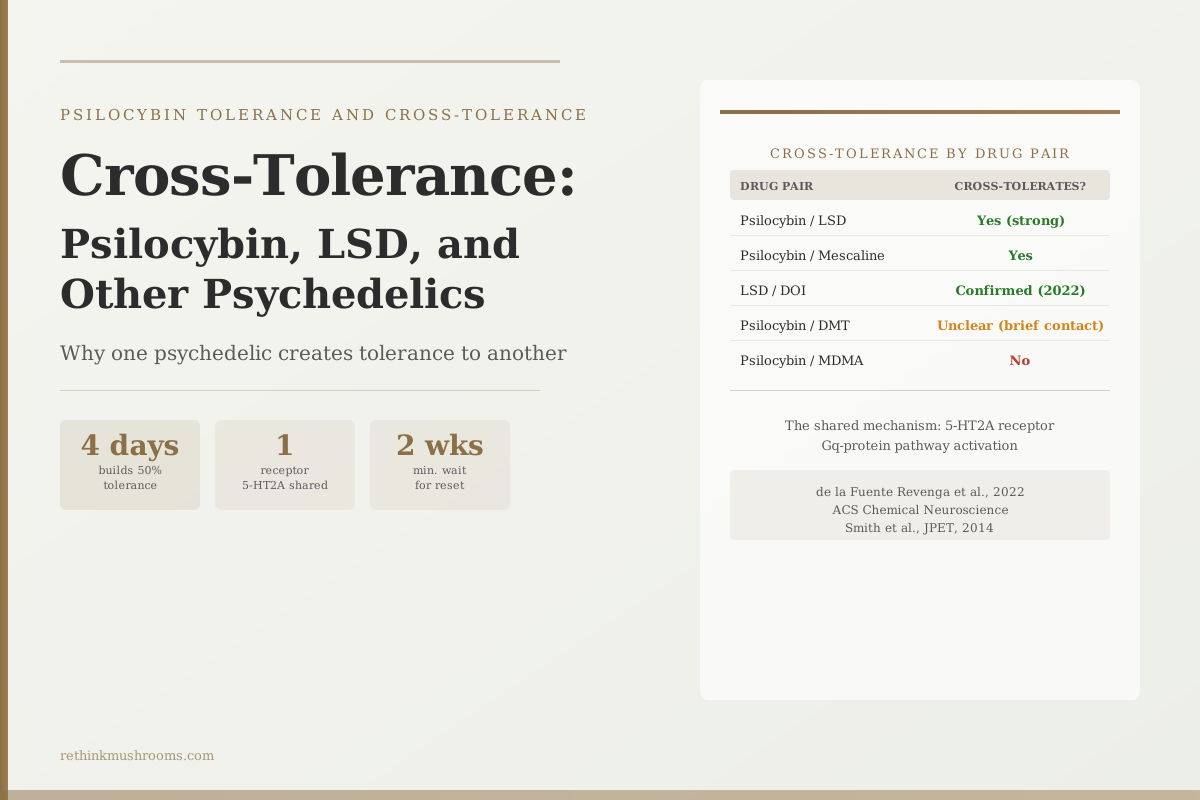
Daily dosing of a psychedelic 5-HT2A agonist produces a progressive decrease in the head-twitch response in mice over four days, and DOI-tolerant mice are also cross-tolerant to LSD. The same 5-HT2A receptor mechanism underlies the long-reported cross-tolerance between psilocybin and LSD in humans.
de la Fuente Revenga et al., ACS Chemical Neuroscience, 2022
2 classes
of psychedelics confirmed to cross-tolerate across structural boundaries: tryptamines and phenethylamines
15 min
DMT duration, apparently too brief to cause the receptor downregulation behind cross-tolerance
1
shared receptor (5-HT2A) responsible for cross-tolerance between psilocybin, LSD, mescaline, and DOI
de la Fuente Revenga et al., ACS Chemical Neuroscience, 2022
 View as image ↗
Take psilocybin on Saturday, then try LSD on Sunday. The LSD will produce little or no effect. Not because LSD doesn't work in your body, but because psilocybin has already depleted the receptor both drugs need to generate their effects. This is cross-tolerance between psilocybin and LSD psychedelics: using one compound temporarily reduces or eliminates the effectiveness of another.
The phenomenon was first reported in humans by Isbell and colleagues in a 1961 paper in Psychopharmacologia titled "Cross tolerance between LSD and psilocybin," which has been the long-standing reference for psilocybin/LSD cross-tolerance even though the original report does not have a modern abstract. The mechanism has since been worked out at the receptor level in animal models. Both drugs activate the same serotonin receptor subtype, called 5-HT2A, and both drive the same receptor-depletion process. When that receptor population is downregulated by one compound, any other compound relying on the same receptors produces a weaker experience.
The broader pharmacology of how psilocybin works and how all tolerance builds is in How Psilocybin Works: The Complete Pharmacology Guide. This article is focused specifically on cross-tolerance: which psychedelics share it, why the mechanism produces it, what makes DMT a probable exception, and what the timeline means practically.
Key Takeaways
- Psilocybin and LSD share complete cross-tolerance because both activate the 5-HT2A serotonin receptor, which downregulates after repeated psychedelic exposure (López-Giménez and González-Maeso 2018)
- Cross-tolerance can extend across structural classes: Smith et al. (2014) found that DOI-tolerant mice were cross-tolerant to the phenethylamine 2C-T-7 and to the tryptamine DPT in the head-twitch response assay, although the same paper found that tryptamines DPT and DIPT did not themselves induce tolerance the way phenethylamines did
- de la Fuente Revenga et al. (2022) confirmed that cross-tolerance between DOI and LSD is mediated by Gq-protein coupling, not by β-arrestin-2 signaling, identifying the exact molecular pathway responsible
- DMT activates the same 5-HT2A receptor but its typical duration of roughly 15 minutes appears too brief to trigger significant receptor downregulation, making cross-tolerance with psilocybin uncertain at typical doses
- MDMA does not cross-tolerate with classical psychedelics because it acts on serotonin transporters rather than directly activating 5-HT2A receptors
- The cross-tolerance window mirrors the psilocybin tolerance window: receptor sensitivity recovers to roughly 50% within a week and returns toward baseline within 1-2 weeks
Why Different Drugs Share the Same Tolerance: The 5-HT2A Explanation
Cross-tolerance between two drugs requires that both use the same biological target. The reason psilocybin and LSD cross-tolerate is not structural similarity. It is receptor overlap.
The 5-HT2A receptor is the serotonin receptor subtype that psychedelics activate to produce their characteristic effects. Psilocin, the active form that psilocybin converts to in the body, binds to 5-HT2A. LSD binds to 5-HT2A. Mescaline binds to 5-HT2A. DOI (a phenethylamine research compound) binds to 5-HT2A. What separates classical psychedelics from other drugs that also bind this receptor is what happens after binding: they selectively activate a specific molecular switch inside the receptor cell, called the Gq-protein pathway.
López-Giménez and González-Maeso, reviewing 5-HT2A signaling in a 2018 paper in Current Topics in Behavioral Neurosciences, documented the pathway in detail.[2] When a psychedelic binds to 5-HT2A, it preferentially activates the Gq-protein side of the receptor's signaling machinery. The Gq pathway, when repeatedly activated, triggers the receptor to be pulled back into the cell and degraded or recycled. Fewer receptors remain on the cell surface. Subsequent doses of any drug requiring those surface receptors produce weaker effects.
This is the mechanism that explains both tolerance within a single drug and cross-tolerance across different drugs. Because all classical psychedelics activate the same Gq-protein pathway at the same receptor, depleting the receptor population through one drug depletes it for all of them.
de la Fuente Revenga and colleagues, in a 2022 study in ACS Chemical Neuroscience, provided the mechanistic confirmation for cross-tolerance specifically.[4] Their mice experiments showed cross-tolerance between DOI and LSD, and they tested a specific hypothesis about which part of the receptor's signaling system was responsible. Knockout mice lacking β-arrestin-2, a different signaling protein in the same receptor system, still developed full tolerance and cross-tolerance. This ruled out β-arrestin-2 and confirmed that tolerance is driven by the Gq-protein pathway. The mechanism is not general receptor fatigue: it is pathway-specific.
Which Psychedelics Cross-Tolerate: The Evidence by Drug Pair
The cross-tolerance picture is clear for some pairs and uncertain for others. Halberstadt and colleagues, in a 2020 paper in Neuropharmacology, found a strong cross-species potency correlation (r = 0.9448 across 36 compounds) between mouse head-twitch response potencies and reported hallucinogenic potencies in humans, supporting the HTR assay's translational relevance for hallucinogen psychopharmacology.[3]
| Drug Pair | Cross-Tolerance | Evidence |
|---|---|---|
| Psilocybin / LSD | Strong, bidirectional in humans | Isbell 1961 (no abstract; long-cited in the field); 5-HT2A mechanism confirmed in animal models |
| LSD / DOI | Confirmed in mice | de la Fuente Revenga et al. 2022 |
| DOI / 2C-T-7 / DPT | Demonstrated DOI→2C-T-7 and DOI→DPT cross-tolerance in mice; tryptamines DPT and DIPT did not induce their own tolerance | Smith et al. 2014 |
| Psilocybin / Mescaline | Inferred from the shared 5-HT2A mechanism, not directly tested | Mechanistic inference only |
| LSD / Mescaline | Inferred from the shared 5-HT2A mechanism, not directly tested | Mechanistic inference only |
| Psilocybin / DMT | Unclear at typical doses | Mechanistic inference only |
| Psilocybin / MDMA | No | Different mechanism (transporter, not direct 5-HT2A agonist) |
Psilocybin and LSD. The best-documented pair. Isbell's 1961 human experiments showed that tolerance to one was tolerance to the other in both directions. Later mechanistic work explained why: psilocin and LSD both bind 5-HT2A with high affinity and both activate the Gq pathway. Any depletion of available 5-HT2A receptors by one compound reduces the accessible binding sites for the other.
Cross-structural-class cross-tolerance. Smith and colleagues, writing in the Journal of Pharmacology and Experimental Therapeutics in 2014, found that cross-tolerance can extend beyond a single chemical family.[1] They tested two phenethylamines (DOI and 2C-T-7) and two tryptamines (DPT and DIPT) in mouse head-twitch response experiments. Daily DOI or 2C-T-7 produced tolerance to itself and DOI-tolerant mice were also cross-tolerant to 2C-T-7 and to DPT, with the cross-tolerance insurmountable by dose. Importantly, the same paper found that DPT and DIPT did not themselves develop tolerance under daily dosing, which led the authors to suggest that tryptamine-class hallucinogens "might have a reduced potential for tolerance development, compared with phenethylamine-derived 5-HT2A agonists." The Smith 2014 paper did not test psilocybin or mescaline directly, so its findings extend to those compounds only by mechanistic inference about the shared 5-HT2A target.
LSD and DOI. de la Fuente Revenga et al. 2022 confirmed the cross-tolerance between these two phenethylamine and ergoline compounds directly, and went further by identifying the Gq-protein pathway as the specific mechanism. This is the most recent mechanistic confirmation of the cross-tolerance phenomenon.[4]
The DMT Exception: Why 15 Minutes May Not Be Enough to Build Tolerance
DMT (dimethyltryptamine) creates a natural test case for the cross-tolerance mechanism. It is a tryptamine, structurally related to psilocybin. It activates the 5-HT2A receptor. On pharmacological grounds alone, it should cross-tolerate with psilocybin and LSD.
The apparent exception comes from DMT's duration of action. Smoked or vaporized DMT produces effects that typically last 10 to 20 minutes. Psilocybin lasts 4 to 6 hours. LSD lasts 8 to 12 hours. The question is whether the brief period of 5-HT2A activation from DMT is long enough to trigger the receptor internalization process that drives tolerance.
The evidence from de la Fuente Revenga et al. 2022 points toward receptor contact time mattering.[4] Tolerance in their experiments developed through repeated exposure over days, not through a single brief exposure. The Gq-protein signaling that drives receptor downregulation appears to require sustained or repeated activation.
DMT's 15-minute window likely provides insufficient 5-HT2A activation to trigger the same downregulation that psilocybin's 4-to-6-hour engagement produces. This would explain the experiential observation that DMT remains effective even shortly after other psychedelics. It is not that DMT bypasses the receptor: it is that the receptor-depletion process is not triggered at typical smoked doses.
The caveat is that this is mechanistic inference, not confirmed experimental data. No human study has tested DMT cross-tolerance with psilocybin directly. The comparison of DMT and psilocybin's broader pharmacological differences is explored in Psilocybin vs. DMT: Comparing Two Tryptamine Psychedelics.
MDMA: A Different Drug, a Different Mechanism
MDMA is frequently grouped with psychedelics in recreational and cultural contexts. Its pharmacology is fundamentally different.
Classical psychedelics are 5-HT2A receptor agonists. They bind to the receptor directly and activate its signaling pathway. MDMA does not bind to 5-HT2A as an agonist. Its primary action is on serotonin transporters: it causes neurons to release serotonin and blocks the transporters that would normally remove it from the synapse. The flood of serotonin activates many serotonin receptor subtypes, including 5-HT2A, but indirectly, not through direct receptor binding.
This distinction matters for cross-tolerance in a specific way. The receptor downregulation that classical psychedelics cause is triggered by direct, sustained 5-HT2A agonism through the Gq pathway. Indirect activation through serotonin flooding does not trigger the same receptor-internalization process to the same degree.
The practical implication: psilocybin tolerance does not affect MDMA's effects, and MDMA use does not deplete 5-HT2A receptors in a way that reduces subsequent psilocybin effects. They act through different enough mechanisms that the cross-tolerance framework does not apply.
MDMA has its own tolerance mechanisms, involving serotonin transporter downregulation and depletion of serotonin vesicles, but those are independent of the 5-HT2A downregulation that underlies classical psychedelic cross-tolerance.
The Practical Window: How Long Between Psilocybin and LSD?
Since psilocybin and LSD share complete cross-tolerance, the waiting period before using one after the other is the same as the psilocybin tolerance recovery window.
The mechanism: de la Fuente Revenga et al. showed that four days of repeated DOI dosing produced a progressive decrease in the head-twitch response in mice, and that tolerance was also observable 24 h after a single DOI administration.[4] Receptor recovery timelines come from animal-model and clinical observation rather than from a head-to-head human RCT: tolerance is reported to lift over roughly one to two weeks, with partial recovery within the first week, although exact recovery curves have not been formally measured in humans.
At 7 days after psilocybin: LSD will produce roughly half to two-thirds of its typical effect. At 14 days: LSD sensitivity is near but not necessarily at full baseline.
This relationship is symmetric. LSD use reduces psilocybin sensitivity by the same logic. The receptor does not distinguish between the two compounds. What it registers is whether its surface population has been downregulated, and by how much.
The 14-day minimum is a widely cited guideline in both harm-reduction and research contexts. Clinical psilocybin trials consistently use 2-to-4-week intervals between sessions, partly for this reason and partly because the therapeutic benefit from each session needs time to integrate before another dose. The deeper evidence on spacing intervals is in How Long Between Psilocybin Sessions? The Tolerance Window.
For the broader receptor science behind the cross-tolerance mechanism, see Psilocybin and the 5-HT2A Receptor: The Key to Psychedelic Effects. For the psilocybin-versus-LSD comparison in full, including differences in duration, potency, and risk profile, see Psilocybin vs. LSD: Similarities and Differences.
The self-limiting nature of psychedelic tolerance, and why it contrasts sharply with addiction pharmacology, is covered in Why Psychedelic Tolerance Is Self-Limiting.
The Bottom Line
Cross-tolerance between classical psychedelics traces to a single shared receptor: the 5-HT2A serotonin receptor, which psilocybin, LSD, mescaline, and other classical psychedelics all activate through the same Gq-protein pathway. When one compound depletes available 5-HT2A receptors, all drugs requiring those receptors produce weaker effects. de la Fuente Revenga et al. (2022) confirmed the Gq-protein mechanism and ruled out β-arrestin-2, resolving the molecular basis. DMT is a probable exception because its brief receptor contact appears insufficient to trigger the same downregulation; MDMA is a definite exception because it uses a fundamentally different mechanism and does not directly activate 5-HT2A.
Frequently Asked Questions
Sources & References
- 1RTHM-00644·Smith, Douglas A et al. (2014). “Tolerance and cross-tolerance to head twitch behavior elicited by phenethylamine- and tryptamine-derived hallucinogens in mice..” The Journal of pharmacology and experimental therapeutics.Study breakdown →PubMed →↩
- 2RTHM-00980·López-Giménez, Juan F et al. (2018). “Hallucinogens and Serotonin 5-HT2A Receptor-Mediated Signaling Pathways..” Current topics in behavioral neurosciences.Study breakdown →PubMed →↩
- 3RTHM-01195·Halberstadt, Adam L et al. (2020). “Correlation between the potency of hallucinogens in the mouse head-twitch response assay and their behavioral and subjective effects in other species..” Neuropharmacology.Study breakdown →PubMed →↩
- 4RTHM-01502·de la Fuente Revenga, Mario et al. (2022). “Tolerance and Cross-Tolerance among Psychedelic and Nonpsychedelic 5-HT2A Receptor Agonists in Mice..” ACS chemical neuroscience.Study breakdown →PubMed →↩