Psilocybin Tolerance, Tachyphylaxis, and Cross-Tolerance
2-4 weeks clinical session spacing
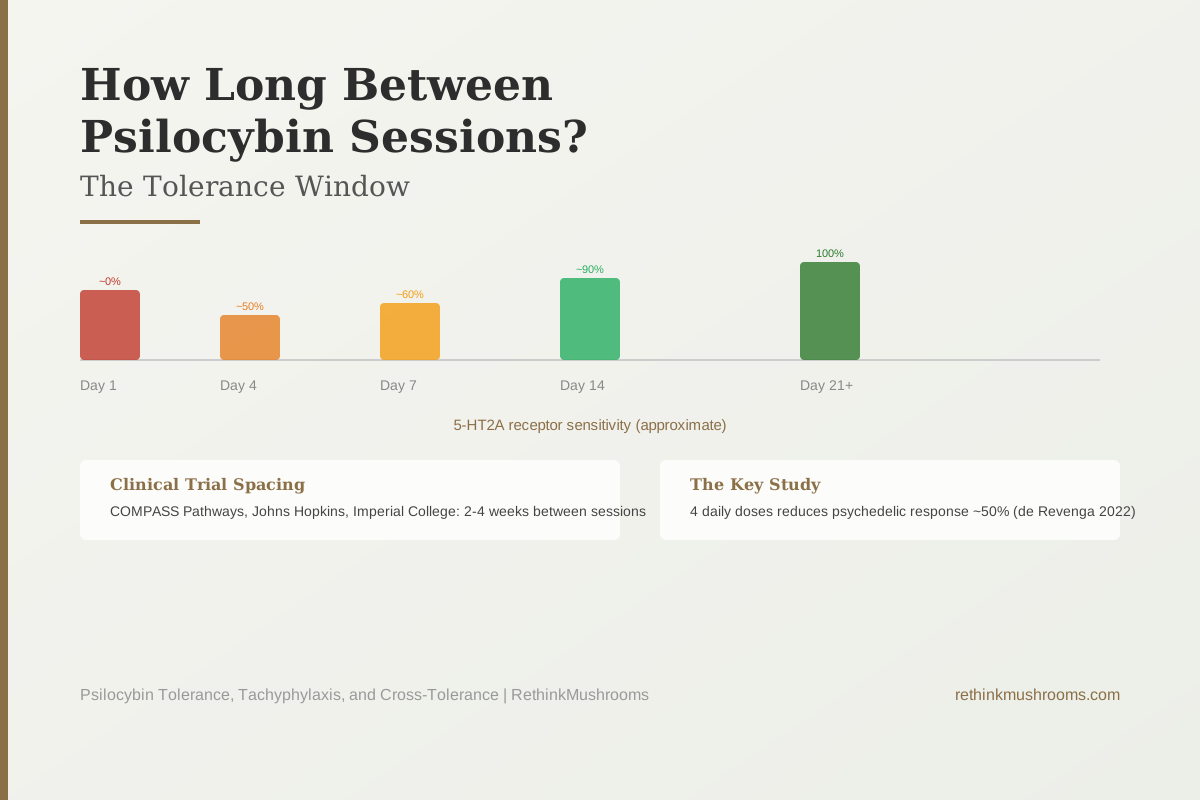
Clinical psilocybin trials space sessions 2-4 weeks apart. A 2022 study quantified why: 4 days of repeated dosing reduces the psychedelic response by roughly 50%. The 5-HT2A receptor that psilocybin activates needs time to recover.
de la Fuente Revenga et al., ACS Chemical Neuroscience, 2022
Single dose
is enough to trigger 5-HT2A receptor downregulation, per pig brain PET imaging (Raval et al., 2021)
~50%
reduction in psychedelic response after 4 days of daily dosing (de la Fuente Revenga et al., 2022)
r = 0.85
correlation between 5-HT2A receptor occupancy and subjective psychedelic intensity in humans (Madsen et al., 2019)
de la Fuente Revenga et al., ACS Chemical Neuroscience, 2022
 View as image ↗
The short answer: the research supports waiting at least two weeks between psilocybin sessions for a full tolerance reset. Clinical trials consistently use 2-4 weeks. The reason is not arbitrary caution. It is biology. Psilocybin works by activating a specific receptor, and that receptor responds to activation by reducing its own availability. Understanding why this happens makes the timeline both intuitive and predictable.
This article explains the receptor mechanism, the timeline the evidence supports, how clinical trials translate this into protocol, and why there is a meaningful difference between "tolerant to the psychedelic experience" and "tolerant to the therapeutic effects." For background on the receptor system at the center of this, see Psilocybin and the 5-HT2A Receptor: The Key to Psychedelic Effects. For the broader pharmacology, see How Psilocybin Works: The Complete Pharmacology Guide.
Key Takeaways
- A single psilocybin dose is sufficient to initiate 5-HT2A receptor downregulation, meaning tolerance begins immediately after the first session (Raval et al., 2021)
- Repeated daily dosing for 4 days reduces the psychedelic response by approximately 50%, per a 2022 study using validated animal models (de la Fuente Revenga et al., 2022)
- The strength of the psychedelic experience directly correlates with the percentage of 5-HT2A receptors occupied by psilocin (the active metabolite), per a human PET study (Madsen et al., 2019)
- Receptor sensitivity returns to approximately 50% within 3-7 days and to near-baseline within 2 weeks; individual variation exists in both the rate of downregulation and recovery
- Clinical psilocybin trials including landmark COMPASS Pathways and Johns Hopkins depression studies use 2-4 week session intervals, reflecting both the tolerance timeline and the extended nature of therapeutic integration
- Tolerance to the acute hallucinogenic experience may develop faster and resolve faster than tolerance to neuroplastic effects; the therapeutic benefit can outlast the tolerance window
Why Tolerance Happens: The Receptor Pulls Itself Back
Psilocybin's psychedelic effects require that its active metabolite, psilocin, bind to 5-HT2A receptors on neurons in the brain. The 5-HT2A receptor is a serotonin receptor, and when psilocin occupies it, it activates a signaling chain inside the cell called the Gq pathway. This activation produces the characteristic alterations in perception, cognition, and emotional processing associated with psilocybin experiences.
The cell responds to this activation in a predictable way: it reduces the number of available receptors. This process is called receptor downregulation. The cell physically pulls receptors off the surface, reducing the total count available for the next encounter with psilocin. Fewer available receptors means less Gq pathway activation for the same dose, which means a weaker subjective experience.
Smith and colleagues documented this specific mechanism in 1999, showing that tolerance to psychedelic effects is mediated by 5-HT2A receptor downregulation specifically, not by desensitization of the related 5-HT2C receptor.[1] The selectivity matters: tolerance to psilocybin is receptor-specific, which is part of why the recovery timeline is predictable rather than open-ended.
A Single Dose Starts the Clock
Raval and colleagues published a striking 2021 finding from a pig brain PET imaging study.[2] PET imaging can measure receptor density across the brain at specific time points. After a single dose of psilocybin, they measured two simultaneous changes in the pig frontal cortex: 5-HT2A receptor density decreased, and synaptic density increased.
The decrease in receptor density is the tolerance signal: even one session initiates the downregulation process. The increase in synaptic density is the neuroplasticity signal: the same session also triggers new connections between neurons (a process called synaptogenesis). These two effects happening simultaneously from a single dose is notable because it means tolerance and neuroplastic benefit are not competing events. They appear to start together.
The practical implication for session spacing: after a first session, the tolerance clock has already begun. A second session the following day would encounter a partially depleted receptor landscape before recovery has had any time to occur.
How Fast Tolerance Accumulates With Repeated Use
De la Fuente Revenga and colleagues provided the most precise available data on tolerance accumulation rate in a 2022 paper.[4] Using validated animal models that reliably predict human psychedelic responses, the study tested what happens to the psychedelic response when dosing is repeated daily for 4 days.
After 4 days of daily dosing, the measured psychedelic response had dropped by approximately 50% compared to the first dose. The study also confirmed that this tolerance is mediated through the Gq protein signaling pathway (the primary route psilocybin activates when it binds 5-HT2A) rather than through a different signaling pathway called β-arrestin-2. Blocking β-arrestin-2 did not prevent tolerance from developing, which establishes that the Gq pathway itself is responsible for driving the downregulation.
This 4-day, 50% relationship provides the most data-grounded anchor for the tolerance timeline: after just 4 daily sessions, you would need roughly twice the dose to achieve the same effect as the first session. After longer intervals of daily use, the relationship would worsen further.
Why Occupancy Is Everything
Madsen and colleagues published a human PET study in 2019 that directly measured the relationship between 5-HT2A receptor occupancy and subjective experience.[3] They gave different psilocybin doses to participants, used PET imaging to measure what fraction of 5-HT2A receptors were occupied by psilocin at peak effect, and correlated that occupancy with self-reported experience intensity.
The correlation was strong: higher receptor occupancy directly predicted stronger subjective psychedelic effects. This is the mechanism that makes partial tolerance so intuitive. If 25% fewer receptors are available after a recent session, and those remaining receptors are occupied at the same rate by the same dose, the total signal reaching the brain is proportionally less. The experience would be weaker not because of psychological expectation but because of the literal reduction in receptor-level signaling.
This occupancy model also explains why simply increasing the dose cannot compensate indefinitely for tolerance. If receptors have been downregulated by 50%, doubling the dose would increase occupancy of the remaining receptors but cannot compensate for the missing receptors themselves.
The Recovery Timeline
The evidence for the recovery side of the tolerance window is less precisely characterized than the buildup side, partly because methodological standardization across studies is more variable. The published consensus across preclinical and clinical data supports the following general timeline:
Day 1 following a session: Tolerance is at its highest. The psychedelic experience would be markedly attenuated by any subsequent dose taken this day.
Days 2-7: 5-HT2A receptor density gradually recovers. Recovery is not linear; the first several days likely see faster rebound than the final days approaching baseline. Sensitivity at the 7-day mark is estimated at roughly 50-70% of baseline in most published estimates, with meaningful individual variation.
Days 7-14: Recovery continues through the second week toward baseline. For most people, sensitivity at 14 days is close to but not fully equivalent to a completely naive receptor landscape.
Beyond 14 days: For people who use psilocybin infrequently (several weeks or more between sessions), 5-HT2A receptor density returns to individual baseline. The speed of this recovery appears to be affected by dose size, individual variation in receptor turnover, and potentially by previous cumulative use history.
These estimates reflect the best available synthesis of animal and human data. The exact timing varies between individuals, and there is no published human neuroimaging study directly tracking recovery at multiple time points after a single therapeutic dose.
What Clinical Trials Do (And Why)
Clinical trials provide the most direct evidence of what researchers with the most mechanistic knowledge have concluded about appropriate session spacing. The landmark psilocybin depression trials, including those from COMPASS Pathways, the Johns Hopkins group, and the Imperial College London group, have all used session intervals of 2-4 weeks between doses in their therapeutic protocols.
This spacing is not solely driven by tolerance biology. Therapeutic psilocybin protocols include substantial preparation before each session and integration work after: a process of making meaning from the experience and connecting it to therapeutic goals. Integration typically requires 1-2 weeks at minimum. A 2-4 week interval accommodates both the neurobiological recovery window and the therapeutic process.
The 2-week minimum common in these trials is consistent with the 5-HT2A recovery timeline: at 14 days, most participants have recovered to near-baseline receptor sensitivity, meaning the second session encounters a receptor landscape comparable to the first.
An Important Nuance: Two Different Tolerances
The acute psychedelic experience and the therapeutic benefits may follow different timelines.
Tolerance to the subjective psychedelic experience (the perceptual alterations, the intensity of the experience) depends on how many 5-HT2A receptors are available at the time of the session. This tolerance builds and reverses on the timeline described above.
Tolerance to the neuroplastic effects (the formation of new synaptic connections that the Raval 2021 PET study documented) may operate on a different schedule. Synaptogenesis takes time to produce its downstream effects on mood, cognition, and behavior. The antidepressant effects seen in clinical trials often continue improving for weeks after the session, well past the point where the acute psychedelic tolerance has already resolved.
This means the therapeutic benefit and the hallucinogenic experience do not have to fully reset at the same pace. Someone who has used psilocybin recently might still be experiencing therapeutic benefits even as the acute psychedelic tolerance resolves, and conversely, someone whose acute tolerance has reset fully might still be in a therapeutic integration period where a second session would be less productive than waiting.
For the specific mechanisms of how tolerance builds with repeated use, see Psilocybin Tolerance: How Fast Does It Build?. For the distinction between tolerance and tachyphylaxis (the rapid, session-by-session version), see Psilocybin and Tachyphylaxis: Why You Can't Trip Two Days in a Row. For why this tolerance mechanism makes psilocybin low in abuse potential, see Why Psychedelic Tolerance Is Self-Limiting and Cross-Tolerance Between Psilocybin, LSD, and Other Psychedelics.
For how long psilocybin lasts at different doses, see How Long Does Psilocybin Last? Duration by Dose.
The Bottom Line
The evidence for session spacing converges on a 2-week minimum for near-baseline 5-HT2A receptor recovery, with clinical trials consistently using 2-4 weeks between sessions. The mechanism is specific: a single psilocybin dose initiates 5-HT2A receptor downregulation (Raval 2021), repeated daily dosing reduces the psychedelic response by approximately 50% after 4 days (de la Fuente Revenga 2022), and the intensity of the experience correlates directly with how many receptors are available for occupancy (Madsen 2019). Two weeks accommodates the neurobiological reset and allows for the therapeutic integration process that clinical protocols require. Tolerance to the acute experience and tolerance to the neuroplastic effects may not follow identical timelines.
Frequently Asked Questions
Sources & References
- 1RTHM-00069·Smith, R L et al. (1999). “Mechanism of tolerance development to 2,5-dimethoxy-4-iodoamphetamine in rats: down-regulation of the 5-HT2A, but not 5-HT2C, receptor..” Psychopharmacology.Study breakdown →PubMed →↩
- 2RTHM-00714·Raval, Nakul Ravi et al. (2021). “A Single Dose of Psilocybin Increases Synaptic Density and Decreases 5-HT2A Receptor Density in the Pig Brain..” International journal of molecular sciences.Study breakdown →PubMed →↩
- 3RTHM-00578·Madsen, Martin K et al. (2019). “Psychedelic effects of psilocybin correlate with serotonin 2A receptor occupancy and plasma psilocin levels..” Neuropsychopharmacology : official publication of the American College of Neuropsychopharmacology.Study breakdown →PubMed →↩
- 4RTHM-01502·de la Fuente Revenga, Mario et al. (2022). “Tolerance and Cross-Tolerance among Psychedelic and Nonpsychedelic 5-HT2A Receptor Agonists in Mice..” ACS chemical neuroscience.Study breakdown →PubMed →↩