Psilocybin vs. Other Psychedelics
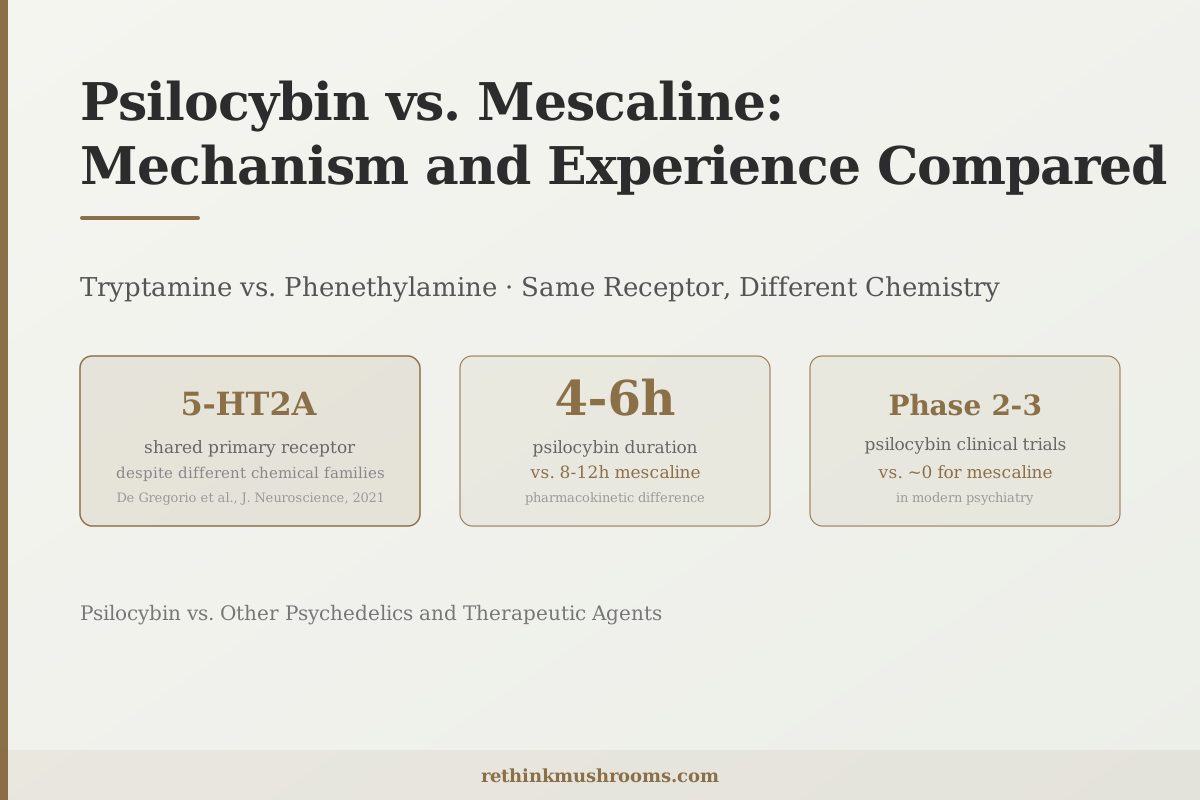
8-12h mescaline duration
Mescaline lasts 8-12 hours despite binding to the same serotonin receptor as psilocybin (4-6 hours). The difference lies in pharmacokinetics and mescaline's additional adrenaline-like receptor activity — same destination, very different journey.
De Gregorio et al., Journal of Neuroscience, 2021
Phenethylamine
mescaline's chemical family — the same class as dopamine and adrenaline, structurally unrelated to psilocybin's tryptamine family
5-HT2A
the primary serotonin receptor both psilocybin and mescaline activate, despite belonging to completely different chemical classes
Near zero
Phase 2-3 clinical trials for mescaline-assisted therapy in modern psychiatry — psilocybin has dozens
De Gregorio et al., Journal of Neuroscience, 2021
 View as image ↗
Psilocybin and mescaline share almost nothing at the molecular level. Psilocybin belongs to the tryptamine family, the same chemical class as serotonin itself. Mescaline belongs to the phenethylamine family — the same broad class as dopamine and adrenaline. These are structurally distinct groups with different ring systems, different carbon chains, different everything. Yet both compounds produce strikingly similar psychedelic effects by activating the same serotonin receptor in the brain.[1]
This convergence is one of the more striking facts in psychedelic pharmacology. Two molecules from completely different chemical families, converging independently on the same receptor target and producing broadly similar experiences. The differences in how they get there — and in what else they activate along the way — explain why mescaline lasts twice as long, feels more physical, and has a distinct character compared to psilocybin. This article covers the psilocybin vs. mescaline comparison in terms of mechanism, experience, and clinical evidence. For the foundation of psilocybin's pharmacology, see the complete psilocybin pharmacology guide.
Key Takeaways
- Psilocybin is a tryptamine (same chemical family as serotonin); mescaline is a phenethylamine (same family as dopamine and adrenaline) — structurally unrelated compounds that both activate the 5-HT2A serotonin receptor[1]
- Mescaline also activates receptors that respond to adrenaline, explaining why it produces more cardiovascular stimulation and physical body sensations than psilocybin
- Duration differs substantially: psilocybin's effects last 4-6 hours; mescaline's last 8-12 hours, consistent with mescaline's different metabolic elimination profile
- De Gregorio et al. (2021) confirmed that psilocybin and LSD share the 5-HT2A agonism mechanism with mescaline, but differ in secondary receptor targets — the secondary targets drive qualitative experiential differences[1]
- Psilocybin has been studied in dozens of Phase 2 and Phase 3 clinical trials for depression, addiction, and anxiety; mescaline has effectively no modern randomized clinical trial data for psychiatric indications[2]
- Peyote (the primary natural source of mescaline) holds a federal religious exemption for Native American ceremonial use in the US; psilocybin mushrooms have no equivalent federal exemption but are undergoing decriminalization at state and municipal levels
Psilocybin vs. Mescaline at a Glance
| Feature | Psilocybin | Mescaline |
|---|---|---|
| Chemical family | Tryptamine (indole alkaloid) | Phenethylamine |
| Primary receptor | 5-HT2A serotonin agonist | 5-HT2A serotonin agonist |
| Secondary activity | Relatively selective | Adrenergic receptor activation |
| Onset | 30-60 minutes (oral) | 1-2 hours (oral) |
| Duration | 4-6 hours | 8-12 hours |
| Primary natural source | Psilocybe mushrooms | Peyote cactus, San Pedro cactus |
| Clinical trial evidence | Extensive (Phase 2-3 for depression, addiction) | Near-absent in modern psychiatry |
| US legal status | Schedule I; state/city decriminalization ongoing | Schedule I; federal religious exemption for Native American ceremonial use |
| FDA breakthrough designation | Yes (depression, addiction) | No |
Both compounds produce altered visual perception, changed sense of time, and introspective states. The table above reflects the pharmacological and research differences; the experiential overlap is real and significant.
Two Completely Different Molecules, Same Destination: The 5-HT2A Receptor
The 5-HT2A receptor is sometimes called the "psychedelic receptor" — it is the primary molecular target of nearly every classical psychedelic, from psilocybin and LSD to mescaline and DMT. The fact that such structurally diverse compounds all converge on this one receptor tells researchers something important: this receptor is uniquely capable of generating the altered states associated with psychedelic experiences.
De Gregorio and colleagues (2021) synthesized what is known about this convergence in a comprehensive Journal of Neuroscience review of hallucinogens in mental health.[1] Their analysis covered psilocybin, LSD, MDMA, and ketamine. A key finding relevant to the mescaline comparison: although multiple compounds activate 5-HT2A, they differ in how strongly they activate the downstream signaling cascade inside the cell — specifically, a protein called Gq/11. LSD produces stronger Gq/11 signaling than psilocybin. Mescaline, as a phenethylamine with different structural geometry at the receptor binding site, produces a subtly different activation signature even though it hits the same receptor.
This matters for understanding why mescaline and psilocybin feel similar but not identical. Same receptor, but the receptor "reads" the molecule differently based on its shape. The downstream signal is not identical. The resulting experience is not identical.
The convergent pharmacology also explains why cross-tolerance exists between these compounds. If you take psilocybin and then mescaline the following day, the mescaline will be less effective. This is because the 5-HT2A receptors have already downregulated in response to the previous day's agonist stimulation. For a deeper explanation of psilocybin's receptor binding and selectivity, see psilocybin receptor binding affinity and 5-HT2A selectivity.
Why Mescaline Feels More Physical: Adrenaline-Like Receptor Activity
If mescaline and psilocybin activate the same primary receptor, why do experienced users consistently describe them as qualitatively different?
The answer lies in mescaline's secondary receptor activity. Mescaline, as a phenethylamine, weakly activates receptors that normally respond to adrenaline and noradrenaline (the body's stress-response neurotransmitters). These receptors control heart rate, blood pressure, pupil dilation, and various body-level arousal states. Psilocybin is much more selective for serotonin receptors and does not substantially activate this adrenaline-responsive system at typical doses.
The practical consequence: mescaline tends to produce more noticeable cardiovascular effects than psilocybin at equivalent experiential doses. Heart rate and blood pressure may rise more substantially. The experience is often described as more energetic and body-present, with vivid and highly saturated visual effects dominating. Psilocybin's experience more commonly turns inward — less visual stimulation for many people, more shift in thought patterns, emotional content, and sense of self.
Yao and colleagues (2024) conducted a meta-analysis of psychedelic therapy for mental disorders that addressed adverse event profiles across substances.[3] The analysis found that MDMA (another phenethylamine) showed higher rates of elevated blood pressure and cardiovascular effects compared to tryptamine-class compounds like psilocybin. Mescaline shares phenethylamine chemistry with MDMA, and while their specific mechanisms are different, this adrenergic overlap pattern is consistent.
Neither compound poses significant cardiac risk at typical doses in healthy individuals, but the profile difference is relevant for people with underlying cardiovascular conditions. Mescaline's adrenaline-like activity makes it more physiologically activating.
Duration: Why a Peyote Ceremony Lasts All Night and a Psilocybin Session Is Done by Afternoon
Mescaline's 8-12 hour duration represents one of the longest natural psychedelic experiences. Psilocybin's 4-6 hours is more contained. The same primary receptor activation, very different time commitment.
The duration difference traces back to how quickly each compound is cleared from the body. Psilocybin is converted to psilocin after ingestion, and psilocin has a relatively short half-life. The peak blood concentration passes, the receptor occupancy drops, and the experience resolves. For a detailed look at psilocybin's timeline, see psilocybin pharmacokinetics: onset, peak, and duration.
Mescaline is eliminated more slowly. It takes longer to reach peak blood levels (onset is typically 1-2 hours vs. 30-60 minutes for psilocybin) and it remains at effective concentrations in the blood for significantly longer. The slower elimination means the window of receptor occupancy stays open for substantially more time.
This duration difference has real practical significance for ceremonial and therapeutic use. Traditional peyote ceremonies in Native American contexts are all-night affairs, structured around the full arc of the mescaline experience. A psilocybin therapy session, by contrast, can be scheduled for an 8-hour day and wrapped by evening. For clinic scheduling, insurance negotiations, and the economics of therapy delivery, this duration difference matters.
Psilocybin Has Dozens of Clinical Trials. Mescaline Has Almost None.
The research landscape for these two compounds looks nothing alike.
Psilocybin has been tested in randomized controlled trials for treatment-resistant depression, major depression, alcohol use disorder, tobacco dependence, cancer-related existential distress, and OCD. Multiple Phase 2 trials have been published. A Phase 3 trial is underway. Two NEJM publications exist. The FDA has granted breakthrough therapy designation for psilocybin in two conditions.
Mescaline occupies a different position entirely in clinical research. Askariyan and colleagues (2025) published a comprehensive review of psilocybin, LSD, MDMA, and ketamine in psychedelic-assisted therapy — four compounds, no mescaline.[2] The omission reflects the actual research landscape: mescaline has effectively no modern Phase 2 or Phase 3 clinical trial data for psychiatric indications. Most mescaline research predates the current era of randomized controlled trials.
Yao and colleagues' (2024) meta-analysis of psychedelic therapy efficacy also did not include mescaline in its evidence synthesis — not because of editorial exclusion, but because no eligible modern trials existed.[3]
The reasons are partly legal and partly historical. Mescaline was scheduled alongside psilocybin in 1970. Unlike psilocybin, it did not attract major institutional research interest in the revival era that began in the 1990s. MAPS (the Multidisciplinary Association for Psychedelic Studies) focused on MDMA. Johns Hopkins and Imperial College focused on psilocybin. Mescaline research did not receive comparable investment.
This does not mean mescaline is therapeutically inert. Traditional use across centuries in multiple indigenous cultures suggests real psychological potency. But the clinical trial evidence that would establish safety and efficacy to FDA standards simply does not exist for mescaline in the way it does for psilocybin.
For comparison articles with substances that do have clinical trial data, see psilocybin vs. ketamine: different mechanisms, overlapping applications and psilocybin vs. MDMA: comparing therapeutic approaches.
The Legal Divide: Federal Religious Exemption vs. Decriminalization
The legal status of mescaline and psilocybin are both complicated, but in different ways.
Mescaline (as peyote) holds a unique legal position in the United States. The American Indian Religious Freedom Act and subsequent federal rulings protect the sacramental use of peyote by members of the Native American Church. This protection is explicitly federal and coexists with Schedule I classification — meaning peyote remains illegal for everyone outside that specific religious context, but its ceremonial use is formally protected in a way that has no equivalent for psilocybin.
Psilocybin lacks any federal exemption but has seen a wave of state and municipal decriminalization. Oregon legalized supervised psilocybin services in 2020 (Measure 109). Colorado passed Proposition 122 in 2022. Multiple cities including Denver, Oakland, and Washington D.C. have decriminalized possession. This decriminalization trajectory has no parallel for mescaline at the state level.
Neither peyote/mescaline nor psilocybin is FDA-approved. The pathways differ: psilocybin is advancing through clinical trials with a plausible FDA approval timeline; mescaline has no equivalent clinical development pipeline.
The San Pedro cactus (which contains mescaline) occupies an additional ambiguous space. The cactus itself is legal to grow as an ornamental plant in the US; extracting mescaline from it is Schedule I. This parallels the status of psilocybin mushroom spores, which are legal to possess in most US states, while growing mushrooms to the point of psilocybin production is not.
For more on the regulatory and policy context around psilocybin specifically, see psilocybin vs. LSD: similarities and differences and what happens in your brain on psilocybin: a neuroscience explainer.
The Bottom Line
Psilocybin and mescaline share a primary receptor target — the 5-HT2A serotonin receptor — despite belonging to completely different chemical families. This convergent pharmacology explains their similar psychedelic effects. The differences flow from mescaline's additional adrenergic activity (more physical, cardiovascular stimulation), its slower elimination (8-12 hours vs. 4-6 hours), and its dramatically thinner clinical research base. Psilocybin has advanced through Phase 2-3 trials with FDA breakthrough designation; mescaline has no comparable modern clinical trial record. Legal status differs as well: peyote holds a federal religious exemption for Native American ceremonial use, while psilocybin is progressing through state-level decriminalization and clinical development.
Frequently Asked Questions
Sources & References
- 1RTHM-01344·De Gregorio, Danilo et al. (2021). “Hallucinogens in Mental Health: Preclinical and Clinical Studies on LSD, Psilocybin, MDMA, and Ketamine..” The Journal of neuroscience : the official journal of the Society for Neuroscience.Study breakdown →PubMed →↩
- 2RTHM-02053·Askariyan, Kiana et al. (2025). “An overview of psilocybin, LSD, MDMA, and ketamine in revitalizing psychedelic-assisted therapy: Insights, limitations and future directions..” Progress in neuro-psychopharmacology & biological psychiatry.Study breakdown →PubMed →↩
- 3RTHM-02028·Yao, Yuan et al. (2024). “Efficacy and safety of psychedelics for the treatment of mental disorders: A systematic review and meta-analysis..” Psychiatry research.Study breakdown →PubMed →↩