Psilocybin Dosing
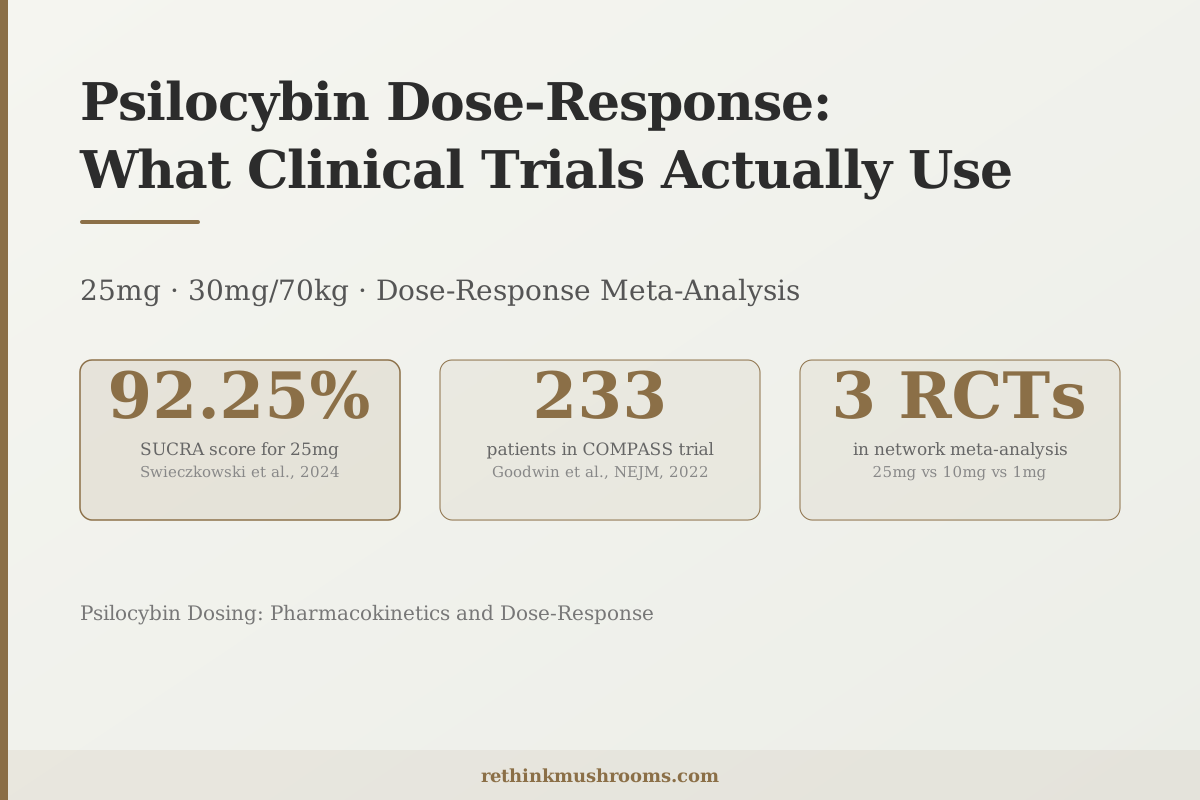
92.25% SUCRA score for 25mg
A 2024 network meta-analysis pooling 389 patients across three RCTs found 25mg psilocybin ranked first among all doses tested for depression — the 10mg dose showed no meaningful separation from placebo.
Swieczkowski et al., J Affect Disord, 2024
233 patients
in the COMPASS Phase IIb trial — the largest single psilocybin dose-response RCT to date
10mg
produced no significant benefit vs. 1mg in the COMPASS trial, despite costing 10× the dose
30mg/70kg
the original Hopkins standard from 2006; roughly equivalent to a 25mg fixed dose for a 70kg adult
Swieczkowski et al., J Affect Disord, 2024
 View as image ↗
In 2022, COMPASS Pathways ran a trial with 233 people who had treatment-resistant depression. Participants were randomly assigned to receive a single dose of 1mg, 10mg, or 25mg psilocybin. Three weeks later, only one group showed a statistically significant reduction in depression scores.[1] The 25mg group improved meaningfully. The 10mg group did not separate from the 1mg control group in any meaningful way. That result, published in the New England Journal of Medicine, handed researchers the clearest psilocybin dose-response data the field had ever produced — and it is the central reason modern trials have converged on 25mg. Understanding how clinical science arrived at this number requires tracing 20 years of methodology, from the early Hopkins weight-adjusted framework through PET imaging studies and two 2023-2024 meta-analyses that settled the question. This article covers the psilocybin dose-response relationship clinical trials have tested, the mechanistic reasons that relationship exists, and the evidence for why the field now treats 25mg as the therapeutic threshold. For a broader grounding in psilocybin's pharmacology, see the complete pharmacology guide.
Key Takeaways
- The COMPASS Phase IIb trial (n=233) showed 25mg psilocybin significantly reduced MADRS depression scores at 3 weeks vs. 1mg placebo; the 10mg dose did not separate from placebo[1]
- A 2024 network meta-analysis of three RCTs (n=389) ranked 25mg as the most effective dose for MDD, with a SUCRA score of 92.25%; 10mg showed no significant antidepressant effect[2]
- Psilocybin's dose-response operates at the receptor level: plasma psilocin concentration determines how many serotonin 2A receptors are occupied, and that occupancy directly correlates with subjective psychedelic intensity[3]
- Clinical dosing started as a weight-adjusted system: the Johns Hopkins 2008 framework defined doses in milligrams per 70kg of body weight — a standard that anchored trials for over 15 years[5]
- A 2021 Hopkins analysis showed 30mg/70kg (the original "high dose" standard) is approximately equivalent to 25mg fixed for an average adult, providing the scientific basis for the shift to fixed dosing[7]
- Psilocin pharmacokinetics show large individual variability in peak blood levels even at identical doses — the 2025 systematic review confirms this inter-individual variability is a key factor in response variation[11]
1mg, 10mg, 25mg: The Three-Dose Trial That Settled Clinical Dosing
The COMPASS Pathways Phase IIb trial enrolled 233 adults with treatment-resistant depression across 22 sites in 10 countries. Participants received a single dose of 1mg (used as an active placebo), 10mg, or 25mg psilocybin under psychological support. The primary outcome was the Montgomery-Åsberg Depression Rating Scale (MADRS) score change at three weeks.
At three weeks, the 25mg group showed a mean MADRS change of -12.0 points versus -7.9 points in the 1mg group. That difference of 4.1 points reached statistical significance (p<0.001).[1] The 10mg group posted a mean change of -7.9 points, virtually identical to the 1mg control. The difference between 10mg and 1mg was not statistically significant.
This three-arm design gives a rare window into how psilocybin dose-response actually behaves. The dose jumped 10-fold between 1mg and 10mg, yet produced no additional therapeutic effect. Then it jumped 2.5-fold again from 10mg to 25mg, and the response became significant. This is not a linear relationship.
Three Major Clinical Trials at a Glance
| Trial | Year | Doses Tested | Indication | Key Finding |
|---|---|---|---|---|
| Griffiths et al. (Psychopharmacology) | 2006 | 30mg/70kg vs. methylphenidate | Healthy volunteers | 30mg/70kg produced mystical-type experiences in ~67% of participants; established the high-dose standard for clinical research[6] |
| Carhart-Harris et al. (NEJM) | 2021 | 25mg fixed (two doses) | Major depression | Comparable antidepressant effect to 6 weeks of escitalopram; first major trial to use fixed 25mg instead of weight-adjusted dosing[8] |
| Goodwin et al. (NEJM) | 2022 | 1mg, 10mg, 25mg fixed | Treatment-resistant depression | 25mg significantly reduced MADRS; 10mg did not separate from 1mg control (n=233)[1] |
The Griffiths 2006 trial used a weight-adjusted dose. The two NEJM trials used a fixed 25mg. The shift between them is not arbitrary — it reflects 15 years of accumulated pharmacokinetic and pharmacodynamic evidence.
The Mechanism: How a Pill Becomes a Dose-Response Curve
Dose-response relationships exist for a reason. With psilocybin, the reason is now understood at the molecular level.
Psilocybin is a prodrug. After ingestion, the body converts it to psilocin, which is the compound that actually reaches the brain and produces effects. Higher doses produce higher peak concentrations of psilocin in the bloodstream. Brown and colleagues (2017) confirmed this with a systematic escalating-dose pharmacokinetic study in healthy adults: the peak psilocin blood concentration and total exposure both increased proportionally as the dose increased.[4]
Higher psilocin blood levels mean more receptors occupied. In 2019, Madsen and colleagues ran a PET imaging study in nine healthy volunteers. They administered psilocybin, measured plasma psilocin concentrations in real time, and simultaneously tracked how many serotonin 2A receptors (the brain's main psilocybin target) were occupied using brain imaging.[3] The result was direct: subjective psychedelic intensity correlated with receptor occupancy, which correlated with plasma psilocin.
The chain is: dose → psilocin blood level → serotonin 2A receptor occupancy → experience intensity. This is the molecular basis for psilocybin's dose-response curve. A 10mg dose produces less psilocin in the blood, which occupies fewer receptors, which produces a less intense experience. A 25mg dose produces more psilocin, occupies more receptors, and crosses a threshold for clinically meaningful effects.
What makes psilocybin unusual is that this relationship appears to have a ceiling for therapeutic benefit. The dose-response is steep between sub-threshold and 25mg, and flattens above it. That matters for understanding why clinical trials have not pushed routinely past 25mg. For a deeper look at what happens at the receptor level, see psilocybin receptor binding and 5-HT2A selectivity.
Where This Started: 20 Years of Weight-Based Dosing
Early human psilocybin research used a dosing framework built around body weight. The logic was standard pharmacology: normalize by body mass to account for variation between people.
Johnson and colleagues (2008) formalized the system that Johns Hopkins used across its early trials. The framework defined four dose categories in milligrams per 70 kilograms of body weight: low (0.5 mg/70kg), moderate (1.0 mg/70kg), high (2.0 mg/70kg), and very high (3.0 mg/70kg).[5] For a 70kg adult, these correspond to 0.5mg, 1mg, 2mg, and 3mg — quite low by today's clinical standards. For a 70kg adult using the high-dose 2.0 mg/70kg category, the actual dose received was 2mg. But the landmark Griffiths trial used a different and higher category: 30mg/70kg, equivalent to 0.43mg/kg. For a 70kg adult, that is 30mg. For a full breakdown of how these weight-adjusted categories map to modern clinical dose ranges, see psilocybin dosing: low, medium, and high doses explained.
Griffiths and colleagues (2006) used that 30mg/70kg dose in a double-blind RCT of 36 healthy volunteers with no prior hallucinogen experience.[6] The headline result: approximately 67% of participants rated the experience as among the most personally meaningful of their lives, and 80% reported lasting positive changes in their wellbeing. This study established 30mg/70kg as the reference point for a "high dose" that could produce the profound subjective effects associated with therapeutic benefit.
That single data point — 30mg/70kg from Griffiths 2006 — anchored clinical dosing for nearly 15 years. Subsequent trials that wanted to replicate the Griffiths effect used the same standard.
Why Johns Hopkins Endorsed a Switch to 25mg Fixed Dosing
Using milligrams per 70kg is standard practice in early-phase drug development. As evidence accumulates, many drug programs transition to fixed doses for later trials. Psilocybin followed that pattern.
Garcia-Romeu and colleagues (2021) at Johns Hopkins published a formal analysis making the case for fixed dosing.[7] Their central argument: 30mg/70kg, the historical high-dose standard, equals approximately 25mg for a person of average body weight (70-75kg). If body weight does not meaningfully predict psilocybin response — and the evidence suggested it did not — then weight-adjusted dosing adds complexity without adding accuracy. The 25mg fixed dose would deliver equivalent effects for most adults.
The pharmacokinetic evidence supported this transition. Brown and colleagues' (2017) dose-proportional PK data showed that psilocin blood exposure scales predictably with dose.[4] This means the conversion from 30mg/70kg to 25mg fixed is not a guess — it has pharmacokinetic backing.
Carhart-Harris and colleagues (2021) provided the first major clinical validation. Their NEJM trial compared two 25mg psilocybin sessions three weeks apart against six weeks of the antidepressant escitalopram in 59 patients with major depression.[8] Psilocybin showed comparable antidepressant efficacy to escitalopram on the primary outcome, and notably better outcomes on several secondary measures. No weight adjustment. Fixed 25mg. It worked.
This trial mattered beyond its efficacy findings. It demonstrated that a fixed 25mg dose, given twice in a structured setting, could compete with a leading antidepressant in a randomized controlled trial published in the world's most-cited medical journal. The weight-based era was effectively over.
For the question of whether body weight actually predicts response, see weight-based psilocybin dosing: how body mass affects response.
Two Meta-Analyses, Same Answer: 25mg Is the Effective Threshold
Individual trials can show dose-response. Meta-analyses confirm it across trials and tell you the shape of the curve.
Perez and colleagues (2023) conducted a systematic review and dose-response meta-analysis of human psilocybin depression studies.[9] Their analysis examined the shape of the dose-response relationship across the available evidence. The finding was non-linear: antidepressant effects increased steeply from sub-therapeutic doses toward the 20-25mg range, then showed diminishing returns at very high doses. This means going above 25mg does not appear to produce proportionally stronger antidepressant effects. For a detailed look at how the dose-response curve behaves from threshold through high and very high doses, see psilocybin dose-response curve: from threshold to heroic doses.
Swieczkowski and colleagues (2024) took this further with a network meta-analysis — a statistical method that allows direct and indirect comparison across trials even when they used different doses against each other.[2] They pooled data from three RCTs with a combined 389 patients. The primary ranking metric was SUCRA (Surface Under the Cumulative Ranking curve), which quantifies the probability that each dose is the best treatment. The results:
- 25mg psilocybin: SUCRA 92.25% — the most likely to be the best dose for MDD
- 0.215mg/kg (approximately 15mg): intermediate results
- 10mg psilocybin: no significant separation from placebo
The 10mg finding is the important one. It tells you that the dose-response is not a shallow gradient where 10mg gives half the benefit of 25mg. At 10mg, the clinical signal essentially disappeared. The threshold appears to sit between 10mg and 25mg, and the field has treated 25mg as the minimum effective therapeutic dose accordingly.
What Dose Alone Can't Predict: The Variability Problem
Two people can take identical 25mg doses and have dramatically different experiences. This is not a flaw in the dose-response framework — it is a known feature of psilocybin pharmacology.
Holze and colleagues (2023) conducted the most precise pharmacokinetic and pharmacodynamic study of oral psilocybin to date. They mapped onset timing, peak effects, and total duration across multiple doses in healthy volunteers.[10] Effects began within 30-50 minutes on average, peaked between 60-130 minutes, and resolved within 4-8 hours. The full detail on duration differences by dose level is covered in how long does psilocybin last: duration by dose. But the variability bands around each of those numbers were wide. Some participants were at peak effects at 60 minutes. Others didn't peak until 130 minutes. The dose-response was real, but the individual timing was not.
Meshkat and colleagues (2025) synthesized the entire available pharmacokinetic literature on psilocybin in a systematic review.[11] Their review confirmed that peak psilocin blood concentrations vary substantially between individuals even at the same dose. The sources of that variability include differences in drug-metabolizing enzyme activity (particularly CYP2D6, which processes psilocin), gastrointestinal absorption differences, and body composition factors beyond simple weight. The review characterized current psilocybin pharmacokinetics as a field with well-established average parameters and substantial unexplained individual variation.
This variability is why researchers cannot simply prescribe a dose and predict an experience. The 25mg standard is the best available clinical estimate of the dose that produces a therapeutic effect in most people. It does not guarantee a consistent experience for any individual person. The factors that do predict individual response — baseline serotonin 2A receptor density, prior experience, psychological preparation — are not captured by the number on the capsule.
For the practical implications of tolerance and re-dosing frequency, see psilocybin tolerance: how fast does it build.
For the relationship between psilocybin the prodrug and psilocin the active compound, see psilocybin vs. psilocin: understanding the active compound.
The Bottom Line
Clinical trials have settled on 25mg fixed-dose psilocybin as the therapeutic standard, supported by the largest available RCT evidence and two independent meta-analyses. The dose-response relationship is non-linear: 10mg produces no clinically meaningful antidepressant effect, while 25mg produces significant effects in most patients. The mechanistic foundation is well-established — plasma psilocin concentration determines serotonin 2A receptor occupancy, which determines psychedelic intensity and therapeutic response. Large individual variability in pharmacokinetics means the same dose does not guarantee the same experience, but 25mg remains the best-evidenced minimum effective threshold.
Frequently Asked Questions
Sources & References
- 1. Source details for this reference are not yet available.
- 2. Source details for this reference are not yet available.
- 3. Source details for this reference are not yet available.
- 4. Source details for this reference are not yet available.
- 5. Source details for this reference are not yet available.
- 6. Source details for this reference are not yet available.
- 7. Source details for this reference are not yet available.
- 8. Source details for this reference are not yet available.
- 9. Source details for this reference are not yet available.
- 10. Source details for this reference are not yet available.
- 11. Source details for this reference are not yet available.