Psilocybin Pharmacology Fundamentals
>95% stability retained by psilocybin over 6 months
Mushrooms store psilocybin rather than psilocin because the inactive prodrug is far more stable. Psilocin — the active compound — degrades rapidly under the same storage conditions.
Gotvaldová et al., Drug Testing and Analysis, 2021
84–109 min
time to peak psilocin levels after oral psilocybin (Tmax)
r = 0.82
correlation between plasma psilocin levels and subjective experience intensity
1.4×
molecular weight ratio of psilocybin to psilocin — not a potency difference
Gotvaldová et al., Drug Testing and Analysis, 2021
 View as image ↗
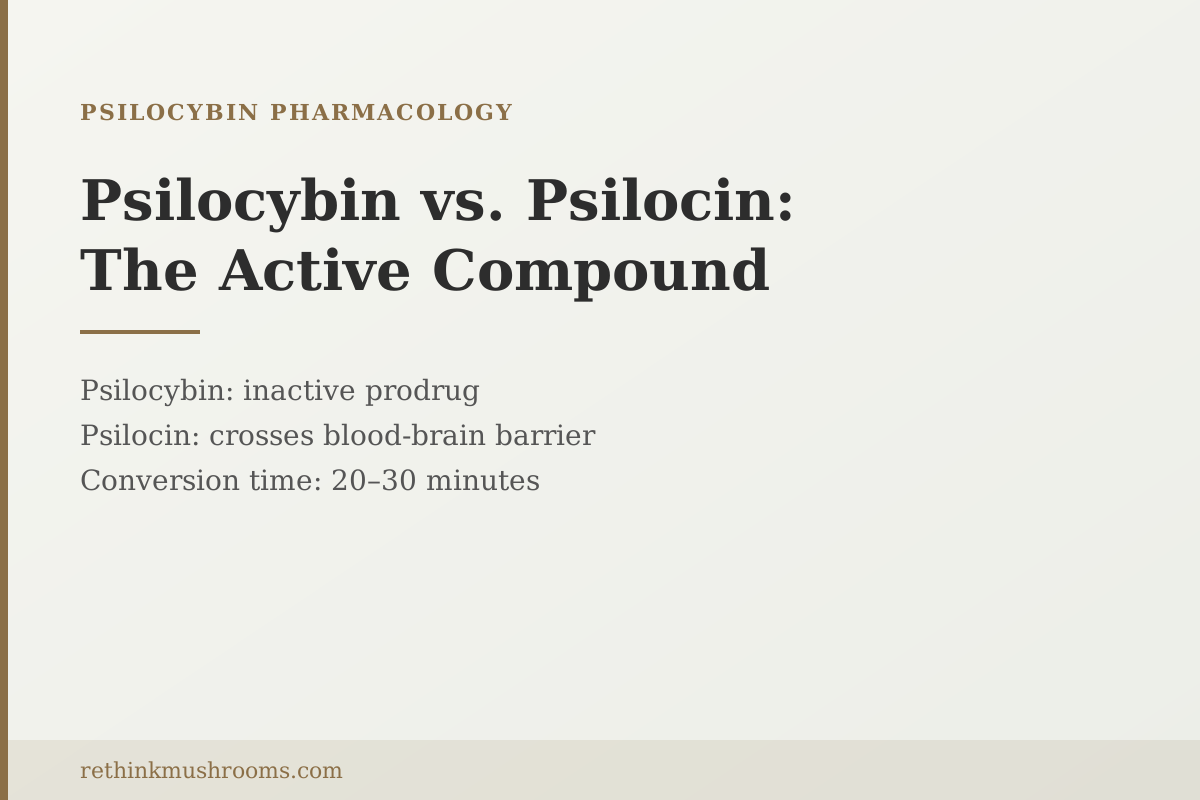
Psilocybin and psilocin are not two different drugs. They are two forms of the same compound at different stages of the same metabolic process. When you consume psilocybin mushrooms, the psilocybin itself does nothing in the brain. It is a prodrug — a chemically inactive precursor that the body must convert before any effect occurs. The conversion happens in your gut, and the product of that conversion is psilocin, the molecule that actually binds to serotonin receptors and produces every psychological effect attributed to psilocybin.
This distinction is not just chemical trivia. It explains how psilocybin works, why the timing unfolds the way it does, why individual responses vary so widely, and why the mushroom stores the inactive form in the first place.
For the full pharmacology arc from prodrug conversion through brain effects, see How Psilocybin Works: The Complete Pharmacology Guide.
Key Takeaways
- Psilocybin is pharmacologically inactive. It cannot bind to brain receptors. The IV psilocybin data from Hasler 1997 demonstrated that psilocin, not psilocybin, is the sole active species after oral dosing.
- The conversion happens quickly: intestinal alkaline phosphatase removes a phosphate group from psilocybin, producing psilocin within 20–30 minutes of consumption (Geiger et al., ACS Chem Neurosci, 2018).
- Psilocin peaks in plasma at 84–109 minutes after oral dosing, with a half-life of 2.6–3.7 hours across studies (Meshkat et al., Pharmaceutics, 2025).
- Plasma psilocin levels predict subjective experience intensity: Holze et al. (2023) found a correlation of r=0.82 between plasma psilocin AUC and subjective intensity ratings — but with ~50% inter-individual variability in how much psilocin any person actually produces from the same oral dose.
- Mushrooms store the prodrug form because psilocybin is dramatically more stable than psilocin. After 6 months, psilocybin retained >95% of its potency while psilocin lost more than 30% (Gotvaldová et al., 2021).
- Psilocin (not psilocybin) has direct anti-inflammatory effects on brain immune cells, adding a second mechanism distinct from receptor binding (Wiens et al., 2024).
Psilocybin Does Nothing in the Brain Until the Body Converts It
The proof that psilocybin is inactive on its own comes from a 1997 study by Hasler and colleagues, who compared the pharmacological effects of oral versus intravenous psilocybin in four participants.[1]
The logic of the experiment was straightforward. When you take psilocybin orally, it passes through the intestinal wall, where enzymes convert it to psilocin. By the time anything reaches the brain, you're working with psilocin, not psilocybin. But if you inject psilocybin intravenously, it bypasses that intestinal conversion step and enters circulation directly as psilocybin.
What Hasler found confirmed the prodrug hypothesis: intravenous psilocybin only produced psychological effects after conversion to psilocin in the blood and peripheral tissues. The psilocybin molecule itself, before dephosphorylation, does not bind to serotonin receptors in any meaningful way. Psilocin was confirmed as the sole active species.
Why? The structure of the two molecules makes this predictable.
Psilocybin has a phosphate group attached to its indole ring. That phosphate group makes the molecule water-soluble. Water-soluble molecules don't cross the blood-brain barrier easily, which is a lipid (fat) layer that blocks water-soluble compounds from entering brain tissue. So psilocybin, even if it somehow reached the brain intact, couldn't get inside neurons.
Psilocin has no phosphate group. It's lipid-soluble — able to dissolve in fat, which means it crosses the blood-brain barrier readily. Once inside the brain, it fits into and activates serotonin receptors, specifically the 5-HT2A receptor that drives psychedelic effects.
The single-step conversion from psilocybin to psilocin is the removal of that phosphate group. The enzyme responsible is called alkaline phosphatase — specifically the version found in the lining of the small intestine. Geiger and colleagues, in their 2018 review published in ACS Chemical Neuroscience, documented this conversion pathway in detail, tracing the chemistry back to Albert Hofmann's 1958 isolation of psilocybin and his subsequent identification of psilocin as the active metabolite.[2]
Why Mushrooms Store the Prodrug: The Stability Argument
If psilocin is the active compound, why do mushrooms contain mostly psilocybin? Why hasn't evolution optimized for storing the already-active form?
Gotvaldová and colleagues answered this directly in a 2021 study published in Drug Testing and Analysis.[7] They stored psilocybin mushroom biomass under the same conditions for six months and measured the degradation of each compound.
Psilocybin retained over 95% of its original concentration. Psilocin lost more than 30% of its concentration over the same period under the same conditions.
The phosphate group that makes psilocybin inactive also makes it stable. It protects the indole ring from oxidation. Psilocin, without that protective group, is reactive and degrades under light, heat, and oxidative conditions. For a mushroom storing its chemical compounds across seasons and environmental variation, the prodrug form is a functionally superior storage strategy.
This is also why dried psilocybin mushrooms retain their potency much better than fresh ones that have been damaged or exposed to air. The psilocybin is stable. The psilocin that forms when the mushroom is damaged, bruised (the characteristic blue bruising), or stored improperly degrades faster.
Psilocybin vs. Psilocin: What's Actually Different
The practical comparison between the two compounds:
| Property | Psilocybin | Psilocin |
|---|---|---|
| Active in brain? | No (prodrug) | Yes |
| Crosses blood-brain barrier? | Poor (water-soluble) | Yes (lipid-soluble) |
| Molecular weight | 284 g/mol | 204 g/mol |
| Stability | >95% retained after 6 months | >30% lost after 6 months |
| Conversion | Dephosphorylated by intestinal alkaline phosphatase | Already active |
| Receptor affinity at 5-HT2A | Negligible (Ki >10,000 nM) | High (Ki ≈107 nM) |
The "psilocin is stronger than psilocybin" framing that appears in many drug information sources needs clarification. Psilocin is 1.4 times heavier than psilocybin by molecular weight. That means a milligram of psilocybin converts to roughly 0.72 milligrams of psilocin. Once that conversion happens, the psilocin molecule that reaches the brain is the same molecule with the same receptor affinity regardless of whether it came from psilocybin or was administered directly. The "strength" difference is a molecular weight conversion factor, not a difference in how powerfully each molecule binds to serotonin receptors.
For a deeper look at how psilocin's receptor binding at 5-HT2A specifically drives psychedelic effects, see Psilocybin and the 5-HT2A Receptor: The Key to Psychedelic Effects.
The Pharmacokinetic Timeline: How Fast Does This Happen?
After oral psilocybin ingestion, conversion to psilocin begins in the small intestine within minutes. Detectable psilocin enters the bloodstream within 20–30 minutes. Psychological effects typically begin around that same time.
Three rigorous pharmacokinetic studies have measured the psilocin time course in humans:
Brown and colleagues tracked plasma psilocin in 12 healthy adults across doses from 0.5 to 3 mg/kg in 2017.[3] Peak plasma concentration (Tmax) averaged approximately 90 minutes. Half-life was approximately 2.5 hours. The kinetics were dose-proportional, meaning doubling the dose roughly doubled the plasma exposure.
Holze and colleagues measured this more precisely in 2023 in 16 participants at a fixed dose of 0.215 mg/kg.[4] Psilocin peaked at about 1.5 hours and had a half-life of 3.3 hours. The most important finding: plasma psilocin levels correlated with subjective experience intensity at r=0.82, meaning higher blood psilocin predicted a more intense experience. But inter-individual variability in psilocin levels was approximately 50%, meaning two people taking identical doses could have very different plasma psilocin concentrations.
Meshkat and colleagues synthesized 25 pharmacokinetic studies in a 2025 systematic review published in Pharmaceutics.[5] Across studies, the peak time ranged from 84 to 109 minutes, and the half-life ranged from 2.6 to 3.7 hours. They identified CYP2C9 enzyme activity and monoamine oxidase activity as major sources of the inter-individual variability — the specific liver and gut enzymes responsible for psilocin breakdown vary substantially between people.
Taken together, the picture is: oral psilocybin produces peak plasma psilocin around 90 minutes post-dose. The experience peaks as plasma psilocin peaks. By 8 hours, psilocin is essentially cleared from the body.
For more on the timing and duration of effects, see Psilocybin Pharmacokinetics: Onset, Peak, and Duration.
Psilocin's Second Role: Anti-Inflammatory Effects in Brain Immune Cells
Most descriptions of psilocin focus exclusively on its role as a 5-HT2A agonist. But psilocin does something else that psilocybin does not, and that distinction adds a mechanistic dimension no competitor currently covers.
The brain contains immune cells called microglia. These are resident brain macrophages — they clear cellular debris, respond to injury, and regulate inflammation in the brain. When microglia are overactivated, they release pro-inflammatory signals including TNF-α and IL-6, molecules associated with chronic neuroinflammation.
Wiens and colleagues, publishing in Molecules in 2024, found that psilocin reduced microglial TNF-α and IL-6 production at concentrations consistent with therapeutic dosing.[8] The effect was dependent on 5-HT2 receptor activation and did not occur with psilocybin, confirming it requires the active, dephosphorylated form.
What this means: psilocin may have a direct anti-inflammatory effect on brain immune cells, independent of its psychedelic action at cortical 5-HT2A receptors. This is a second mechanism operating in parallel with the better-known serotonergic pathway, and it's only possible because psilocybin converts to psilocin.
Whether this microglial effect contributes to the therapeutic outcomes observed in clinical trials — depression, anxiety, addiction — is not established by current evidence. The Wiens study is preclinical and in vitro. But it adds another dimension to why psilocin, specifically, is the pharmacologically meaningful molecule in this pair.
Beyond Psilocin: Other Active Compounds in Psilocybe Mushrooms
Psilocybin and psilocin are not the only alkaloids in psilocybin-containing mushrooms. Sherwood and colleagues characterized four related tryptamine compounds in a 2020 study published in the Journal of Natural Products.[6]
Baeocystin is an N-demethyl analogue of psilocybin that follows the same prodrug logic. Its pharmacology is more nuanced than the "weaker psilocybin" shorthand suggests: in Sherwood's assays, baeocystin on its own produced no detectable psychedelic activity in the mouse head-twitch response, yet its dephosphorylated metabolite — norpsilocin — is a potent 5-HT2A agonist in vitro. Whether baeocystin produces meaningful psychoactive effects in humans is not yet established.
Norbaeocystin is another analogue that was weakly active in the Sherwood assays, suggesting it contributes minimally to the total pharmacological effect.
Aeruginascin is different again. It is a quaternary ammonium tryptamine — a permanently charged molecule that, unlike psilocin, does not readily cross the blood-brain barrier. Structurally it is closely related to bufotenidine, a potent 5-HT3 receptor agonist, and it has been found so far only in Inocybe aeruginascens (Jensen et al., 2006).[9] That structural kinship has prompted speculation that aeruginascin shapes the distinctive character of Inocybe aeruginascens ingestions, but its actual receptor pharmacology and its contribution to the whole-mushroom experience remain poorly characterized rather than established. Claims that it acts as a 5-HT3 antagonist to blunt nausea are not supported by the current evidence.
A 2024 study of norpsilocin and related analogues reinforced the point that these minor tryptamines are not simply weaker copies of psilocin.[10] Norpsilocin is a potent 5-HT2A agonist in the test tube, yet it produces no psychedelic-like effects in animals because — differing from psilocin by a single N-methyl group — it does not efficiently reach the brain. Each of these compounds has its own pharmacological profile, and whether a molecule acts centrally at all is decided as much by its ability to cross into the brain as by its receptor affinity.
For a deeper look at how receptor binding selectivity shapes the pharmacology of psilocin and related compounds, see Psilocybin Receptor Binding Affinity: Why 5-HT2A Selectivity Matters. For what happens in the brain once psilocin reaches it, see What Happens in Your Brain on Psilocybin? A Neuroscience Explainer.
The Bottom Line
Psilocybin is a pharmacologically inactive prodrug that must be converted to psilocin by intestinal alkaline phosphatase before it produces any brain effect. The conversion removes a phosphate group, transforming a water-soluble, brain-impermeable molecule into a lipid-soluble compound that crosses the blood-brain barrier and activates 5-HT2A serotonin receptors. Psilocin peaks in plasma 84–109 minutes after oral dosing and clears within 8 hours. Plasma psilocin levels correlate strongly with experience intensity (r=0.82), but inter-individual variability in conversion efficiency of approximately 50% means the same dose can produce very different plasma levels across people. Mushrooms evolved to store the prodrug form because psilocybin is far more stable than psilocin under real-world conditions. Psilocin also has direct anti-inflammatory effects on brain immune cells that psilocybin itself does not.
Frequently Asked Questions
Sources & References
- 1RTHM-00021·Hasler, F et al. (1997). “Determination of psilocin and 4-hydroxyindole-3-acetic acid in plasma by HPLC-ECD and pharmacokinetic profiles of oral and intravenous psilocybin in man..” Pharmaceutica acta Helvetiae.Study breakdown →PubMed →↩
- 2RTHM-00509·Geiger, Haden A et al. (2018). “DARK Classics in Chemical Neuroscience: Psilocybin..” ACS chemical neuroscience.Study breakdown →PubMed →↩
- 3RTHM-00461·Brown, Randall T et al. (2017). “Pharmacokinetics of Escalating Doses of Oral Psilocybin in Healthy Adults..” Clinical pharmacokinetics.Study breakdown →PubMed →↩
- 4RTHM-00830·Holze, Friederike et al. (2023). “Pharmacokinetics and Pharmacodynamics of Oral Psilocybin Administration in Healthy Participants..” Clinical pharmacology and therapeutics.Study breakdown →PubMed →↩
- 5RTHM-00945·Meshkat, Shakila et al. (2025). “Pharmacokinetics of Psilocybin: A Systematic Review..” Pharmaceutics.Study breakdown →PubMed →↩
- 6RTHM-00654·Sherwood, Alexander M et al. (2020). “Synthesis and Biological Evaluation of Tryptamines Found in Hallucinogenic Mushrooms: Norbaeocystin, Baeocystin, Norpsilocin, and Aeruginascin..” Journal of natural products.Study breakdown →PubMed →↩
- 7RTHM-00688·Gotvaldová, Klára et al. (2021). “Stability of psilocybin and its four analogs in the biomass of the psychotropic mushroom Psilocybe cubensis..” Drug testing and analysis.Study breakdown →PubMed →↩
- 8RTHM-00914·Wiens, Kennedy R et al. (2024). “Psilocin, the Psychoactive Metabolite of Psilocybin, Modulates Select Neuroimmune Functions of Microglial Cells in a 5-HT2 Receptor-Dependent Manner..” Molecules (Basel.Study breakdown →PubMed →↩
- 9RTHM-00101·Jensen, Niels et al. (2006). “Aeruginascin, a trimethylammonium analogue of psilocybin from the hallucinogenic mushroom Inocybe aeruginascens..” Planta medica.Study breakdown →PubMed →↩
- 10RTHM-00908·Sherwood, Alexander M et al. (2024). “Psychedelic-like Activity of Norpsilocin Analogues..” ACS chemical neuroscience.Study breakdown →PubMed →↩