Poria (Fu Ling) & Blood Sugar
73 randomized trials
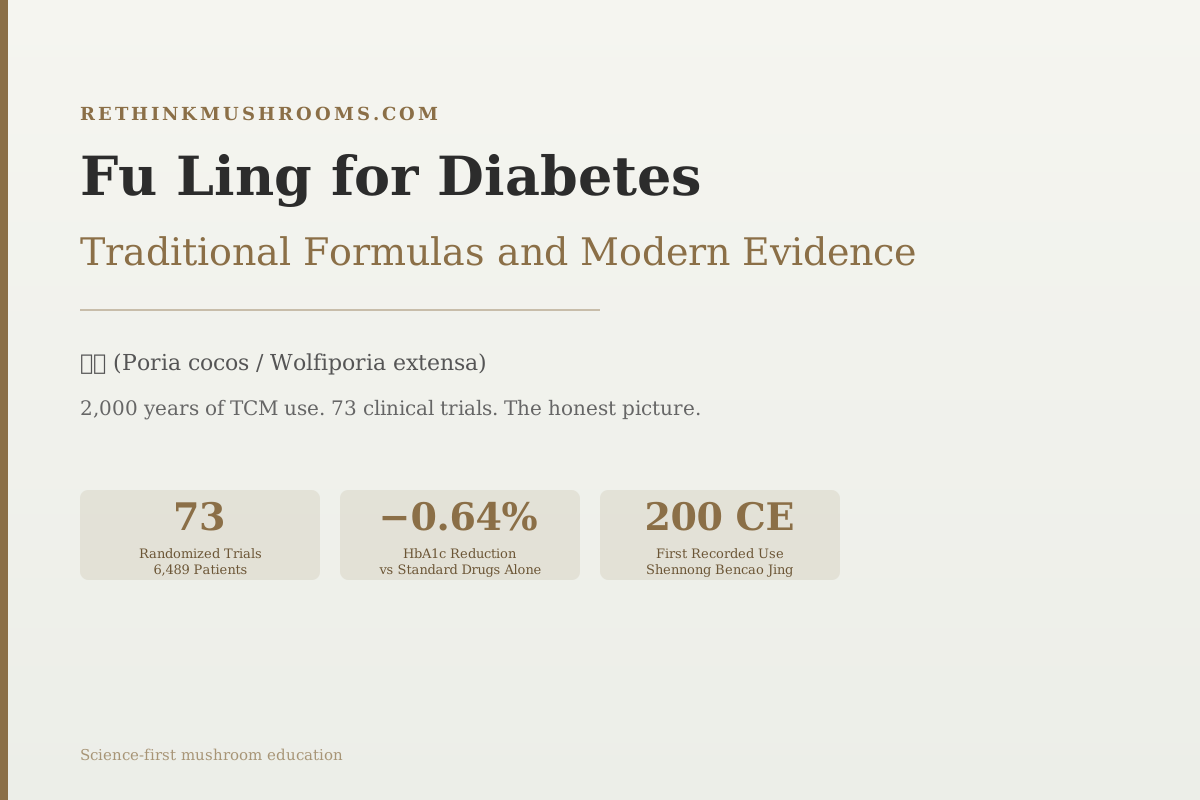
A 2022 meta-analysis of 73 RCTs found Poria-containing formulas reduced fasting glucose by 0.82 mmol/L and HbA1c by 0.64% when added to standard diabetes treatment in 6,489 participants.
Luo et al., PLoS One, 2022
−0.82 mmol/L
fasting glucose reduction vs drugs alone (6,489 patients)
−0.64%
HbA1c reduction when Poria formulas added to standard treatment
2,000+
years of Fu Ling use for wasting-thirst syndrome in classical TCM
Luo et al., PLoS One, 2022
 View as image ↗
Two thousand years before HbA1c tests existed, Chinese physicians were identifying and treating a condition they called Xiao Ke (消渴). The name translates as "wasting-thirst syndrome," and the clinical picture it described (extreme thirst, constant hunger, frequent urination, and progressive weight loss) maps closely to what modern medicine calls type 2 diabetes. Fu Ling (茯苓), the dried sclerotium of the Poria cocos mushroom, appeared in classical formulas prescribed for Xiao Ke as far back as the Shennong Bencao Jing, one of the foundational texts of Traditional Chinese Medicine compiled around 200 CE.
That history matters not just as a curiosity. A 2022 meta-analysis of 73 randomized controlled trials found that Poria-containing formulas produced measurable reductions in fasting glucose, HbA1c, and postprandial blood sugar when added to standard diabetes treatment.[1] Modern research is validating what clinical practice accumulated over two millennia, but with an important caveat about how that evidence was generated.
Fu Ling is the same mushroom as Poria cocos (now classified as Wolfiporia extensa). Fu Ling is the Chinese pharmacopoeial name; Poria or Wolfiporia is the botanical classification. For an overview of the mushroom's full properties and uses, see what is Poria (Fu Ling)?.
Key Takeaways
- A 2022 meta-analysis of 73 RCTs (6,489 participants) found Poria-containing formulas reduced fasting blood glucose by 0.82 mmol/L, 2-hour postprandial glucose by 1.15 mmol/L, and HbA1c by 0.64% compared to standard hypoglycemic drugs alone (Luo et al., 2022)
- Every one of those 73 trials used Poria in a multi-herb TCM formula, not Poria extract alone; the clinical evidence base is formula-based, not isolated-Poria-based
- Poria contains two chemically distinct bioactive classes: polysaccharides (including pachymaran and beta-glucans) and triterpenoids (including pachymic acid and dehydrotrametenolic acid), each with documented glucose-lowering activity via different pathways (Sun et al., 2011)
- Animal research identified dehydrotrametenolic acid as a PPARgamma agonist (the same receptor type targeted by thiazolidinedione drugs), which may partly explain the insulin sensitizing effects seen in formula trials (Li et al., 2011)
- Fu Ling is among the ten most-prescribed herbs in Chinese medicine for type 2 diabetes and appears in numerous classical formulas including Si Jun Zi Tang and Liu Wei Di Huang Wan
- A 2023 systematic review placed Poria among the most evidence-supported edible mushrooms for diabetes, alongside Reishi and Lion's Mane, in the context of their distinct glucose-lowering mechanisms (Li et al., Nutrients, 2023)
Fu Ling Treated Wasting-Thirst Syndrome 2,000 Years Before "Type 2 Diabetes" Had a Name
The classical TCM diagnosis of Xiao Ke was divided into three subtypes based on which organ system was most affected: the upper type (shang xiao) was characterized by intense thirst; the middle type (zhong xiao) by excessive hunger and eating; the lower type (xia xiao) by frequent urination and progressive weight loss. All three subtypes overlap significantly with the symptoms of uncontrolled diabetes mellitus.
Chinese physicians treating Xiao Ke were doing something more sophisticated than simply cataloguing symptoms. They were identifying patterns and matching them to formulas that had demonstrated clinical benefit across generations of practice. Fu Ling appeared in these formulas not as the sole active ingredient but as a key supporting herb. In classical TCM theory, it was understood to tonify the spleen and eliminate dampness, language that maps imperfectly onto modern biochemistry but in practice pointed toward Fu Ling's effects on digestion, fluid metabolism, and what we might now describe as metabolic dysfunction.
The Shennong Bencao Jing placed Fu Ling among the superior herbs, a category reserved for substances considered safe for long-term use and effective at strengthening the body rather than merely treating acute symptoms. This classification is consistent with what modern research describes: not a drug-like rapid glucose suppressor, but a compound that modulates the metabolic environment over time through multiple mechanisms.
The two thousand years of clinical use is not evidence in the modern sense. No randomized control existed. But it represents something real: a large-scale, multi-generational empirical observation that Poria-containing formulas improved the symptoms of a condition that strongly resembles type 2 diabetes. Modern clinical trials are now asking the same question with better measurement tools.
73 Clinical Trials Later: The Numbers Behind Fu Ling's Modern Evidence
The most important piece of evidence for Fu Ling and diabetes is Luo and colleagues' 2022 systematic review and meta-analysis, published in PLoS One.[1] It analyzed 73 randomized controlled trials enrolling 6,489 participants with type 2 diabetes.
The treatment in every trial was a Poria-containing TCM formula added to standard hypoglycemic medication (typically metformin, sulfonylureas, or insulin). The comparison group received standard medication alone. The results showed:
- Fasting blood glucose: reduced by 0.82 mmol/L in the formula group compared to drugs alone
- 2-hour postprandial blood glucose: reduced by 1.15 mmol/L
- HbA1c: reduced by 0.64 percentage points
- Adverse events: significantly lower in the integrative treatment group than in the drugs-alone group
A 0.64% HbA1c reduction is clinically meaningful. For context, many approved diabetes medications achieve 0.5 to 1.5% HbA1c reduction in Phase 3 trials. The integrative treatment produced additive effects on top of existing medication, not instead of it.
The adverse event finding is also worth attention. The Poria-containing formulas did not increase side effects. The integrative groups actually reported fewer adverse events than the drug-only groups, though the mechanism for this difference is not clear from the meta-analysis alone.
This represents one of the larger evidence bases for any TCM herb in a specific chronic disease indication. Seventy-three trials is not a small number; it reflects the integration of Poria-containing formulas into mainstream TCM clinical practice across China over decades.
The Critical Caveat: All 73 Trials Used Poria in Multi-Herb Formulas
Here is the part most competitor articles omit, and it is the most important thing to understand when evaluating this evidence.
Not one of the 73 trials tested Poria extract alone against a control. Every single trial used Fu Ling as one ingredient among several in a multi-herb TCM formula. Common co-ingredients include Astragalus (Huang Qi), Coptis (Huang Lian), Yam (Shan Yao), and many others, depending on the specific formula. These herbs have documented glucose-lowering properties in their own right.
This means the clinical evidence cannot tell us what portion of the observed blood sugar reduction comes specifically from Fu Ling versus the other formula ingredients. The 0.82 mmol/L fasting glucose reduction belongs to the formula, not to Fu Ling as an isolated agent.
The 2026 comprehensive review of Poria pharmacology acknowledged this directly: while multiple active compounds in Fu Ling have demonstrated glucose-lowering activity in cell culture and animal models, the isolated human clinical evidence for Poria alone does not yet exist.[2]
This is not a reason to dismiss the evidence. The 73 RCTs are real trials with real patients and real results. The honest interpretation is that Poria is an effective component of TCM formulas for type 2 diabetes, a finding consistent with 2,000 years of clinical observation. Whether Poria would produce equivalent effects as a standalone extract at a specific dose is a separate question that current evidence cannot answer.
The Classical Formulas That Feature Fu Ling for Blood Sugar
Fu Ling appears in dozens of classical TCM formulas. Several are particularly relevant to the Xiao Ke indication and have been studied in the modern diabetes context.
Si Jun Zi Tang (Four Gentlemen Decoction) is one of the foundational formulas of Chinese medicine for strengthening the spleen and stomach. It contains Poria, Ginseng (Ren Shen), White Atractylodes (Bai Zhu), and Honey-Fried Licorice (Zhi Gan Cao). It appears in many of the RCTs captured in the 2022 meta-analysis as a base formula to which other ingredients are added.
Liu Wei Di Huang Wan (Six-Ingredient Rehmannia Pill) is the classical formula for kidney yin deficiency, a TCM pattern associated with the lower-type Xiao Ke presenting with frequent urination and weight loss. Poria is one of its six ingredients. Modern clinical research has used variants of this formula for type 2 diabetes with kidney involvement.
Shen Ling Bai Zhu San (Ginseng-Poria-White Atractylodes Powder) is specifically designed for spleen deficiency with dampness, a TCM pattern that overlaps with the metabolic dysfunction of early-stage type 2 diabetes. Fu Ling is a principal ingredient in this formula.
What these formulas share is the role of Fu Ling as a spleen-tonifying, dampness-resolving herb that supports metabolic function. Modern research suggests the mechanisms behind this traditional function include polysaccharide prebiotic effects on gut microbiota and triterpenoid effects on glucose enzymes and insulin signaling; for deeper detail on these pathways, see Poria polysaccharides and glucose metabolism and Poria and insulin resistance: mechanisms.
Two Active Compound Classes Behind the Glucose Effects
Understanding what Fu Ling contains helps explain why it has been historically effective as a formula ingredient. A 2011 comprehensive review identified two primary bioactive classes with distinct pharmacological profiles.[3]
Polysaccharides, including pachymaran and beta-glucan fractions, are large sugar chains that survive digestion largely intact and reach the large intestine. There, they function as prebiotic substrate, selectively feeding beneficial bacteria. The resulting metabolites, including butyrate and other short-chain fatty acids, feed back into insulin signaling pathways that affect glucose uptake in muscle and fat tissue.
Triterpenoids, including pachymic acid, dehydropachymic acid, tumulosic acid, and dehydrotrametenolic acid, are fat-soluble compounds absorbed in the upper gastrointestinal tract. Li and colleagues identified dehydrotrametenolic acid as an agonist of PPARgamma, the nuclear receptor targeted by the entire thiazolidinedione class of diabetes drugs (rosiglitazone, pioglitazone).[4] Their animal study used 50 mg/kg Poria extract in db/db diabetic mice and measured significant blood glucose reduction alongside identification of the PPARgamma-activating compounds.
The PPARgamma connection is pharmacologically significant. PPARgamma activation improves insulin sensitivity in fat and muscle cells by increasing the expression of glucose transporter proteins. A natural compound that activates this receptor works by the same fundamental mechanism as a major drug class, even if through different binding characteristics.
The 2026 Poria pharmacology review confirmed that both pathways contribute to antidiabetic effects: polysaccharides work primarily through the gut microbiota axis affecting insulin sensitivity, while triterpenoids produce more direct enzyme inhibition and receptor activation effects.[2]
For more on how the polysaccharide class affects the liver specifically, see Poria polysaccharides and hepatic glucose output reduction. For the full picture on the insulin resistance mechanisms, see Poria and insulin resistance: mechanisms.
Fu Ling Among Mushrooms Studied for Diabetes
Fu Ling is not the only mushroom with documented glucose effects, but a 2023 systematic review placed it in a distinct tier based on the volume and consistency of evidence.[5] Li and colleagues reviewed the diabetes-relevant literature for edible and medicinal mushrooms and found that Poria (alongside Reishi and Lion's Mane) had among the strongest evidence bases, with Poria's notable distinction being the quantity of clinical trial data from its use in TCM formula research.
The comparison is instructive because different mushrooms work through different pathways. Reishi polysaccharides affect pancreatic beta cells and insulin release in some models. Maitake's D-fraction and SX-fraction interact with insulin receptor signaling. Poria's primary effects, as the 2011 chemical review established, center on polysaccharide prebiotic effects and triterpenoid insulin sensitization. For a direct comparison of the Reishi pathway, see Reishi polysaccharides and blood glucose control in diabetic patients.
What this means practically is that the mushroom-diabetes evidence base is not monolithic. Poria's documented effects in the 73-trial meta-analysis reflect formula-based integration with standard care over time. Other mushrooms have smaller clinical evidence bases but different mechanistic profiles. The comparison helps locate Poria's evidence accurately (substantial but formula-dependent) without implying that other mushrooms with less clinical data are necessarily less effective in isolation.
The 2026 Poria review also noted that Poria's historical position as one of China's top 10 herbs for type 2 diabetes reflects a practical reality: it has been tested in the field of clinical medicine far longer than most substances now in pharmaceutical trials, and the 73 RCTs are the modern confirmation of that accumulated experience.[2]
For the full picture on the blood sugar research in Poria, including animal mechanism studies and the dose-response questions, see Poria and blood sugar: hypoglycemic research.
The Bottom Line
Fu Ling (Poria cocos) has been a component of TCM formulas for the condition now recognized as type 2 diabetes for approximately 2,000 years. A 2022 meta-analysis of 73 randomized controlled trials in 6,489 patients confirmed that Poria-containing formulas added to standard diabetes treatment produce statistically significant reductions in fasting glucose (−0.82 mmol/L), postprandial glucose (−1.15 mmol/L), and HbA1c (−0.64%). The critical context: every one of those trials used Poria as part of a multi-herb formula. The isolated human clinical evidence for Poria alone does not exist. Animal and mechanistic research has identified two distinct active compound classes, polysaccharides and triterpenoids, operating via gut microbiota and PPARgamma pathways respectively. The traditional use and the modern meta-analysis point in the same direction; the formula dependency is the honest caveat that most sources omit.
Frequently Asked Questions
Sources & References
- 1. Source details for this reference are not yet available.
- 2. Source details for this reference are not yet available.
- 3. Source details for this reference are not yet available.
- 4. Source details for this reference are not yet available.
- 5. Source details for this reference are not yet available.