How Growing Substrate and Conditions Shape Mushroom Bioactive Content
35-40% starch in typical MOG products
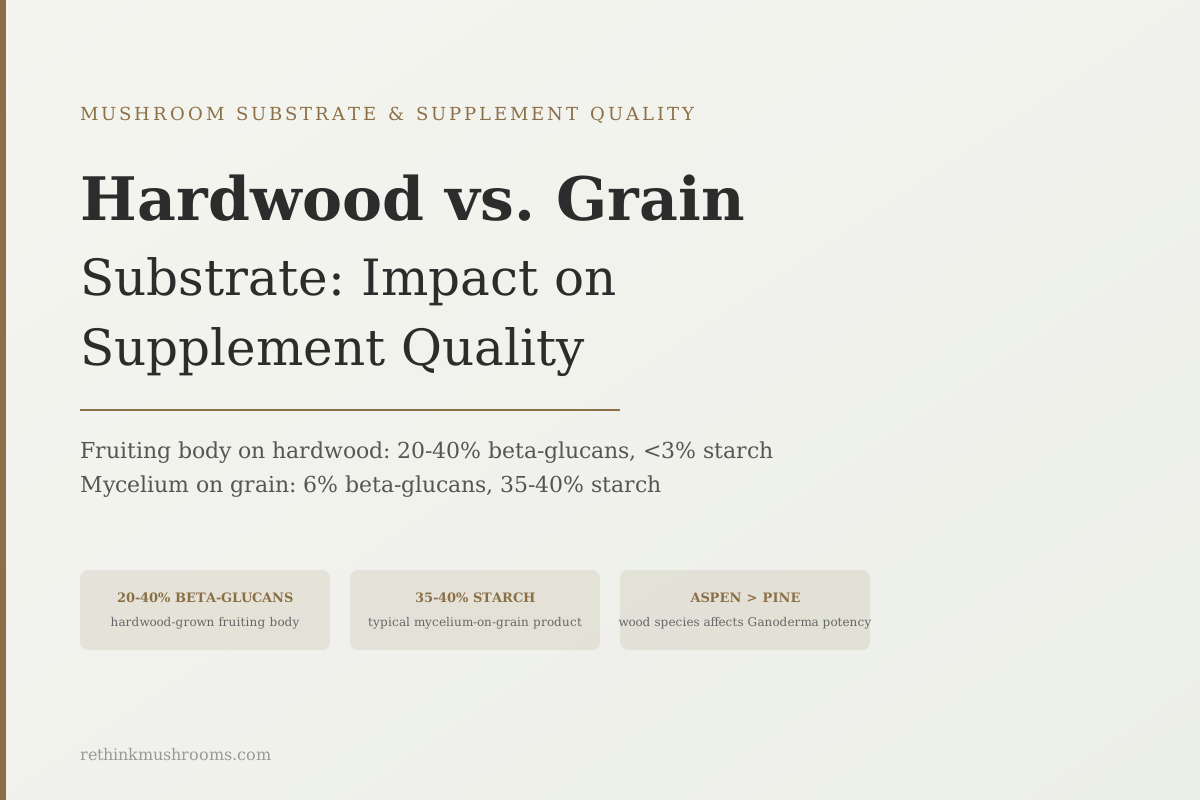
Mushroom supplements made from mycelium grown on grain (MOG) average 6% beta-glucans and 35-40% grain starch. The same serving from a fruiting body grown on hardwood averages 20-40% beta-glucans and under 3% starch. The difference is the substrate.
NAMMEX industry testing; Timm et al., Adv Appl Microbiol, 2025
20-40%
beta-glucans in hardwood-grown fruiting body
6%
beta-glucans in typical mycelium-on-grain product
Aspen > pine
even wood species affects Ganoderma beta-glucan content
NAMMEX industry testing; Timm et al., Adv Appl Microbiol, 2025
 View as image ↗
Pick up almost any mushroom supplement and you will not find "hardwood substrate" or "mycelium on grain" on the label. The supplement facts panel lists the mushroom species. It does not list what the mushroom was grown on. But what a mushroom grows on (its substrate) is one of the most significant factors determining what ends up in a finished supplement.
This is not a minor quality distinction. The gap between a fruiting body grown on species-appropriate hardwood and mycelium grown on grain (the most common form found in US supplements) is large enough to affect whether a supplement delivers meaningful amounts of the bioactive compounds that make medicinal mushrooms worth studying. For the foundational explanation of why substrate matters biologically, see How Growing Substrate Affects Mushroom Bioactive Content. For the broader fruiting body vs. mycelium debate, see Fruiting Body vs. Mycelium: The Great Mushroom Supplement Debate.
Key Takeaways
- Fruiting bodies grown on hardwood substrates typically test at 20-40% beta-glucans with under 3% starch; mycelium grown on grain averages 6% beta-glucans and 35-40% starch
- The starch in mycelium-on-grain products is residual grain from the growth medium, not mushroom material, meaning a significant portion of a typical serving is grain filler
- A 2025 comprehensive review found substrate composition is the single most critical determinant of nutritional value and bioactive content across multiple mushroom genera
- Even within hardwood, wood species matters: Ganoderma lucidum grown on aspen (Populus tremula) produced significantly higher beta-glucan content than Ganoderma grown on pine
- Wild mushrooms provide a useful benchmark for beta-glucan content, and well-controlled cultivation on hardwood can approach or match those levels
- The most honest counter-argument is that myceliated grain may have prebiotic value from fermented grain compounds, but this does not address the beta-glucan deficit
The Numbers That Define the Debate
The practical stakes of the hardwood-versus-grain question come down to what a supplement actually contains.
NAMMEX, one of the leading organic mushroom ingredient suppliers and the company that has done the most systematic testing of this question, has published testing data comparing beta-glucan and starch content across product types. Fruiting bodies grown on hardwood substrates consistently test in the range of 20-40% beta-glucans with starch under 3%. Mycelium grown on grain substrates averages around 6% beta-glucans with 35-40% residual grain starch.
That 35-40% starch in mycelium-on-grain products is not mushroom starch. It is the residual grain from the growth medium that was never separated from the mycelium before processing. When mycelium grows through grain (typically rice, oats, or wheat), it infiltrates the grain structure. Removing mycelium completely from the grain without also removing the mycelium is not commercially practical at scale, so the grain typically gets processed along with the fungal material. The result is that a significant portion of each serving of a mycelium-on-grain supplement is grain.
The beta-glucan gap is equally significant. Beta-glucans, the fungal polysaccharides most strongly linked to the immune-modulating effects of medicinal mushrooms, appear at roughly six to seven times higher concentrations in hardwood-grown fruiting bodies than in mycelium-on-grain products. A supplement with 6% beta-glucans is delivering a much smaller dose of that compound than one with 30% beta-glucans, even at identical serving weights.
This is not a manufacturer quality problem. It is a substrate chemistry problem. And a 2025 comprehensive review by Timm and colleagues in Advances in Applied Microbiology confirmed the scientific basis for this pattern: substrate composition is the single most critical determinant of nutritional value and bioactive content in cultivated mushrooms, across Agaricus, Lentinula (shiitake), and Pleurotus genera.[2] The review found this relationship consistent across species, not specific to any one genus.
Why Hardwood Chemistry Produces More Bioactives
Grain and hardwood are both carbon sources. But they are not equivalent ones.
Grain provides simple carbohydrates: starch, simple sugars, and basic nitrogen compounds. Mushrooms can grow efficiently on grain because the carbon is readily available in a digestible form. Rapid growth on simple substrates is efficient for the fungus.
Hardwood provides something grain does not: lignin, complex polyphenols, and aromatic compounds that mushrooms enzymatically break down during colonization. These complex organic molecules are precursors to the secondary metabolites that distinguish medicinal mushrooms. When a mushroom like Ganoderma lucidum (reishi) colonizes hardwood, it expresses enzymes that degrade lignin and other hardwood polymers, and in the process converts aromatic precursors into triterpenes (ganoderic acids) and other secondary metabolites.
Grain does not supply these precursors. Mycelium growing on grain has the carbon it needs to proliferate, but the aromatic feedstocks for secondary metabolite synthesis are absent. The result is faster-growing mycelium with a different chemical profile.
This explains why the fruiting body versus mycelium debate, as typically framed, is partly a substrate debate in disguise. A fruiting body is nearly always grown on a species-appropriate substrate (hardwood for wood-loving species like reishi, lion's mane, and shiitake). Mycelium is very often grown on grain for commercial efficiency. The substrate difference, not just the developmental stage difference, contributes substantially to the bioactive content gap.
Even Within Hardwood, Wood Species Matters
The hardwood advantage is not uniform. The species of wood used as substrate has its own measurable effect on bioactive output.
Cortina-Escribano and colleagues tested this directly in 2020, published in Molecules.[1] Growing Ganoderma lucidum (reishi) fruiting bodies on aspen (Populus tremula) versus pine as the wood substrate, they found significantly higher beta-glucan content in fruiting bodies from aspen-grown specimens. The aspen advantage was not marginal. It was significant enough to support substrate selection as a quality control variable, not just a cost variable.
The same study found that cold treatment during cultivation, a stress applied in the late growth phase, increased fruiting body yield.[1] This connects to a broader principle: environmental stress, including temperature stress, activates the same secondary metabolite biosynthesis pathways that species-appropriate substrates support. A mushroom under controlled stress is producing more of the compounds associated with its medicinal activity, not less.
For supplement consumers, the aspen versus pine distinction is typically invisible on a label. But for manufacturers and growers, it represents a demonstrable quality lever. Premium reishi products from suppliers who specify their wood substrate are more likely to reflect these substrate chemistry differences than products that simply list "reishi mycelium" or "reishi fruiting body" without substrate information.
The Multi-Species Evidence: Not Just Ganoderma
The substrate effect is not specific to reishi. The Timm 2025 systematic review spans multiple commercially cultivated genera.
For Agaricus bisporus (the common button mushroom family, including medicinal varieties), substrate nitrogen content and composition significantly affected beta-glucan and ergosterol profiles. For Lentinula edodes (shiitake), growing on supplemented hardwood sawdust versus simple straw showed consistent bioactive content differences. For Pleurotus (oyster mushroom), similar substrate-dependent variation in antioxidant and polysaccharide content was documented.[2]
The pattern is consistent enough across genera that substrate type functions as a reliable proxy indicator of bioactive quality, not a perfect predictor (genetics and cultivation conditions also matter), but a reliable starting point for evaluating a supplement's probable quality.
Thakur and colleagues' 2024 review in World Journal of Microbiology and Biotechnology provided additional context for Ganoderma specifically: substrate composition, strain selection, and environmental conditions together account for the 10-20x price differential between wild-harvested and cultivated commercial reishi products.[3] The most expensive commercial reishi extracts use log-grown fruiting bodies on oak or hardwood logs, the closest commercial analog to wild-growing conditions. The cheapest use mycelium on grain.
Wild Mushrooms as a Benchmark
Wild-harvested mushrooms provide a natural reference point for what species-appropriate growth conditions produce.
Mirończuk-Chodakowska and colleagues conducted an analytical survey of wild Polish mushrooms specifically measuring beta-glucan content, published in the International Journal of Environmental Research and Public Health in 2020.[4] Wild specimens showed significant inter-species variation, as expected, but the survey established analytical baselines for what wild growth conditions produce in terms of beta-glucan concentrations.
These wild baselines matter for evaluating cultivated products because wild mushrooms grow on species-appropriate substrates under natural stress conditions (competition, temperature variation, pathogen pressure). They represent the high end of what a species is biochemically capable of producing. Well-controlled cultivation on hardwood, with appropriate strain selection, can approach these wild levels in beta-glucan content.
The gap between wild levels and mycelium-on-grain levels is substantial. Cultivated fruiting body on hardwood falls between wild and MOG products in most comparisons. The cultivated-hardwood option is more consistent and safer from heavy metal contamination than wild-harvested, while offering substantially better bioactive content than grain-substrate alternatives.
For more on the wild versus cultivated comparison, see Wild-Harvested vs. Cultivated: Does Growing Method Affect Potency?.
The Counter-Argument: Does Myceliated Grain Have Any Value?
Paul Stamets, the mycologist whose advocacy for myceliated grain products represents the strongest counter-position in this debate, has argued that fermented grain substrate has its own distinct health value. The argument is that fungal fermentation of grain creates compounds, including partial beta-glucan structures and modified polysaccharides, that may have prebiotic value.
This is not an unreasonable scientific claim. Fermentation does change substrate chemistry, and there is some evidence that partially fermented grain has different effects on gut microbiome than unfermented grain.
The limitation of this argument is scope. Even granting the premise that myceliated grain has prebiotic value, this does not address the specific claim about beta-glucan content. The bioactive compounds that the research on lion's mane cognition, reishi immune modulation, and turkey tail cancer adjuvancy is built on are fungal beta-glucans (specifically beta-1,3 and beta-1,6 glucans) and, in the case of reishi, triterpenes. Mycelium-on-grain products consistently test low for both. The prebiotic fermentation argument is a separate claim that does not address this deficit.
Honest framing: both positions can be partly right. Myceliated grain may have fermentation-derived value. It also does not deliver the fungal beta-glucan concentrations that hardwood-grown fruiting body products deliver. These are not contradictory statements.
For deeper detail on the starch content problem specifically, see The Starch Filler Problem: Why Mycelium on Grain May Be Mostly Rice. For how to identify substrate type from a label, see How to Spot a Mycelium-on-Grain Supplement: Label Red Flags.
What the Substrate Choice Tells You About a Supplement
Substrate is rarely listed on a supplement label. But several label markers correlate with substrate type.
Products explicitly labeled "fruiting body" are grown on a physical substrate and harvested as developed mushroom tissue. Products labeled "mycelium" or "full spectrum" may or may not use grain. The key analytical marker is beta-glucan percentage listed on the label: anything below 10% should prompt closer examination. Products claiming 25% or more beta-glucans are more likely to reflect species-appropriate substrate, though self-reported beta-glucan content without a certificate of analysis is unverifiable.
The most informative documents are not the label; they are the certificate of analysis (COA) from third-party testing and, where available, the supplier's substrate documentation. A COA that lists starch content alongside beta-glucan content reveals the grain-substrate problem directly, because grain starch does not naturally appear at high levels in fungal fruiting body tissue.
The practical implication of the Timm 2025 substrate review, the Cortina-Escribano 2020 wood-species data, and the Mirończuk-Chodakowska 2020 wild benchmarks is consistent: substrate type is the upstream determinant of bioactive content. Extraction method and processing matter downstream, but they cannot compensate for a substrate that does not supply the precursors needed to produce the compounds worth extracting. For context on how extraction choice affects potency, see How Reishi Triterpenes Differ from Polysaccharides in Mechanism and The Science Behind the Fruiting Body vs. Mycelium Argument, which covers how these substrate differences show up in finished products The Science Behind the Fruiting Body vs. Mycelium Argument.
The Bottom Line
The hardwood-versus-grain substrate question is the most practically consequential quality issue in the mushroom supplement market. Industry testing shows fruiting bodies on hardwood averaging 20-40% beta-glucans and under 3% starch, while mycelium on grain averages 6% beta-glucans and 35-40% grain starch. A 2025 peer-reviewed review confirmed substrate as the most critical determinant of bioactive content across major cultivated mushroom genera. Within hardwood, wood species matters further: Ganoderma grown on aspen tested significantly higher in beta-glucans than Ganoderma grown on pine. The Stamets counter-argument, that myceliated grain has fermentation-derived prebiotic value, is not without merit, but it does not address the therapeutic beta-glucan deficit that the laboratory evidence documents.
Frequently Asked Questions
Sources & References
- 1. Source details for this reference are not yet available.
- 2. Source details for this reference are not yet available.
- 3. Source details for this reference are not yet available.
- 4. Source details for this reference are not yet available.