Turkey Tail Dosing & Safety
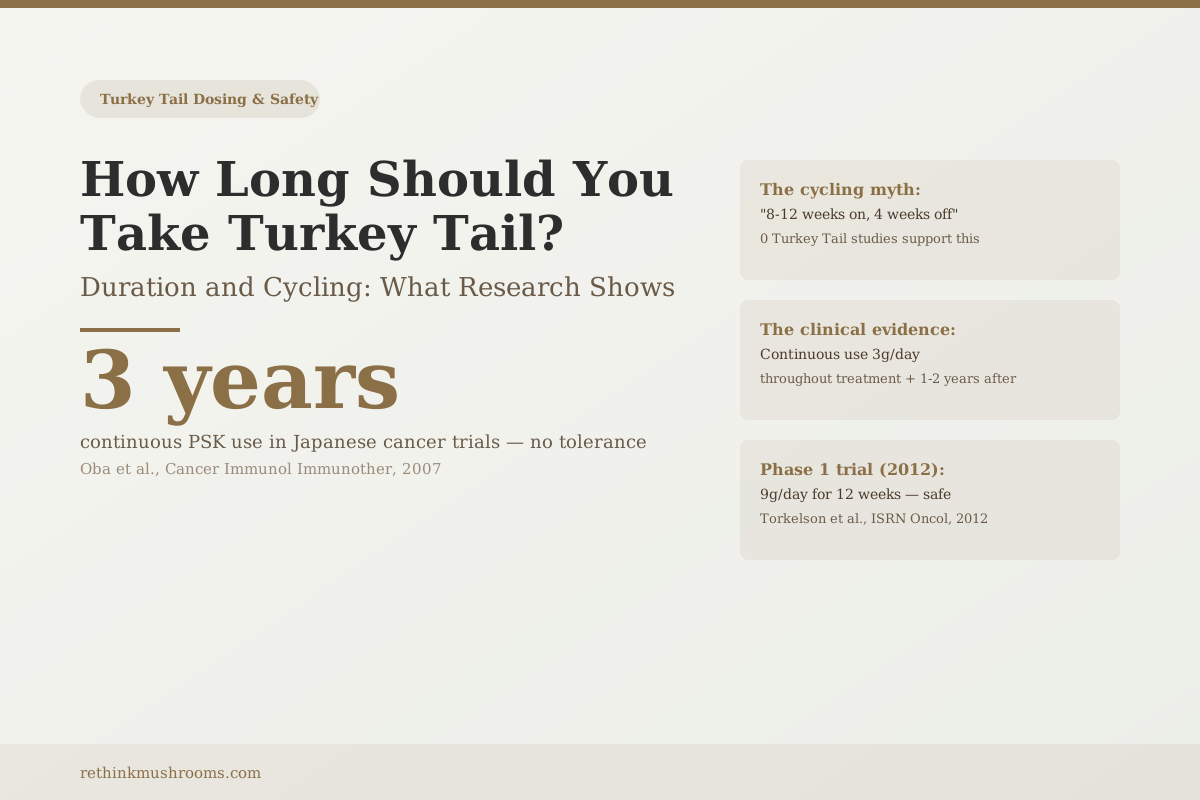
3 years continuous use
Japanese PSK cancer trials used Turkey Tail extract continuously at 3g/day for up to 3 years — no tolerance, no declining efficacy, and no safety signal that would prompt cycling in any study.
Oba et al., Cancer Immunol Immunother, 2007
40+
years of continuous clinical use as a prescription cancer medicine in Japan (Sun 2012)
0
Turkey Tail clinical studies establishing an evidence-based cycling protocol
9g/day
highest dose tested safely in Torkelson's Phase 1 trial over 12 weeks (2012)
Oba et al., Cancer Immunol Immunother, 2007
 View as image ↗
How long to take Turkey Tail — whether to cycle it, whether continuous use is safe, and when it starts to work — are among the most searched questions about this mushroom. And the most common answer circulating in the supplement world is confidently wrong.
The "8-12 weeks on, 4 weeks off" cycling protocol you'll see on supplement blogs and product pages has no clinical evidence behind it for Turkey Tail specifically. It is borrowed from general recommendations for adaptogenic herbs and applied to a mushroom whose clinical research tells a different story.
The actual data: Japanese PSK trials used continuous 3g/day dosing during chemotherapy and for up to two years afterward, with no evidence of tolerance development, no declining efficacy over time, and no safety signal prompting cycling in any study.[1][7]
The complete introduction to Turkey Tail mushroom and its evidence base covers the pharmacology and clinical history. This article focuses specifically on duration and cycling: what the research actually shows, why the cycling advice is unsupported, and how duration recommendations differ across use cases.
Key Takeaways
- Japanese PSK trials used continuous 3g/day dosing throughout chemotherapy and for 1-2 years afterward — no tolerance or declining efficacy was documented (Oba et al. 2007, Ma et al. 2017)
- Sun et al. (2012) documented 40+ years of continuous PSK use in Japan as a prescribed cancer medicine — the longest safety record of any medicinal mushroom
- Torkelson et al.'s Phase 1 trial (2012) used doses up to 9g/day of whole Turkey Tail mushroom for 12 weeks in cancer patients with an excellent safety profile
- The 8-12 week cycling recommendation appears universally in supplement content but is not supported by any Turkey Tail clinical research — it derives from general adaptogen cycling principles
- Saxe et al.'s 2026 RCT used polypore mushroom mycelia (including Turkey Tail) as a COVID vaccine adjuvant in healthy adults — the most recent prospective safety data outside oncology
- Jeitler et al. (2020) provides practical integrative oncology guidance: 3g/day during treatment, 1-2g/day maintenance; duration typically 3-12 months aligned with chemotherapy course
The Cycling Claim Has No Clinical Evidence Behind It
The 8-12 week cycling protocol for Turkey Tail is presented with confidence on hundreds of supplement sites. None of them cite a clinical study establishing this protocol for Turkey Tail. That is because no such study exists.
The cycling recommendation originated in traditional herbal medicine practices, specifically the idea that adaptogenic tonics — herbs used to support stress resilience and general vitality — should be cycled to prevent the body from adapting to their effects. This principle has some empirical basis for certain plant-derived adaptogens. It was subsequently applied to medicinal mushrooms as a category, without distinguishing between mushrooms with adaptogenic properties and mushrooms with well-characterized immunological effects.
Turkey Tail, through its pharmaceutical extract PSK, has a clinical evidence base rooted in oncology. In Japan, PSK has been a prescription cancer medicine since 1977. Sun and colleagues' 2012 review in Current Medicinal Chemistry documented the 40-year history of PSK clinical development, noting that continuous daily use throughout and after chemotherapy courses was the standard protocol in all major trials.[7] The concept of cycling — interrupting treatment to prevent adaptation — does not appear in any PSK clinical protocol reviewed.
Whether the cycling logic applies differently to non-pharmaceutical supplement-grade Turkey Tail products (at lower polysaccharide concentrations) is an unanswered question. But the cycling recommendation is not derived from that comparison either. It simply borrowed a general principle and applied it without justification.
What the Japanese PSK Trials Show About Duration
The most important primary source for Turkey Tail duration data is the Japanese PSK clinical trial literature, accumulated over more than four decades.
Oba and colleagues published a meta-analysis of PSK as an adjuvant to gastric cancer surgery and chemotherapy in Cancer Immunology, Immunotherapy in 2007, synthesizing multiple trials.[1] The standard dose used across these trials was consistently 3 grams per day, divided into three doses. Dosing was continuous throughout the chemotherapy course and typically continued for 12 to 24 months afterward. The meta-analysis found improved overall survival and disease-free survival in PSK-treated groups. Critically, the benefit did not diminish over the treatment period — there was no evidence of tolerance or tachyphylaxis (the medical term for a body adapting to a treatment and becoming less responsive to it).
Ma and colleagues' 2017 network meta-analysis in Oncotarget examined PSK in gastrointestinal cancer across multiple RCTs, again finding improved outcomes at the standard 3g/day continuous dose.[2] The safety profile was favorable across multi-year data: PSK did not augment chemotherapy toxicity, and adverse events were rare and mild.
Sun and colleagues' 2012 review in Current Medicinal Chemistry placed the 40-year clinical track record in context.[7] PSK has been used at 3g/day continuously during and after chemotherapy for gastric, colorectal, and lung cancers since its pharmaceutical approval in 1977. Jeitler and colleagues' 2020 narrative review in Frontiers in Pharmacology summarized the practical dosing guidance from this body of evidence: 3g/day during active chemotherapy, reducing to 1-2g/day as a maintenance dose after treatment, with duration aligned with the treatment course (typically 3-12 months) and some trials supporting benefit at 36 months.[8]
How Long Did Clinical Trials Actually Run?
The duration of clinical evidence for Turkey Tail spans a wide range depending on the study:
Torkelson et al.'s 2012 Phase 1 trial at the Bastyr University/USDA National Cancer Institute — the first US clinical trial using whole Trametes versicolor mushroom rather than pharmaceutical PSK extract — ran for 12 weeks at doses of 3 to 9 grams per day in nine breast cancer patients who had completed conventional treatment.[5] The 12-week duration was selected as appropriate for a Phase 1 safety trial, not because it represents an optimal or maximum duration. Dose-dependent increases in NK cell activity were observed within this timeframe.
PSK gastric and colorectal cancer trials in Japan ranged from 12 months to 36 months of treatment duration. The Oba 2007 meta-analysis included trials with 1-year and 2-year follow-up data. The benefit at 2+ years was maintained without evidence of diminishing returns.
Zhong and colleagues' 2019 meta-analysis of 23 RCTs using Turkey Tail or Ganoderma as cancer adjuncts found consistent safety and efficacy signals across all trial durations included.[3] No trial in this meta-analysis reported tolerance or declining efficacy as a concern.
The pattern across all these sources is consistent: Turkey Tail clinical research supports continuous use over months to years, not cyclical use over weeks.
How Long Until Turkey Tail Takes Effect?
This depends on what effect you're measuring and what form you're taking.
In Torkelson's Phase 1 trial, NK cell activity showed dose-dependent increases within the 12-week observation window, suggesting immune-activating effects are measurable within weeks of starting supplementation.[5] However, the clinical oncology outcomes measured in the Japanese trials — improved survival rates and disease-free survival — were assessed at 3 months, 6 months, 1 year, and 2 years. These are outcomes that emerge over extended treatment periods, not weeks.
For gut microbiome effects (documented in Pallav et al.'s 2014 PSP RCT with healthy volunteers), changes in Bifidobacterium and Lactobacillus levels were measurable within the study's timeframe of several weeks. The link between Turkey Tail supplementation and gut microbiome changes is explored in Turkey Tail Powder vs. Extract: Which Form Is Most Effective?.
The honest answer for general immune support: there is no clinical data in healthy adults establishing a minimum effective duration or an onset-of-effect timeline. The available data comes from immunocompromised cancer patients, where the context is different.
Narayanan and colleagues' 2023 systematic review of clinical studies on medicinal mushroom supplements in cancer patients noted significant variability in supplement quality and dosing across commercial products, and emphasized that supplement-grade Turkey Tail products often cannot be assumed equivalent to pharmaceutical PSK at the same dose or with the same timeline of effects.[6]
Three Use Cases, Three Different Duration Frameworks
Cancer adjuvant therapy. The clinical evidence supports continuous use aligned with the chemotherapy course, typically 3-12 months, and up to 2-3 years for maintenance after treatment. This is what the Japanese PSK literature establishes. For people considering Turkey Tail in this context, the dosing and duration should be discussed with an oncology team — not because Turkey Tail is dangerous alongside chemotherapy (the Ma 2017 meta-analysis specifically found it does not augment chemotherapy toxicity), but because the treating team needs to know about all supplements and can help contextualize dosing.
General immune support in healthy adults. There is no clinical data establishing an optimal duration or cycling protocol for this use case. The cycling recommendation floating in supplement content is not evidence-based for Turkey Tail. The most defensible position, given the safety profile documented across decades of clinical use, is that continuous use at standard supplement doses (1-3g/day of extracted product) carries low risk. Whether cycling produces any benefit remains an untested question.
Specific clinical indications. Turkey Tail has been studied for HPV and in vaccine adjuvant contexts. For condition-specific protocols, the duration follows the treatment context. The HPV application is covered in detail in Turkey Tail for HPV: Dosage and Evidence-Based Protocols.
The 2026 COVID Vaccination RCT: A New Duration Question
Saxe and colleagues' 2026 RCT in BMC Immunology tested polypore mushroom mycelia as an adjunct to COVID-19 vaccination in a randomized clinical trial.[4] This is significant for duration questions for two reasons.
First, it provides the most recent prospective safety data on Turkey Tail mycelium in a healthy adult population outside of oncology context. The trial found the supplement to be safe and well-tolerated under the trial protocol.
Second, the vaccine adjuvant use case represents a short-duration protocol: supplementation timed to immune activation around vaccination rather than extended chronic use. This is a distinct use paradigm from either cancer adjuvant therapy or general immune maintenance. It suggests a potential emerging model where Turkey Tail is used for defined short periods tied to specific immune challenges, rather than either cycling or continuous use.
Whether this vaccine-adjacent use case will become an established protocol requires further research. But the trial's safety profile in healthy adults adds an important data point to the long-term Turkey Tail safety record.
Long-Term Safety: What the Evidence Base Covers
The safety data for Turkey Tail is unusually extensive for a medicinal mushroom, largely because of the pharmaceutical PSK track record.
Zhong's 2019 meta-analysis of 23 RCTs found that adverse events across all trials were rare and mild, with no serious adverse events attributable to Turkey Tail or PSK across the combined study populations.[3] Narayanan's 2023 systematic review confirmed this safety pattern and noted that among medicinal mushrooms, Turkey Tail has the most extensive clinical safety documentation available.[6]
For very long-term use at supplement doses — beyond the 3-year maximum documented in the Japanese trials — there is no specific clinical data. The absence of safety concerns in the available evidence provides reasonable reassurance, but it is a statement about what is known rather than a definitive claim about unlimited duration safety.
The specific drug interaction considerations most relevant to duration — particularly for immunosuppressant medications, where Turkey Tail's immune-activating effects create a theoretical concern for transplant patients on anti-rejection drugs — are covered in Turkey Tail Side Effects: What the Safety Research Shows. The compound comparison for PSK vs. PSP: Turkey Tail's Two Active Forms provides relevant context for understanding why duration data from PSK pharmaceutical trials may not translate directly to PSP-based or whole-mushroom products.
The Bottom Line
The evidence consistently supports continuous Turkey Tail use, not cyclical use. Japanese PSK trials documented safe and efficacious continuous dosing at 3g/day for up to 3 years in cancer patients — no tolerance, no declining efficacy. The 8-12 week cycling recommendation is not based on Turkey Tail clinical research. Duration should follow the use case: continuous aligned with treatment for cancer adjuvant applications; no evidence-based cycling protocol exists for general immune support.
Frequently Asked Questions
Sources & References
- 1. Source details for this reference are not yet available.
- 2. Source details for this reference are not yet available.
- 3. Source details for this reference are not yet available.
- 4. Source details for this reference are not yet available.
- 5. Source details for this reference are not yet available.
- 6. Source details for this reference are not yet available.
- 7. Source details for this reference are not yet available.
- 8. Source details for this reference are not yet available.