Tremella & Skin Science
0 human skin trials
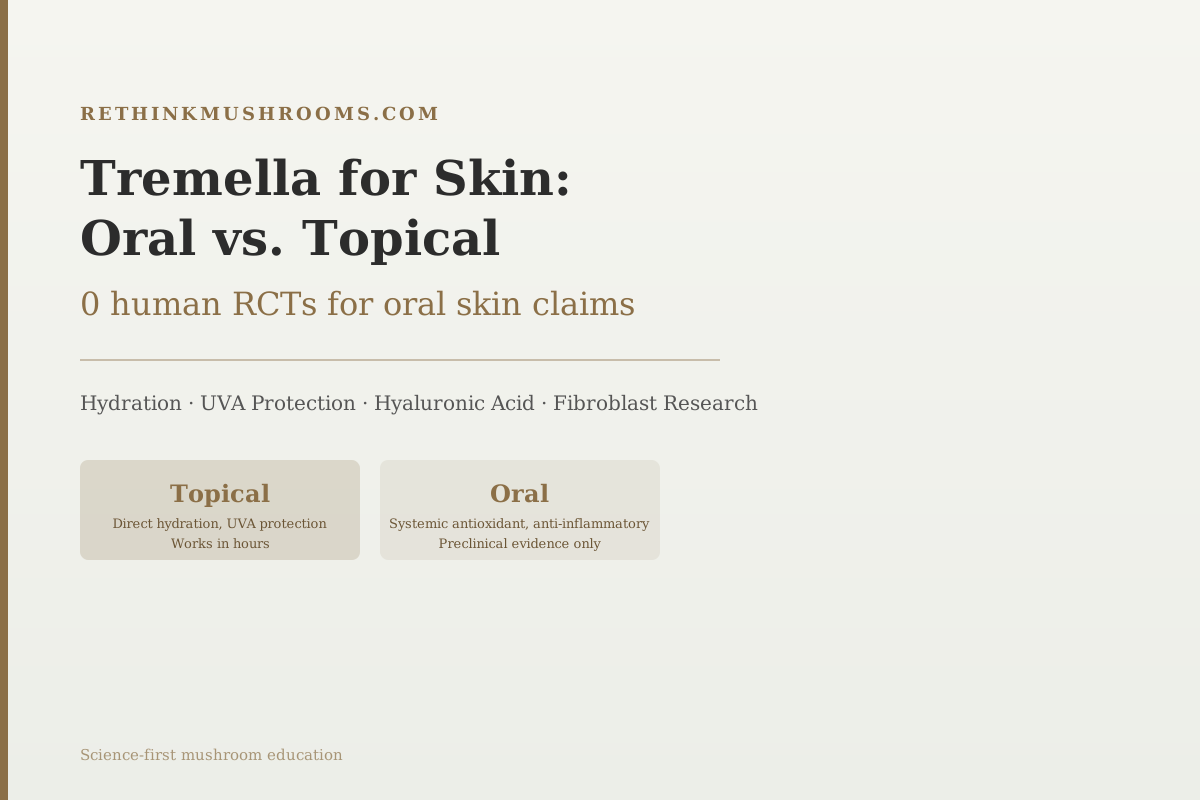
No published human clinical trial has tested tremella for a skin endpoint by either route. The usual claim that topical is proven and oral is speculative does not survive contact with the literature: the only study that compared both routes directly found oral worked better.
Mineroff & Jagdeo, Archives of Dermatological Research, 2023
Oral > topical
the result when researchers compared oral and topical tremella polysaccharides head to head in a mouse model of atopic dermatitis; both routes helped, but oral was significantly more effective (Xie et al., 2022)
87.76%
the hyaluronic acid content of a tremella extract characterized by NMR, FTIR, and MALDI-TOF in 2025, with a molecular weight above 2000 kDa, confirming the mushroom as a genuine non-animal hyaluronic acid source (Galla et al., 2025)
In vitro & animal
the evidence ceiling for tremella and skin per a 2023 dermatology review; the reviewers state that most studies have been limited to in vitro and animal models and that clinical research is still needed
Mineroff & Jagdeo, Archives of Dermatological Research, 2023
 View as image ↗
Most articles marketing tremella for skin follow the same script: cite research on tremella's skin biology, then recommend a supplement. A smaller group of articles pushes back with what sounds like the sober correction, arguing that only topical tremella has real evidence while oral tremella is marketing.
Both versions are wrong, and they are wrong in the same way. They assume the evidence separates by route. It does not. It separates by species.
Every study supporting tremella for skin, by either route, is a cell-culture experiment or an animal model. There is no published human clinical trial testing tremella for any skin endpoint, topical or oral. And in the single study that tested the two routes against each other in the same animals, oral administration did not merely hold its own; it outperformed topical application. This article separates what was actually measured from what gets claimed.
For the broader introduction to tremella and its compounds, see what is tremella mushroom: the beauty mushroom explained. For dosage guidance for oral use, see tremella dosage guide: how much should you take?.
Key Takeaways
- No human clinical trial has tested tremella for a skin endpoint by either route; a 2023 dermatology review in Archives of Dermatological Research states that most studies have been limited to in vitro and animal models and that clinical research is still needed
- The only head-to-head comparison of the two routes gave oral and topical tremella polysaccharides to mice with induced atopic dermatitis; both improved transdermal water loss, epidermal thickening, and ear edema, but oral was significantly more effective than topical (Xie et al., 2022)
- Topical tremella has the deeper mechanistic file: it protects human dermal fibroblasts from UVA damage via the Nrf2/Keap1 pathway (Fu et al., 2021) and human keratinocytes from UV damage via TXNIP and TXNRD2, with the latter also confirmed topically in a chronic UV-irradiated mouse model (Lin et al., 2023)
- A 2025 chemical characterization found tremella extract is about 87.76% hyaluronic acid with a molecular weight above 2000 kDa, confirming it as a real non-animal HA source; this study measured structure and purity only, not skin performance (Galla et al., 2025)
- The "15% more effective than hyaluronic acid" figure in supplement marketing does not appear in any of the peer-reviewed literature reviewed here
- Topical effects are physical and fast; oral effects, if they occur in humans, are immune- and microbiome-mediated and would take weeks
The Real Split Is Animal vs. Human, Not Topical vs. Oral
The conventional framing puts topical tremella in the "evidence-backed" column and oral tremella in the "theoretical" column. Checking that framing against the actual papers dissolves it.
The 2023 review by Mineroff and Jagdeo in Archives of Dermatological Research is the most useful single source here, because its job was to survey the whole field rather than report one result. The reviewers describe roles for tremella extract in skin antiaging, photoprotection, wound healing, and barrier protection, and then state the constraint plainly: most studies have been limited to in vitro and in vivo animal models, and future clinical research is needed to understand the role of T. fuciformis in dermatology.[2]
That sentence applies to both routes equally. It is not a verdict against oral supplementation; it is a description of a field that has not yet run a human trial on anything.
Evidence by Route
Both Files Stop at the Same Rung
The usual story is that topical tremella is evidence-backed and oral is speculative. Laid side by side, the two routes have the same ceiling: animal models. Neither has been tested on human skin.
Topical route
Applied to the skin surface
- Cell study
Human dermal fibroblasts protected from UVA damage; Nrf2 up, Keap1 down, collagen I, elastin and HA retained
Fu 2021
- Cell study
Human keratinocytes protected from UV apoptosis and ROS via TXNIP and TXNRD2
Lin 2023
- Cell study
Melanin and tyrosinase reduced in melanoma cells; keratinocyte and fibroblast migration accelerated
Chiang 2022
- Animal study
Topical tremella reduced UV-induced skin damage in a chronic UV-irradiated mouse model
Lin 2023
- Not done
No human trial with a skin endpoint
Mineroff & Jagdeo 2023
Oral route
Swallowed as food or supplement
- Cell study
Antioxidant, anti-inflammatory, immunomodulatory and anti-aging activity catalogued across the polysaccharide literature
Wu 2019 review
- Animal study
Oral tremella improved transdermal water loss, epidermal thickening and ear edema in atopic dermatitis mice
Xie 2022
- Animal study
Mechanism traced to gut microbiota shifts and raised regulatory T cells in mesenteric lymph nodes
Xie 2022
- Not done
No human trial with a skin endpoint
Mineroff & Jagdeo 2023
The one direct comparison
Xie and colleagues gave both routes to the same strain of mice with induced atopic dermatitis. Both helped. Oral administration was significantly more effective than topical. The skin improved because the immune driver was addressed upstream, not because the molecule was delivered to the surface.
Scope note: the head-to-head result comes from chemically induced dermatitis in mice, which is inflamed diseased skin rather than healthy skin seeking cosmetic hydration, and mouse doses do not convert directly to human doses. It establishes that the oral route can reach skin outcomes. It does not establish a human dose, and it does not make either route clinically proven.
Sources: Fu et al. (2021) [ref 1]; Mineroff & Jagdeo (2023), Archives of Dermatological Research 315(7):1883–1886 [ref 2]; Wu et al. (2019) [ref 4]; Xie et al. (2022), Frontiers in Pharmacology 13:944801 [ref 5]; Lin et al. (2023) [ref 6]; Chiang et al. (2022) [ref 7].
What Happens When Tremella Polysaccharides Touch Your Skin
Tremella polysaccharides are strongly hygroscopic, meaning they attract and hold water, and they form a thin film on the skin surface that slows evaporation. This is the same class of physical mechanism behind hyaluronic acid in skincare, and it is why tremella is positioned as a plant-based HA alternative. This part of the story is physical chemistry rather than clinical pharmacology, and it is not seriously disputed.
The biological claims go further, and they rest on two cell-culture studies plus one animal confirmation.
Fu and colleagues exposed human dermal fibroblasts, the cells that produce collagen, elastin, and the skin's own hyaluronic acid, to UVA radiation with and without tremella polysaccharide pretreatment.[1] Pretreated cells showed lower reactive oxygen species and malondialdehyde, higher total antioxidant activity, and increased activity of the antioxidant enzymes catalase, superoxide dismutase, and glutathione peroxidase. At the signaling level, tremella upregulated Nrf2 and downregulated Keap1, the cell's primary oxidative-stress defense switch. Pretreated cells also retained more collagen I, elastin, and hyaluronic acid than UVA-exposed controls.
Lin and colleagues addressed a different layer of skin and, importantly, did not stop at the dish.[6] In primary human skin keratinocytes, tremella polysaccharides protected against UV-induced apoptosis and reactive oxygen species production, acting through thioredoxin interacting protein (TXNIP) and thioredoxin reductase 2 (TXNRD2), an antioxidant system distinct from the Nrf2 pathway Fu identified. The team then tested topical tremella in a chronic UV-irradiated mouse model and found it alleviated UV-induced skin damage in the living animal.
That last step matters more than it sounds. It is the one place where the topical delivery question is actually answered rather than assumed: applied to the skin of a living mammal under repeated UV exposure, tremella polysaccharides produced a measurable protective effect. Two independent antioxidant mechanisms converging on photoprotection, with one confirmed in vivo, is a genuinely reasonable evidence base for the photoprotective claim, short of a human trial.
A third study, by Chiang and colleagues, tested tremella on pigmentation and wound repair.[7] In murine B16F10 melanoma cells, tremella reduced melanin content and tyrosinase expression in a concentration-dependent way, which is the standard in vitro screen for a skin-brightening ingredient. It also accelerated migration of human HaCaT keratinocytes and Detroit 551 fibroblasts in a wound-healing assay. The authors are explicit that these are in vitro results and that clinical studies of safety and efficacy are still required. Brightening and wound-healing claims built on this study are running well ahead of it.
For a deeper look at the UV protection research, see tremella and UV damage prevention: photoprotective effects.
The One Study That Tested Both Routes Against Each Other
Almost every comparison of oral and topical tremella is an argument from first principles: topical is direct, oral has to survive digestion, therefore topical wins. One research group actually ran the experiment.
Xie, Yang, Liang, Zhu, Yuan & Du (2022) · Frontiers in Pharmacology
- Population
- Mice with dinitrofluorobenzene (DNFB)-induced atopic dermatitis
- Intervention
- Tremella fuciformis polysaccharides (TFPS), administered orally
- Comparator
- The same polysaccharides applied topically
- Finding
- Both routes improved transdermal water loss, epidermal thickening, and ear edema. Oral administration was significantly more effective than topical application. Oral TFPS also raised CD4+CD25+Foxp3+ regulatory T cells in mesenteric lymph nodes and shifted fecal metabolites and gut microbiota composition.
positive An animal model of an inflammatory skin disease, not healthy human skin, and not a cosmetic hydration endpoint. It establishes that the oral route reaches skin outcomes; it does not establish a human dose.
Xie et al. (2022), Frontiers in Pharmacology 13:944801 [ref 5]
The finding is worth sitting with, because it inverts the usual intuition.[5] Transdermal water loss is a barrier-function measure, close to what people mean by skin hydration. Oral tremella improved it more than putting tremella directly on the skin did.
The mechanism the authors identify explains why. Oral tremella polysaccharides were not acting as a topical moisturizer delivered the long way around. They shifted the gut microbiota and increased regulatory T cells in the mesenteric lymph nodes, calming the immune activity that drives atopic dermatitis in the first place. The skin improved because the immune driver was addressed upstream.
This reframes the entire oral-versus-topical question. The two routes are not competing to accomplish the same thing by different paths. Topical tremella is a barrier and antioxidant intervention at the skin surface. Oral tremella is an immune and microbiome intervention whose skin effects are downstream consequences. For a condition driven by immune dysregulation, the upstream route won.
Two honest caveats. This is one study in mice with chemically induced dermatitis, and inflamed diseased skin is not the same target as healthy skin seeking cosmetic hydration. And a mouse dose does not convert to a human dose in any straightforward way.
The "Rivals Hyaluronic Acid" Claim
The hyaluronic acid comparison appears in nearly every brand article about tremella, often with a specific number attached.
Marketing Claim Audit
Myth vs. evidence
The claim
“Tremella is 15% more effective than hyaluronic acid at holding moisture.”
Repeated across supplement and skincare marketing copy, usually with no citation attached.
What research shows
UnsupportedNo study in the peer-reviewed literature reviewed here reports a 15% advantage for tremella over hyaluronic acid. The 2025 chemical characterization that is usually invoked measured composition and structure, not comparative moisture performance, and ran no head-to-head hydration test against animal-sourced HA.
The underlying positioning is defensible even though the number is not. Galla and colleagues confirmed by NMR, ATR/FTIR, and MALDI-TOF that tremella extract is a genuine non-animal hyaluronic acid source, at roughly 87.76% HA content with a molecular weight above 2000 kDa. That supports tremella as a real vegan alternative to animal-derived HA. It does not rank the two.
Galla et al. (2025), Foods 14(8):1362 [ref 3]
It is worth being precise about what the 2025 paper did, because it is frequently overstated in both directions.[3] Galla and colleagues set out to evaluate whether hyaluronic acid extracted from Tremella fuciformis retains the chemical and physical characteristics that give conventional HA its biological functionality. They ran compositional and structural analyses: hyaluronic acid content, metal screening, purity, pH, NMR, ATR/FTIR, and MALDI-TOF. The extract came out at approximately 87.76% hyaluronic acid with a molecular weight above 2000 kDa, and the spectroscopic work confirmed the material as non-animal hyaluronic acid.
This is a solid ingredient-science result, and it is the strongest scientific support for tremella's positioning as a vegan HA alternative. It is a characterization study. It contains no antioxidant assay, no anti-inflammatory assay, no comparison of skin outcomes against animal-sourced HA, and no clinical endpoint. Claims that tremella-derived HA is superior to conventional HA on antioxidant or anti-inflammatory activity do not come from this paper.
Oral Tremella and Skin: Following the Evidence Chain
Wu and colleagues' review of tremella polysaccharide research catalogs the bioactivities reported across the literature: antitumor, immunomodulatory, antioxidant, anti-aging, anti-inflammatory, hypoglycemic, and hypocholesterolemic effects, alongside the structural characterization work that connects those activities to the molecule.[4] Several of these are directly relevant to skin. Chronic low-grade inflammation is one of the main drivers of accelerated skin aging, and oxidative stress degrades collagen and elastin.
The step that used to be described as the weak link, whether orally administered polysaccharides can produce any skin effect at all, is the step Xie and colleagues answered affirmatively in mice.[5] Notably, they answered it without requiring intact polysaccharides to cross the gut and travel to the dermis. The immune and microbiome mechanism means the molecule can do its work in the gut and still change what happens in the skin.
What remains genuinely unknown is the human translation: what dose, over what duration, in people, for which skin outcomes. That question is open for oral tremella. It is equally open for topical tremella.
- Cell studiescompleted
Human dermal fibroblasts (Fu 2021), human keratinocytes (Lin 2023), melanoma cells and human keratinocyte/fibroblast migration (Chiang 2022).
- Animal studiescurrent
Topical tremella in a chronic UV-irradiated mouse model (Lin 2023); oral vs. topical in DNFB-induced atopic dermatitis mice, oral superior (Xie 2022).
- Case reportsmissing
No published dermatology case reports for tremella.
- Small human trialsmissing
No human trial with a skin endpoint has been published for either route.
- Large randomized trialsmissing
- Meta-analysesmissing
Tremella's skin evidence tops out at the animal tier for both routes. That is further than most cosmetic mushroom ingredients get, and it is two full rungs short of anything that should be described as clinically proven.
Mineroff & Jagdeo (2023), Archives of Dermatological Research 315(7):1883-1886 [ref 2]; Fu et al. (2021) [ref 1]; Xie et al. (2022) [ref 5]; Lin et al. (2023) [ref 6]; Chiang et al. (2022) [ref 7]
For information on collagen support mechanisms and what the research says about oral tremella and structural skin proteins, see tremella and collagen production: can it reverse skin aging?.
How Long Each Route Takes to Work
The two routes operate on genuinely different clocks, and this is one place where the mechanistic reasoning is reliable even without human trials.
Topical tremella's surface effects are physical. Hygroscopic polysaccharides bind water and the film slows evaporation from the moment the product is applied. Nothing has to be absorbed, metabolized, or signaled. The antioxidant and photoprotective effects seen in Fu and Lin's work are a slower, cumulative story requiring repeated exposure, but the immediate hydration feel is available in the same session.
Oral tremella cannot work that way. If the Xie mechanism carries over to humans, the sequence runs through gut microbiota composition and regulatory T cell populations before anything reaches the skin. Microbiome shifts and immune-cell population changes take weeks, not hours. No human trial provides a timeline, so any number here is inference rather than data, but expecting visible skin change from oral tremella in under four to six weeks would be optimistic, and eight to twelve weeks is the more realistic window based on how comparable interventions behave.
Using Both Routes Together
Understood correctly, the two routes are not redundant, and the case for using both is stronger than the usual "cover your bases" reasoning suggests. They act on different systems.
Topical is a surface intervention: humectant hydration, barrier support, and antioxidant protection where UV actually lands. It works immediately, and the photoprotective mechanism has in vivo support. It is the right tool if the goal is hydration, barrier comfort, or an antioxidant layer under sunscreen, and it is a legitimate vegan alternative to conventional HA serums.
Oral is an upstream intervention: immune regulation and microbiome modulation, with skin change as a downstream effect. On the available evidence it is the better-supported route for inflammatory skin conditions specifically, since that is the model in which it was tested and won. It is the slower, less direct, and less certain option for straightforward cosmetic dryness.
The practical read: if you want hydration and surface comfort, topical is faster, mechanistically simpler, and gets you there tonight. If your skin issue is inflammatory in character, the one head-to-head study points toward oral, with the significant caveat that it was conducted in mice. Neither route is clinically proven for any human skin outcome, and anyone selling either as proven is ahead of the science.
Before You Self-Treat
ModerateAtopic dermatitis and other inflammatory skin conditions need a clinician
Concern
The strongest oral-route finding in this article comes from a model of atopic dermatitis, a medical condition. That result can read as an invitation to substitute a mushroom supplement for dermatological treatment of eczema or comparable conditions.
What the research says
The study was conducted in mice with chemically induced dermatitis. No human trial has tested tremella for atopic dermatitis or any other diagnosed skin condition, and no effective human dose has been established. It is not a substitute for prescribed treatment, and stopping an existing regimen in favor of it is not supported by any evidence.
Particularly relevant for: Anyone with diagnosed eczema, dermatitis, or another inflammatory skin condition; anyone who is pregnant, breastfeeding, immunosuppressed, or taking immunomodulating medication
What to do
Treat tremella as a possible complement, never a replacement, and discuss it with a dermatologist or physician before adding it. This article is research summary, not medical advice.
Xie et al. (2022), Frontiers in Pharmacology 13:944801 [ref 5]; Mineroff & Jagdeo (2023) [ref 2]
See tremella side effects: what the research shows for a full review of the oral supplement safety data before adding it to your regimen.
The Bottom Line
Tremella's skin evidence separates by species, not by route: every supporting study for both oral and topical use is a cell-culture experiment or an animal model, and no human trial with a skin endpoint has been published for either. Topical tremella has the deeper mechanistic file, with two independent antioxidant pathways identified in human skin cells (Nrf2/Keap1 in dermal fibroblasts, TXNIP/TXNRD2 in keratinocytes) and topical photoprotection confirmed in a chronic UV-irradiated mouse model. But in the only study to test both routes in the same animals, oral tremella outperformed topical on transdermal water loss, epidermal thickening, and ear edema in mice with induced atopic dermatitis, working through gut microbiota and regulatory T cells rather than through the skin surface. A 2025 characterization study confirmed tremella extract is about 87.76% hyaluronic acid at above 2000 kDa, supporting it as a genuine vegan HA source, though it made no performance comparison against animal-derived HA and the widely repeated "15% more effective" figure appears nowhere in the literature. Topical works within hours by physical mechanisms; oral, if it translates to humans, would take weeks through immune pathways.
Frequently Asked Questions
Sources & References
- 1RTHM-01353·Fu, Hao et al. (2021). “Tremella fuciformis polysaccharides inhibit UVA-induced photodamage of human dermal fibroblast cells by activating up-regulating Nrf2/Keap1 pathways..” Journal of cosmetic dermatology.Study breakdown →PubMed →↩
- 2RTHM-01754·Mineroff, Jessica et al. (2023). “The potential cutaneous benefits of Tremella fuciformis..” Archives of dermatological research.Study breakdown →PubMed →↩
- 3RTHM-02086·Galla, Rebecca et al. (2025). “Non-Animal Hyaluronic Acid from Tremella fuciformis: A New Source with a Structure and Chemical Profile Comparable to Hyaluronic Acid..” Foods (Basel.Study breakdown →PubMed →↩
- 4RTHM-01140·Wu, Yu-Ji et al. (2019). “Structure, bioactivities and applications of the polysaccharides from Tremella fuciformis mushroom: A review..” International journal of biological macromolecules.Study breakdown →PubMed →↩
- 5RTHM-01635·Xie, Lingna et al. (2022). “Tremella fuciformis polysaccharides alleviate induced atopic dermatitis in mice by regulating immune response and gut microbiota..” Frontiers in pharmacology.Study breakdown →PubMed →↩
- 6RTHM-01736·Lin, Mengting et al. (2023). “Tremella fuciformis polysaccharides alleviates UV-provoked skin cell damage via regulation of thioredoxin interacting protein and thioredoxin reductase 2..” Photochemical & photobiological sciences : Official journal of the European Photochemistry Association and the European Society for Photobiology.Study breakdown →PubMed →↩
- 7RTHM-01497·Chiang, Jo-Hua et al. (2022). “Tremella fuciformis Inhibits Melanogenesis in B16F10 Cells and Promotes Migration of Human Fibroblasts and Keratinocytes..” In vivo (Athens.Study breakdown →PubMed →↩